
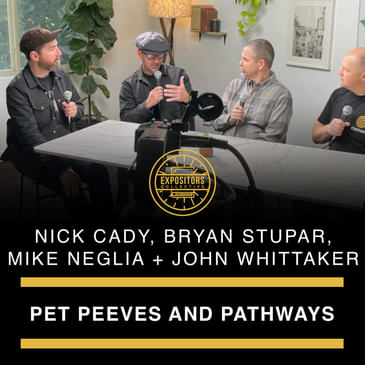
The Leadership Team of Expositors Collective (minus Alan Stoddard) talk about some pet peeves they have about preaching. Brian, Nick, John and Mike speak about habits and choices that preachers make that make it hard to listen to them. The second half of the conversation takes a more positive spin as John talks about discipleship pathways and what avenues that are available to help congregants mature and grow spiritually. John Whittaker's online resources for spiritual growth can be found here: https://www.johnwhittaker.net/courses
Video Course:
Earlier in 2024 our leadership team got together in Twin Peaks, California to film all of our best content with a professional videographer for a soon-to-be-released Expositors Collective online preaching training course. We’ve taken the material from our in-person training events and distilled it into a master class style online resource, with discussion guides for group use and personal reflection questions for individual use.
We can’t wait for you to see it, and use it to help equip the next generation of expository Bible teachers in your church!
Recommended Episodes:
The Entire Service is Worship : Noah Beumer + MIchael McCallebb : https://expositorscollective.org/expositors-collective-podcast/episode-74-the-entire-service-is-worship/
Scripture Memorization and Spiritual Formation : Kieran Lenahan : https://cgnmedia.org/podcast/expositors-collective/episode/scripture-memorization-and-spiritual-formation-with-kieran-lenahan
Meditation and Contemplation : Dave Sylvester: https://cgnmedia.org/podcast/expositors-collective/episode/scripture-memorization-and-spiritual-formation-with-kieran-lenahan
Pleasanton, California Expositors Collective Training Event
We’re excited to be partnering with Valley Community Church to host our first training seminar in the Bay Area. We have a lot of friends (and podcast downloads) in that part of California and we know that it is going to be a great time!
May 24th & 25th
(Registration coming soon)
For information about our upcoming training events visit ExpositorsCollective.com
The Expositors Collective podcast is part of the CGNMedia, Working together to proclaim the Gospel, make disciples, and plant churches. For more content like this, visit https://cgnmedia.org/
Join our private Facebook group to continue the conversation: https://www.facebook.com/groups/ExpositorsCollective
Click here to support Expositors Collective
[00:00:00] Most of us as preachers aren't good enough communicators to keep people's attention for that long. So we might think we're all that, we might think we're awesome, but most of us aren't that awesome. It's the rare communicator who can actually be engaging and hold people's interest for a long time. Most of us just don't have that skill set. So let's be humble enough and honest enough to admit that. And then also usually less is more. If you work really hard in preparation, it takes more work to write a short sermon.
[00:00:30] It's been usually during the week and you didn't work hard enough to account for actually preaching a sermon that was focused and on target.
[00:00:38] Hey, welcome to the Expositors Collective Podcast Episode 316. I'm your host Mike Neglia. And this episode is a conversation that is with four of the five members of the Expositors Collective Leadership Team. Nick, Brian, John and I were speaking.
[00:00:59] While we were up in Twin Peaks, California, Dr. Ellen Stoddard wasn't able to join us but the four of us have a conversation about some of the pet peeves that we have about preaching and then we have a more substantial and thoughtful conversation about pathways to spiritual growth and what we can do on Sunday mornings that help believers to grow.
[00:01:28] And also help unbelievers to become followers of Jesus. The sound quality is okay, but that's what it's like when you're in a busy room having a good conversation.
[00:01:44] So pull up a chair, join us, talk about pet peeves and pathways.
[00:01:49] Hey, welcome to the Expositors Collective Podcast. This is 3Dude's talking. I'm here with my friends and my colleagues Nick Katie and Brian Stewart.
[00:02:07] What's up? How's it going? Good. We're in beautiful Twin Peaks, California. Is that the name of the town? It is? Yeah. Yeah, it's an actual terror hit.
[00:02:16] I think I saw a sign that when we came in, it said Twin Peaks population 1,500.
[00:02:21] Okay. Okay. So we're here because we are doing two things. We're doing kind of a mission vision values planning session for the future of Expositors Collective and also we've been recording a cool like video teaching series.
[00:02:38] Mike, do all of your listeners know who the members are of the leadership team? Do we call leadership team or steering committee? What do we call it?
[00:02:46] Leadership team. We used to call it steering committee but now it's a leadership team. Okay. I think the super fans do. The ones who have gone to our website, Expositors Collective.
[00:02:55] Is that the only way to find out? Could you tell us? Well, no, I'm saying maybe now this is the other way to find out. Yeah. So here's with two of the five members of the steering committee.
[00:03:06] There's me, leadership team. Leadership team. Yeah. There's myself. There's Brian Stewart. There's yourself. There's Dr. John Whitaker and Dr. Allen Stoddard.
[00:03:19] That's five, right? Yep. Yep. Yeah. And so four of us are here for this planning session. Allen wasn't able to make it and we've been, yeah.
[00:03:27] Putting out pumping out content. We've been recording servants into a video camera like it was March of 2020. Yeah.
[00:03:35] It's been a while since I did that. Yeah. It's not my favorite. Yeah. But I know that it's valuable. Why is it valuable?
[00:03:43] Well, because it creates our content in a way that exists for number one posterity, but also for people who geographically or for schedules and other reasons can't make it to our training events.
[00:03:56] Or maybe they want to rewatch content like maybe you heard a great talk and you're like well, that 20 minutes is over and I can never get it back. Well now you can.
[00:04:05] Yeah. You can watch the video. Yeah. Yeah. And your own time and you can pause it and go back and listen to it again and hopefully provides another helpful angle of learning and growing processing.
[00:04:18] Yeah, what I've heard a lot in our in-person training events is on the last day people shake my hand and just be like oh this was really great.
[00:04:26] There's a lot of people back home that I wish came to this. And of course they could listen to the podcast, but we're trying to make some like high quality exclusive just video content for the sake of maybe sharing it with your team or reviewing it and that's what you've been doing.
[00:04:41] Yeah. And the fact is we only do three to four in-person events per year. Yeah. And if the timing doesn't work out, if the travel doesn't work out then well of course people can listen to the podcast.
[00:04:53] But this is like in one place where you can watch the video, you can pause it. You can take notes. It'll be produced well and have slides, et cetera.
[00:05:01] Yeah. Well to have everything consolidated the content that's well. Take care of is going to be a helpful.
[00:05:10] Is it a master class? Is that I think master class as an actual like registered trademark of master class incorporated.
[00:05:18] Oh. So it's like a master space bar class following the master himself, the Lord Jesus Christ.
[00:05:26] Christ. Yeah. That's good. Yeah. Hey, Brian can I ambush you and ask you question?
[00:05:33] Yeah please. What's your like least popular preaching opinion or what's a what's your like strongest held.
[00:05:42] Like insignificant thing on preaching. You know what I mean? Like what's like a small thing that really bothers you.
[00:05:49] Oh, small thing that really bothers me. Oh my goodness. Like while I'm personally preaching or while I observe this and other people.
[00:05:59] Well you don't make mistakes. So one of the mistakes. One of the mistakes other people make that you want to riff about for a few minutes.
[00:06:07] Yeah. Yeah. It might sound kind of petty but there's there's some preachers their intonation the way they communicate or just their their verbal approach sometimes can be a little bit of a challenge for me personally to really to hear well.
[00:06:28] You know, it's kind of in some ways that I think there is an art to being able to communicate. I'm not saying that I've figured this out. There's probably a lot of nuances to how I communicate that are probably an annoying to other people but
[00:06:42] and I think it's a highly personalized type of an approach. So I think there are some things for me that make some preaching challenging to receive and to hear even though the content might be exceptional and passionate and really good in moving and
[00:07:01] but the way the delivery that's kind of an idea. The delivery is not one that is just helpful for me personally. It's a highly subjective approach but yeah, so I'm not going to name names because I don't know.
[00:07:15] Is it like an accent or like some accents don't do it for you? No, there's nothing to do with like certain actions. No, no, that's fine. I don't even know how to describe other than just simple.
[00:07:27] Impassioned ways some preachers can communicate some things that just don't do it for me. That make it difficult for me to really receive the content.
[00:07:40] So in some ways I can read some authors and when they preach it live versus reading a content or reading their service here, for example, it's a little bit of it. It's the same content but one is being delivered via reading
[00:07:55] being the other is being delivered by way of their unique way of which they communicate or talking. So one is a little bit more palatable for me, the other is not.
[00:08:05] So that's kind of my big thing.
[00:08:10] Not much too impassioned to that is.
[00:08:13] Yes, I think perhaps that would probably be if I were to define it. Yes, it come across maybe kind of sappy or overly impassioned is yeah makes it difficult for me to engage with it.
[00:08:34] Okay, more personal.
[00:08:37] Equal about you.
[00:08:39] Well now I was thinking about something else but now I'm thinking about that too where I agree with that like there's a famous saying like if you don't have anything to say then just pound the pulpit really hard or something like that.
[00:08:51] Like sometimes people make up for lack of content with an impassioned delivery. I also personally don't like it when yeah, I guess for me, I want them to have good content and so sometimes I found that I get frustrated if I feel that there's a lack of content.
[00:09:12] See, I can listen to someone that has really good content and even if they're monotone or not a really well articulate in their delivery of it.
[00:09:22] If they're contents good, I can take something from that and have that transform my life and I can you don't say for it and think about a process it could be good.
[00:09:33] But yeah, I'm with you as well content. I think it's also you got to have something to say, you know, I think just getting up there because you got to say something.
[00:09:42] Yes, something that can be problematic especially for people that might be in a more regular routine of preaching communicating.
[00:09:49] I think there was something to be said about keeping your relationship to the content fresh.
[00:09:55] Yeah, contents always going to be fresh. It's the word of God. It's always life giving, but our relationship to that content sometimes you know we requires reawakening of our soul to reengage with it, to see it afresh and that can be art especially if it's something we've preached multiple times or we're overly familiar with.
[00:10:15] So sure, you know what else to the pitpew of mine? Yeah. Have you ever heard somebody use like a pithy saying that was not correct or not accurate?
[00:10:25] Yeah, like okay, you ever heard somebody like talk about the be attitudes and like these are the attitudes that you should be but you're like that is not what that means.
[00:10:34] Okay, yes. And also that's you know, yeah, that was that was an attempt at being cute and it wasn't cute and it wasn't even accurate.
[00:10:44] Right. Yeah, yeah. How about you Mike? Maybe riffing on your previous thing, you and I sat under some preaching and we were talking about it.
[00:10:57] Yeah, where it was it was kind of like not the best content but the the preacher almost was convinced in of the profundity of certain certain phrases and would yeah like step aside from the pulpits and then say it as if they just said the most profound thing in the world.
[00:11:17] Yeah, so John Whitaker what's what's something that makes it really hard for you to like receive God's word when someone else is preaching or like what's a pet peeve that you have what's something that you think that should be like abolished from the preaching vocabulary or practice.
[00:11:37] So the reality is I have worked really hard not to get too pet peeved about preaching right because you know when you preach a lot and you teach preaching, you have to work really hard.
[00:11:52] So I've worked with hard that so I've kind of closed off that half my brain but with inexperienced preachers it really drives me crazy when they come up and they him and Ha and they seem insecure because the entire audience feels insecure for you.
[00:12:06] And that's just that's really awkward so that bugs me.
[00:12:11] Experience preachers who go on and on and on and have no sense of they think that they can just talk forever and people's time doesn't really matter that drives me crazy.
[00:12:23] So you know they're 47 minutes and they show no sign of slowing down drives me crazy like why not you know I mean so that bugs me it's like you know I mean particularly when you know you got kids in the kids ministry and you got volunteers over there and I'm like think about everybody else who's being impact and people now are coming for second service in the parking lots already getting crowded but there's no parking because we're sitting long and first that drives me crazy be respectful.
[00:12:48] You got to think about all of that. So I think that that bugs me and it bugs me when people read read their manuscript okay drives me crazy.
[00:12:58] I just like just don't why are you reading to me like I could read that so just email that out if you're going to do that why not just sit and talk to me yeah so you got some song for someone who says you try not to have strong opinion.
[00:13:09] These are saying I just I'm aware of but you yeah yeah okay coming back to your second one why shouldn't they preach long it's God's word like it's important why why should they curtail or edit when it could be less evil yeah.
[00:13:27] So first off part of it's part of planning the service so does this does the service plan for an hour sermon right or whatever that so we got it got to consider that but beyond that the reality is most of us as preachers aren't good enough communicators to keep people's attention for that long.
[00:13:46] So we might think we're all that we might think we're awesome but most of us aren't that awesome it's the rare communicator who can actually be engaging and hold people's interest for for a long time most of us just don't have that skill said so let's be humble enough and honest enough to admit that yeah.
[00:14:01] And then also usually less is more if you work really hard in preparation it takes more work to write a short sermon so if you're a long sermon that means you were undisciplined usually during the week and you didn't work hard enough to account for.
[00:14:14] Actually preaching a sermon that was focused and on target yeah yeah anything.
[00:14:20] Oh yeah I agree I was you know where I was going in my mind as we were talking about that is that I realize this expository collective we champion expository preaching in this space right but the other thing I was thinking is that if you talk for let's say like a really long time like you're talking about preparing your service that also shows a certain belief about the fact that you're not going to be able to do it.
[00:14:44] So I think that's about the importance of certain things forming people in certain ways right and so in other words you believe that that is the most important thing that people need in order to be formed into the image of Christ.
[00:15:01] So I think there's something to be thought about in that realm.
[00:15:05] I agree with you and it's amazing the number of churches that for example don't do communion because you know they only do it every now and there's reasons for that but one of the reasons is well most services just don't have time.
[00:15:19] It cuts into the preaching time yeah it's like so but why is that sacrament not also a key part of celebrating Jesus and forming God's people why is it only the preaching of the word and this is from a guy that has preached and taught preaching and teach the Bible I believe it but I don't think it I don't think it I don't think it's a good thing.
[00:15:34] I don't think it alone is the only thing that is most important on Sunday morning.
[00:15:39] Yeah yeah what how does the sacraments form Christians?
[00:15:44] Yeah it gives them an opportunity to remember Jesus and remember what was paid for their salvation and to tangibly and experientially taste and see that the Lord is good like to experience the gospel in a very concrete tangible and remind them that we're not for the grace of God shown to me in Jesus there go I.
[00:16:03] Yeah and then the parallel question is then within how does preaching then form the Christian yeah yeah do you want to answer that one well you put a lot of thought into that I know that you put a lot of on.
[00:16:15] Yeah well I mean so I firmly believe that the word of God you know is powerful right and has the power to shape and to form and so clear compelling teaching from the word of God is necessary for helping people unlearn the lies that are in the way that God is.
[00:16:32] We learn the lies in the falsehoods of the worldviews of culture around us and learn the truth in the ways of God it's critical for that.
[00:16:40] I believe it's deeply necessary I just don't believe it's it by itself is enough it's not it's necessary but not sufficient so we need clear compelling good teaching of the Bible we need more than that if people are actually going to reject the falsehoods and embody the way of Jesus.
[00:16:57] And then in addition to the sacrament of communion what other like people might call them means of grace or what are the other ways of spiritual growth exist out there yeah yeah beyond Sunday morning service or repulsion yeah let's stay in Sunday morning like what else on Sunday morning can cause him to grow spiritually yeah yeah is a good question me Sunday morning has a distinctive and unique gift to the body right because it's a large group so there's certain things to do.
[00:17:26] So there's certain things you can't do on a Sunday morning is effectively as you can say in a small group or in a classroom right just don't get some of those things but another key sacrament baptism when you can celebrate the coming of someone you know moving from outside of the family of God into the family of God right outside of Christ into Christ that's formative particularly if you see that and do that well I think that's very formative yeah obviously singing and worship you know is a way for us to express.
[00:17:55] One of the things that a lot of Protestant churches don't always do really well we don't have a plan for the public reading of scripture and so people don't get this whole sense of the story of scripture just through you know more the church church with the church calendar gets some of that we don't always get that story you know so I think that's something we need to.
[00:18:19] To think about in some Protestant churches that are less liturgical when you say reading the scripture do you mean before the sermon or do you mean as part of a active worship as part of an active worship as part of the church liturgy you know give attention to the public reading a scripture Paul tells Timothy and we don't give much attention to it oftentimes and and then when we do it's random ad hoc it's you know I mean we don't have to necessarily follow the church calendar or the liturgical calendar per se but that there's years of collected wisdom of how we can do it.
[00:18:49] How to do it well that the church is acquired and there might be some things we could learn from that about you know certain times of the year and how you plan the year around the church calendar and readings that help people learn the story of God revealed to us in the text description.
[00:19:07] Yeah Nick how else do you think people can grow spiritually on a Sunday morning or do you want to back up I think didn't you have baptisms just recently yeah why do you do them?
[00:19:17] Yeah how how does let's say not the baptized person but the observer of a baptism how does that help them grow spiritually.
[00:19:27] Yeah I mean they're witnessing and celebrating it's a unifying thing when the whole congregation that's something I often say to our church so we'll do baby dedications which again can seem like a much more passive thing like you're watching something happen with somebody else
[00:19:43] but one of the things I always say when we do baby dedications and baptisms is that I'll say we are a congregation not a crowd and therefore we have a responsibility towards this person.
[00:19:54] They are publicly declaring that they have died and resurrected with Christ and now we as a congregation are coming alongside them to say we are going to help you to grow in the Lord
[00:20:07] and we're going to keep you accountable we're going to encourage you and we're this community that's going to do this but one of the things we do when we do baby dedications is that we do a corporate reading of a text from the French Huguenots I got this from Conor Barry
[00:20:22] That is awesome.
[00:20:23] That's awesome.
[00:20:24] I adapted it slightly but there's this phrase at the end of it you know it says for you God created the world for you God gave the prophets and the scriptures and these things right and then at the very end it says
[00:20:35] you cannot possibly know these things fully now but we your church promised to tell them to you until you make them your own and I always kind of choke up when we say that part because it's beautiful.
[00:20:46] But I always lead into it saying we are a congregation not a crowd and as we do this this baby dedication we're not just praying for this family and saying hey good luck I hope it works out.
[00:20:57] But we are saying we commit to coming around you as your church and helping you raise your children in the Lord and doing that and that leads into the other thing I was going to say that can happen in sunny morning space is that you know we do a call the worship that's the crowd the congregation all read something together.
[00:21:15] The crowd.
[00:21:16] Yeah I see how hard that is though right but there are other ways of doing it right there like responsive readings that I've heard people do there many ways to do it one thing somebody asked me this recently they said hey is this call the worship thing is this like something from your Calvary Chapel background and I said well some Calvary
[00:21:34] some Calvary temples do it the reason why I like to do it is because I it gives us an opportunity it gives people in the pews or chairs an opportunity to say out loud to read something out loud it's a it's for some usually but they're public reading scripture and they're doing it's participatory and I think that's the best that participatory piece is really important.
[00:21:58] I think that's something that I've heard from a number of young like 20 somethings who grew up in Calvary Chapel S type churches other kind of non-denominational evangelical churches and are moving towards Anglican churches or other more the church churches is there's more participation it feels rooted and it feels more embodied and I hear that from a lot of young people and so capturing some of those embodied elements and those participatory elements I think is important.
[00:22:25] I was going to say that a way that people can grow on Sunday mornings is through service whether it's even if it's greeting if it's passing out community elements if it's you know it's it's it's an embodied way to even say like you know my time is not my own I'm part of this congregation I'm there on the one hand I am there to receive right also there to contribute and to give yeah so as you were listening out ways that the Sunday morning can be a place of spiritual growth.
[00:22:54] My mind was going towards volunteering and serving yeah Jesus just identified himself as a servant yeah and therefore to be disciples of him is to serve so I agree yeah yeah anything else miss out there's probably others but that's pretty good off the top of our head yeah ways to grow spiritually outside and then coming back to where preachers the podcast is up preaching how can our sermons either like highlight those way yeah I suppose it's the
[00:23:24] role of our sermons to highlight ways that people can be growing spiritually like that or is it to preach the good news in such a way that causes people to grow on the spot or or or be built up in their most holy faith.
[00:23:39] Maybe both.
[00:23:41] If I'm understanding what you're asking I do think you know by preaching the text and preaching the gospel in keeping with the text there is there hopefully will be some rearranging of ideas and rearranging of the internal furniture rearranging of their motivational structures that will want to serve and follow and live for Jews in the world so in the moment in the preaching moment yeah but I do think it's appropriate times to highlight.
[00:24:05] Things happening in the congregation or stories from the congregation that showed people some of the values and some of the things that matter the danger of that and I've seen it done well I've seen done poorly it's when it's done poorly it's done poorly when it it it's like boasting in the organization celebrating the organization you know all about how great we are as an organization as a church rather than.
[00:24:27] You know celebrating what Jesus is doing in the life of a person how great Jesus is and it's not good to be part of his family and so when it's done well I think it's more pointing towards Jesus and the work he's doing in the lives of people and in his congregation rather than celebrating us as an organization as a church and how great we are yeah.
[00:24:44] Yeah I've been thinking a lot about spiritual growth in the past like that was kind of one of our folk folk guy focuses focuses of 2023 we wanted you know by God's grace Calvary Quark will be a healthy church home.
[00:24:56] That creates life giving environments for spiritual growth and meaningful connection those are focused for the year and it continues on into this coming year but we did a 13 week series on spiritual growth like is focusing on it and that's why I was even investigating some of the resources that are great on John Whitaker dot net having to do with spiritual growth
[00:25:18] and yeah essentially I or the other preachers we're talking about the series we called habits of grace and growth so we're talking about the habits you know spiritual disciplines but we just gave them a yeah spiritual
[00:25:30] a cooler name a more up to date name but essentially a lot of the preaching was based on all right here's a habit that you should know about here's why it's difficult and then here's how you can do it.
[00:25:43] We added something right the end of each of those shorter sermons actually interviewed somebody from the church about how that habits helped them grow but it was definitely was like each one felt like homework you know yeah now you know this you've heard a little testimony about it now go do this habits yeah which I think is good but then I that's why I was asking this earlier questions
[00:26:04] like what kind of growth can happen in the spot instead of just learning something and then now go and do likewise yeah no I think that's important one of the piece I think is really important goes again beyond this you know on the spot and beyond the Sunday morning but it undergirds it and makes it more powerful and that is churches have to have a very clear discipleship pathway
[00:26:26] very clear spirits or growth pathway and if you don't have that it's going to weaken almost everything you do and and most churches don't they even the ones that think they have it don't really have it like how does a person go from unbeliever to mature believer what's the pathway
[00:26:42] and how does your church help encourage people down that pathway and leave them down that pathway and and once you have that then those habits become one piece of helping move people down the pathway
[00:26:55] Sunday morning and the worship service and the preaching becomes another tool to help move people down that pathway but if they don't have that then they have no goal they have no destination to try and get to so they just know they're coming and doing religious things at church but they don't necessarily feel like they're going
[00:27:11] anywhere and so like I talked to one fellow who when I presented a path you know on a sermon and helped them see he waited for me after service to talk to me at his point was
[00:27:21] I have been a Christian for 10 years no one has ever told me a path like that all I knew was I supposed to go to church yeah I was supposed to volunteer to come back and I was supposed to
[00:27:29] tie so I did those I volunteered and served I came and I tied but I still have the same anger issues I did 10 years ago and I still have a lot of the other
[00:27:38] same issues and I I didn't know where I was going but you just told me where is going so now what do I do well the path itself allowed
[00:27:46] to self assess and motivated him to want to start doing some things to change and so having a really clear path I think empowers all those other bits and pieces that we often do is part of our church experience.
[00:27:58] Yeah what's that path for the way I articulate this is the language I've used because I just think it's simple and clear and it's kind of biblical so that's our goal.
[00:28:08] Expositors collected kind of biblical.
[00:28:11] So pre faith those are people that are coming to congregation who are curious they're exploring they have questions they're not sure they believe yet they're pre faith and then you have new faith so they're brand new to the faith right these are really put their faith in Jesus maybe they just got baptized
[00:28:26] in the brand new believers then you have young faith okay they've been around for a little bit so they're young in the faith then you have growing faith in the amateur faith the language of faith helps us know that that's what we're trying to do we're trying to help people all grow in faith by following Jesus right so
[00:28:39] so those categories have helped right and then then what I think is important is to say okay what are the top two or three needs of someone in each of those stages
[00:28:47] top two or three needs of someone in the pre faith stage well they need someone who's you know a believer that can help answer their questions and model for them what it looks like to follow Jesus
[00:28:55] that's really what they need to share the gospel with them and answer their questions and model for them what looks like a fall of Jesus they need that.
[00:28:59] And you know someone who's in the new faith stage what do they need well they need someone a relationship with someone who's further down the path to answer their questions and to guide them in their new faith
[00:29:07] and they need to learn how to read their Bible and pray consistently. You get a new believer in relationship with the more mature believer who's guiding them and answering their questions encouraging them asking their families doing praying with them and you get them reading their Bible and praying you know more often than that they're going to grow in their faith right
[00:29:21] young faith you know what it's on the young faith with the top two or three needs and so you know mature faith one of their greatest needs of someone who's mature in the faith is they need relationships with someone who's new or young in the faith because then those people start asking them questions and now it helps them learn some things
[00:29:34] and helps reinvigorate their faith and so once you identify those needs then what the next step is organization as a church is you say all right now what can we do to meet those needs and address those needs what resources and opportunities can we create to meet those needs
[00:29:48] and begin to do that sort of stuff also you create this pathway where it helps people move more intentionally down that discipleship pathway towards maturity but that's that's about five minutes or something
[00:29:59] that could take a long time to talk about sure yes where can people find out more about your thoughts on spiritual growth and discipleship pathways well there's some stuff on john wager dot net there's a whole lot of stuff that I need to write and record and put out there that I haven't put out yet but they can find that my Bible life podcast do I did a whole series
[00:30:14] of my Bible life podcast about disciple making how do you make disciples and how do you live as a disciple so Bible life podcast you can check that out as well it's got some stuff on there too awesome link in the description hey Nick what do you think about all of that
[00:30:27] I think it's really we have tried as a church to create a discipleship pathway okay I like the way you laid it out though that was really good like as far as what people need we've been more thinking about how to actually meet those needs more than we have been about
[00:30:42] articulating what people need each stage but we did lay out of pathway and you know what it came from was a frustration that I personally felt which is I guess that's how I do a lot of things
[00:30:54] because you get frustrated and I think that's actually that's a normal progression of growth and change but okay so for example preaching one of the reasons why I started preaching differently and putting more effort into it was
[00:31:06] because I got frustrated that people would walk away and not remember things that I said so how do I preach in a way that helps them to not forget
[00:31:14] because I don't think anybody wants to go to church and then leave and have no idea what they just heard so that was that but when I came into discipleship
[00:31:22] I got frustrated hearing people say things like our church doesn't do discipleship and I knew that that wasn't true
[00:31:30] but I also knew that if they don't know that that's not true then there's a problem
[00:31:35] and so we did lay out a very clear discipleship pathway of how our disciples made at this church
[00:31:43] and so I think that what you're articulating is good and for each church I think it'll look slightly different but I like what you said because it can be
[00:31:51] you can put flesh on those bones in different ways depending on your church depending on your people, depending on your context
[00:31:59] it's true all right sounds good hey this podcast went from a couple guys talking to like something useful
[00:32:11] a masterclass on a masterclass from the master because masterclass might be covered
[00:32:21] oh yeah that's right we don't want to know exactly all right well this is great thanks guys I hope that this episode
[00:32:27] and all that we do at Expositor's Collective helps you to grow in your personal study and public proclamation of God's word
[00:32:33] thanks guys
[00:32:35] all right well thanks for listening guys isn't John smart isn't he just like effortlessly smart
[00:32:43] he just walks into the room looking for his water bottle and then proceeds to sit down
[00:32:48] and then just like drop all of this wisdom into the microphone I really I think that guy is so cool
[00:32:56] Brian and Nick are smart too but there's just something about Dr. John Whitaker that blows the rest of us out of the water
[00:33:04] anyway speaking of water don't you want to go to the east bay of California because May 24th and 25th
[00:33:14] is our next in-person training event and we're going to learn about some of the nuts and bolts of preaching maybe we'll learn about transitions
[00:33:22] and how to do them better than I just did there's going to be information on our social media
[00:33:28] Twitter Instagram Facebook as well as on our website expositors.co about our training event in Livermore, California
[00:33:38] in the east bay and I hope that I can see you there I hope that this episode and the training event and
[00:33:48] the video series I hope all this works together to help you grow in your personal study and public proclamation of God's word
[00:33:56] this podcast is a part of CG and media a podcast network that points to Christ we are supported by listeners like you
[00:34:02] to help us create more great shows visit cgmedia.org slash support