
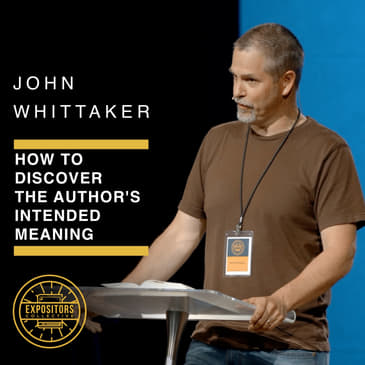
John Whittaker teaches a workshop in Temecula California on how the inductive Bible Study method helps to discover the divine and human author's meaning of a text.
John Whittaker is a preacher, teacher and pastor. He holds theology and ministry degrees from Boise Bible College, Cincinnati Bible Seminary, and a doctorate in preaching from Gordon-Conwell Theological Seminary - the only reason for all of that is to help bring God's word into the lives of people more effectively. John has been serving in ministry for 30 years. He has served as a Professor of Preaching and New Testament at Boise Bible College for 19 years. During that time, he also helped plant a church in Kuna, Idaho, where he led the adult education ministry and preached for 11 years. He has taught classes for Eternity Bible College and taught and preached in various places around the country and the world. Most recently, he served for nearly 4 years as one of the teaching and campus pastors at The Pursuit, in Boise and is currently on the preaching coaching team at Calvary Boise.
You can learn more about John Whittaker at https://www.johnwhittaker.net/
Additional Resources:
Listeners Bible Commentary: https://www.listenerscommentary.com/
The Listener’s Commentary provides clear, accessible teaching through each book of the New Testament in audio format so you can learn and live the Bible.
https://www.crossway.org/articles/10-tips-for-getting-started-with-inductive-bible-study/
Recommended episodes:
Cody King on bivocational ministry: https://www.expositorscollective.com/podcast/2019/9/17/episode-65-bivocational-ministry
Neil Spencer on Inductive Bible Study: https://www.expositorscollective.com/podcast/2019/4/10/the-who-what-when-where-and-why-of-bible-study
Josh Turansky on Inductive Bible Study: https://www.expositorscollective.com/podcast/2020/2/7/episode-88-treat-your-text-like-a-crime-scene-bonus-episode
Pleasanton, California Expositors Collective Training Event May 24th & 25th
We’re excited to be partnering with Valley Community Church to host our first training seminar in the Bay Area. We have a lot of friends (and podcast downloads) in that part of California and we know that it is going to be a great time!
To register or for more information visit https://expositorscollective.org/gatherings/
The Expositors Collective podcast is part of the CGNMedia, Working together to proclaim the Gospel, make disciples, and plant churches. For more content like this, visit https://cgnmedia.org/
Join our private Facebook group to continue the conversation: https://www.facebook.com/groups/ExpositorsCollective
Click here to support Expositors Collective
[00:00:00] To our job as Bible students, first and foremost, is not to create our own message, come
[00:00:07] up with our own message. It's to discover the message of the text. That's our aim.
[00:00:12] What are the author intent to communicate by what they're saying in this paragraph
[00:00:17] at this point in this book?
[00:00:21] Hey, welcome to the Expositors Collective Podcast episode 320. I'm your host, Mike
[00:00:26] Neglia. And the voice that you heard is our guest for this week, Dr. John Whitaker.
[00:00:32] John has spent the past three decades pastoring and as a professor in various Bible colleges,
[00:00:40] he wants to help people follow Jesus by learning to hear what the Bible actually says.
[00:00:47] And that comes across in this session that you are going to hear. This is a recording of one
[00:00:55] of the main session messages that he gave earlier on how to discover the author's intended meaning.
[00:01:04] In other words, what does the Bible actually say? He is going to teach us what sort of questions
[00:01:11] we should be asking, how do we interpret and then how do we apply God's word to our own heart
[00:01:18] and to those who are listening to us? If you are listening to this episode,
[00:01:24] and if you think, man, I wish I could have been in the room when this was taking place. Well,
[00:01:30] I want to invite you to join me, John and others in Pleasanton, California
[00:01:38] in the San Francisco Bay Area, May 24th and 25th. We do a two-day Bible teaching training workshop
[00:01:48] and I'd love for you and your team to come along. We think that there's something for everybody
[00:01:54] that attends this group, whether you're a brand new novice or whether you're an experienced
[00:02:02] preacher, all of us can benefit from this type of teaching and this type of coaching.
[00:02:08] Visit our website, expositorscollective.com. It's going to give you registration details.
[00:02:14] Hopefully I'll get to see you and your team in Pleasanton, California, May 24th and 25th.
[00:02:22] All right, here's the recording of Dr. John Whitaker on how to discover the author's intended meeting.
[00:02:36] I get to talk about Bible study at least for now that we're going to talk about
[00:02:41] and Jim ended the last session, emphasizing the power and importance of the text.
[00:02:48] That if the preacher simply reads the passage then there's something good that you can take away
[00:02:53] from the sermon, right? And that's because this book is a treasure.
[00:02:59] And we can get so familiar with it, particularly if we spend a lot of time studying it or
[00:03:03] teaching or whatever, that we forget the treasure it is. It's a treasure to us. And so
[00:03:08] if we were merely a stand-up comedians, right? We could come with our own content whenever
[00:03:17] we wanted to put together our own act, our own gig and we could talk. We could make people
[00:03:22] laughing to be great. If we were purely a motivational speaker then the same thing. We could
[00:03:26] come up with some, you know, our own one-liners and things people could tweet out or whatever else they
[00:03:30] wanted to do. We don't get that luxury if we're going to be expositors and that's who we are.
[00:03:35] We're expositors. We don't get to create our own content. We're slaves to this content
[00:03:42] and this is a treasure, not just for us but for those that we get to teach the Bible to and pass
[00:03:48] it on to. And there is in fact the listeners commentary that Mike referenced that has convinced me
[00:03:55] over the last handful of years putting that out and then the emails I get back from all around
[00:03:59] the world. There is a massive hunger among people to say, just help me understand this book.
[00:04:06] Just help me understand this book. What is it really saying? And how can I know God through
[00:04:12] this book? And that's really what we get to focus on in our teaching and preaching as expositors.
[00:04:18] And so in order to do that well, in order to teach this book well to be expositors, well,
[00:04:25] we're a slave to this book. We have to dig into this book and understand it. And so when it comes
[00:04:30] to that, the first thing we need to make sure we understand is what is our aim? What's our aim when
[00:04:36] it comes to Bible study? We're talking about inductive Bible study. And when we say aim, notice
[00:04:43] the three letters, a-i-m. What is our aim? Our aim as expositors, as students of God's word,
[00:04:55] is to identify the author's intended meaning. That's the aim. That's what we're after. And that's
[00:05:04] because this book is intended to be communication and any communication, whatever it is, there is
[00:05:10] an intended message that the speaker or writer is intending to get across. So our job as Bible
[00:05:19] students, first and foremost, is not to create our own message, come up with our own message. It's
[00:05:26] to discover the message of the text. That's our aim. What do the author intend to communicate
[00:05:32] by what they're saying in this paragraph at this point in this book? So that's what we're after. Now
[00:05:38] how do we do that? How do we discover the author's intended meaning? Well, that's what I want to
[00:05:45] talk about over the next few minutes. And this is going to be super fast. If we're drinking from a
[00:05:51] fire hose all day, well then this is going to get a start off going really fast. I taught a 15-week
[00:05:58] semester course on this topic. We're going to do it in 15 minutes. So we're flying. So real quick
[00:06:07] overview. Here's the overview. There's three parts to inductive Bible study and it looks like this.
[00:06:13] Observation, interpretation, application. Observation is reading the text and just kind of getting a
[00:06:20] feel for what's there. What do I see? Interpretation is then digging in and wrestling with the text and
[00:06:26] saying, okay now what does it mean? And then application is standing back and prayerfully engaging
[00:06:32] with God and thinking about the text and talking to God until we can say, here's how I respond.
[00:06:38] Observation, interpretation, application. We'll come back to the details of that but let's just
[00:06:44] this is do a little practice real quick before we walk down. How do we do that? Psalm 1. If you have
[00:06:51] your Bible open it to Psalm 1. Hopefully have your Bible because you're going to be using them a lot
[00:06:56] today and tomorrow. Psalm 1 and I'm working out of the the new American standard it says this,
[00:07:04] how blessed is the person who does not walk in the council of the wicked or stand in the path
[00:07:09] of sinners nor sit in the sea to scoffers but his delight is in the law of the Lord and his law he
[00:07:14] meditates day and night. If we were to make some just some initial observations right we just read
[00:07:21] those two verses real quick. What are some of your initial observations? I know we're just getting
[00:07:27] started but still is the middle of the afternoon so maybe a little interaction might help kind of
[00:07:31] purchase up a little bit. So what are some initial observations on Psalm 1 versus 1 and 2?
[00:07:38] What do you see? Okay, meditate day and night. We could even ask some questions about that. One is
[00:07:46] what does it mean to meditate? How do I do that? Also day and night. What about my job?
[00:07:53] What about my kids? What does it mean to meditate day and night? We're going to have to think that
[00:07:59] through. How do we work that into just all the responsibilities of life? So how does meditate
[00:08:04] and life actually go together? We're going to wrestle with that. What else? What are some other
[00:08:08] observations? Okay, who's the ungodly? If you read verse 1, he does not stand in the council
[00:08:16] of the wicked or the path of sinners, see to scoffers. Who are those people? The ungodly, the wicked,
[00:08:21] the scoffers, right? Who are those people? What kind of people do we refer to by that? What else?
[00:08:28] Bless. What does it mean to be blessed? Right? And what sense are they going to be blessed? I've
[00:08:32] done some pretty righteous people that didn't seem so blessed from at least the American standard. So
[00:08:37] what are we talking about by blessed? Right? What else? Walkstand sit. That's an interesting progression.
[00:08:45] Right? Walk. Stand. Now I'll send you seated. Is there any significance to that? Right? We make
[00:08:52] observations like this as we're working through the text. Let's just look at verse 3 real quick and
[00:08:57] then we'll talk about what we did. Verse 3 says, the person who meditates on the law of the Lord will be
[00:09:04] like a tree planted by streams of waters which yields its fruit in its season whose leaf does not
[00:09:11] wither in everything he does. He prospers. All right, what are some observations about verse 3?
[00:09:20] What does prosper mean? Does it mean I'm going to have a rich bank account or what? What does prosper mean?
[00:09:27] What else? What is the fruit? What kind of fruit are we talking about? Notice it says it yields
[00:09:33] its fruit. It's very specific. It's not any random fruit. It's the particular fruit of that
[00:09:39] particular tree. It's fruit. That's interesting. What does that mean? What else?
[00:09:45] Planted. Notice they didn't find itself there by accident. It's planted. That sounds more
[00:09:50] intention on deliberate. It's an important observation. Right? So this is what we're talking about. It's
[00:09:55] observation. Interpretation then would come back after that and say, okay, we would do some research
[00:10:01] and try to figure that stuff out. And we would say, okay, so walkstand sit. That does seem like a progression
[00:10:08] and we learned that in Hebrew poetry there's different kinds of parallelism. Some lines will restate
[00:10:14] this exact same thing in different language sometimes it'll add to. It seems like this is adding to.
[00:10:19] So we want to research that. Check that out. This planted actually mean planted. Is this really what
[00:10:25] it sounds like where it's not just accidentally seed blown there deliberately put there? We could even
[00:10:30] research stream and realize, oh, that actually might be referencing some sort of irrigation canal. I
[00:10:36] don't know if you have those around here in Temecula. We have those in Boise because it's a desert. So
[00:10:41] if you're going to get any water, you got to have canals that move the water to where you need it. Right?
[00:10:46] You could keep working through the whole thing and you could talk about chaff and research chaff
[00:10:50] and what that is right? Interpretation. We begin to wrestle with what does this mean
[00:10:54] until we can put it back together and then how do we respond?
[00:10:59] All right? That's inductive Bible study observation, interpretation, application. So let's take those three parts
[00:11:09] and talk then about, you know, although we just kind of real quickly hit Psalm 1, let's talk about what we
[00:11:15] were doing and then give you some tips for how you can do each of those three those three stages
[00:11:19] of inductive Bible study well. Right? So observation. The key thing we're talking about with observation is what do I see?
[00:11:27] That's what we're asking. What do I see when we read the text? And so we want to merge ourselves in it.
[00:11:33] We want to read it over and over again. We want to read it probably in multiple different translations
[00:11:38] and just kind of fill our minds of text and see what we can see. And one of the things that helps me
[00:11:44] think about different kinds of things to look for is a simple little acrostic cure. What's the cure?
[00:11:50] And these stands for various things. So the C stands for connected. How are things connected?
[00:11:57] What's the relationship between ideas? What's relationship between sentences? How does this paragraph connect
[00:12:02] with the paragraph before and the paragraph after it? How are things connected? You're looking at
[00:12:07] therefores and so that's and because and however in those kinds of words, right? And how things
[00:12:12] are related by how they're connected unfamiliar to you. So you might as you're doing observation
[00:12:18] you might want to mark down to things that are unfamiliar. What's chaff? Like Psalm 1 mentions
[00:12:24] chaff. What's chaff if you're not a farmer, you know, you may not know or you've never grown wheat
[00:12:29] or barley, you may not know what chaff was right. So you have to think that through and or other
[00:12:34] unfamiliar things. I'm familiar customs and habits when we will look at a passage here in a second
[00:12:41] out of Luke chapter 7. This woman's crying at Jesus' feet. How in the world did you get to Jesus'
[00:12:47] feet when he was eating? There's something going on there, right? It's custom. And so we want to
[00:12:52] look at unfamiliar customs or post-resurrection in the gospel of John. It says that Peter was stripped
[00:12:58] for work. Was he fishing buck naked? Like what does it mean to be stripped for work and how should
[00:13:04] we picture that? I'm familiar or you know a denarius or a lepton or different denominations
[00:13:10] of currency that show up in the gospels, right? Or unfamiliar people groups who in the world
[00:13:15] the emalachites and why does God want the Israelites to kill them all?
[00:13:20] Right. So things that are unfamiliar or the R stands for repeated when you start to see
[00:13:26] repetitions in a book, repetitions in a paragraph, or even a repeated pattern that you saw
[00:13:32] you know earlier in the Bible. Now this pattern's showing up again. Hmm. Why is that? Let's pay
[00:13:38] attention to those things. So note things that are repeated or the E stands for emphasized one
[00:13:45] way to emphasize things is repeating it. But in other ways to list it off, right? And things
[00:13:50] of that sort are the things that seem to be emphasized in the way it's put in the text or shows up in
[00:13:55] the text. So that helps just wrestle with what do I see? Another another little strategy or tool
[00:14:02] that will help you do observation well is the standard kind of journalistic questions. Who? What?
[00:14:09] Where? When? Why? How, right? Like those sorts of questions. Ask those questions as you read the text.
[00:14:17] Who are the ungodly we had asked when we were looking at Psalm 1, right? Who are the scoffers?
[00:14:23] It's not a word I use every day. Who are the scoffers in Psalm 1? What does it mean to meditate?
[00:14:29] Right? And how do you meditate and still do life? We're going to have to wrestle with that. So
[00:14:34] ask these questions or if you're reading a narrative text, where is this place?
[00:14:39] You know, Ephesus in Acts chapter 19 they burn a whole lot of magic books in Ephesus. Can we
[00:14:44] find anything about Ephesus and its relationship to magic that might explain why that's a big deal
[00:14:49] in Ephesus? So we're going to do a little research about the city of Ephesus and where it's at
[00:14:53] and the significance that it played in the first century world. So ask who, where, when, why? When
[00:14:58] you do that if you ask to those cure kinds of things and these kinds of questions all of a sudden
[00:15:04] you have a bunch of data you're looking at. It's like you've gone to a crime scene if you watch
[00:15:11] you know crime scene TV show type stuff, right? And you've now got all this data but you've got to
[00:15:16] still figure out what does it mean? What does it mean? That's the next step. So observation says
[00:15:22] what do I see? But interpretation is well now I've got all these questions, all these initial
[00:15:27] observations, all these initial ideas, what do I do with all that? Well what you do is you begin
[00:15:33] to try to figure out the answers to the question so you can ask what does this passage mean?
[00:15:39] What does this passage say? What's the significance of it? And so we move to interpretation and we ask
[00:15:46] what does it mean? What does it mean? And when you're doing interpretation the key things
[00:15:50] we're looking for primarily have to do with context. These top two on this list have to do with
[00:15:59] the two main sources of context we want to pay attention to, the historical context and the literary
[00:16:05] context. When we talk historical context what we have to recognize is that when you pick up your
[00:16:11] Bible and read or when you tell somebody else to pick up their Bible and read it's like traveling
[00:16:19] to a foreign country in a time machine. That's what you're doing. You're traveling to a foreign
[00:16:24] country and you're doing so in a time machine because you're going back in time to a place that
[00:16:34] is probably different even than that place is today because of the time difference. And so
[00:16:40] there is a massive amount of historical and cultural background that this isn't readily apparent
[00:16:45] to us we don't automatically know it, we didn't live there, we didn't have their hopes,
[00:16:50] their dreams, their fears, we didn't have their historical experience and so we've got to dig
[00:16:54] into the historical background. We got to try to bring it to life, we got to try to understand
[00:16:59] the cultural context and who these people are and why they're doing some of those things
[00:17:03] and when we begin to do that also not only does the story or the text kind of become three
[00:17:10] dimensional jump off the page but things that seem confusing is like oh in their culture that made
[00:17:15] a lot of sense. Why does Sarah say to Abraham here's Hagar you're servant make a baby with her
[00:17:25] to us it's like weird to Abraham and Sarah is like perfect sense they didn't have
[00:17:31] been vitro fertilization you needed to protect your family property and your family land
[00:17:37] and your family lineage and heritage how do you do that surrogate?
[00:17:44] So Sarah saying since I can't get pregnant let's use a surrogate. Weird dust made sense in their
[00:17:50] cultural context it was the standard way to do it they were just doing it the normal old human
[00:17:55] way and that was the problem. God's like wait hold on hold on hold on I got a better idea let's do
[00:18:01] my way. Cultural context we have to know the cultural background and the historical background
[00:18:07] that includes the situation the story of the prodigal son very familiar who's the original audience
[00:18:13] for the story of the prodigal son. Well Luke chapter 15 tells us the Pharisees the story is not
[00:18:23] addressed to out and out sinners who are off in Las Vegas you know doing whatever they can do
[00:18:28] you know living it up and partying it up and the story is told to the religious people are
[00:18:32] sitting at church who were looking down on that person that's the original audience that changes
[00:18:37] the angle on how we read the story and how we hear the ending of the story that the older brother
[00:18:43] is still outside. So you're going to soften his heart and see actually going to come into the party
[00:18:46] or not. The situation that's part of the historical context literary context literary context is how
[00:18:55] does this fit into the flow of thought of the book and how does it fit in relationship to the paragraphs
[00:19:00] before and after it or to the stories before and after for reading narrative how does this fit
[00:19:05] in the flow of what is written that's the literary context we have to pay attention to that right
[00:19:11] and so again you're paying attention to connections at that point there is therefore now no
[00:19:17] condemnation for those who are in Christ Jesus for for what the law could not do because it was
[00:19:20] to the flesh God did sending his son in the likeness of sinful flesh as an offering for sin he
[00:19:25] condemns him in the flesh right Romans chapter 8 notice there is therefore now no condemnation
[00:19:32] we're so quick to grab onto the end of Romans chapter 7 the things I want to do I don't do and the
[00:19:37] things I don't want to do I do we miss the solution. Romans chapter 8 there is therefore now no
[00:19:44] condemnation for those who are in Christ Jesus this is telling us how to be set free from the peril
[00:19:49] of Romans chapter 7 you do it by not walking according to the law but walking according to the
[00:19:53] spirit by faith in Jesus Christ context and so we got to pay attention to the literary context as
[00:19:59] we do that that'll involve things like words and grammar and paying attention to specific words
[00:20:04] and having to do word studies and things okay maybe that's an unfamiliar word and I'm not sure
[00:20:08] what that means we're going to dig into that and sort that that word out we're going to have to
[00:20:12] think through meditate and Psalm chapter 1 what does it mean to meditate day and night we're
[00:20:17] gonna look at that phrase we're gonna look up the word meditate and we're gonna learn that word
[00:20:21] actually is used sometimes of like a lion lying on its prey and you're just meaning the idea of the
[00:20:27] word is to ruminate to chew it up and that's what we're doing with scriptures can you do that as
[00:20:31] you're going about your day yes you can you can chew it up as you're going about your day
[00:20:36] get those free moments when you're driving in the car and set of listening to something the car
[00:20:40] you keep silently just ponder what you were reading that morning or whatever else it is right
[00:20:44] you look at the word and you wrestle what does that word mean and we dig into it we figure it out
[00:20:49] and then oh now I get what's really going on genre what's a genre it's type of literature
[00:20:55] there's different types of literature in the Bible you got historical narrative you got poetry
[00:20:59] book of Psalms and some of the prophets and some of the other wisdom writings are poetry you got
[00:21:05] apocalyptic literature the book of Revelation what in the world is that most of us feel that
[00:21:10] when we read Revelation right pocket it's a particular type of literature it was common
[00:21:15] to the Jews they were familiar with apocalyptic they knew how it worked even if we don't so we're
[00:21:18] gonna have to figure out the different genres and figure that stuff out and then this last
[00:21:23] little bullet point under interpretation is so often overlooked in classes on how to study the
[00:21:29] Bible books on how to study the Bible it's so critical after you have done all the observation
[00:21:34] and you've done all your research what do you have a bunch of scraps a bunch of pieces which doesn't
[00:21:41] do a whole lot of good unless you put it all back together and say what's the main point
[00:21:46] and so we've got to before we're done with interpretation we got to you know kind of reassemble
[00:21:51] this whole thing and say step back and read the whole paragraph and say oh what's this paragraph
[00:21:57] about I get it and if you're looking at Psalm chapter one right we would say oh I see what this
[00:22:03] paragraph is about it's about the outcome of the wicked and the righteous what's the outcome
[00:22:10] of a wicked life and what's the outcome of a righteous life well the way of the wicked will perish
[00:22:15] but God knows the way of the righteous it'll last right now we know this what's it's about
[00:22:22] this is making a point about there's two different ways to choose in life the way of the righteous
[00:22:27] or the way of the wicked one leads to life one leads to death put it all back together
[00:22:34] into a coherent whole and so at that point then once you have all the parts put back together
[00:22:40] the whole now you're ready to say so what do I do how do I respond how do we respond as the people
[00:22:48] of God and how do we respond in relation to each other how do we respond in relationship to God
[00:22:54] how do we respond in relation to the world how do we respond to the text and that's application
[00:23:01] and just to help help us do that well here are four questions that'll help us be really intentional
[00:23:09] about application had Robinson who some of you might know that name he was one of the most well-known
[00:23:16] teachers of preaching for probably 50 years in the United States he used to say more heresy happens
[00:23:22] at the point of application than any other point in the sermon so we need to be really intentional
[00:23:28] and deliberate at this move when we go from interpretation to how do we respond we can't be
[00:23:34] haphazard or sloppy so four questions tell what's the original purpose of the text why was this
[00:23:40] text written in the first place what are we trying to achieve at this point in the text why did the
[00:23:44] author put this here what's the original purpose what was the original response in other words how
[00:23:49] would the original audience needed to respond what was the original author trying to get the
[00:23:54] original audience to do in response to this text how are they going to respond then we can ask how
[00:24:02] are we similar and how are we different from the original audience there are some similarities
[00:24:07] and differences we're not them right when you read you know Ephesians or Colossians or Galatians
[00:24:13] just have to accept you're reading somebody else's mail you're not the Galatians no one's coming
[00:24:21] into your church well it could happen these days with the Hebrew roots movement but most likely
[00:24:26] probably know it's coming into your church and saying unless you're all circumcised you're really
[00:24:30] not part of Abraham's family you're not really justified right so then what do we do with Galatians
[00:24:36] since that's not the exact same issue that's the issue that was going on behind how are we similar
[00:24:40] how are we different and then once we have that sort of sorted out then we can we can begin to say
[00:24:46] okay so what's our response how do we respond and view of what the original purpose of this text is
[00:24:53] and what and what the original writer was after and their response how do we respond now that we
[00:25:01] understand all of that and that helps move us to being very intentional in our response now I
[00:25:09] would be remiss if I didn't just say this as we wrapped up this session to echo what Jim said
[00:25:16] the ultimate goal of scripture is not for us to do something to the text we're we've got to
[00:25:24] do our study to make sure we're being responsible and we're teaching the truth but at the end of the day
[00:25:29] the text wants to do something to us and so as we dig in and as we look at it at some point we just
[00:25:38] need to step back and remember this is God's word it's a treasure given to us to help us
[00:25:45] know God and know ourselves and know who we are and where we stand and we ultimately sit under
[00:25:51] this text not over this text and so once we do our Bible study and once we think we have some
[00:25:57] of the details figured out then let's push push back and meditate on the text and talk to God
[00:26:03] about what we're seeing in the text and engage with God and let them speak to us in the text so that
[00:26:07] when we stand and speak to others we're not just giving a bunch of historical facts and a bunch
[00:26:13] of random data we're giving a word from God because we've encountered God in the text ultimately
[00:26:19] that's all right all right thanks for listening all the way to the end man that was powerful that
[00:26:27] was like lot of content wasn't it well in the show notes still be links and resources where
[00:26:34] you can find other stuff from John Whitaker about understanding the Bible and putting it into practice
[00:26:42] he actually is the brain and the voice behind the very popular listeners commentary which is an
[00:26:50] audio book week by week chapter by chapter commentary through the Bible he's currently going
[00:26:57] through Matthew but there's a great back catalog it's not like sermon it's not like a regular
[00:27:02] podcast it truly is like an audio commentary basically you've got to check it out for yourself I
[00:27:10] love it I listen almost every single week also I forgot to mention this but John is on the
[00:27:18] leadership team of expositors collective he's just one of the brilliant minds behind the scenes
[00:27:26] that are trying to cultivate and create a resource that is going to benefit you and that is going
[00:27:32] to help your Bible teaching because we believe that by equipping and enriching and empowering you
[00:27:40] it's going to benefit the men women children that are going to listen to your Bible studies
[00:27:47] and your sermons so if you're interested in contributing towards the the financial needs
[00:27:54] the running costs of expositors collective both this weekly podcast and the travel costs
[00:28:01] associated with these conferences that we do a couple times per year well on our website there is
[00:28:08] a give button and we would really appreciate any contribution you could make towards the
[00:28:15] ministry that myself and John and others get to be involved in well anyway I hope that this
[00:28:21] episode and all that we do at expositors collective help you to grow in your personal study
[00:28:26] and public proclamation of God's word this podcast is a part of CG and media a podcast network
[00:28:31] that points to Christ we are supported by listeners like you to help us create more great shows
[00:28:36] visit cgmedia.org slash support