
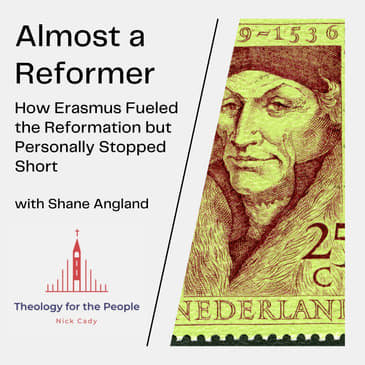
Desiderius Erasmus is one of the most important figures in the history of the Protestant Reformation. He was a key thinker, and the compiler of many of the manuscripts that were used in translating the Bible from Greek and Hebrew into languages of the people. He was also in communication with many of the key figures of the reformation, like Martin Luther.
And yet, Erasmus stopped short of being a Reformer. In this episode, I speak with Shane Angland about this intriguing person, what contributions he made, and why he fell short.
Shane Angland is from Ennis, Ireland and holds a Masters of Divinity from Dallas Theological Seminary.
Make sure to check out the Theology for the People website at nickcady.org
[00:00:00] The difference is, I think that Luther had an encounter with the gospel. He had an encounter
[00:00:12] where God chilled him and made him alive again. I mean, Luther said a great theologian
[00:00:17] is made by being damned. That's when you realize that in yourself you have nothing
[00:00:23] and when the world itself turns against you. But Arasmus knew nothing of that. And so
[00:00:28] there is that danger that we can pursue knowledge apart from the challenge and the power of
[00:00:34] the gospel. And if we are not chained by what we study, we do need to humbly ask the Holy
[00:00:39] Spirit to do a radical work in our hearts.
[00:00:45] Desiderius Arasmus is one of the most important figures in the history of the Protestant Reformation.
[00:00:50] He was a key thinker and he was the compiler of many of the manuscripts that were used
[00:00:56] in translating the Bible from Greek and Hebrew into the languages of the people. He was also
[00:01:01] in communication with many of the key figures of the Reformation like Martin Luther, and yet
[00:01:07] Arasmus stopped short of being a reformer himself. In this episode I speak with Shane England about
[00:01:13] the intriguing story of Desiderius Arasmus of Rotterdam who he was as a person, what contributions
[00:01:20] he made and where he fell short. Shane has been a frequent guest on theology for the people. He holds
[00:01:26] a master's of divinity from Dallas Theological Seminary, and he is an excellent resource on the topic
[00:01:33] of historical theology. I hope you'll enjoy this conversation. I'll be back at the end with some final
[00:01:39] words.
[00:01:44] Well Shane thanks for being on theology for the people again. Good to have you back.
[00:01:49] Thank you so much Nick. Good to be here.
[00:01:50] What today what we're talking about is Arasmus of Rotterdam and the humanist movement in Europe
[00:01:57] and the contributions that that made to the Reformation. For example, like you had suggested this topic
[00:02:05] and I love hearing you talk about historical theology and the history behind the theology but tell
[00:02:11] me a little bit about why you're passionate about this topic in particular.
[00:02:17] Well I really have a great regard for Arasmus as we discuss him. I'm sure people will maybe come to
[00:02:27] their own have you on him, but he contributed an awful lot to the reform of the church without
[00:02:34] necessarily intending that. And that's one of the great ironies of this man is that
[00:02:41] he's contributions vastly outweigh his intentions. And in many ways he set down some
[00:02:49] excellent ideas, some excellent values that the church in the West and the Reformation in
[00:02:57] particular did draw some great lessons and strength from. On the flip side he is a complex
[00:03:04] character and I think you know that's part of my interest in him is that he is a man
[00:03:09] that is multifaceted and ultimately disappoints both sides of the Reformation in Western Europe.
[00:03:17] So he's a disappointment to everyone even to himself possibly, but his contributions are not
[00:03:25] diminished nonetheless. I think you did have an incredible influence on the Reformation
[00:03:30] in Europe which is the turning point for the Western church certainly. Yeah we'll talk a lot
[00:03:35] more about him as we get into this of course, but let me just begin by asking you this.
[00:03:40] Do you consider Arasmus to be a reformer? Should he be counted amongst the reformers or not?
[00:03:47] My own view is that he's a reformer with a small or he did want reform in the church.
[00:03:55] He certainly did however when push came to shove he was more of a spectator than a reformer.
[00:04:03] He was a scholar, he was a poet, he was a man of letters but he was not a Martin Luther.
[00:04:12] A Martin Luther is a rare thing that sometimes God raises up in the church.
[00:04:18] Luther was a man of many flaws, he was a brush, sometimes a vulgar man, Arasmus was a man
[00:04:24] of manners, a man of culture and etiquette and yet when push came to shove I think Luther stood firm
[00:04:32] for the truth whilst Arasmus backed down and ultimately took his stand against
[00:04:40] Luther and the reformers at the end of his life. So let's back up and just give an overview
[00:04:47] of who is Arasmus of Rotterdam, what was his life and his role in the humanist movement in Europe?
[00:04:55] Yeah so he was a son of a Catholic priest, so again that's Europe in the 15th century so he's
[00:05:03] born in the 15th century around 1466. He has an older brother Peter and his father is a Catholic
[00:05:10] priest both his father and his mother they're not married but they obviously have a long-term
[00:05:16] relationship. They both die when Arasmus is about 14 years old and what normally happens then is
[00:05:22] you are a ward of the church so you're under the protection of a patron or of the church and so
[00:05:28] Arasmus is sent to school but already at a young age he shows a tremendous talent for Latin,
[00:05:34] for reading, for writing and he wants to pursue a life of scholarship however he's not in a position
[00:05:42] to do that because he more or less is forced as a young man to enter the monastery because there
[00:05:47] aren't many other options for him so he enters the monastery in Gouda in the Netherlands,
[00:05:53] a place called Stein and he's looking back at his life he said that's one of his biggest regrets
[00:05:59] is that he had to enter into that monastery. At that time the the monastic life in Europe
[00:06:05] is quite moribund it's quite stale there are attempts to to bring about a spiritual renewal within
[00:06:13] the monastic movements and particularly in the Netherlands where Arasmus was a young manastec you
[00:06:18] have this movement called the brethren of the common life you have this idea that true spirituality is
[00:06:25] is a simple Christianity, a sort of a mere Christianity that is less concerned with ceremony and ritual
[00:06:32] and more with a love for the Lord Jesus Christ. And so you see books that are written around this time
[00:06:41] Thomas the campus the imitation of Christ would have been one of the books produced by this movement
[00:06:46] I don't know if you've read that book but it's you know it's an interesting book it doesn't really have
[00:06:52] any theology of the gospel at all in it and yet it has remained a very popular work and that is
[00:06:59] the kind of spirituality it's sort of a moralistic, pietyst theology that Arasmus would have grown up with
[00:07:07] and it became to satisfy with it he didn't find it intellectually challenging didn't find it
[00:07:12] that it was in any way respectable or deep or challenging and he had bigger plans.
[00:07:20] And so as a young man he managed to procure the patronage of a of a bishop in France,
[00:07:25] Bishop of Cambrai and to his great delight he was sent to the supreme university in Europe
[00:07:33] the mother of all theological universities, the University of Paris where he was hoping to do these
[00:07:39] studies and to gain a doctorate. And it's at that time that he is beginning to be recognized even
[00:07:46] among these peers as a man of profound elegance, a man who can write Latin like one of the ancients
[00:07:54] like one of the classical writers he has a great skill with the pen he has a passion to produce
[00:08:01] beautiful Latin writings he's passion really even theology even though he's in a theological school
[00:08:06] he's passion more as literature, poetry, philosophy but he is growing ahead of his peers
[00:08:15] he spends some time in Italy where he is following the bishop there to do some work and he witnesses
[00:08:23] Pope Julius, the Pope Julius the emperor, the warrior pope as he was known attack Bologna
[00:08:30] when he's army to besiege us and so he has the fleet and so he's seeing a lot of the corruption
[00:08:36] and decadence of the church and he is dissatisfied with both his theological learnings because he
[00:08:42] doesn't find it challenging doesn't find us you know it has anything we need to offer him the
[00:08:47] scholastic message and he's disarranged with the state of the church it seems to be more concerned
[00:08:53] with more than the power than it is with the simplicity of the gospel. So an attorney point for him
[00:08:59] and his own life comes when he discovers the writings of an earlier humanist writer Christian guy
[00:09:07] called Lorenzo Valla and Valla really was one of the founders of European humanism and humanists
[00:09:14] are really is a movement that is concerned with the humanist studies which are history rhetoric literature
[00:09:21] but Valla in the 15th century he had exposed some of the the sforgeries used by the papacy to
[00:09:28] claim power for itself by exposing the language and the content of those letters as impossible to
[00:09:34] be coming from the early centuries and he also produced his what he called the annotations on a
[00:09:39] New Testament and this is back in the 15th century you know this is over a hundred years before
[00:09:43] Luther or Rasmus and already people at Lorenzo Valla are saying you know the Volgate Bible when it says
[00:09:49] do penance that's completely misleading the Greek the Greek metanoia means to repent it means
[00:09:54] to change one's mind and he says this this idea of penance as we understand it in the Latin Bible
[00:10:00] the sacrament of penance you know where you have to have contrition to confession satisfaction
[00:10:05] to do works to gain release from temporal punishment from sin he said that has nothing to do with
[00:10:11] the actual text of the Bible if you read it in the Greek so already Valla is demonstrating to
[00:10:17] Rasmus that the study of the original languages of the Bible could be a means of producing a more
[00:10:25] accurate Bible and in doing so could actually be a vehicle for reforming the Catholic Church
[00:10:31] and so he actually brought the works of Valla which you found handwritten in the manuscripts
[00:10:36] in a monastery he brought those to a printer and had them printed and this really helped his
[00:10:41] reputation to be established as here is a voice of reform in the church and here is a voice
[00:10:47] of what good scholarship looks like it's not it's not you know telling people that true spirituality
[00:10:54] is going through ceremonies and sacraments or pilgrimages or kissing the relic of some toll
[00:11:00] belonging to a saint it's about understanding the truth it's about going back to the writings
[00:11:08] it's about also broadening your intellect and for Rasmus and many of the humanists the quest
[00:11:14] for knowledge is the quest for virtue and that is a very moralistic way of maybe looking at the
[00:11:20] Christian life and I think Luther the Reformers would critique that view but that's that is the
[00:11:26] perspective that Rasmus is coming from and in doing so he's certainly influenced by Plato because
[00:11:31] Plato's view of wisdom is the pursuit of virtue the life of the philosopher reading is about a
[00:11:37] establishing what is righteousness I mean that is the great question in Plato's the republic you
[00:11:43] know what is justice that's the question that they all sit around to discuss and so for Rasmus he
[00:11:48] felt that the church in order to get out of the corruption the ignorance the barbarity of what
[00:11:55] he was seeing in the late middle ages it requires a pursuit of grammar rhetoric manners learning
[00:12:05] and being able to assess what the language of scripture actually says and so that's where he's
[00:12:10] coming from and this is becoming a very popular movement in the European universities it's seen
[00:12:14] as a progressive reforming movement and Rasmus has really seen as the champion of this
[00:12:20] he publishes several works that reintroduce into into scholarship some of the great sayings
[00:12:26] of the classical periods of the produces a book called the Adagia which is a collection of
[00:12:32] Greek and Latin proverbs and it provides context and escalations for these and people are thinking
[00:12:37] yeah this is really what we need this is what the church needs we don't need clergy that are so
[00:12:42] ignorant that they can't even tell you where the Lord's prayer is or who wrote us we need clergy
[00:12:48] that are educated and have sound minds and are able to articulate clearly and forcefully
[00:12:57] the teachings of the church in simplicity and so that's really where Rasmus fits into this whole
[00:13:02] movement in the church that is leading into we could say the great reformation this is the
[00:13:09] intellectual climate that Luther and the other reformers arrive later too.
[00:13:15] I wonder if you know some of our listeners maybe when they hear that word humanism
[00:13:21] if they have like an assumption that it means something different than what it meant for
[00:13:27] Rasmus and the humanists at that time meaning that they hear humanism and they feel that
[00:13:33] that is something which is opposed for example to belief in God you know and so what would you
[00:13:40] say in response to those those concerns yeah look words words change meaning I think
[00:13:46] humanism as it's as a word itself is a 19th century coinage so it is a late term that we're
[00:13:53] going to put back at this time but people like Rasmus and John Colette and other people Thomas more
[00:13:58] they would regard it themselves as students students of the humanities so that means that they are
[00:14:04] studying classical literature that means that they're studying rhetoric that means that they're
[00:14:09] they're studying poetry and all of these things that you know even in universities today we have
[00:14:14] the faculties of the humanities that per se is not anti-Christian and these people would have
[00:14:20] regarded themselves as Christian there are there isn't a sense that humanism is an alternative
[00:14:26] worldview to Christianity rather humanism is a movement within European universities that are
[00:14:32] trying to you could say improve the intellectual foundation of the church's teachers and its doctrine
[00:14:39] and so they regarded themselves as instrumental to the life of the church not opposing the existence
[00:14:45] of the church they regarded themselves definitely as moral and intellectual reformers of the Christian
[00:14:54] church in the west and to do so they wanted to look at the classical studies they wanted to look
[00:14:59] at rhetoric and this really is maybe one of the subtle distinctions that emerges in humanism as
[00:15:04] opposed to scholasticism which was the dominant sort of philosophical and educational
[00:15:12] message in European universities up until this time scholasticism is more concerned
[00:15:19] about this substance of an argument and its structure and its logic the humanists are more
[00:15:30] concerned with the rhetoric and the presentation of an argument so they would say you know if you read
[00:15:37] Thomas Aquinas you know is that really helping anyone to understand anything or is it so logical
[00:15:43] is it so philosophical is it so structured that it actually fails to communicate anything would
[00:15:49] it not be better to rise in such a way that people's imaginations are set on fire when you read a work
[00:15:57] and it actually penetrates their heart and their soul with your pros and with your
[00:16:04] glamour and with your skill that you communicate the truth far more effectively so they would say
[00:16:10] yeah it is and so that's why they would even write satires they would write satirical works that were
[00:16:15] hilarious and people would read them and enjoy them but there was a deeper theological message
[00:16:22] within that so Erasmus wrote several of these satirical works one is the praise of Folly and it's
[00:16:29] sort of a comedic work where Folly is personified as this person and she is saying really how great
[00:16:35] she is and how really Folly is is the supreme good but the the the meaning of that book really is
[00:16:43] a serious truth where we're in Erasmus is arguing that the wisdom of the world
[00:16:49] scholasticism aristartial Aquinas he says this wisdom is foolishness to God but the foolishness of God
[00:16:59] simple Christian who lives his life in obedience and you know is honoring to his family the foolishness
[00:17:06] of God is true wisdom and that's that's what he's trying to get at and it does so in a very engaging
[00:17:13] lightly way not breaking it down into you know thesis antifesis synthesis these very strict logical
[00:17:21] ways of looking at theology so that's where humanism is coming from it's a different way of
[00:17:24] trying to get truth in a way that resonates that is they would say aesthetically beautiful
[00:17:30] and how did Erasmus's humanist philosophy then influence his approach to theology and the church
[00:17:37] one of the main things you could say that the humanism gave to Erasmus was the idea of the importance
[00:17:45] of classical studies and that means that for Erasmus he really saw it he is driving gold in
[00:17:53] might to produce on the one hand a beautiful and accurate Latin Bible a sort of a new
[00:18:00] vulgate to correct the errors of the Latin Bible to produce a new Latin Bible that was bought
[00:18:05] eloquent and accurate and that would be a vehicle to teach the church truth and also he wanted
[00:18:12] to go back to the very earliest Christians back to the classical period that he regarded of the
[00:18:17] church the church fathers wanted to go back to Augustine Jerome Chrysostom and these you know
[00:18:24] influential early church fathers and produce and print critical editions of their works because
[00:18:31] he felt in doing so that early church fathers were able far better to communicate than he
[00:18:38] felt that the later medieval scholastics were and that's interesting because if you look at a writer
[00:18:43] like Augustine you know I was writing in the fourth fifth century Augustine's training is rhetoric
[00:18:49] Augustine's training is the humanities you could say of the classical era his background is rhetoric
[00:18:56] public speaking that's where he was employed before his conversion and his sermons are engaging
[00:19:03] they are filled with evocative imagery with with challenges to the audience with poignancy
[00:19:11] with with ambiguity and so Erasmus said that's really a brilliant example of how you need to
[00:19:17] communicate theological truth it's not by breaking down these these questions into logical steps
[00:19:24] would become so dry and so metaphysical that people really are able to understand anything
[00:19:30] rather go back to the earliest Christians go back to the classical period and so that's what
[00:19:34] really drove Erasmus and the benefit you could say is twofold for the church
[00:19:40] to produce his new Latin Bible Erasmus needed to show
[00:19:45] why he was changing the Bible in the first place the Latin Bible so to do that he was going
[00:19:50] to produce his Bible with two columns on each page on the one column you would have his new Latin
[00:19:55] version and on the left column you would have the underlying Greek New Testament the original
[00:20:02] source that's that's the classic humanism at fontis back to the sources and so that was twofold
[00:20:08] it was to show and to justify to a scholarly audience his decisions in translating as he had
[00:20:16] and also to produce and to put in the hands of the church the Bible in the original language
[00:20:21] and he's worked with the church fathers in producing these many many volumes of Jerome and Augustine
[00:20:28] and Christosdom was twofold again on the one hand it was to to give a really good theological
[00:20:35] tool to the church where we would benefit and spiritually grow by listening to these
[00:20:40] exemplary early Christians and secondly it was also to demystologize the church fathers
[00:20:46] it was kind of to to undercut this sort of medieval view that the church has always spoken with
[00:20:54] one voice on every single topic and in many ways by producing critical editions of the church
[00:21:00] fathers Erasmus is actually undercutting the authority of the church fathers to some extent
[00:21:06] because people will clearly see that hey he all on there are any church fathers
[00:21:12] often are teaching things that the late medieval church you know are teaching are they're not
[00:21:17] teaching with the late medieval church or teaching or teaching a teaching that the later medieval
[00:21:22] churches condemned so there are differences and secondly sometimes you'll find differences even
[00:21:27] among the early church fathers themselves so what this is showing us is that some of these more
[00:21:33] unscolarly claims by the late medieval church that the church has the authority to speak
[00:21:38] with the one voice that has one tradition that is ever always an unchanging you simply untrue
[00:21:46] from a scholarly perspective and that opens the door to reform because if the church can be shown
[00:21:51] to deviate from what it has previously taught or if there can be clear evidence of theological
[00:21:57] development and you could say corruption then that opens the door to a serious conversation to
[00:22:03] reformation because you are putting reformation on a scholarly footing you're not just saying look
[00:22:09] I'm unhappy with the way things were let's just try this no you're saying hold on we've deviated
[00:22:14] not only from what scripture says but what from the early churches said and to use the church
[00:22:19] fathers correctly we must understand that these are church fathers that sometimes spoke with
[00:22:24] discord and voices even amongst themselves so that should give us a humility when we come to
[00:22:29] questions of theology that should give us a sense of perspective and it certainly demolishes
[00:22:35] this idea that tradition with the capital T is the possession of the church that's always
[00:22:41] and forever unchanging that will be clearly demonstrated to be untrue so in doing those two things
[00:22:46] I think you did the church and the reformation a great service because those were utilized
[00:22:50] to a large degree by the reformers those two tools that gave them how was the desire for a new
[00:22:57] volgate received by the Roman Catholic Church it's very controversial and Erasmus is a wise
[00:23:05] enough man to know that he could get in serious trouble for doing this now he is a well respected
[00:23:12] scholar by 1516 when he does move to to basal and switch lengths to get this produced and he has
[00:23:19] two problems one the first problem is that already in Spain Cardinal Chaminnis is producing a mega
[00:23:26] Bible the university there in Spain is producing this massive multi-volume Bible where you have
[00:23:35] the Greek and the Latin and in the Old Testament you have the Septuagints the Greek translation
[00:23:41] you have the Hebrew and the Latin so this is a multi-volume work and it has credible
[00:23:46] and lexican dictionaries to go with it so it's a huge project that is produced by the university
[00:23:53] in Calcutansian and Spain by Cardinal Chaminnis the problem is that if that gets out first it will
[00:24:03] become the gold standards because that will be the first time that the church will have a
[00:24:06] printed Greek New Testament text so Erasmus is under pressure to get his out first and the second
[00:24:13] problem he has is that he doesn't have papal permission to do it which is always risky because
[00:24:19] this is the 16th century you know you can get in a lot of trouble for just doing things like this
[00:24:24] so to get around those the first option he has is just to get his edition out the door
[00:24:31] Ed Long minimal editing so he manages to procure a handful of manuscripts 12th century manuscripts
[00:24:37] quite late by modern scholarship was that they were the best that he has in basal
[00:24:42] and he edits the text rapidly it does have a number of errors he says in his own letters that
[00:24:48] it was not even edited it was just pushed out of the printing press to get out there and the
[00:24:53] second thing he does is he dedicates the work to pope Leo the 10th the pope so that's kind of
[00:24:59] getting around not having a papal permission you're dedicating the work to the pope and then
[00:25:04] it's a roaring success it is produced this new Latin Bible it has the Greek text and he's new Latin
[00:25:11] version it's well received by many but there are also many within the theological faculties of
[00:25:19] Europe that are outraged that Arrasmas has the the arrogance to correct Jerome's vulgate Bible and
[00:25:30] the accusation is how can you correct what's perfect how can you correct what the church
[00:25:34] is used for a thousand years how can you say that you know maybe they were wrong and he does face a
[00:25:40] lot of backlash but not so much from the authorities as from fellow scholars fellow Roman Catholic
[00:25:46] scholars and he goes back and forth defending himself in that he's he's defences that you know
[00:25:53] is it not better to correct an error than simply to maintain a tradition and he clearly says that
[00:25:59] you know the manuscripts of the Latin Bible as they're copied over a thousand years contain errors
[00:26:03] and it's the duty of Christian scholarship to remove those errors those copious errors those omissions
[00:26:10] additions that scribes make over by copying these things by hand and so Arrasmas is challenging
[00:26:15] he's he's detractors to value accuracy and truth rather than tradition and there is pushback
[00:26:23] people say you know he's he's taking verses out or that he's twisting the text but to get around
[00:26:29] that Arrasmas you know produces the parallel Greek text and he also produces a large number of
[00:26:35] explanatory notes these annotations where he sets out to defend these decisions
[00:26:41] and obviously some of the decisions he makes are at groundbreaking like you know when he gets to
[00:26:45] the Matthew chapter three when Jesus calls repentance in the Latin Bible it has you know do penance
[00:26:51] penitentiomagotate Arrasmas translates it as repent he did so on the basis of Catholic scholarship
[00:26:58] he's careful to point it out he said I'm not the first person to bring this up look at Lorenzo
[00:27:03] Vallo in the last century he said the very same thing look at the Greek text the Greek text is
[00:27:08] not about the sacrament of penance the Greek text is about a change of mind it is about turning
[00:27:12] to God it's about repentance so he was trying to defend his translation and he certainly did face
[00:27:19] backlash for us um you know it's it's hard maybe to all to understand that the the privileged
[00:27:27] place the Latin Bible had in the in the Western church but for many people and you know some
[00:27:32] detractors wrote to Luther Martin Dorp in one of them and he says you know if I compare the Latin
[00:27:37] Bible to a Greek manuscript and I see that the Greek manuscript goes one way I say goodbye to the Greek
[00:27:44] bye bye now Greek irrelevant the Latin Bible is the ghost standard and so Arrasmas is facing
[00:27:51] that kind of traditional culture ironically Arrasmas points out this is the very same critique
[00:27:57] that Jerome faced in their in their four hundreds when he said about revising the Latin Bible
[00:28:04] of his day to produce the vulgar people accused him of changing the Bible so Arrasmas said this is
[00:28:10] nothing new but we should be ashamed that here we are in the 16th century using these
[00:28:16] same traditional arguments against Christian scholarship that Jerome had to refute you know
[00:28:23] going back a thousand years but his he's he's publication is it is overall I think a great success
[00:28:31] yeah I mean that's interesting it's the same argument it's kind of used today when it comes to
[00:28:34] those who advocate for example here in the United States we probably have more of it um but the
[00:28:39] King James only type thing right where it's like they uh prop up the King James I've even heard
[00:28:45] people go so far as say that you know if give me the Greek texts and give me the King James I'll
[00:28:49] choose the King James because they believe it has some sort of special uh revelation from God in
[00:28:55] imbued in there or something yeah and and that is just pure tradition it's it's a it's a
[00:29:02] espionage scholarship and you know humanism for all its faults it had the courage to ask those
[00:29:09] questions what is the evidence and where does it lead us um this you know scholasticism was not
[00:29:16] necessarily interested in evidence it was interested in preserving what had been handed on before it
[00:29:20] was interested in the tradition that it had inherited it had become fossilized but humanism had
[00:29:26] that that burning ambition to say hold on are we are we sure about this I'll be brave enough to ask
[00:29:33] the question is this even true um I think that's incredible you know Erasmus's Greek and Latin Bible
[00:29:39] he's 1516 edition he called it the no form instrumentum he called it the new instrument because in
[00:29:45] Erasmus's mind this was an instrument of reform he he regarded his scholarship as a weapon in the
[00:29:53] hand of the church to demolish false teaching bad practice and to bring about within educators
[00:30:01] university circles a true understanding of the bible there was even the university student in
[00:30:07] England who when he read Erasmus's Greek New Testament he said his name is Thomas Minnaker he said
[00:30:14] either this is not the gospel or we are not Christians wow he was so amazed reading the Greek
[00:30:21] New Testament that there were so many things that he had assumed were true teachings of the church
[00:30:26] that were not in the bible and this was beginning to shake people's traditional assumptions concerning
[00:30:34] you know what does the bible actually say and you know we spoke another time about William Tindale
[00:30:40] Tindale was the same he was coming and using Erasmus's Greek New Testament to produce the
[00:30:44] English Bible as was Lutheran through produced his German bible using the second edition
[00:30:48] that Erasmus produced yeah and I know that Zvinglie in Switzerland was highly influenced by Erasmus's
[00:30:56] work and that they were they were in contact with each other and indeed I wanted to ask about like so
[00:31:04] the collection of manuscripts that Erasmus was able to put together for his translation I know
[00:31:12] that that was used you mentioned is used in Germany and it was I know that it was also used in hungry
[00:31:17] to create what's called the catterly bible which is the first you know all these translations
[00:31:24] that were coming about in the early days of the Reformation and different European languages
[00:31:29] and isn't this the same group of manuscripts then that was used for the King James Bible in England
[00:31:36] yeah so it is important that we I guess we understand what he's doing Erasmus is producing a critical
[00:31:41] text um sometimes we we use critical texts of modern critical texts in the 20th century but
[00:31:47] Erasmus is producing a critical text and what that means is he is taking Greek manuscripts
[00:31:54] and he's comparing them and whether or difference since he has to make a decision based on criteria
[00:31:59] based on evidence based on what is the most likely reading under obvious mistakes
[00:32:05] and he is producing an edited Greek text that is using multiple manuscripts as the basis for that
[00:32:11] all these manuscripts are simply the the base of evidence that he's drawn from to produce
[00:32:17] an edited text that he thinks best reflects the original now he was in the embassel Switzerland when
[00:32:23] he was producing this text he only had access primarily to about half a dozen six or so manuscripts
[00:32:28] they're all from the 12th century they're they're quite late Greek manuscripts so we would
[00:32:35] categorize those as Byzantine manuscripts so they really reflect the the imperial Greeks
[00:32:42] of the sort of eastern Orthodox churches from the late middle ages onwards they don't necessarily
[00:32:48] reflect the very earliest primitive text that we have today and that's only because Erasmus
[00:32:54] didn't have access to those manuscripts I mean he he said that he is methodology was to use
[00:32:59] the most ancient texts that he could get he sounds on and in basal Switzerland that was a 12th century
[00:33:06] but you know he produced a remarkable text that did serve as the basis and the subsequent
[00:33:12] revisions of his text Erasmus revised his New Testament five times
[00:33:17] exterior base a revised it multiple times Roberts the Fanos Edges et the Elzevere Brothers
[00:33:23] revised it so this Greek New Testament went through multiple revisions over the over the decades
[00:33:29] and it could serve the basis for tindale it served the basis for the Geneva Bible from Luther
[00:33:34] or the King James there are cases though in the King James Bible where the King James editors
[00:33:41] made a decision not to follow Erasmus or the Greek printed texts they actually
[00:33:47] adopted a reading from manuscripts that wasn't evident in the printed texts so we do see it on
[00:33:52] an on occasion so even the King James translators are are using the critical tools available to them
[00:33:59] to try and produce the most aquatex that they could in their day and that's commendable and that
[00:34:04] carry with it the spirit you could see of humanism which was to go back to the sources to use
[00:34:08] the best evidence available yeah and I mean I guess that goes on until our modern day but sometimes
[00:34:14] people always ask you know like why do we need new translations and I think there are kind of two
[00:34:19] reasons one is that the English language changes but the other reason is because we find
[00:34:26] older and more reliable and more ancient manuscripts absolutely absolutely the Byzantine
[00:34:33] texts that Erasmus used is the very very latest in the chain of textual transmission and it
[00:34:41] has been shown since the 19th century to be a confated text which is typical of late medieval
[00:34:47] manuscripts so what we typically see in Byzantine manuscripts is that if we do have
[00:34:52] various readings within manuscripts the Byzantine texts typically will combine both readings
[00:34:58] over earlier manuscripts into sort of a longer reading to preserve the text as best that they could
[00:35:03] a good example that would be in Luke's gospel where Jesus metaris to Bethesda so manuscripts read
[00:35:09] that he retired to a desert place the Byzantine manuscripts say that he retired to a desert place
[00:35:14] which was called Bethesda so they can combine both various readings and that's that's fairly typical
[00:35:19] and that just shows the conservative nature of medieval scribes that they were trying to preserve
[00:35:23] as much as the texts as they could and modern textual tools available going back to the earliest
[00:35:30] manuscripts typically will show that the more simpler the more primitive reading that's what
[00:35:36] underlines the modern English translations so it's following the best evidence that we have
[00:35:41] can you discuss a little bit about Erasmus' relationship with Martin Luther?
[00:35:46] Sure like a lot of the relationships with Martin Luther it was quite volatile
[00:35:52] when Erasmus produced his 1516 edition and he was a superstar people you know you would become
[00:36:00] a celebrity in your town if you had received a letter a handwritten letter from Erasmus you would
[00:36:05] be you would be a superstar people would just want to shake your hand so Erasmus was writing
[00:36:10] high in a crest of massive popularity and as the reformation is beginning to start both sides want
[00:36:17] to take hold of Erasmus for their own cause the Catholic Church won Erasmus to defend the church
[00:36:23] against the reformers the reformers won Erasmus to stand up for them and to speak against the
[00:36:29] big corruption in the church and in 1516 Erasmus received a letter from an Augustinian monk
[00:36:35] from Germany in the letter tank Erasmus for his scholarship and his work and he said you know
[00:36:41] in your writings I'm not sure that you have fully grasped what Paul means by justification so maybe
[00:36:49] you should just go back and read Paul and really delve into what Paul means by being made righteous
[00:36:55] and Erasmus never responded to that letter but that letter came from Martin Luther so Luther was
[00:37:01] thankful to Erasmus and really wanted to to engage him and they did correspond somewhat
[00:37:07] but one I think of the great downfall to Erasmus is that he is really a spectator to the
[00:37:15] reformation she does not want to become involved for years people were telling him you need to
[00:37:20] declare on what side of this dispute are you are you for the reformation or are you against it
[00:37:26] and Luther you know said you need to come out and say one way or the other
[00:37:31] Thomas Moore on the Catholic side you need to come out and say which side do you want
[00:37:35] but for Erasmus he wouldn't he did want to get involved and this is probably one of the weaknesses
[00:37:41] I think in Erasmus's own view of theology is that he doesn't really place a high value
[00:37:50] on dogmatic theology so he doesn't place a high value even on some of the articulations
[00:37:57] of the central theology of the Christian Church he would go so far as to say that this
[00:38:02] the Aryan dispute in the fourth century was you know a waste of time really who's to say one way or
[00:38:09] the other would it would have not had been better far from dividing the church to just remain
[00:38:14] silent on this question of Holmuk-Mussiar is Christ of one essence with the father or is he
[00:38:20] of a similar essence but Erasmus would say at the end of the day would it not have been better to
[00:38:24] say nothing so Erasmus's own theological view really diminishes the value of dogmatic theology
[00:38:34] and by dogmatic theology we don't mean aggressive theology we simply mean the articulation of what
[00:38:40] the church believes to be the faith Erasmus is very loose on that and so he doesn't want to get
[00:38:46] involved ultimately he joins the faculty theological faculty at Nuvant and he comes under increasing
[00:38:54] pressure to to come out against Luther and he has to leave that university because if he's
[00:39:00] he's moderate stance finally Erasmus picks off the pen and decides to write a work addressing
[00:39:06] and Erasmus doesn't address really the issue of justification by Faith Alone he doesn't address
[00:39:12] the issue of indulgences he doesn't address the issue of papal supremacy all of those questions
[00:39:17] Erasmus can flip-flops back and forth in his own mind but what Erasmus comes down to is
[00:39:22] is interesting because within humanism at this time you could say one of the chief goods
[00:39:30] a one of the chief virtues that they would extol his personal freedom and Erasmus's
[00:39:35] his own life is a good story of personal freedom he manages to get out of the monastery which is
[00:39:40] rare at that time he manages to obtain a papal dispensation where he's free to become a roaming
[00:39:45] scholar never commits to any school never commits to any faculty wants to move around once to really
[00:39:53] kind of do his own projects his own way and so personal freedom for him was a high virtue and so
[00:40:01] when he came to finally address Luther he addressed him on the issue of free will as he wrote his book
[00:40:06] unfree will where he says that Luther has gone too far in stressing the sovereignty of God and that
[00:40:13] he does not place enough emphasis on human freedom and strange enough he concludes the work by saying
[00:40:20] you know what at the end of the day who's to say one way or the other it's just better not to say
[00:40:24] anything at all classic Erasmus Luther picked up that work and responded with the bondage of the
[00:40:30] will where Luther goes in such extreme language you could say that he gives Erasmus no option
[00:40:38] to understand where Luther is coming from and Luther rebukes him he says you know what you're
[00:40:43] you're like you're like this wave that's tossed around you won't say one way the other he says
[00:40:48] that's cowardice just come out and say what you truly believe he says I'm not ashamed of what I
[00:40:53] believe and I believe of the bondage human will but the human will is unable to choose the good
[00:40:58] he's unable to choose God but it actually hates the things of God unless it is born again so Erasmus
[00:41:03] you know faces the the onslaught of Luther and not really use a public break for the first time
[00:41:08] between these two men and Luther is very disappointed with Erasmus that he has kind of chose sort of
[00:41:15] a coward's way out that he didn't really come down one way the other on this issue and you know
[00:41:20] Luther he was grateful for Erasmus's work but he said you know Erasmus is like Moses you know he
[00:41:26] he led the people so far but he stayed in Moab and he says I don't know if he'll ever make it to
[00:41:31] the promised land and sadly he said you know Erasmus is probably done more harm than good at the end of
[00:41:36] the day when we come back to look at Erasmus's translations you know he was facing serious criticism
[00:41:42] from the Catholic Church for changing the Bible and one of those questions was how he translators
[00:41:48] the Latin Bible and its view on penance and attention and we see I think a crumbling
[00:41:56] over Erasmus and this issue which is rather unfortunate the first edition came out bold it came
[00:42:01] out strong it changed it to repent the second edition likewise it used a sort of a synonym with
[00:42:09] that concept it had the translation to change your mind which I think is very accurate to the
[00:42:14] Greek met Noelle which does involve a changing of one's mind however the pressure was increasing
[00:42:21] on Erasmus more and more and people were using his translation as an example of everything that
[00:42:26] was wrong with the church you know this idea of diminishing the sacraments diminishing the tradition
[00:42:30] diminishing the power of the church to actually grant absolution and satisfaction true indulgences
[00:42:36] and true penance and so crazily enough Erasmus's third edition of his Greek New Testament when he had
[00:42:44] the Latin translation portion on his third edition he translates penitency a magnitude again he
[00:42:50] goes back to due penance and that I think is in and also the quintetitions of Erasmus translate met Noelle
[00:42:57] as due penance that's indicative of Erasmus he if you try to avoid conflict as much as possible he was
[00:43:05] you could say an ivory tower theologian he got great joy out of reading the classics out of
[00:43:11] editing works about producing sound scholarship but when push came to shove he didn't
[00:43:17] stand by his own convictions and several writers have pointed his out and Johann Poisinga and
[00:43:22] his biography of Erasmus he said if you look at Erasmus's life there are no crises of faith
[00:43:29] there is no tower experience like Luther would describe where you know he has this inner torment
[00:43:36] at the idea of the righteousness of God that God is righteous nothing terrified Luther more because
[00:43:43] he understood how far he fell short from the righteousness of God and yet the gospel you know
[00:43:49] is good news and how could you reconcile that and that breakthrough with Luther you know as he
[00:43:54] teaches through Romans as it begins to understand about the the righteousness of God is where
[00:43:59] it feels from faith to faith that it is imputed to the sinner that the sinner is declared righteous
[00:44:04] on the basis of what crisis done and this is for him the the conversion experience Luther
[00:44:11] is changed this is a an existential moment for Luther in his life when it changes the course of
[00:44:18] the church's history and there's nothing like that in Erasmus you know Erasmus when Luther is on
[00:44:25] his knees wrestling with the righteousness of God Erasmus is producing books like on
[00:44:32] how children should have good manners you know how they should wipe their noses and you know not be too
[00:44:38] boisterous in public he's producing his colloquies which are a series of sort of conversations between
[00:44:44] friends you know in the manner of Plato or something and in one of these conversations he writes
[00:44:50] sanctus socrates orapronobus same socrates pray for us you know baffling kind of stuff you know
[00:44:57] it's oh Luther is is having a breakthrough with the gospel and ironically you know one of the
[00:45:04] tools that God used was Erasmus's Greek New Testament but yet Erasmus himself is
[00:45:11] is untouched by that message to a large extent and I think that really is indicative of the man
[00:45:17] he he doesn't see the value in theological controversy he doesn't see the value of what Luther
[00:45:23] he does write to some friends to say you know I think the church has been too hard on Luther
[00:45:27] I think they will react it like they always do but at the end of the day Luther felt that
[00:45:33] Erasmus had chosen the side of all of the Catholic Church against the Reformers and from
[00:45:37] Erasmus's point of view he felt that Erasm I felt that Luther had gone too far he had made too much
[00:45:43] of a big issue about this question of justification and that was the very first thing that
[00:45:48] young Martin Luther I've written to Erasmus in 1516 he said you know I really appreciate your work but
[00:45:55] when it comes to the new stitia dee the justice of God the righteousness of God he says I don't know
[00:46:01] if you fully if you fully wrestles with that teaching and Erasmus you know yeah I think I probably
[00:46:08] know more than you do but Luther in the in the turmoil of his own soul you could say it was being
[00:46:14] broken apart by this doctrine because they brought him to nothing and it revealed to him the power
[00:46:20] of the gospel that God alone could save him with Erasmus you know he was happy to be
[00:46:25] expected or he was happy to to sail through life really you know I read the bondage of the will
[00:46:33] in preparation for for thing that I did for for seminary and I found it super intriguing you know
[00:46:43] for a couple reasons one reason is because I mean Luther just he like he said he just blasts
[00:46:48] Erasmus right like insults him all the time and like gets in these little digs that do come through
[00:46:56] in translation but I'm sure they were even even worse in the original um but you know one of the
[00:47:02] things that Luther essentially says to him is he's like you know Erasmus you have come down on this
[00:47:09] idea of the freedom of the will because it's the tradition of the church but essentially you're
[00:47:15] not even being consistent with your own humanism right like you're not being consistent and your
[00:47:20] own thing of going back to the source if the sources the scriptures if the scriptures have a
[00:47:25] authority this is what the scriptures teach and what you can see is the you know development
[00:47:32] of the theological method of the reformation in contradiction yes who in earlier theological
[00:47:38] method held by scholasticism and and the Roman Catholic Church prior to the reformation
[00:47:44] and yeah so what do you think are some of the lessons that we can learn from Erasmus's engagement
[00:47:50] with theology and the church and the authority of scripture and how can that you know influence
[00:47:56] us today yeah it's he's a strange character he in many ways he was instrumental and Luther did say
[00:48:06] that he was used by God as God intended to use him and yet we don't really read Erasmus anymore
[00:48:13] I mean maybe I mean when was the last time anyone read the adagia or the colloquies
[00:48:20] I read praise of volley I've read the human free will neither of them are are great works to be honest
[00:48:27] I mean they're interesting but they don't they don't meet you with the same force as the freedom
[00:48:34] of a Christian Martin Luther or the boundary of the will you know they don't they don't have
[00:48:40] I sense an encounter with the power of the gospel and there I think there is a lesson there certainly
[00:48:47] for us on the one hand we do not as Christians want to produce a culture within our church that
[00:48:55] diminishes and degrades education and the mind and the humanists were correct that it is
[00:49:03] honoring to God to use scholarship and to use our minds in a way that he's befitting the greatness
[00:49:10] of God and that ignorance is not a virtue I mean you know people can produce a sort of a piety that
[00:49:18] extolls laziness and intellectual sort of I guess I'm trying to find the words but yeah
[00:49:28] I sort of dismissal of education or study as somehow unspiritual but that's wrong and if you look at
[00:49:36] the history of the reformation the great leaders and movers of the reformation included is
[00:49:41] you know men of learning even the anabaptists the radicals the the primary leaders of that movement
[00:49:47] were heavily drawn from seminaries and from theological institutes and it's a good thing
[00:49:52] and you know Arasmus did give the church the number of gifts he gave us you know he's no
[00:49:58] from instrumentum he gave us that great text that was the springboard for many vernacular translations
[00:50:04] including the English Bible the German Bible and for that we should be grateful however the
[00:50:09] lesson I think we could draw is that the ultimate goal that the teleological end the sort of the
[00:50:18] grand prize in studying the Bible is not eloquence it's not it's not ennesthetic it is the
[00:50:29] the living God and that really is where we need to ask the question are we studying in order to
[00:50:37] worship God or are we just seeking to become a sort of a head full of knowledge a respective scholar
[00:50:45] for that end in itself I think that is a lesson that we can take from Arasmus a scholarship that
[00:50:52] that seeks to avoid the controversy of truth for the sake of reputation I think he's no longer
[00:51:00] Christian scholarship it's it's become something vain it's become something useless
[00:51:05] Arasmus knew deep down that he was backing down on things that he was convinced of we talked about how
[00:51:11] initially translators repentance as repent and change one's mind which dramatically linguistically
[00:51:19] theologically he's correct and he was drawing on the best scholarship of the day he was drawn
[00:51:25] from those scholars that went before him that laugh for instance but when push came to shove in his
[00:51:30] third edition when he reintroduced the comma you had me you had him in first John under pressure
[00:51:38] he also changed that translation to dependence because he didn't want the conflict
[00:51:43] even though he's annotations he lays out clearly how the evidence is overwhelmingly supporting
[00:51:48] the idea of repentance not the sacraments or repentance not the sacrament dependence
[00:51:54] Lutheran contrast you know would say here I stand I could do no other
[00:51:59] and at the difference is I think that Luther had an encounter with the gospel
[00:52:05] he had he had an encounter where God chilled him and made him alive again I mean
[00:52:10] Luther said a great theologian is is made by by being damned and that's the makings of a
[00:52:17] theologian is when you are damned you're when you realize that in yourself you have nothing
[00:52:22] and when the world itself turns against you but Arasmus knew nothing of that and so there is
[00:52:27] that danger that you know we can pursue knowledge apart from the the challenge and the power of the
[00:52:33] gospel and if we are not changed by what we study we do need to humbly ask all these gurus
[00:52:40] to do a radical work in our hearts because we can deceive ourselves we can we can read now we can
[00:52:45] study how tragic would it be for a Christian to have a Bible with verses underlying and margine
[00:52:52] notes and things highlighters in different colors and you could tell you know quote Bible
[00:52:59] verses all day long and you treat your spouse with contempt that you treat your your family
[00:53:06] with dishonor is that is that is that enough that your your Bible is full of underlining and notes
[00:53:15] it's not enough that's not the end purpose like Tim Delf said we studied the Bible to encounter
[00:53:21] the living God and that that is the challenge that scholarship is to be respected and treasured
[00:53:27] and pursued and there is nothing greater than to study God's word and that takes discipline
[00:53:32] and I would recommend you know for people if God so calls and puts down your heart to pursue
[00:53:36] theological education it's a wonderful thing it's a beautiful thing but it is supposed to be
[00:53:42] an encounter with God and God's word is supposed to be changing us and that is the challenge that
[00:53:47] we all face is that we are changed in conformity to Christ not just that we learn more about the Bible
[00:53:55] and I think the lesson too that we've learned from Erasmus is you know that he gave us
[00:54:03] he gave us an example though of where the church can learn from and that is by looking at
[00:54:11] this idea of tradition Erasmus himself ironically like you said was guilty of falling back into
[00:54:17] this idea of the consensus ecclesiastical idea of the church has spoken of one voice on a certain
[00:54:22] issue that's a big claim if people make that claim then it needs to be backed up with evidence
[00:54:29] you know in the Barley's of the will Luther takes Erasmus the task he says you know you're not even
[00:54:33] accurately reflecting this scholastic view on human free will I mean you've basically diminished
[00:54:38] the role of grace non-existence so even Erasmus's own view was not even in accordance with late
[00:54:44] scholasticism but Erasmus you know was taken to task and Luther says you know you're not even in
[00:54:50] accordance with with the early church fathers you know go read the gospel and again and this is
[00:54:54] not what he teaches so you know when we do formulate ethyology yes that we do need to value
[00:55:03] the learning of our forefathers and of our own traditions that we come from however we need
[00:55:09] to examine those and to have the courage to examine those in light of scripture and to learn
[00:55:14] from others we can be deceived if we do grow up in a single denomination or tradition where we
[00:55:20] can we can assume on certain questions that the church is always spoken this way when in fact it
[00:55:28] hasn't and in fact there may be room for new ones there may be room for re-evaluation and that's
[00:55:33] a good thing and I think that's important definitely in the Christian church to have that desire
[00:55:39] to pursue truth yeah I think that's that's a great point I had known some people who were enamored
[00:55:46] with the Roman Catholic church for this reason that they felt that their only exposure to Christianity
[00:55:51] had been with Protestant churches and they felt that they were so you know fragmented in their views
[00:55:56] on different topics and they said yeah you know they kind of enamored the idea that the Catholic
[00:56:02] church has always only spoken with one voice and only has one opinion right and I was you know at
[00:56:08] the time I was deeply engaged in studying the church fathers and I was like well that's just not
[00:56:14] true at all like you know the church fathers us you know they had many different opinions and I mean
[00:56:20] you think about like Tertulean even talks about on the topic of baptism he says well some people
[00:56:26] over here practice it this way some people practice it that way and that's just how it is and it
[00:56:31] was like he was okay with that nuance and absolutely and like you're talking about like you can go through
[00:56:37] the church fathers and then see how later scholasticism didn't even agree with the consensus of the
[00:56:43] fathers and so I think that's a really great point to bring up but yeah you've just given us so much
[00:56:50] to think about and really a depth of knowledge that really helps us understand how we've gotten to
[00:56:57] where we are today and what things to consider as we walk with the Lord and study so thank you so
[00:57:03] much yeah you're welcome you know Tim Dail and Arise and the Stight in St.
[00:57:08] New York 1536 and in many ways they had some overlap but there was a marked difference really I
[00:57:16] think at the end so it's a challenge definitely that we pursue God because he is beautiful because
[00:57:24] he's true that he's worth your changes that's encouraging thanks for having me on really appreciate
[00:57:29] it yeah it's great to have you Shane thanks for listening to this episode of Theology for the
[00:57:36] People new episodes are released every Wednesday so make sure to subscribe to the podcast on whatever
[00:57:43] app you use in the next episode I will be speaking with Randy Newman Randy works with the C.S. Lewis
[00:57:49] Institute and he will be talking about engaging atheists and unbelievers effectively with the gospel
[00:57:57] Theology for the People is a listener supported program if you have enjoyed or been encouraged by
[00:58:02] this content please consider sharing it with others and leaving a review on either Apple podcasts
[00:58:08] or Spotify and if you'd like to support the show financially there's a link in the show notes where
[00:58:13] you can make a donation to support the show until next time thanks for listening and God bless you