
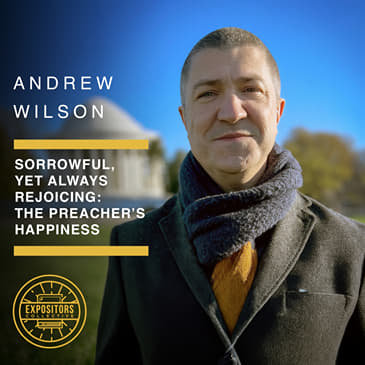
What happens when a preacher knows a Bible passage is true but has not yet come to believe it is good news? And can a pastor proclaim joy without pretending that suffering is easy?
Mike Neglia talks with Andrew Wilson about the character and craft of preaching, and the happiness of the God whose Word we preach. Andrew recalls his first sermon and the candid feedback that exposed more than a problem of delivery. They discuss sermon preparation, the different advice preachers need according to their temperament, when visual illustrations help, and the temptation to apologise for what Scripture says.
The conversation then turns to Andrew’s book Happiness. Is Christian joy the same as an upbeat personality? What does “sorrowful, yet always rejoicing” mean when you are sitting with someone in deep grief? And what work must a preacher do before asking a congregation to receive a difficult text as good news?
Andrew is the teaching pastor at King’s Church London and a columnist for Christianity Today. His books range from biblical theology and everyday worship to the history of the post-Christian West.
Andrew Wilson’s books
Happiness: What It Is, Where to Find It, and How to Make It Last Forever — Andrew Wilson
https://www.crossway.org/books/happiness-hcj/
God of All Things: Rediscovering the Sacred in an Everyday World — Andrew Wilson
https://zondervanacademic.com/products/god-of-all-things
Remaking the World: How 1776 Created the Post-Christian West — Andrew Wilson
https://www.crossway.org/books/remaking-the-world-hcj/
The Life We Never Expected: Hopeful Reflections on the Challenges of Parenting Children with Special Needs — Andrew and Rachel Wilson
https://www.crossway.org/books/the-life-we-never-expected-tpb/
Other books discussed
Desiring God: Meditations of a Christian Hedonist — John Piper
https://www.crossway.org/books/desiring-god-hcj/
The Pleasures of God: Meditations on God’s Delight in Being God — John Piper
https://www.crossway.org/books/the-pleasures-of-god-case/
King’s Church London
https://www.kingschurchlondon.org/leadership/
Expositors Collective equips, encourages and mentors preachers and Bible teachers to grow in their personal study and public proclamation of God’s Word.
https://expositorscollective.org/
Expositors Collective is part of Calvary Chapel Cooperative, a family of ministries working together to strengthen churches and support faithful leaders.
https://calvarychapelcooperative.com/
[00:00:00] There is no way that a preacher should ever stand up and preach a passage that he does not believe is wonderful news, right? Now, that doesn't mean that temperamentally you're going to be like, you know, froth and bubbles again about every passage. Of course it doesn't. But if I don't believe that the passage I'm preaching is good news to everybody, I shouldn't really be preaching it yet. Hey, welcome to the Expositors Collective Podcast, episode 460. I'm your host, Mike Neglia.
[00:00:27] And the voice that you just heard is that of Dr. Andrew Wilson. Andrew is currently the teaching pastor at King's Church London and is the author of a lot of books, but most recently, Happiness, What It Is, Where to Find It, and How to Make It Last Forever, published by our friends at Crossway.
[00:00:50] In this conversation, we talk about the craft and character of preaching, personally, what it's like to receive correction, how to know your own temperament and find your own voice, and then how to speak with conviction about what scripture says. We, of course, we, of course, speak about happiness and joy, how to preach good news when life is hard, and then also how to speak honestly to people who are suffering.
[00:01:20] So, in this conversation, I found Andrew to be both practical and pastoral. And so, here is our conversation. All right. Hey, welcome to the Expositors Collective Podcast. I am sitting down with Pastor Dr. Andrew Wilson, and we're going to talk about happiness and a bunch of other stuff. So, good afternoon, Andrew. Thanks for coming on the show.
[00:01:49] Good afternoon, Mike. Great to be with you. Thanks for having me. Yeah, well, I've been, I just finished your most recent book, Happiness, but I've been reading your stuff in print and online for a long time. So, to talk with you on Zoom is very exciting. I appreciate it. Well, that's very kind of you. Well, we start every episode by asking about the first time you've ever taught the Bible. Yes. And oftentimes, that's a nice way to get to know people, to hear some of their story or their upbringing.
[00:02:18] But do you remember your first sermon you ever gave, ever delivered? Yeah, I remember it very well. I have had, I mean, this might speak some of your listeners right off the bat, I don't know. I have had, I think, two prophetic dreams in my life, and one of them was about my first ever sermon. I was 17 years old, and I dreamt in a, you know something, I don't know if you've ever had dreams like this, where you feel like this is a God-given dream.
[00:02:48] Well, I just do very little of this. Normally, my dreams are weird. And then the two which I feel like have been God-given were things where I had a very clip, it didn't feel surreal at all. They felt like an actual picture of something that was about to happen, and then it did exactly like the dream happened. And it was a dream of me speaking in my school chapel, which while I was there, no pupil had ever done. It was only ever teachers would speak, and it was a vision of me preaching in my school chapel. And I thought that's never happened. I just thought it was weird.
[00:03:16] I thought it was a weird moment. And kind of forgot about it until I was asked to do it. And six months later, it exactly as I've, you know, the same imagery, the same place, the same thing. And I was asked to preach in a kind of house service in my chapel and basically preach the gospel of the cross, age 17, in my chapel. I got ended up, it was this thing I got made fun of by some of the other kids. And I also got a headmaster's commendation, which in my school was quite a big thing for doing this very sort of animated thing.
[00:03:45] I did it all extemporaneous, if you like, and we kind of prepared it, knew what I wanted to do. And it was 10 minutes long and it was pretty hard hitting. And I probably wouldn't do it the same way now. You'd hope I'd learned something in the last 30 years, but it was also quite an amazing thing. And I think I don't think I felt at all like God is calling me to do this for a living or anything like that. I didn't feel that, but it was quite a remarkable experience of a huge privilege to be able to do it. And I think that's probably, yeah, well, that's where it started.
[00:04:16] So, yeah, it was quite a, quite a moment. Yeah. All right. I've interviewed like 450 preachers and no one has ever had a story like that before. I don't know if that might be a very bad thing and it might mean everyone goes this guy can't possibly expand the Bible. He has prophetic dreams, but that just in my case, that's what happened. So, yeah. In this prophetic dream that you had, did the sermon go well? That I'm afraid.
[00:04:45] I don't know because it kind of didn't. It wasn't really like that. It was like a, it was the setup of it. It wasn't here's the resolution. So I didn't get the whole message. I didn't know what I was even supposed to preach, but I think it went well in reality. And that's what matters. That was going to be my follow up question. Yeah. What about in actuality? Okay. Yeah. So, so did, do you think that was given to you in such a way as to, as to prepare you? Because you didn't go out and seek it out afterwards or you were still asked by the headmaster to do so? No, I didn't know.
[00:05:15] I, I, I dismissed it. I thought, well, that doesn't happen. Just, it's just a dream. And I think it's only afterwards or it's only as it begins to approach, you think I've dreamt this. This is what, this is how it went. And so, no, I, I think it, I think sometimes you, I think this is true of all kinds of, whatever people make of different kinds of guidance. But I think often that's what happens is you, you only realize the extent to which God has prepared you for it when the task is ahead of you and when you realize you need it.
[00:05:42] And I think sometimes you get that with all kinds of encouragement or leading ahead of time. That if you, if you receive something like that and then you think, right, this is it, it's going to happen. I only need to make it happen. That's often not the wise way to respond at all. In some ways, what you need is this is in order, this is God has given me this to the degree that he has in order that when I get there, I will know this is something he foresaw and it's going to be okay. And that's, that's how I took it anyway. I'd feel like that.
[00:06:08] And I would probably encourage others to in the same way if it was to happen to someone in my church. Yeah. Yeah. You know, I figured eventually some of your charismatic beliefs would, would work its way to this conversation. I didn't know at like the 45 second mark, we'd be diving deep into this. I, that wasn't intentional at all. Yeah. Well, I asked him. You asked the question. I asked a very specific question. Yeah. Okay. Excellent. All right.
[00:06:35] And so that was a, a 10 minute message at a school chapel. Do you, do you also remember like, let's say more your, your longer message. I've listened to other sermons of yours and they're longer than 10 minutes anymore. Kind of your first kind of classic, maybe Sunday morning sermon. Yeah. So I know we now, we now preach for 25 to 30 minutes in our church. I have done for that for years. So yeah, my first longer message would have probably been about a year after that. And I was asked to preach at a youth service in our church on a Sunday morning.
[00:07:06] And it was like the kind of the youth do the youth take over for them. You know, the way I was our band. It was like the young people would did the band and whatever like that. And I preached on, um, Elijah at Mount Carmel and the, the Z basically zeal for God. And it was at a church in mid Sussex. It was at a time. It was called King's church. Hey, would see. So, um, a church about 30 or 40 miles south of London.
[00:07:34] And it was my home church that I went to when I wasn't at school. And I, I picked up that text in the middle of the, in the middle of one Kings 18, where it says, how long will you waver between two opinions? If the Lord is God, follow him. If Baal is God, follow him. And I preached that. I don't remember loads of what I said about it, except that that was the sort of the key line and some of the responses that people had to me afterwards. But it was a really, I think it was really well received. I think churches are lovely to young people trying to preach for the first time.
[00:08:03] And they were. And yeah, that's the first in a way, like regular sermon, a sermon that would be a bit similar to what I do now that I did. And that was probably aged 18. I would think. Yeah. Yeah. That's encouraging. And I, and I love these stories of churches being kind to young people that are dipping their toes into something that's very, very challenging. And of course they're not doing it that great.
[00:08:27] Uh, but to have a receptive congregation, you know, I'm sure more nods than usual, or perhaps more, I don't know if your church does a lens, but you get more. Yeah. Exactly that. Yeah. People, those people are lovely and they want you to, they're rooting for you. They exactly, you know, it's in everyone's interests that it goes well. Yeah. Yeah. Yeah. Well, that kind of transitions into like the next question. I, I, I love to hear those first sermons, first sermon stories. Often they're awkward.
[00:08:57] Sometimes they're miraculous. Um, but, but what has been like some significant areas of growth? You said it's been about 30 years, um, since then, um, are there things that you used to do that you have deliberately stopped doing or invertedly other things that you, you certainly have like put work into starting? Yeah. So, uh, I mean, loads and loads and loads of things. I think I would probably went to rewatch or reread.
[00:09:22] I think, um, I think I hope that the main growth has been character stuff. I think so that my dad was very helpful early doors, probably about, uh, two years in to doing bits and little bits and pieces of preaching. And I just couldn't work out why I kept saying things that I hadn't intended to say that ended up sounding dismissive or cocky or arrogant or whatever.
[00:09:52] And he said, the thing is though, out of the overflow of the heart, the mouth speaks and you are saying those things in unguarded moments because that is actually what's in your heart and it's coming out. And you can't protect yourself from that by stopping saying it. You have to protect yourself by stopping thinking it or wanting to say it or having it in your heart. So I think the character changes have probably been the biggest ones that, um, yeah, arrogance or dismissiveness or just a lack of, you know, yeah.
[00:10:22] Just a lack of humility is probably that's the big, I would think that's probably somebody who'd heard me in 1996 and 2026. I would hope that's one of the things they, they'd see had changed and God has done that in a whole lot raft of ways. Um, but stylistically and technically, I think one of the first things I noticed actually is in my first probably five or six years of preaching regularly, what I noticed was that my notes got a lot fuller.
[00:10:46] And that what I wrote was I was riffing off things quite, yeah, I would expect the opposite to happen. I would think you start off writing very full notes and then it gradually, uh, you know, by the time you're an expert, you just need any five bullet points and you're off. Whereas in my case, the opposites happen. If I compare my notes in 2005 with my notes now, I think I would see just far more words now, far more care taken to script key bits and get them right.
[00:11:14] Um, even in the last 10 years, I've noticed my notes are just a little bit more careful. I don't have anything like a full manuscript. I don't do that, but I'm much more guarded now about what I say and how I want to word it, particularly the very beginning and the very end of the message. I think that's changed. I think I probably make fewer points in some ways than I would have done earlier. And my much more, my structures are much better. I think I'm probably more carefully organized.
[00:11:42] I think, um, and that I think obviously comes with practice. I think the structures are more intuitive. Um, and I probably do fewer visual illustrations than I used to. I was very big on that as was taught to preachers, a kids worker. And so it was always very visual. And I think what would happen is I'd end up doing so many different visual things that it became a bit of a muddle as to what exactly the key idea was. Whereas I think now I would be more, I think, selective about those sorts of things. So there would be a few examples of ways in which I think that's evolved.
[00:12:11] Thanks. Thanks for thinking about that kind of live on air. When you say less visuals, do you mean like less slides or less props? Oh, sorry. No, like props visual. I do use slides sometimes as well, but I, I'm less wedded to them. No, I mean, probably, I think someone who was helping me, she was a physio fun enough. She never preached in her life. She was a lecturer and she was very good at lecturing. And she gave me some help about 15 years ago.
[00:12:41] Uh, she was our chair of trustees in our church. And she said, I want you to just meet up and just talk through how you're doing it. Just the craft of presenting oral messages. And she said, the thing is what you're doing is you're doing, you've got so many ideas and so many visual things. You were using that. Yeah. Like a prop or a, or a video, something you illustrate. I'm quite an animated person. So I quite often will almost build a visual thing with using myself. And I use quite a lot, almost like a bit of physical theater. I don't mean to overstate that, but I will do it that way that, you know,
[00:13:10] trying to make an enormous sort of pyramid tower or something in the head. And then imagining people being in different parts of it. But she says, if you do that three times, it's just, you don't need them. You don't, you, you, you've got one and you can do that one well, but what's happening is you're diluting the impact of the one by doing too many of them. And I think that's what I've probably, that's what I meant rather than, I do occasionally use visual slides,
[00:13:30] but normally I would rather use an object or use the slides for points, which are harder to verbal, either a quotation, which I want to refer to or something like that. But I think I probably by preference would rather not have to use the screen at all, if I can, and just make it memorable through a combination of the words and the visuals. Okay. So you're not bringing a ladder on stage and climbing up the ladder. I have, I have done that actually. Exactly that. I have done it with a ladder. Exactly that really.
[00:13:58] But I would, I would normally, I find the, if things are too big theatrical, they, they can distract. I think people have very different views and it's very subjective, isn't it? But I think I, I have done that exactly that with a ladder because of a point I was trying to make. And I remember what I was preaching is in Ephesians chapter four, but I think I probably on, on balance, big props like that.
[00:14:23] And partly this is also because our church is multi-site. So I would have to walk into the room carrying a ladder. It looked like a workman. So I, I, that might be partly a factor, but I prefer smaller, more portable things, particularly things that you can reveal. So I did this the other day, I was preaching in the conference on William Tyndale and had a sword and a crown and various other things to try and illustrate what I was saying about the word of God.
[00:14:47] And so, but those things are small enough that you can conceal them near the stage rather than everyone sitting there wondering what on earth is going on with that ladder. So I generally don't do that. Yes. Yeah. Yeah. Have you heard of Chekhov's gun? It's like, yeah, yeah, yeah, yeah. Yeah. The idea is that like, if a gun is introduced in the first third of a play, it's going to be fired by the, by the third parts. And so, yeah, if there's a ladder behind you, people know you're going to climb on it eventually. And it's not gonna be very surprising when it takes place.
[00:15:16] No, exactly. So I do less. I think probably I would have been more inclined to do that 20 years ago than I am now. Okay. So, yeah, that would be another little change. But it's still there. It's still there. So, yeah, you were still pulling out swords and crowns somewhat even recently, but so you've dialed it down, but it's still there. My preference would be to always have a visual in a sermon, partly because I think Jesus does. I don't think he does it all the time, you know, consider the lilies and the birds and the bread.
[00:15:41] You know, and we often imagine him doing that as a mulling in a library, you know, consider the lilies. Like he's not saying, think of a lily. He's like, there they are. They're right. I'm sitting here on a hillside. Of course, the flowers of the field are right here. So I think that sort of language, that sort of way of teaching is very helpful for people. But I don't make it a rule. I used to. I used to have it like every week. What is my visual? Because I was taught again. I taught to do it in kids work, and that's how I learned to preach. So I took that into my Sunday preaching.
[00:16:10] But I would I would do that now when it serves. But I wouldn't always do it. Okay. And you mentioned that it was, I believe what one of your trustees who sat you down and was talking through these things. What was her name? Let's let's give her the. Her name was Nikki Petty. Shout out Nikki Petty. I actually don't remember if she was a trustee at the time or whether she became a trustee after that conversation. Okay. But she I knew her in both. I can't actually remember, but her full time job. She was a physio lecturer at the university in our town.
[00:16:41] And yeah, she would she I think she came to me actually think she said, you know, I think we could just talk about how you deliver messages and help. And maybe you someone put her up to I really don't know. Yeah, it was she did it with other other young preachers as well. And it was so helpful because she wasn't she said, I'm not here to talk about the content really how you what you're going to say. That's not my question. I want to talk about how you actually get better at public communication and putting across a point to an audience.
[00:17:08] And it was so helpful. And about a year after a year of meeting up, she said, OK, I think we're done. I think you've I think you've really grown and improved in this period. I don't think I can help you more. Maybe others will. But it was just really lovely and made a big difference at the time. Yeah, that is that's very special. And I'm sure the way that she approached it, you know, and the way that you received it really meshed very well, because that that could be could be a disaster to an insecure preacher.
[00:17:36] And it also could be like a bulldozer if it's like a domineering, you know, person who wants to kind of just control things from from the pew. But yeah, I'm glad for that. The way that combination worked out. Yeah, it was very good. Yeah. She also said, stop apologizing when you said sometimes you will say things like this is just me and this is my view. But others say stop doing that. Like if it if it isn't what God says, don't say it. And if it is, then don't apologize for it. And that was the closest you got to giving me direction on content.
[00:18:04] But I also found it quite stylistically, quite helpful. I think she read me well. So she knew this guy is not a risk of disappearing into himself and worrying about everything. If it is much more the other way, much more likely to be too, you know, too overconfident rather than underconfident. But on that area, she she she called me out. She noticed, yeah, you just keep you sound like you're dithering about what it means. And so that was also very helpful.
[00:18:34] Yeah. So less dithering and more proclamation. Yeah. Yeah. Okay. And I jotted down some thoughts as you were you were talking at the very beginning, you were speaking about the off the cuff remarks that used to be part of your life. And then also and also preaching and then the character work that removed that and then talking about as the longer you preach, the longer your notes gets.
[00:18:59] And I wonder, do you see value in carefully thought out notes as as a way of removing the possibility of off the cuff remarks that derail the sermon or that are regrettable for the preacher? Well, for me, definitely. So I but I think there's a lot of if I'm training preachers, I think that there are a lot of factors to consider. And one of them is self knowledge is your temperament, really.
[00:19:28] Like, what are you what are your I'm already referred to several temperamental factors even in my own life already in this conversation, because I place quite a big role in the way I think about it. So I think if you so let's say you're an external processor, extroverted, enjoy making people laugh and engaging, love conversation. You will probably like me. Right. I'm like that. So I probably find that being able to get people's attention is not very difficult and being able to think aloud and formulate what I think is not very difficult.
[00:19:57] And actually being able to bounce off what I see on the page and speak fairly fluently about it is also not difficult. And therefore, my the downside of me writing longer notes is not very great because I'm quite good at seeing a note and then but still retaining eye contact with people.
[00:20:16] My downside is because I'm thinking aloud, I might often say things that I don't really mean or that get me into hot water or that reflects an unwise judgment on something or that misconstrue or miscommunicate something as I'm just improvising. I say something and a sensitive conscience person over there has misheard it and it's gone too hard or a person with a less sensitive conscience has heard it and it's not gone hard enough because I haven't thought carefully enough about it.
[00:20:40] So I need more of the introvert to lean into the introvert skill of like write it down, be clear about exactly what I want to say. But if I was talking to someone of the opposite temperament who is more cerebral, bookish, thoughtful, inclined to formulate thoughts very carefully, it more perhaps introspective, more likely to worry about what they said than to be overconfident about what they said. I actually might give them the opposite counsel because I might say for you that your danger will not be that you're throwing out all sorts of unguarded thoughts.
[00:21:08] You actually are very good at not doing that. You only say what you mean and you've thought about it carefully beforehand. But your danger might be that you are not as visually engaging or not as you don't make an emotional connection as easily. You're more likely to be tied to the notes, less likely to engage with the person. So you might need to take the opposite counsel on the one I've just given myself because of the kind of person you are. So I think it depends who you are and what sort of pitfalls you are more likely to fall into as to whether or not what I've done is a good idea or a terrible idea.
[00:21:38] Yeah, yeah. And what Calvin says, like the knowledge of God and the knowledge of self are so important. And so you you know yourself and in our own church, we have an up and coming preacher. I'll probably listen to this. Luke, I'm talking about you. Luke is great. Luke has like the absolute like just best content. You know, you kind of described, you know, someone who's cerebral and thoughtful and that's that's Luke. He's caring, cerebral, thoughtful for his next sermon.
[00:22:05] I'm going to be encouraging him, have less notes, more bullet points, which you can glance at and then look up and then say these great thoughts to the people that are in front of you whilst not reading them because it's such good content. So, yeah, you got to know yourself. You got to know how we come across. And then so some people need more notes. H.B. Charles said that if everything he regrets in the pulpit was an off the cuff remark, he's like, I've never regretted anything.
[00:22:35] I've said on purpose, but I regretted so many of the casual comments that slip out. That's very interesting. I haven't heard that. And yeah, I, I often say when I'm again to others, I've said it to my wife when she's speaking as well. Just trust, trust the notes. If you've written it down and you thought about it, you trust what is there. Yeah. Yeah. And that's but I've never heard. I didn't know HB said that as well. I'm sure that's that's a very wise comment.
[00:23:01] Yeah. Yeah. And I, I, I probably regret a few things that I've said that I have written down. I don't have the confidence of HB to never regret any of those, but, but yeah, it's the off the cuff stuff that I've regretted. And, and so, but yeah, thank you so much for the lessons that you've learned in three decades plus. Um, but now, um, as I mentioned, yeah, I've, I've read your commentaries on Corinthians and I believe Revelation and, uh, but yeah, let's talk about this book, Happiness that just came out. Thank you. Thank you.
[00:23:31] I've, I've really enjoyed it. And, uh, two weeks ago I was on, um, holiday in the UK and was reading there. It just felt appropriate to, to read, to read you while I was there. I was on the beach reading and then I came across, you described, um, the joy of sitting at a, at a British beach reading books.
[00:23:49] And I was like, I had this real meta moment of like, I'm literally doing that right now. Um, so yeah, what a, it's been a fun read. Uh, definitely have enjoyed it. It's given some, some food for thought. And, uh, I have some questions in regards to like the, the preacher, but, uh, what's the, what's the pitch of the book or what's the, the big gist of the book before we, we dial into, uh, Bible teachers and preachers.
[00:24:14] Yeah. So the subtitle is, uh, so it's a happiness is the title. And then the subtitle is what it is, how to find where to find it and how to make it last forever. Yeah. And that in some ways you're trying to summarize the book with that. I think that the heart of it is God is happy. He wants you to be happy too. Um, and in order to, and we, and you want that too.
[00:24:34] And in order to pursue and maximize your happiness, ultimately you find that in God, that's where it's found. He is, his presence is fullness of joy. But there are some things that you could know that we can know about ourselves, about the way that we work as individuals, about the way that human life works in the sense of the happiness evolving over time and different places, the way in which you can form spiritual habits, which will increase your joy.
[00:25:02] And actually the way in which you understand that the sheer nature of what happiness is, even when you use that word, what are you talking about? There are lots of things that you can do that will increase your happiness, but some of them seem quite mundane and menial as, uh, daily routines or habits. Some of them are enormous, you know, life changing choices like following God and delight in, you know, in delighting in him forever. Um, but there's a lot of things you can do that will actually increase your joy.
[00:25:29] And then I want to talk about how we do that in a way as to integrate the Christian vision of joy and God with quite a lot of other things that wise people, both now and in years gone past have said about happiness, because I think there's a lot of commonality between them. So it's really a book about how to be happy, but a book that assumes and tries to argue for the idea that that's something we only truly find in God, but nevertheless gives a lot of comment and hopefully insight that would be for you to decide on how to pursue it in the here and now as well.
[00:25:57] Yeah. Yeah. Thank you. Um, I appreciate that. And yeah, it's, it's, it's good. You know, I read Desiring God long ago. I was, I was radicalized by John Piper and I've been, I've been pursuing happiness and joy in God, uh, ever since. And I, I, I like you're kind of in conversation a little bit with him, like, you know, presuming that maybe of a certain demographic of Christian reader that we're aware of some of that,
[00:26:24] but I think you bring something fresh and, uh, I don't want to say an upgrade, but it's a, it's a building upon, um, uh, what Piper has given to us with Christian hedonism. Yeah. I mean, John, John's books have, I've read, I don't know, not all of them, but most of them, I think, and they've always influenced me in so many ways. I, I just think it's remarkable, but that, I do think that that sort of double, that two punch of Desiring God and the pleasures of God,
[00:26:52] the idea that God is joyful and that we in God are to be joyful have just been transformative. And I, yeah, in this book, I'm really, when I, what I described the book as when I, you know, if I gave a, a two page version of the book, it would be, there are three traditions I'm trying to integrate here. One of them is really the one I found in Piper and have since learned it goes, you know, much, you know, for the, it's not just Jonathan Edwards, but you get bits of that in Augustine, all sorts of Christian thinkers, Pascal, but, you know, happiness in God.
[00:27:20] And then there's a sort of more modern science, positive psychology thing, which often would be a little bit despised by folk who love, a lot of people who love Piper wouldn't like the books with yellow covers in the local bookshop. But I actually think there is more overlap between them often than we realise. And then the third tradition is more like a sort of philosophical, the good life is the beautiful life is the happy life kind of tradition, which you find in some of the great Christian thinkers, you also find in some pagan thinkers, you know,
[00:27:49] some of it you find in Aristotle, you know, and you find it in other writers on philosophy now and trying to integrate that sort of philosophical, the pop psychology, modern science view, and then the theological exegetical view, trying to bring all of those together in to, to show you. And there is, as I said, there is more commonality than you would think between those traditions and what some of the things they observe about happiness, which is really delightful to explore. Yeah. Yeah.
[00:28:15] And on this podcast, we're here to talk to preachers about preaching. And so do you think that preachers should be happy people? Yes, but... What's the best way of answering that? So I'll give you the yes and then the but.
[00:28:38] The yes is, I think Christians in general are called, you know, come and share your master's happiness. Rejoice in the Lord always. And again, I say rejoice. So, and a lot of the book is about that and it's trying to draw on the fact that that is what Christians are called to be and called to be joyful and to delight and to take pleasure. And that actually, if it's important for anybody, it's important for preachers because people take... Preachers have a unique...
[00:29:09] Maybe it's not entirely unique, but it is certainly a very prominent role in setting the expectations of what the Christians, the Christian life can and should look like for both believers and unbelievers in a way that is quite rare. Very few people model the Christian life in quite that way. And preachers have that responsibility and that joy. And therefore, if we are morose or grumbly or cantankerous, or even if we're just a little bit...
[00:29:36] I think that sets a bar which, for better or worse, will affect the way that other people perceive the Christian faith. And I often think of the story I heard of one guy who I heard... He was a preacher himself, but he said, when I was brought up, I grew up on the island of Cyprus. Because the only exposure I had to Christianity was I went to a church one day and there was a man at the front with a huge hat and a very long beard saying,
[00:30:01] in utmost solemnity, my heart is full and my cup overfloweth. And I just didn't believe him. And so I never heard... I never went back and I never heard anything about the gospel. I think because if people... Another analogy I use, if people swim in the English Channel or, no doubt where you are, the Irish Sea in April, and they go, come in, the water's lovely. And you're like, but they're shivering to pieces. Like, I don't believe you. Like, come and find everlasting joy.
[00:30:29] But you just don't look like you are experiencing that everlasting joy. It's very hard to get people to believe you. So that's what I mean by yes. The but... But... Is I think you have to ask the question, compared to what? Are we saying that people who preach need to be temperamentally sunny, upbeat, bouncy, chipper people? Which I am. That doesn't mean that...
[00:30:54] But are we saying that people have to have that personality in order to be qualified to be a preacher? And I would say absolutely not. And many of the greatest preachers in history have not been. They're actually quite earnest, intense people. Who do not naturally go... They're not all froth and bubbles. They're not all sweetness and light. And actually, they're very serious people. As well as being joyful people. And I think that's... You mentioned Piper already. And you could talk about C.S. Lewis and many others. You know, the seriousness of joy in God. And I think you have to ask, compared to what?
[00:31:24] So I want... Definitely preachers... I want preachers to be happier people than they would be if they were not Christians and were not preachers. But that's not to say that they are all just temperamentally upbeat, positive, look on the bright side, Charlie Smiles characters. Because a lot of people are not like that anyway. That's not because they're not... It's not because we want Christians or preachers to be happier people. It's because those things are temperamentally given to us.
[00:31:50] And it's one of the things I explore in the book, the relationship between temperament and Christian faith. So I'm... But having said all of that, but... I want to come back and say, yes, but I do still think it is part of a preacher's role to... By the way that they live, by the way they talk about the things of God, to exalt in and revel in and delight in the truths of the gospel in a way that commends them by their very emotional reaction to the truths they are describing.
[00:32:18] And I think if preachers don't communicate in... I don't mean force it. I mean just naturally exude a delight in God and in the wonders of Christ in the way they preach, the people who hear them won't ultimately believe that it is a delightful thing that they're saying. And... Well, that's the risk. And so I do think in the end, my primary answer is yes. But I want to hedge it with all sorts of caveats about the difference between being delighted in God and just being an upbeat person. Does that help? Well, I think so. I think so.
[00:32:48] And so there is temperament that is involved and some people are more... Yeah, you used... Cantankerous? Grumbly? Morose? Yeah. Is that a personality type or are those choices? Because I think, yeah, there is like a more like optimistic personality type. But then when you use words like cantankerous or morose, is that a personality type or a choice?
[00:33:15] Well, I deliberately used words that I am to evoke quite a negative example of that type. Right? So I don't want... Because what I don't want to communicate is that somebody who's serious can't be happy. Yeah. I absolutely don't believe that. Sure. I'm deliberately using quite negative words. Yes. Yes. You know, someone who's grumbly or morose. To me, those things are not virtuous. They are things that actually you can be a nitpicker. You can be a fault finder. You can be complainy. That's the sort of thing.
[00:33:45] I know the word cantankerous isn't in scripture, at least not in my translations. But that sort of spirit that characterizes Israel in Numbers 11 or whatever. You know what I mean? This is never... Nothing's ever good enough. You know, I can't... Instead of rejoicing in what God's given me, I'm going to complain about the lack of cucumbers. That's right. So I'm deliberately choosing it in a non-virtuous form, which is a bit of maybe a cheap shot, but I'm trying to draw a quick... Make a quick point in a cartoonish way. But so those things, I think, are moral failings.
[00:34:16] But I do think... So let's say take a word like glum, right? Which would be... To me, that's halfway between grumbly cantankerous, which is clearly a vice, I would say, and naturally serious, quiet, reflective, thoughtful, but not particularly demonstrative, which I see as entirely morally neutral. That's just... That's part of someone's temperament. That's not good or bad, right? Right.
[00:34:42] It's the opposite of me, but there are lots and lots of preachers who are like that as a personality. So let's say glum. It's like that to me is where it tips into a problem. So if someone is not only... Well, I'm just not the most demonstrative person, so it would be very false for me to stand up and start dancing. I'm not going to climb a ladder in a sermon either. I'm not going to start singing in sermons. I do that quite a lot. I'm not... I'm just not like that. It would seem performative for me to do that. That isn't my temperament. It is... People would immediately see through it. And it's not our church traditions way either, right? So that's fine.
[00:35:12] But I think if on a spectrum from I am more thoughtful and measures and not naturally demonstrative to grumbly cantankerous, I think it would tip that spectrum of words, tip somewhere around the word glum or even excessively downbeat. I just think there... I think it is possible, and it's more common in some traditions than in others, for a thoughtfulness
[00:35:38] to shade into a sort of... It's downbeat to the point of becoming almost looking like you are not actually that happy in what you're saying. Because sometimes that's the cerebral manner of communication. But to be honest, I rarely see this, right? Most people who preach are not like that. So thoughtful people come alive as they describe the truths of the gospel. I just think about, you know, some of those...
[00:36:07] You know, I don't know, Alistair Begg and Sinclair Ferguson, people whose natural temperament would be... And whose tradition would be its quite thoughtful exposition. But you see them talk about the death of Christ for them, and this sort of... They might not do it with the same noise and froth as you would get from an American megachurch pastor, or from me. But you would quickly see this person is thrilled by what they are describing. And you would get that from Piper, and you get that from lots of modern examples. And so that's what I would want us to aim for that.
[00:36:36] But I think if people are dour in their presentation of the things of Christ, I think it will... It is at risk of communicating that these truths make people feel like that. And I don't think that is for the good of the non-Christian or the Christian who's listening to them. Yeah. Yeah. And so we're emphasizing, or I'm emphasizing, I suppose, the preaching aspect of the pastoral task. The pastoral side of the pastoral task oftentimes is very unhappy.
[00:37:07] In the past 26 hours, I'm doing the math here. Yeah. After service yesterday, I was speaking with a woman who's stage four cancer, has just been told that it's spreading and it's technically incurable. Spoke with her, prayed with her. And just before this Zoom call, I had kind of a follow-up meeting with somebody, and she's processing the death of her father from earlier in the summer. And we could compare notes, and I'm sure you have also these types of things on your diary.
[00:37:37] I just found it, I guess, ironic seeing, you know, it was check-in with this person, and then the very next appointment is talk with Andrew Wilson about happiness right afterwards. And such a, you know. So as we are, like, walking in the trenches of life with people, and we're up close, and you know, actually on Saturday, I did a wedding. So I'm bouncing from these happy things to very sad things, and then happy again, ping-ponging back and forth.
[00:38:04] Can you make a case for, maybe, you made a case for a happy preacher. What about the happy pastor walking through darkness and grief and gore of life? Well, I'll, if I can, I'll unpick two different things there, because I think the case to make for a happy or joyful pastor is not, that's not difficult, because I think you start with the joy of God, the joy of Jesus, the good shepherd, the joy of Paul, the constant exhortations
[00:38:33] to rejoice in, and his own joy in Philippians, alongside Epaphroditus was spared, otherwise I would have had sorrow upon sorrow. Yeah. His imprisonment, his grief at his friends suffering to near death, mingled with his joy in his converts and his exhortations for them to be joyful in spite of severe challenge and trial and poverty and persecution, all those things. So I think that's quite an easy case to make. And if you want to, like a text, I think Hebrews 13 is the one, you know, obey your leaders
[00:39:02] and submit to their authority, because they're keeping watch of you as people who must give an account and make sure that they do, you know, let them do this with joy and not with groaning, because that would be of no advantage to you. So if I'm a pastor who is not joyful and I'm groaning or grumbling or, you know, whatever it might be. Now, I don't just mean, I'm, I don't mean in the sense of crying with you at the hospital bedside, of course, I mean, but joyful pastors are advantageous to their congregants or their
[00:39:31] parishioners and pastors who are not joyful are not. And that, that it wouldn't, it doesn't, I would not help Christians if I was not joyful and I was doing my job with grumble, you know, with grumbles rather than joy. So I think that's quite easy. The difficult bit of what you're asking, I think though, is how do you do that in situations of great grief and sorrow? What does it actually mean for me to be talking to the person with stage four cancer and joyful?
[00:40:01] How do I do that? And I think this is where, for me, Paul's language of sorrowful yet always rejoicing and the, and the ways in which, I mean, Peter does the same, you know, in this you rejoice though. Now for a while, you've been grieved by many kinds of trials, all those sorts of texts where you think, what do you mean? How are you able to rejoice and grieve at once? And those, and the Psalter is classic like this, right?
[00:40:28] It's constantly toggling between joy, grief, exuberant celebration, deep reflection, tears, lament. And so there's lots of this in the Bible, but I do think people often struggle to know how to do with it and what to do with it. And the analogy I use in the book, which I hope helps, is I live 200 meters from the sea and at any given point that sea near me is moving in three different directions. There is what I can see on the surface, which might be coming from one angle.
[00:40:55] There is where the tide is going in the middle, which is might be pulling the opposite direction to the waves actually. And then there is what the Gulf Stream is doing, which is the huge, massive flow down at the bottom of the ocean, which that's the one that makes the real difference actually, because that's the one that means that it's warm relatively in Britain compared to places much nearer the equator in North America where the water flow is colder. But those things are always happening in all three directions.
[00:41:19] And it's possible for us to be sat in a moment, very cheerful, to have a life circumstance at the sort of tidal intermediate level that is really challenging and hard. And then at the deep level to be being warmed by the glorious gospel of Christ and the joy that comes from God. And for those things all to be happening at once in our lives, that in the moment I might
[00:41:44] be hearing tragic news and tears are coming into my eyes and I am sitting with a person hugging and saying, I'm just so sorry. I don't know how to walk. There's nothing to say here. At the same time as I'm experiencing a life, you know, a tidal level of actually circumstances in my life are going quite well at the moment. I'm content in my marriage. My kids are doing well. My whatever. I just received a promotion or I just a book's doing well or whatever. And then at the deep gospel joy, you know, the deep ocean current level.
[00:42:14] I've got joy that nothing will ever take away from me circumstantially. Conversely, it's possible for me to be still sitting with a person who's just received at a wedding. It's like I want to rejoice with those who rejoice as I want to mourn with those who mourn. I want to express the joy of this moment on the surface level, even if the tidal level of my middle level, if you like, of my emotional life is actually very challenging. I'm experiencing as I have, as we all do, you know, my sister's got cancer and my kids
[00:42:42] are regressing or experiencing great trial and having a lot of difficulty in my pastoral life. But in this moment, I want to rejoice with this couple at the surface. And I also at the deep level, I'm still being warned by joy in Christ. And so I think we have to reflect to some degree on the complexity of our own emotional lives and to recognize that it is not performative, is not hypocritical to in a moment to express exuberance and joy with someone and to show the empathy that is needed for the grief or
[00:43:11] the joy while recognizing that at our own circumstantial life stage level, life might be very hard. And at the same time, we want to experience the joy of God in Christ that never goes away and to be able to burrow into that. And in many ways, the more hard life is on the surface, the more you need to burrow into the joy in God. So that's a long answer. But I feel like when Paul says sorrowful, yet always rejoicing, I feel like he must have something like that in mind. We know this. We it is possible to be superficially happy and substantially sad.
[00:43:42] But for Christians, it is also possible to be superficially miserable, miserable. And by which I don't mean it's not real. I mean, you can feel absolutely blue. Everything is going wrong. When you feel ill, this is what happens. Like I am. Oh, I just feel like the world is ending. But I also know that that is not the only reality about my life and that deep down there is a heartwarming joy, unspeakable and filled with glory. And I need to lean into it if I'm going to get through the superficial misery. Yeah, thank you.
[00:44:10] And yeah, that's the sea imagery, the three different layers. Yeah, I know that so deeply, you know, and so much. And yeah, thank you. And yesterday, you know, sorry, two days ago at the wedding, you know, it's great. You know, I've known this woman who's getting married, you know, for the past seven years. I've baptized her. You know, there's this joy that's there. But then she's also moving away. And then also at the hotel, like my adult son with special needs is up in his hotel room,
[00:44:39] you know, and he's like texting me kind of like childish things, you know, so I have this like this sadness over my own happiness for her. But then she's moving away. And then I got to preach the next day. My sermon's not even finished yet. So all these multiple layers, any at any, you can do a core sample of you or me at any moment. And there's deep abiding joy in Jesus. And then there's heartbreaking sadness. And then there's just the stress of tomorrow and the happiness of the moment. It's so complicated. But thank you for putting words to some of this.
[00:45:08] It's phenomenally helpful. Well, I'm so glad. And thank you. I mean, one thing that really helped me in this regard, which I forgot to say is we keep quoting Piper. I think that's just, you know, he's just shaped us both, I guess. But he has a wonderful section in one of his books, and I forget which one, where he talks, I think, about the infinitely complex emotional life of God. I think that's the phrase he uses. I might have misstated that. And he talks about how the fact that God experiences exactly this kind of thing that we do, because
[00:45:37] God is able to rejoice. I think it's when he's talking, might be when he's talking in the pleasures of God about whether God, how can God rejoice in the death of the wicked and not rejoice in the death of the wicked at the same time? And it's that sort of, God is able to experience more layers of, in that sense, response. I know a lot of us would not like the word emotion when spoken of God. I understand why. Certainly not. You don't want to have passions in the sense of his suffering them.
[00:46:03] But whatever word we give to that sense that God delights or God laments, whatever the word we'd use, and emotion to me seems, you know, is a reasonable word as long as we understand what we don't mean, that God experiences the same thing. That there are events which simultaneously delight and grieve God. And Piper makes that case, I think, very convincingly, because it's one of the ways he makes sense of the fact that evil is allowed even as God is going to triumph over it, or that a tragedy is both God's will and not God's will in different ways.
[00:46:32] And I think, therefore, for us to see, we do that. Jesus, simultaneously, can be like, how does he feel about the death of Lazarus? Yes, he's devastated. But he also says, this is that God may be glorified through it. And in that sense, is able to, to some degree, he doesn't use this word in the text, but I think we'd stand back and say, yes, there is a almost a joy there or a desire for that to happen, even as he's devastated personally by the impact of the loss of his friend. And that's what you do when you deal with a sovereign God.
[00:47:00] And I think, to some degree, we experience the same in miniature in our own emotional lives. I don't know if that helps, but I found that. Sure does. Yeah, or sounds familiar anyway. So, moving back towards preaching and then connecting these things, you know. So, at the wedding, I was stressed because my sermon wasn't ready. And, you know, I got there. And then yesterday, I preached Revelation chapter 21. I've been working my way through Revelation. I know that you have been working your way through Revelation.
[00:47:29] You just taught like a two-day seminar on it. And I think in 2019, you preached it at your own church. Can you be happy while preaching Revelation? And not just Revelation 21 and 22, you know, the happy bits. But what about all the stuff that goes prior to that? Chapter 20 and etc. Ought a preacher to be happy while speaking about the great white throne judgment and the, you know, destruction and death of the guilty?
[00:48:00] Yeah, absolutely. I think he should. I'm not saying that's as easy as I think there are some passages that you just look forward to and you're excited about and you don't have to do any soul work on yourself to go, this is going to be great. Wow, I get to preach Ephesians 2 today or Luke 15 or whatever it is. And then there are other passages where you go, whoa, I need to. But let's put it this way. There is no way that a preacher should ever stand up and preach a passage that he does not believe is wonderful news. Right?
[00:48:28] Now, that doesn't mean that temperamentally you're going to be like, you know, froth and bubbles again about every passage. Of course it doesn't. But if I don't believe that the passage I'm preaching is good news to everybody, I shouldn't really be preaching it yet. I should be. I need to do more work to go, why is this? Why is it good that God has done that or that this has happened? And even in, I mean, I don't think Revelation actually is very difficult there. I think there are harder passages.
[00:48:57] I think if I'm preaching the last four chapters of Judges or whatever, how do I see that as good news? Now, I do because I see because of that refrain, you know, in those days there was no king. Everyone did what was right in their own eyes. And this is showing us what happens when we don't have a king and why we need the king who's going to be ruling justice and so on. So there's always a link, right? But in Revelation, yeah, I do. I think the martyrs do in Revelation. The martyrs are crying out for justice.
[00:49:25] And then when the evil is thrown down, everyone, I mean, that's probably the, I would say the most widely performed celebration song in the history of the world is Handel's Messiah. I don't know if it's true, but I would get, it's certainly going to be in any shortlist you make. And when they are singing hallelujah, hallelujah, hallelujah, the smoke from her goes up forever and ever. They're singing about the throwing down of the whore of Babylon and the collapse of all of the evil institutions and the death of, you know, many people and the destruction of the world's banks and all these,
[00:49:54] I mean, they are, they're cheering because evil has been thrown down. And I think they, and I think we are invited to sing with them and emulate them in the flow of Revelation. So yeah, I do think we should celebrate those things. Clearly not with a malevolence and gloatiness and schadenfreude that that could imply, but yeah, we are, I think we need to see why what God has revealed in his word is good and should be, if understood and applied properly is a source of joy for all people who want to find joy in God.
[00:50:24] And that in some passages is way, I'm in Ezekiel in my devotions at the moment. It's much harder in some passages than others. But you, but yes, we should. And I think that's part of what we are commending as preachers. Yeah, I'm in Ezekiel in my devotions at this moment too. Maybe we're probably in the, are you in the one year Bible? No, I've never actually whispers, never done the one year Bible. Oh, okay. Tried to do it once, got stuck, never went back to it. I read slower than that.
[00:50:53] Okay. Okay. We both happen to be in Ezekiel right now. So that's, yeah. Okay. Sorry. I thought we were going to have a moment there, but apparently not. Okay. Yeah. So, so I like what you said that like every preacher should be convinced that it is, that their passage for that week is, is good news. Am I paraphrasing you correctly? Yeah. Yeah. Which shouldn't be too hard. And, and you don't want to come up and be like, oh, shucks fellas. Sorry, everyone.
[00:51:22] This is a real downer this week. Um, but yeah, that in everything, maybe smuggled a little bit deep, like in the end of judges or in a odd way in Ezekiel, or in a challenging way, like in revelation it's, it's there. Well, I think it's challenging. You don't, but. No, no, it is. I guess I'm, what I mean is I think the set to me, quite a big part of the plot of revelation is that when these terrible judgments happen, we are inclined to go, Ooh, but the people,
[00:51:51] the people of God revel in those things happening, but that isn't true of the horrible events at the end of judges. That's why I think judges might be a harder example. Okay. Yeah. Yeah. But yeah, that is what I'm saying. Um, and I think that's what I do by the way, when I come to read the Bible for myself as well in my devotional life, I'm, I talk about this in the book. I think I'm panning for gold. I'm going, there is, there is gospel joy in this text somewhere for me, but there's also some slugs, which I need to kind of,
[00:52:20] I need to keep shaking it and keep wrestling with it and keep, come on. I don't know. I've never been gold panning, but I'm sure that's what it like. It's like you get sludge, but in there is gold. And it's only when I know that there is gold that I keep looking for it until I found it. And I think that is what the preacher is doing. It's just the preacher is doing it for the whole congregation, not just themselves. Yeah. Yeah. I haven't been gold panning recently, but you know, two,
[00:52:50] that's a similar equivalence. Yeah. It's, it's closer to you than it is to me. You should give it a shot. It's, it's great. And okay. After that awkward transition, final question. We've heard about your first sermon and growth since then. The last question for every interview is what about your next sermon or what's something that you're trying to improve in? Is there, is there something you're working on right now that you'd like to get better at by the next time you preach? I mean, at a personal level,
[00:53:20] probably the main thing I am trying to do at the moment is that I'm going to have to, the main skill I'm going to have to learn in the next year or two is actually the different, I've been a teaching pastor, but not the lead pastor of my church for 20 years and two different churches. And I'm going to take on the leadership of a church in a year. And I'm going to need to learn how to, how that differs and how to do that as an almost a completely new skill, like that. I'm not just teaching. I'm also trying to, I mean, I'm all,
[00:53:50] you're always doing both shepherding and teaching together, but I think the balance will shift somewhat and I'm not sure how to do that. And I don't, so that one I'd have to come back to in a year's time, but I think that's probably a skill I know I'm going to need to develop. Um, I think it, to me, it varies quite a lot by the kind of sermon series we're in. So when we are in a series now, that's got quite a practical focus and the, the challenge in a way is trying to make sure that it is as clearly exegetically
[00:54:19] rooted as possible. Whereas when I'm in a series that is much more expository, where you're going through a book at some length, it's making sure that it's fresh and accessible and people can see we're going to do Deuteronomy. Now I'm that, that to me is like a, that may end up being one of the hardest series that I've done because it's not a book that most Christians naturally understand. And even there's quite large sections of it that it's quite some work to see how this applies to the Christian. So I think it's probably still that.
[00:54:49] And you're kind of in the more, the more daily growth, what would I love to be better at in a year's time than I am now? I think is how do I grow at helping people see why these texts are filled with life and joy and direction for people's lives today. But that's something I've been, have been working on for 20 years and we'll work on for another 20 years. So I expect that's not a new thing. The new thing I think is that how am I going to learn to preach as a lead pastor, which I haven't had to do until now. And I just feel like that is,
[00:55:19] if I'm honest, that's probably the skill that I think I'm in a year's time. I will notice I am deficient in the most and need to grow. How to do that well. But that would be my guess. Something that I'm hoping to be deficient in, in the future or aware of my deficiencies in the future. What a, what an optimistic way of looking at that. Well, I'm, I'm reaching for, hold on. Are you aware of,
[00:55:49] is a fellow crossway author, um, John Curry's book, the pastor as leader. No, he specifically addresses even, uh, the connection between preaching and leadership. So may I commend, may I do some cross-pollination and check out your fellow crossway author, John Curry. I think he might be helpful. No, that's a great, that's a great shout. Yeah. It's, it's yeah. Yeah. Very specific thing you want to grow in. And, uh, someone here, I think he's Scottish if I recall.
[00:56:18] And, um, so he's on the same time zone as you and he has done the work in advance to help you connect preaching and leadership. No, that's great. Thank you. Happy to endorse that. Okay. Yeah. So I think, I think that's about it. Anything else you want to say? Uh, you know, thank you for this book. I'm just really grateful for the conversation. I love the way it's weaved between happiness, preaching and the other things we've touched on. So yeah, thank you so much. Yeah. Well, I, um, yeah, it's always a joy. And, uh, again,
[00:56:48] you've been kind of in the background of my life. I've, I've listened to you on podcasts and reading books and happy to tease out, I guess, this weird combination of happiness and revelation and lots of other things. So thanks for making time and all the best. Thank you so much. And so to the listeners of this podcast, I hope that this conversation and all the video expositors collective helps you to grow in your personal study and public proclamation of God's word. All right.
[00:57:15] Thank you for listening all the way to the end. And there's links to Andrew's books. And then the other books that were mentioned in the conversation, you can find links to them in the show notes or in the YouTube description, wherever you are listening or watching to this conversation. And speaking of, if you're watching on YouTube, would you leave a comment? Let us know where you're listening from. Let us know what makes you happy. Um,
[00:57:45] leave a negative review. I don't care. Just, uh, boost that algorithm. And if you are listening on Apple podcast, if you could leave a five-star review, uh, that would be something helpful and useful as we're trying to get the word out about these types of conversations. I hope this conversation and all that we do at Expositors Collective help you to grow in your personal study and your public proclamation of God's word.
[00:58:15] Thanks for listening. I will see you next episode for episode 461.