
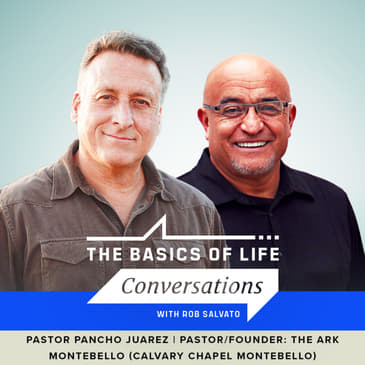
Season 6, Normal People Making a Difference, continues with Pastor Rob Salvato and his conversation with Pastor Pancho Juarez of the Ark Montebello in East Los Angeles. Pastor Juarez shares his story growing up and coming to Christ, meeting his wife and struggling through her health issues, pastoring a church through these times in East LA, and how we reach this new generation.
[00:00:13] Welcome to Season 6 of The Basics of Life Conversations with Rob Salvato.
[00:00:26] How do you speak to the millennial? How do you speak to generation Z? How do you speak to people R-H, you know, I'm a baby boomer?
[00:00:34] How do you speak to some of these people that are almost old and young people? How do you do that? You must change.
[00:00:41] Welcome to Season 6 of The Basics of Life Conversations podcast.
[00:00:46] The theme of this season is normal people who are making a big impact.
[00:00:52] In this series of conversations, I'm going to be talking with some normal people who God is using in some incredible ways.
[00:01:00] And I think you're going to find some of these conversations to be insightful and inspiring.
[00:01:07] Today my guest is Pancho Juarez, pastor of the Ark Church in Monabello, which is in East LA, California.
[00:01:16] I've known Pancho for a number of years and have been so blessed by his ministry.
[00:01:21] And I'm excited to introduce him today to our podcast listeners.
[00:01:25] Pancho is going to be one of the main speakers at the upcoming Calvary Global Network Conference at Calvary Chapel in Costa Mesa, June 27th through the 30th.
[00:01:36] And today we're going to talk a little bit about that conference and his message, but I want to begin by talking about his story and his family, his wife's battle with cancer.
[00:01:47] And one of the things that I love about Pancho is that he is always real and raw, and you are going to hear that in this conversation.
[00:01:56] And so now here is my conversation with Pastor Pancho Juarez.
[00:02:02] Well welcome to the conversation Pancho.
[00:02:05] Thank you. Thank you.
[00:02:07] Man, it's so good to have you on our program and excited that you're going to be sharing at the upcoming CGN conference.
[00:02:15] Are you excited about that?
[00:02:17] Yes I am. First of all let me thank you for allowing me to be in this podcast. I'm very blessed. Thank you so much. I'm excited.
[00:02:24] Awesome. Yeah, it's going to be a great conference.
[00:02:27] And I was really, really stoked when I saw that you were one of the main speakers on the lineup.
[00:02:33] And I know everybody that goes to it's going to be really, really blessed.
[00:02:38] But today I'd like to just introduce you and talk a little bit about your story to maybe people who don't know who Pancho Juarez is.
[00:02:47] And the blessing that you have been to so many of us for a really, really long time.
[00:02:54] So how did you get started serving in ministry? Tell us your story.
[00:02:59] Oh well you know what I was just a hoodlum. I just got out of the Marine Corps.
[00:03:04] I was trying to make up for three years of my life and I got stupid and on drugs.
[00:03:09] And I ended up one time being invited to Cabo Chapa Costa Mesa for a concert.
[00:03:15] And that was May 17, 1975.
[00:03:20] And I walked up, received the Lord and my life was transformed.
[00:03:25] So my girlfriend and I were going to Costa Mesa all the way from East LA all the way to Costa Mesa.
[00:03:33] And then later on we found a little church close by.
[00:03:36] We didn't know it was a denominational church. We didn't know that until later on.
[00:03:41] But that allowed us to serve at the little church and I became a nusher.
[00:03:46] Immediately within three months of being saved I was a nusher.
[00:03:50] And ministry had been in my bones ever since.
[00:03:54] So at what point did you feel called to be a pastor? How'd that happen?
[00:03:59] I knew it. I knew it. I knew it exactly. Oh my God, Lord have mercy.
[00:04:05] We were in Sunday school and the pastor who was teaching our Sunday school
[00:04:14] because it was a denominational church we had to go to Sunday school before the service.
[00:04:18] And so we were studying the book of Exodus and the pastor said that he didn't study.
[00:04:24] That he had an emergency and he says, you know, so I told him, well, why don't you let someone of us teach it?
[00:04:32] And I think he misunderstood me and he was wanting to get up here and teach it yourself.
[00:04:37] And that's not, I was not challenging. I was asking a question but he took that.
[00:04:42] So I took it. I go, okay, I'll teach it because I had learned the lesson the night before.
[00:04:49] And that's when he said, you know what? You're called. You should invest your life going to college.
[00:04:57] There was a denominational college in Riverside at that time. It still is.
[00:05:02] And he told me that I should apply there otherwise I would never be in ministry.
[00:05:07] And that was the sign that I don't see Peter or James the less
[00:05:16] or if I fell in you going to college, they were called. I knew that from the beginning.
[00:05:22] And I knew in 1978, Rob, summer of 1978, maybe not a pastor, maybe a leader, maybe a conveyor of the truth,
[00:05:34] an explainer if I may, of the truth, not in the capacity of a pastor.
[00:05:40] I had a good job. I didn't want to be a pastor. But in 1978, that's when it came, it hit me.
[00:05:48] Wow. So I've always looked at you as a gifted communicator when I have heard, anytime I've ever heard you share.
[00:05:58] Did you feel that, you know, like prior to this, like that you, you know, in the job maybe you had or did you,
[00:06:06] did you feel like, you know, hey, God's kind of gifted me at communicating.
[00:06:10] Was that something that you felt or did that come later?
[00:06:15] Yes. I mean, the communication came within my own peers, within my own community, within my own subculture.
[00:06:24] So I was able to reach people that in other words, people that don't know what it is to be born again,
[00:06:32] they don't have that experience. But I have an experience of a non-believer. I know what it is.
[00:06:39] So I got into their element and I was able to speak their language, but with the new enlightenment as a Christian.
[00:06:49] So I was able to communicate where they were at in this station in life because I've been there.
[00:06:55] But now, I mean, that was just like a rat telling other rats where the good cheese was at.
[00:07:01] Yeah, that's good.
[00:07:02] That's great cheese.
[00:07:03] I love it. So your church is in East LA and that's where you've been for the whole time that you've been in ministry as a pastor.
[00:07:14] Why East LA? Why'd you end up there? Was it probably?
[00:07:18] Well, when we get to glory, we'll ask Jesus because like I shared, man, East LA, I mean, we want to leave East LA.
[00:07:30] My wife's from East LA. She's from Lincoln Heights. I'm from Boe Heights and that's East LA big time.
[00:07:36] We both wanted to leave. I mean, we just wanted to move out.
[00:07:41] But again, the calling is quite riveting. Quite, quite it really hits you. It convinces you. It persuades you and you can't do nothing else.
[00:07:55] You just got to do what you got to do to find contentment. So we said, Lord, if that's what you want, we'll stay here.
[00:08:02] And we've been here now 30 years officially, but it's been for me has been 33 to 34 years.
[00:08:10] Wow. My dad said to me once, if God's calling you to something or to somewhere, you're never going to be happy until you're where God wants you to be and doing what God wants you to do.
[00:08:25] And I think the fact of the matter is that's exactly where he wanted you and Millie and your family to be.
[00:08:34] And boy, has he used you guys there in a tremendous way. But I know there's been challenges too.
[00:08:40] So for people who are maybe not familiar with East LA, what have been some of the challenges of pastoring there?
[00:08:49] Well, you know, it's a deep rooted culture, tradition and biblical illiteracy. I mean, I believe that before I came to Jesus, I believe because I had gone through my own biological cultural religion.
[00:09:09] And I went through the rights and the ceremonies. I thought I'm done. I know who I am because I went through all these rituals already.
[00:09:17] And I was so wrong. And I believe in many things that I've never read. So when I became a Christian, I began to read the book of John as they told me read the book of John.
[00:09:30] So I read the book of John and I wasn't proficient at reading until one guy gave me an idea. He says, do you have a study Bible?
[00:09:38] I don't even know what a study Bible is. He says, no, you have all those Bibles that give you for free. You know, cheap Bible.
[00:09:46] He says get yourself a study Bible. Why is that? He says the words of Jesus are red. All the words of Jesus are in red.
[00:09:54] He says, just read the color red letter. Everything is read it. So you know what? I think that's exactly what I did.
[00:10:03] And I went through, I started with Matthew reading only red letters.
[00:10:09] And by the time I began to read in the Beatitudes, when Jesus said, and do not be like the pagan, for they prayed repetitiously.
[00:10:20] And I said, oh my, this is where I used to do. And so it was enlightening.
[00:10:28] And so the challenges here, there's a lot of people. They are religious. They have perception they are not biblical and to convince them because they're like Peter.
[00:10:41] Peter had the Jewish roots and God had to do something to his heart because he was about to meet Cornelius.
[00:10:52] And God had to do a little surgery in Peter's heart. He says, you have to get out of your culture. You better learn this new culture.
[00:11:03] And so in Los Angeles, East LA, it's a subculture. It's a blue collar community.
[00:11:12] And being a Christian, you go one step to a lower culture. Being a Calvary Chapel pastor and you go to another lower subculture.
[00:11:25] And so those were the challenges. But those challenges have been met with enthusiasm because every challenge always gives an opportunity to grow.
[00:11:41] And that's what we've been doing. We've been growing.
[00:11:44] It's interesting how a lot of different places have that type of traditional culture that really marks that place.
[00:11:56] When we moved to Oregon and church planted there, and we were in a community that I was quite surprised because I'd heard that how Oregon was so liberal.
[00:12:07] And we ended up in this very conservative, very religious community.
[00:12:12] More churches than I had ever seen in my life in a community.
[00:12:17] And I literally had a guy say to me once, Calvary Chapel, he goes, you guys teach to the Bible, right?
[00:12:25] And I go, yeah. And he goes, and you guys have that like contemporary worship, right?
[00:12:30] And I said, yeah. And he says, and you guys are actually open to the gifts of the Holy Spirit, right?
[00:12:35] And I said, oh, yeah, yeah. That's totally what our churches.
[00:12:38] He goes, oh, I love to go to a church like that. I said, why don't you come?
[00:12:41] And he says, oh, he goes, my family's been a part of, and I can't remember the, I think it was first Baptist or something.
[00:12:47] He says, oh, my family's been a part of this for 100 years. I could never leave.
[00:12:52] And I had never, I hadn't experienced that at all having grown up here in Southern California.
[00:12:59] So it's interesting that you marked your, you kind of landed on the cultural religious culture traditions as one of the biggest challenges
[00:13:11] because I would have thought you would have said something along the lines of the, you know, poverty and the gang life
[00:13:18] and all of that. That is also a part of East LA, right?
[00:13:22] That is correct. That is correct.
[00:13:24] But the bigger challenge was breaking through the cultural tradition, religious traditions.
[00:13:31] Absolutely.
[00:13:33] Because you know, as you know that when people are experiencing sorrow, pain, crisis, they always look for spiritual advancement
[00:13:43] because they're pushed in the corner of a crisis, but they resort to incantation.
[00:13:49] They resort to weirdness.
[00:13:52] And so when you speak to them and you just bring the simplicity of the gospel,
[00:13:59] but their culture, their tradition, their ignorance, their pervasiveness of not knowing and relying only on clergy to dictate to them
[00:14:11] and it just, it doesn't connect the doubt. How can I be saved by grace? How does this work?
[00:14:18] And so that's been the challenge.
[00:14:20] Yeah.
[00:14:21] What have been some of your biggest blessings being there in East LA?
[00:14:25] Well, you know, like this past Sunday, this past Sunday was Mother's Day. It's Mother's Day, right?
[00:14:30] But man, life, how wonderful to see, never to diminish the glorious spectacle of people receiving Christ for the very first time.
[00:14:44] Amen.
[00:14:45] And not only that, but you know, I can recall one family.
[00:14:51] I prayed for one man who had brain cancer and it was inoperable brain cancer.
[00:14:57] And so sure, I prayed for you and I pray that God will prepare his heart, his soul, his mind to meet the Lord.
[00:15:05] I did not pray that God would heal him.
[00:15:09] I just gave him the blessing that he would be in Conring Glory and that the angels will come and usher him in.
[00:15:18] Well, he got healed.
[00:15:20] Wow! That's so cool.
[00:15:22] And you know, all of a sudden, like what happened and all he can attribute was, well, I want you to pray for me.
[00:15:30] Dude, I became pontificated. His whole family came to the church and they wanted to meet me and they wanted me to pray over them.
[00:15:41] And so, but I make sure learning from Peter and John in heaven is not about me.
[00:15:50] We have no power as a part of Jesus Christ.
[00:15:53] And so to see that what God did with one man, he got the whole family to be here.
[00:16:02] And you see the transformation.
[00:16:04] That to me is payday, man.
[00:16:06] Just to see the transformation.
[00:16:08] And I've seen it day in and day out, day in and day out.
[00:16:12] So it's beautiful.
[00:16:14] Amen. There's been a lot and just really so much transformation that has happened through your church there in East L.A.
[00:16:23] And through your ministry.
[00:16:25] It's just so amazing and such a blessing.
[00:16:28] I want to switch gears here a little bit.
[00:16:30] So you and your precious bride, Millie, you've been married now for how many years?
[00:16:36] Oh my, we're going on 40, 47 years.
[00:16:39] 47 years. That is so cool.
[00:16:43] That's amazing.
[00:16:44] But we know each other now for 49.
[00:16:49] So we've been to Cinco de Mayo when she met me and she fell in love with me.
[00:16:54] And Cinco de Mayo at East L.A. college campus.
[00:16:58] That's when I met her at Cinco de Mayo.
[00:17:00] And we became friends.
[00:17:02] And so then we married.
[00:17:04] She left me when she became a Christian.
[00:17:06] She says she left me for a Jewish man.
[00:17:09] So she became a Christian first.
[00:17:12] And then I came about a year later and then we were serious.
[00:17:17] And then we got married in in in 76.
[00:17:22] And how many kids?
[00:17:24] We're still doing it.
[00:17:25] Yeah, amen.
[00:17:26] How many kids?
[00:17:27] We have five adult children.
[00:17:29] Five adult children.
[00:17:31] So let's go back because I know there's going to be guys that are in gals that are going to be listening to this, that, you know, they're in ministry, their kids are younger.
[00:17:42] What were some of the challenges that you've experienced balancing ministry and family?
[00:17:50] How'd you guys navigate that?
[00:17:52] Well, you know, in all fairness, Rob, in all fairness, as you know, I'm a Mexican American.
[00:18:00] So being Hispanic, we hold very dear to family.
[00:18:06] Someone does not have to be a Christian to find loyalty within the family.
[00:18:12] That's something that you see as part of their culture.
[00:18:15] But it's much more grander when you become a Christian and it's much more greater.
[00:18:21] Because now you see the responsibility.
[00:18:23] So for me, I was able to balance things out even to this day.
[00:18:30] My family comes first.
[00:18:32] You know, now my older children, we have five of the first three and they tell me that that you made choice to become in ministry more than us.
[00:18:44] And as much as I'm trying to deny it, they said, dad, we're telling you as adult children, you messed up.
[00:18:51] Wow.
[00:18:52] And I don't like to hear that.
[00:18:53] So I'd be telling you, I think I did a wonderful job.
[00:18:57] But evidently I did not and I'm listening to them.
[00:19:01] And so I passed that out now.
[00:19:03] In fact, today, today we had a pastor's breakfast and I spoke to the young man who led us in worship.
[00:19:09] He's only 36 years old.
[00:19:11] He's excited.
[00:19:12] He has three children and I got him by the side and I said, listen, don't do this.
[00:19:17] Don't do that, but do this to this.
[00:19:19] Yeah.
[00:19:20] Don't be like many of us.
[00:19:21] They will regret.
[00:19:22] We regret it.
[00:19:23] I wish I can turn the hands of time and I can change things.
[00:19:26] But I thought I did an exceptional job.
[00:19:29] But there's no manual for this.
[00:19:31] Yeah, that's true.
[00:19:32] There's no manual.
[00:19:33] There's no manual.
[00:19:34] And I regret some of the things.
[00:19:36] But on the other hand, I didn't do it out of maliciousness.
[00:19:41] I didn't do it out of ignorance.
[00:19:43] I just did it because I thought I was balancing things out.
[00:19:47] Yeah, but I was going to say, I think that sometimes people don't realize that being in ministry oftentimes can be 24-7.
[00:19:58] Because you get a call in the middle of the night, somebody died or whatever and that's a part of it.
[00:20:04] And plus, maybe more than any other profession out there, your family is sharing you with so many people.
[00:20:16] Hundreds, sometimes thousands of people.
[00:20:20] And I know with my kids, I told them this.
[00:20:25] I said, I just want you to know, you can interrupt me.
[00:20:29] If I'm talking to somebody at church, you can interrupt me anytime that you want.
[00:20:33] I said, I just want you to come up and be polite and just say to the person, excuse me.
[00:20:39] But I want you to know, I wanted them to know that, that they can interrupt me.
[00:20:44] And it was funny sometimes when we had a school here at our church, my kids went to school here.
[00:20:51] I'd be in a counseling appointment in my office and they'd come knock on the door and they'd open up the door
[00:20:58] and they'd say, excuse me.
[00:20:59] And then they go, dad, can I have five bucks?
[00:21:02] And the other person, most of the time would laugh.
[00:21:06] They'd be like, oh, that's so sweet.
[00:21:09] But I told them, I said my kids share me with a lot of people and I want them to know that they come first.
[00:21:17] So I really tried to navigate that as well.
[00:21:21] But it's tricky.
[00:21:22] It can be, it's a balancing act for sure.
[00:21:27] Now you're, I just got to say this too for anybody.
[00:21:34] In fact, go on Instagram and just check it out.
[00:21:36] But Poncho's family is there are some of the most beautiful people, physically beautiful,
[00:21:46] but also, you know, just spiritually beautiful.
[00:21:48] But I've never seen a family, bro.
[00:21:52] I mean, just every single person in it is just a great, so photogenic.
[00:21:57] It's amazing.
[00:21:59] But yeah, beautiful family, beautiful family.
[00:22:02] But oh, thank you, Rob.
[00:22:04] Thank you so sweetly.
[00:22:05] But let's talk for a minute about your precious bride, Millie, because there was a time she was battling brain cancer.
[00:22:12] And what was that like?
[00:22:15] What was that like for you as a husband?
[00:22:17] But I also like to, you know, because I've never gone through that.
[00:22:21] Praise God.
[00:22:22] My wife has never had an ailment like that.
[00:22:25] But I'm imagining that you're, you know, on the one hand, you're here, your husband trying to support Millie and walk with Millie through this.
[00:22:33] But then your dad, you know, and you have your kids and they're, you know, wrestling with, you know, what's going on.
[00:22:40] And then in the midst of all that, you're also, you know, trying to lead and pastor this church.
[00:22:46] So what was that whole experience like and how long did it last?
[00:22:51] And I know it's still actually there's some ongoing effects now, but can you speak to that a little bit?
[00:22:58] Yes.
[00:22:59] Before I forget my wife is under remission.
[00:23:02] I will forget to say that, you know, she's under remission, but it was a nightmare.
[00:23:08] It was a very malicious disease.
[00:23:11] It belittle, oh my God.
[00:23:16] It belittle me.
[00:23:20] It destroyed me for a while.
[00:23:23] It's a form of PTSD.
[00:23:26] So, you know, you have the doctors that first of all, they couldn't diagnose her.
[00:23:32] She went undiagnosed for almost a year.
[00:23:36] She was losing her balance and she was falling on me.
[00:23:40] There was a time we were at, we were in Knott's Berry Farm and she said, hold me, hold me.
[00:23:47] I'm falling.
[00:23:48] She fell down in front of all the people.
[00:23:50] Wow.
[00:23:51] And I was trying to carry her and it was very hard for me to carry her.
[00:23:56] She went limp on me and security came and they thought that she was actually drunk.
[00:24:02] Oh wow.
[00:24:03] They got her drunk.
[00:24:04] I go, no, no, no.
[00:24:05] She had an episode.
[00:24:06] I didn't, so we went and they thought that she had a net Punichello syndrome.
[00:24:12] They thought that she had some kind of palsy.
[00:24:15] We did, we, she, we didn't know.
[00:24:18] And then lo and behold, she had a tumor in her brain close to the brainstem, which is the computer of your, your muscles and all your motors from your body.
[00:24:32] And she had also maltlimoma of the eyes, so compromising her vision.
[00:24:37] So finally doctors just told us, you know, make preparations and I felt like I felt in, in, in well everything went dark on me.
[00:24:49] And we were in the process of buying another building.
[00:24:53] We're ready committed to $2.3 million.
[00:24:56] Now we're committed now to another 2.4 million dollars.
[00:25:00] Wow.
[00:25:01] And it was a very hectic time.
[00:25:04] One of my girls was in high school and the way she acted out, she started getting, she started smoking weed and started drinking and shoplifting.
[00:25:14] That's not in her DNA then.
[00:25:16] She was just reacting out of anger.
[00:25:18] Right.
[00:25:19] And she said, Lord, you took my daddy in ministry and are you taking my mother?
[00:25:23] What's your trip?
[00:25:24] So she was very angry.
[00:25:26] And I had two little ones at the time and I had to take care of them.
[00:25:30] I opted not to have a care nurse for a milli.
[00:25:33] I took care of her.
[00:25:35] And this went on treatment and medication.
[00:25:39] She was bed rest in bed rest for almost a year and a half to two years.
[00:25:43] So I took care of her for five and a half years.
[00:25:46] I was in, I was in New York and doing ministry when I got a call.
[00:25:51] She told me, I got news for you.
[00:25:53] And I go, Lord Jesus, no.
[00:25:55] And they said, I'm under remission.
[00:25:59] But, you know, and so the way Dr. Chamberlain, you never forget your oncologist's name by the way.
[00:26:07] You never forget his name.
[00:26:09] And so Dr. Chamberlain said, yes, your wife experienced an instantaneous resolution unknown.
[00:26:16] Oh, wow.
[00:26:17] My wife experienced a what?
[00:26:20] An instantaneous resolution unknown.
[00:26:23] Instantaneous, okay.
[00:26:25] Resolution, okay, unknown.
[00:26:28] So you mean you don't know why she was healed.
[00:26:31] That is correct.
[00:26:32] Oh, we call those in our church, we call those miracles.
[00:26:37] He goes, that's correct.
[00:26:39] That's what you guys call it.
[00:26:41] Wow.
[00:26:42] So it was wonderful.
[00:26:45] You know, and so we deal with it.
[00:26:47] She's always, she's, she's part of the fraternity of many of us who have gone through oncology.
[00:26:54] And I realized something that the caregiver goes through psychological terror.
[00:27:00] The caregiver goes through much pain, emotional, psychological.
[00:27:04] It is just hurtful.
[00:27:06] I remember if I can confess this, this has been open already.
[00:27:09] So I'm not making a confession to you, Pastor Rob.
[00:27:12] But, but you know, I was so, I was so down when she was at the hospital and they, they had shaved her head.
[00:27:20] And they gave me the most grimace news and they're going to put a shunt in and in her brain.
[00:27:26] And it was just horrible.
[00:27:30] And I just, I wish I had some medication.
[00:27:33] I did not.
[00:27:34] I went back to my neighborhood.
[00:27:36] I went to a liquor store.
[00:27:37] I got me some cheap white wine and I just drank and I cry.
[00:27:42] And I told my staff, I told my staff, I told my board, I told a congregation, I'm sorry, you know, but they identified with my pain.
[00:27:53] Yeah.
[00:27:54] And I was forgiven like, like God forgave me.
[00:27:57] They forgave me.
[00:27:58] But man alive.
[00:27:59] I will never criticize any other pastor who's going through a dark time.
[00:28:04] I would never criticize him.
[00:28:07] I will pray for them because people don't understand the pain, the despair, the loneliness and to say goodbye.
[00:28:16] My wife says, you know, before I die, I want to go to Hawaii.
[00:28:19] So I remember putting everything on plastic, man, put on credit card to school, the whole family, all five kids.
[00:28:25] And we had a ball where people are going, hey, aloha.
[00:28:29] We knew that this was our last aloha.
[00:28:32] Wow.
[00:28:33] But God had other plans.
[00:28:35] Yes.
[00:28:36] God had other plans.
[00:28:38] And so Millie said, well, you know what?
[00:28:41] My next wish is to go to Switzerland.
[00:28:44] I go, nah, I ain't doing that.
[00:28:46] You got to call the make the wish foundation for that.
[00:28:50] But God was gracious.
[00:28:52] We were able to, we were invited.
[00:28:54] We were invited to speak at the castle in Austria.
[00:28:57] Wow.
[00:28:58] So while we're at the castle in Austria, we had some friends and they took us up to Switzerland, the Alps.
[00:29:03] And I told Millie, get out.
[00:29:05] Why?
[00:29:06] Get out.
[00:29:07] You're in Switzerland.
[00:29:08] We just crossed the border.
[00:29:09] I said, go and do your thing.
[00:29:10] Sound of music.
[00:29:11] Go over there.
[00:29:12] Go for it.
[00:29:13] So it's memorable, Rob.
[00:29:15] So thank you for allowing me to go back and conjure some of the memories that I still have.
[00:29:23] But we're all cool now.
[00:29:25] That's great.
[00:29:26] You know, when you were talking about what you confess there, I think sometimes people, they
[00:29:34] forget this about pastors as that pastors are human too.
[00:29:39] And we bleed and we hurt and we go through things.
[00:29:47] And you know, it's, I appreciate you just being vulnerable and sharing that.
[00:29:54] And, you know, because I know right now there's probably somebody that's going to listen to this who's just in the midst of one of the darkest times that they've ever been through.
[00:30:05] Absolutely.
[00:30:06] Yeah.
[00:30:07] Oh, there's two years of this shelter in place has done a number of many of our colleagues, if they're honest.
[00:30:16] So I want to be as honest as possible with them that you're not alone.
[00:30:21] Amen.
[00:30:22] And so, yeah, you're not alone, man.
[00:30:26] And so let's let's let's let's all rouse from this sleep and let us go to the throne of mercy in time of need.
[00:30:33] Amen.
[00:30:34] Amen.
[00:30:35] That's a good place to segue to, you know, the conference that's coming up that you're going to be speaking at.
[00:30:42] And what are you excited about as relates to this CGN conference happening at Calvary Chapel Costa Mesa in June?
[00:30:51] Well, one of them is the inclusion.
[00:30:54] I'm glad that someone was very thoughtful to invite me.
[00:31:00] And, and you know what?
[00:31:02] I'm a pro-plamer and explainer of the gospel.
[00:31:06] And if I'm giving a platform, especially to peers, people there, they're in the same echelon in life like myself.
[00:31:15] You know, Rob, you've been in the ministry over 20 years because you're you're you're a peer, you're you're a Yoke fellow, you're my colleague.
[00:31:26] Yeah.
[00:31:27] Right.
[00:31:58] Anywhere I can hang around with vision minded folks, I get excited.
[00:32:03] Yeah.
[00:32:04] Amen.
[00:32:05] So I look forward to it.
[00:32:06] I look forward to it because it's been for me almost a decade since since since since I've had this fellowship necessity in these two years of COVID has taught me the value of friendship, camaraderie ship fellowship in Cornania.
[00:32:25] And it has to, it has to take place.
[00:32:28] Amen.
[00:32:29] Amen.
[00:32:30] Poncho, give us a little just a little taste of what you're going to be speaking on at the conference.
[00:32:37] A little taste.
[00:32:38] You know, the title of my message is called Moral Character Modification.
[00:32:42] Okay.
[00:32:43] It is taken from the life of Peter.
[00:32:45] Peter, Peter had to learn some valuable lessons.
[00:32:49] So he goes through a character alteration and alteration.
[00:32:54] I know you're married, Rob.
[00:32:56] I know you're married.
[00:32:57] When you got married, your life was altered.
[00:33:00] Yep.
[00:33:01] Right?
[00:33:02] Oh yeah.
[00:33:03] Big time.
[00:33:04] It changes you.
[00:33:05] You have to change.
[00:33:07] You have to modify your behavior.
[00:33:09] You are no longer single.
[00:33:10] Right.
[00:33:11] When you became a father, it altered you.
[00:33:14] Yep.
[00:33:15] It changed you.
[00:33:16] Big time.
[00:33:17] Your priorities, your whole conforming.
[00:33:18] It was revamping adjustment in character personality.
[00:33:21] So when you become a pastor, it changes you too.
[00:33:24] You must modify it.
[00:33:26] Yep.
[00:33:27] But modification continues as ongoing.
[00:33:30] It never ends until, I mean if you're still breathing, you're still alive, you're in the mode of transition.
[00:33:37] Yep.
[00:33:38] And so what is happening and what I've seen with many of my peers, they get stuck in a rut.
[00:33:45] And there's no change.
[00:33:47] Yeah.
[00:33:48] It's like if you go to a dentist and he's doing standing up dentistry, you know that dentist
[00:33:55] who's old.
[00:33:56] Yeah.
[00:33:57] They don't do stand up dentistry anymore.
[00:34:00] Every dentist now does sit down dentistry.
[00:34:03] They all sit down.
[00:34:04] Yeah.
[00:34:05] They understand the value of sitting down in their posture.
[00:34:08] And a dentist when he graduates from dental school, he holds back to re-hown to get more equipment,
[00:34:17] to be more savvy, to hone his skills.
[00:34:21] And the same thing with a pastor.
[00:34:23] Right.
[00:34:24] And Peter goes through those changes in just living life.
[00:34:28] Yes.
[00:34:29] You know he learned his lesson and in chapter 21 of John, Jesus speaks to him.
[00:34:34] He goes, man, feed my sheep and there's the transformation.
[00:34:36] Yep.
[00:34:37] And then in the book of Acts chapter two, another transformation.
[00:34:40] And then in chapter 10, preparing for another transformation to minister to an Italian stallion,
[00:34:46] by the name of Cornelius.
[00:34:48] So, but he's not done yet.
[00:34:51] You see in Galatians chapter two that Paul has to go up to his face to once again to
[00:34:59] modify his behavior.
[00:35:01] Yeah.
[00:35:02] So that's what I'm going to speak about.
[00:35:04] The alteration of character in the life of a leader.
[00:35:12] That's going to be good.
[00:35:13] Boy, I can't wait to hear that one.
[00:35:15] Yeah, it's going to be rich and you know, it's interesting.
[00:35:19] You talk about sometimes you've seen people that they don't change and our culture is
[00:35:24] changing though.
[00:35:25] And our message doesn't change but our methods have to change.
[00:35:30] We have to be able to see.
[00:35:33] I was just talking about this today with our staff and our staff meeting about how as we
[00:35:39] see culture change, you know, we have to be seeking God for, you know, how we're to reach
[00:35:46] these people.
[00:35:47] And what you're talking about though is even more important and it's that inner character
[00:35:52] change.
[00:35:53] And you know, I like to say this, we never arrive.
[00:35:57] Not until we get to heaven.
[00:35:59] And you know, I call it God's endgame.
[00:36:03] Romans 829 that he's seeking to conform us into the image of his own dear son.
[00:36:09] And that's just an ongoing process.
[00:36:11] And I think this is something, Pancham, if you've thought about this before, but I
[00:36:15] think sometimes we as pastors can fall into this trap where we start thinking about,
[00:36:23] you know, well, this is who I am.
[00:36:26] And this is, you know, this is what I do and I'm so important because this is, you
[00:36:34] know, God's called me here to this particular thing.
[00:36:37] And I often think of it this way that God could use anybody that he would want to
[00:36:44] to do what he's doing here at Calvary Vista or at your church there in
[00:36:48] Monabello.
[00:36:49] God could choose anybody, but he has chosen you to be there in East LA.
[00:36:53] He's chosen me to be here in Vista.
[00:36:56] And I actually think that the reason I'm here has more to do with what God is
[00:37:02] wanting to do in me, not through me.
[00:37:06] You know what I mean?
[00:37:07] Sometimes that's a hard thing to grasp though.
[00:37:11] You know, it's, we think, oh, I'm here because God wants to do this great
[00:37:15] work through me.
[00:37:16] And I've come to realize that he could have used anybody, but I'm here because this
[00:37:24] is the training ground.
[00:37:25] This is the place where he's using this place, this group, these people,
[00:37:30] these situations to mold me and shape me into who he wants me to be.
[00:37:36] And like you said, that's an ongoing thing.
[00:37:39] I agree.
[00:37:40] I agree.
[00:37:41] I agree.
[00:37:42] Poncho, what are you hoping people walk away with after hearing your message?
[00:37:48] Wow.
[00:37:50] I hope and I pray that they embrace change.
[00:37:54] If they don't embrace change, there's the dysfunction of the junction in my
[00:38:00] opinion because change will come as you just alluded earlier.
[00:38:05] The culture is changing.
[00:38:07] Look at the millennials.
[00:38:09] Yeah.
[00:38:10] The Barna group just came with, were not just came.
[00:38:13] It was in 2020, in September 2020.
[00:38:16] This is almost two years ago that millennials and generations Z, they call them the
[00:38:22] do nots.
[00:38:23] They do not believe that God exists.
[00:38:26] They do not believe even if it does exist, they do not care.
[00:38:30] How do you speak to the millennials?
[00:38:32] How do you speak to generations Z?
[00:38:34] How do you speak to people R-H, I'm a baby boomer.
[00:38:38] How do you speak to some of these people?
[00:38:40] They're almost old and young people.
[00:38:42] How do you do that?
[00:38:43] You must change.
[00:38:45] You must embrace adaptability.
[00:38:48] You must be what I call it, we're in the world.
[00:38:53] We're not in the world.
[00:38:54] I call it affiliation without contamination.
[00:38:57] I like that.
[00:38:59] I'm in the world, man.
[00:39:01] I live in the community.
[00:39:05] I'm in the world.
[00:39:06] I'm not over the world, but I'm not going to be detached from them.
[00:39:10] I am to be included in there.
[00:39:13] So affiliation without contamination.
[00:39:16] And I hope that the comfories when they go to the conference, if they're still alive,
[00:39:22] God can still use them for His glory and find purpose.
[00:39:25] And I hope and pray that a lot of them are gripped with guilt and shame and sorrow
[00:39:33] and pain and regret.
[00:39:36] Those emotional pillars are not even pillars, they're toxic.
[00:39:42] They'll destroy your joy, your hope, your love, your enthusiasm.
[00:39:47] And there are many of our colleagues right now.
[00:39:50] I hear them.
[00:39:52] They don't know how to navigate.
[00:39:55] So I hope and pray that they will realize that we had a loving God
[00:40:00] who can love you.
[00:40:02] You cannot outlove Him.
[00:40:05] I have given God many reasons for Him not to love me.
[00:40:09] And every one of them becomes back.
[00:40:13] He says, I love you.
[00:40:15] I don't understand that kind of love.
[00:40:18] But I will always love Him who loves me unconditionally.
[00:40:21] So good.
[00:40:23] Just one thing, Rob.
[00:40:25] It's one of my anthem songs.
[00:40:27] Anthem songs.
[00:40:29] The Washington Post has their readers.
[00:40:32] If you can put an anthem to the last two years, what song will you choose?
[00:40:36] You know what song they chose?
[00:40:38] Help, The Beatles.
[00:40:40] Okay, there you go.
[00:40:42] Help me, you know I'm down.
[00:40:44] Get my feet back on the ground.
[00:40:46] And I have a theme for all of my life and that is 1 Corinthians 1558.
[00:40:52] My beloved brethren, be steadfast, immovable, always abounding in the work of the Lord.
[00:40:58] Here it is, knowing that your labor is not in vain in the work.
[00:41:02] Amen.
[00:41:03] We keep on keeping on.
[00:41:04] Amen.
[00:41:05] You know I think sometimes too people in ministry get so bound up in the fear of failure.
[00:41:12] I think that's a huge thing happening right now with so many.
[00:41:17] And really, you know we, I think the reason why that happens is we are judging quote
[00:41:24] unquote success by the wrong margins.
[00:41:27] And really it boils down to what you're talking about and what you just quoted as just being steadfast
[00:41:34] and immovable, being faithful.
[00:41:36] That's what God is, you know that's what he's calling.
[00:41:39] That's what he's looking for for us.
[00:41:41] And I think when we come to realize like you're saying that hey God's got me in this place for a reason
[00:41:48] and a purpose and a lot of it has to do with what he's wanting to do in molding and shaping me
[00:41:53] and changing me, it changes the whole perspective.
[00:41:56] And I think it can really become a lot more fun.
[00:42:00] So I think this is going to be a tremendous message.
[00:42:04] And for anybody who's listening to this, I just have to say if you've never heard Pastor Poncho preach,
[00:42:12] especially when he preaches to other pastors and ministry leaders,
[00:42:17] I feel like he has a tremendous gifting to be able to do that.
[00:42:23] And I've heard him a handful of times over the years now and every single time I walk away just feeling built up
[00:42:31] and encouraged and feeling like I heard a specific word from the Lord.
[00:42:36] So I know that you're going to be blessed in hearing him and there's some other just tremendous speakers
[00:42:42] that are going to be speaking at this conference.
[00:42:44] Our good friend Tony Clark is going to be there and as well as a host of some other really powerful speakers.
[00:42:53] But I know you're going to be blessed to hear Pastor Poncho and Poncho,
[00:42:59] I know that God's going to use you in a mighty way.
[00:43:02] So thanks for taking the time.
[00:43:03] Thank you God.
[00:43:04] Yeah, thanks for taking the time today to be on our show and just looking forward to hearing some great reports from the conference.
[00:43:12] And I just want to encourage you to keep on doing what you're doing there in in Manabello because God's using you in such a powerful way.
[00:43:20] And I know I speak for many when I say that you are very loved and appreciated.
[00:43:26] So God bless you, my friend.
[00:43:30] Thank you Pastor Rossi.
[00:43:32] Hi to your family from me.
[00:43:33] The Lord bless the Slovato family, your ministry.
[00:43:36] And thank you again for such an invitation.
[00:43:39] Thank you.
[00:43:40] Amen.
[00:43:41] Thank you for listening to season six.
[00:43:56] This season is all about God's stories and we have more content coming your way.
[00:44:00] If you'd like access to more Christ centered content, we'd love to direct you to the Good Lion podcast network.
[00:44:07] Simply go to goodlion.io for more Christ centered content.
[00:44:11] And if you enjoyed this conversation, we'd love it if you shared it with a friend, wrote a review or left a rating.
[00:44:17] Otherwise, we'll see you next time here on The Basics of Life Conversations.