
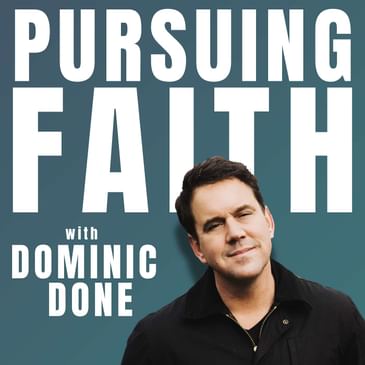
In this episode of Pursuing Faith (first published by the Unbelievable Podcast), Dominic debates British philosopher and atheist, Julian Baggini. Julian is the author of over 20 books, founder of the British Humanist Association, has written articles for the New York times, the Guardian, and the Wall Street Journal, and has given a Ted Talk on philosophy and neuroscience.
Dominic and Julian discuss the virtues, human longing and purpose, and what the world would look like without God.
Links:
https://www.pursuingfaith.org
https://podcasts.apple.com/us/podcast/unbelievable/id267142101
https://www.julianbaggini.com
https://justinbrierley.com
[00:00:03] Welcome to the Pursuing Faith Podcast, where we explore questions of faith, doubt, and life. I am your host, Dominic Done. Hey everyone. Well, before we dig into this week's episode, I just want to take a minute and give you a year-end update.
[00:00:27] We began Pursuing Faith about two years ago because of the massive need that we saw to help people who are struggling to navigate issues relating to faith, doubt, and apologetics. And this podcast, I'll never forget, basically began in a wooden shed.
[00:00:45] I picked up a cheap microphone, I spent forever trying to figure out how to connect it to my computer, hit the record button, started sharing some thoughts, which then led to conversations with really interesting people, which then ultimately led to starting a non-profit ministry called Pursuing Faith.
[00:01:05] And here's what's crazy. Over the last couple years, especially the last six months, we have seen our podcast grow from just a handful of downloads to, as of this week, unbelievable, over 120,000 downloads. In fact, a friend of mine who works in the publishing space,
[00:01:25] he called me up last week and he's like, Hey Dom, don't know if you know this, but Pursuing Faith is now in the top 1.5% of podcasts globally. I mean, that completely blew me away. And I am so, so thankful for what God is doing
[00:01:42] because looking back over 2023, what a crazy, busy, fun year. I mean, we had the opportunity to teach a week-long course on faith and doubt in Mexico, speak in dozens of venues throughout the nation, be on a TV show in Dallas,
[00:01:59] launch a book, participate in an apologetics conference at a university, shoot a series of short videos, write articles, be interviewed on podcasts, develop a course for churches on how they can grow in faith. I mean, it's been an incredible year and I just want to say thank you.
[00:02:18] Thank you for your encouragement. Thank you for your prayers. Thank you for your participation in this ministry because none of this would have happened without your prayers and generosity. So if you want to partner with us, if you want to connect with us,
[00:02:37] if you want to support Pursuing Faith or see what we're up to in 2024, go to our website, pursuingfaith.org. Well, in this episode, I want to share with you a fascinating debate that I had with the philosopher and atheist Julian Beguini.
[00:02:56] You may have heard of him. Julian is an author of over 20 books, the founder of the British Humanist Association. He's written articles for The New York Times and The Wall Street Journal, given TED Talks on philosophy and neuroscience.
[00:03:09] And a few months back, we got to sit down with the host, Justin Brierley, and record a show for Premier Christian Radio, which is based in London, England. As you'll hear, Justin does a brilliant job moderating our debate as we talk about the virtues, human longing, purpose,
[00:03:27] and what the world would look like without God. I really hope you enjoy this conversation. Tell us about this book then, Dominic. Your Longing Has a Name. What's behind this book? Yeah, so my first book was about doubt. We talked about that in your last show.
[00:03:52] This one is the other side of doubt. It's specifically about how our faith can flourish, how our soul can thrive in difficult times. And as a pastor, walking with people through this incredible season of disruption, the pandemic, the sting of grief and loss,
[00:04:12] trying to navigate work and school and church via Zoom, the racial tensions, social tensions, political tensions, global unrest, economic anxiety. Now we have a war in Ukraine, right? All of these complex struggles has left many, many people in a place of,
[00:04:32] well, the New York Times said that we're languishing a few months ago. The emotional state of our nation and our world is one of languish. I think that's a really fascinating word because it's also connected to the word longing.
[00:04:46] And so in the book, I delve into that and I talk about some of the things that we're all wading through. I share some of our own story. The last couple of years has been fairly difficult for my family. Lost a few family members as many people have.
[00:05:03] Many, many people have been walking through the valley of the shadow of death. My wife's mother, she passed away on Christmas Eve during the pandemic or Christmas Day, actually. And so walking through that, seeing grief, walking with people through their own seasons of grief
[00:05:22] and realizing, okay, our souls right now are struggling. You look at the stats and they're absolutely devastating. 75% of people say that they're overwhelmed by stress. 72% feel exhausted. And the one that's really heartbreaking is 48% say they're hopeless.
[00:05:43] And so I wrote this book to really engage some of those longings, the languish, and to ask the question, really, how can our souls thrive in the midst of these difficult times? Because it's almost like you see a juxtaposition in Scripture where on one hand,
[00:06:02] it's very real, very raw about the struggles and pain that we endure. But on the other hand, Jesus promised the abundant life. He said, come to me if you're weary and heavy laden, you'll find rest for your soul. The Bible begins with a flourishing, beautiful garden, right?
[00:06:20] Eden, which means delight. Psalm 1 describes a tree that thrives and flourishes. And so I think the question is, how can we in the midst of devastation, heartache, difficulty, grief, experience a soul that is coming alive and flourishing?
[00:06:38] And so that journey led me to that passage that you read from 2 Peter 1. And it's kind of, it is one of the lists of virtues that you see in the ancient world. And there are several in Scripture. But I landed on that one because it's lesser known.
[00:06:53] And I really like the approach that Peter takes towards it. And he was a soul who went through his own season of languish and pain and heartache and then discovered the beauty and rest that Jesus promised.
[00:07:06] And so part of it's biographical, looking at his life and then exploring these seven virtues or gifts that God has made available to us. Well, thank you very much for that intro to the book. And we're going to, as I say, explore some of these virtues.
[00:07:21] Julian, welcome back to the show as well. I've had you on more recently than Dominic, though it was still about a year and a half ago you came on to talk about the godless gospel with Sky Jitani at the time. A great conversation, by the way.
[00:07:34] I'll make sure it's linked from today's show. But tell us what you've been up to in the intervening time. I think you've had another book out yourself. You seem to produce at least one a year, Julian. Yeah, well, you know, it is my full-time occupation.
[00:07:47] So I think a lot of people, they say, how do you write so many books? But they have got other jobs to do. This is kind of my job. Yes, well, it's been disrupted.
[00:07:56] I've been quite fortunate in the sense that the pandemic hasn't sort of hit me personally terribly badly, which is I've been very lucky. And also because of the way I work and because of my temperament, I didn't even suffer from the sense of isolation.
[00:08:12] In fact, in some ways I'm the kind of person who a lot of people who secretly kind of quite liked that kind of semi-withdrawal from the world, to sort of bring out our more monastic side, if you like. So yeah, no, it's been, yeah, I really can't complain.
[00:08:28] I've been one of the most fortunate ones. But I mean, I would agree with Dominic, even if you're not personally affected by this, that the background in the world at the moment weighs upon us all. And, you know, you wake up and you hear what's been going on.
[00:08:41] And it does seem like, you know, for a while now, really, there's been like one thing after another. So I think that whether you're directly affected or not, this is sort of in the atmosphere. And yeah, it leads people to question, you know, what it's all about.
[00:08:58] I mean, there's no doubt that there have been a set of unprecedented events, obviously COVID, you know, war in Europe has not, you know, happened in what 70 years or 80 years or whatever. But I sometimes wonder, is it that it's the events that are causing the kinds of issues
[00:09:16] that Dominic outlined there or has our resilience somehow gone down? Are we not as able to handle these types of issues as our forebears perhaps were? Maybe we haven't been developing the virtues that may be more commonplace. What do you think, Julian? Well, it's terribly complicated.
[00:09:34] I mean, I think, you know, whatever's going on in the world with events, I mean, life is always a combination of, you know, blessings, to use that word, and trials and tribulations. You know, there's never been a time in history at a personal level, there are always difficulties.
[00:09:49] I don't know whether people have become less resilient overall, because I think these things don't tend to be unidimensional. So I think, for example, you pay prices for things, there are trade-offs. So I think if you compare, for example, our present generation with the generation
[00:10:05] who lived through the war, in some ways you can say the Second World War, you know, in Europe and, well, the world. A lot of people sometimes think that generation was more resilient. In some ways they were, but partly that was because they were less open emotionally,
[00:10:22] they didn't discuss things so much, they just got on with it. And although they had benefits, that also had its prices. There's a lot of pain which couldn't be expressed and couldn't be processed. I think now, partly because we're not prepared to do that,
[00:10:37] we do want to vent things more. In a way, I think the difficulties are more open about them. So it may not be that we're any less resilient deep down, it's just that people are very open expressing how tough they're finding it, how difficult they're finding it.
[00:10:52] So it's very difficult to disentangle that from what people are actually feeling. I mean, I was going to say in today's show, what I want to do is really have you guys just explore on a practical level
[00:11:03] what it would look like for people to potentially develop the virtues in ways that help them to flourish and cope with whatever the events are in life that may be pulling people down. I mean, just before we get into that,
[00:11:16] should we talk about how virtues have been defined? I mean, we've heard that list from 2 Peter 1. If you were to sort of talk about the virtues, Julian, from your perspective, where would your mind go? Which particular list would you be thinking of?
[00:11:29] Yeah, I wouldn't have a list as such, but I'd go back to the approach which is strangely similar between Confucius and Aristotle. They were not that far apart in time, but very far apart in culture, and there's no evidence of any interaction.
[00:11:45] But they both kind of shared a common attitude towards virtue. And I think for both of them, what you would define virtue as is if you like the habits and dispositions of character which enable us to flourish as human beings. And that's not an inherently individualistic creature
[00:12:03] because for both Aristotle and Confucius, human beings were of necessity social. So you cannot flourish as a human being without flourishing socially. So that's why there's this overlap between what is good for us as individuals and what is good for society.
[00:12:20] Now I think one of the interesting things, again, you find in both of those philosophers, is that becoming a virtuous person is a task. It's something that requires work and effort, and therefore most people aren't virtuous actually.
[00:12:36] So going back to your question about have we lost sight of the virtues and so forth, I think at any time in history you probably would have found those people teaching virtue saying, I don't see a lot of it around me. You've really got to work on it.
[00:12:48] And I think that one of the ways in which I think most religious, maybe all major religious traditions in the world and a lot of this secular thinking overlap is that they both of them take seriously this idea that virtue is something that needs to be worked on.
[00:13:05] And I think that's a commonality that I kind of appreciate with people of faith as a person of no faith myself. In a way what I think, you know, sometimes people have strong views on these things, what they both agree on is the taking seriousness of life
[00:13:20] and taking seriousness of the cultivation of your own character. We may have different beliefs about what the goal of that is or what's guiding it, but we both take that very seriously I think. Yeah, go ahead Dominic, you were going to say something.
[00:13:33] Yeah, I mean I would definitely agree with that definition and would also agree that there is going to be a difference in what is the source of virtue, where is our virtue headed. But throughout scripture virtue is a descriptor for God,
[00:13:49] it's the descriptor of Christ being formed in us and it is a habitual, it's a disciplined, as you said, a disposition towards the good. I think where we may differ is what is our definition of the good and where does that source come from.
[00:14:05] I mean when it comes to the way you see virtues, as it were outlined in scripture and being practiced in the world, would you agree essentially with Julian's view that it's something that has to be worked on, developed,
[00:14:21] are these things that can be kind of downloaded to us spiritually as far as you're concerned Dominic or is it something that you kind of have to spend a lifetime on? Yeah, I mean one of the virtues that I outline in the book is perseverance.
[00:14:32] So by definition this is something that we have to work at, there is an element of that disciplined focus, that disposition that the Spirit of God works in us. While at the same time I believe that when someone comes to Christ they are a new creation in Him
[00:14:51] and the old things have passed away and all things have become new. But one of the things I love about what Peter does in 2 Peter is that he is inviting our souls to flourish and our faith to blossom and bloom.
[00:15:05] But he also knows that none of us start the journey fully formed, that caring for our soul takes time and mentorship under Jesus is a lifelong marathon towards health. It's not an instantaneous to show up and expect to win sprint.
[00:15:20] And I think that's one of the reasons why Peter specifically says add these things to your faith. You're building something, one upon the other. Goodness is the foundation, but these other virtues flow from that space and I believe, Irenaeus kind of talks about this,
[00:15:36] but this is a process that begins now and as a Christian I believe then finds its fulfillment in eternity. Julian, when it comes to the virtues, do you see them as something which we can simply work towards, I suppose psychologically?
[00:15:55] There's always this tension whenever I speak to an atheist as to what extent it's our circumstances that basically hand us stuff and to what extent we actually have genuine self-control over building and developing virtues. And I'm not sure exactly where you stand on this,
[00:16:13] but I don't know whether you're a determinist ultimately who thinks actually, well, you will be what the universe has determined you to be or whether we can genuinely strive towards and build moral character and virtue and everything else.
[00:16:27] I don't know whether you kind of take a position on that. Well, I do, but I'd take up the whole program probably to articulate it. In a way, I kind of think that, let's put it this way, I think the heavy-duty metaphysical question of free will,
[00:16:42] whether in an ultimate sense we could have done otherwise, is kind of a distraction. I think in practical terms, we all of us have capacities to do certain things or another. Our choices make a difference and we have that capacity to work on things.
[00:16:57] Now, I think that probably if you chip away at that, you'd find that at bottom, you can only live the life that you could have had. But whether it even makes sense to think there's a more profound version of free will, I'm not sure.
[00:17:11] And of course, even in the Christian tradition, there's been a lot of disagreement about that with people like Luther, of course, thinking that we're completely determined. So, you know, I don't think that, although I think a lot of people would like to simplify this
[00:17:23] in the sense that the materialist atheist kind of believes that everything is determined in this rigid way and that you need a kind of a religious dimension to kind of give us that spark of free will.
[00:17:35] But I think it's much more complicated to actually articulate what it means to have that free will in a way that is different. But I think in practice, though, yes, you've got to work on it. I think one of the big differences is that, again,
[00:17:50] depending on your religious tradition, in a lot of religions, there is this idea that the human being is incapable of achieving this for themselves. Right. And in a way, most atheists would agree with that. The human beings are incapable of anything like perfection.
[00:18:06] We can improve incrementally, but there's only so far we can go. And what religion often offers is that promise that with divine assistance, we can be taken to that place we could not go by ourselves. And obviously, if you believe that, that's very nice and very, very encouraging.
[00:18:23] What the atheists would call their own hard-nosed position is that we don't have that. What we do have, though, we do have other people and we do have solidarity. And again, you can find points of similarity there because in practice, again,
[00:18:40] if you take something like the Christian religion over the centuries, it is very much emphasised the importance of the congregation, the community as a source of mutual support and reinforcement. But, of course, at the end of the day, it believes that behind that is a yet greater power
[00:18:56] that can take you even further. So I think this is one of the ways in which ultimately you have to be a consistent atheist, somewhat more pessimistic than you would be if you had faith. I think that's true. But not pessimistic, I say somewhat more pessimistic,
[00:19:11] a relative term. I think you can still believe in the capacity of human beings to improve and to do good things together and by ourselves. Dominic, I suppose you're not denying that secular atheist people can develop virtues
[00:19:28] as much as Christians can. What's the difference as far as yours is concerned? Yeah, I mean, that's an intriguing question. Again, I think it comes back to the source. I think it comes back to understanding God's purpose for humanity.
[00:19:42] I think there's a profound connection between purpose and the flourishing life, purpose and the virtues. And as a Christian, I believe that God's original purpose for the first humans was much vaster than just existence.
[00:19:59] He didn't manufacture Adam and Eve as soulless automatons or animals just driven by instincts and urges. What you see in Genesis is God conceived of living souls, sacred beings who were suffused by their earliest gasp by the Spirit's power. I think of Genesis 2, verse 7, I believe,
[00:20:21] where it says when God created humanity, he breathed into them, breathed into Adam, and they became a living soul. It's fascinating that word living is actually semantically connected to flourishing. In fact, a verse after God breathed into Adam,
[00:20:41] the same Hebrew word is associated with the Bible's most common metaphor for the flourishing life, which is a tree. In Latin, I think flourishing means to be full of flowers. So God's vision for humanity is of a soul that's blossoming with verdant color.
[00:21:01] And it's fascinating that that flourishing, that initial flourishing, was a byproduct of Adam and Eve inhaling, in a sense, God's breath. They're prospering and thriving, in a sense, putting on display the words of Jesus when he said, I've come that they may have life
[00:21:19] and have it to the full. So I share all that to say that as a Christian, we believe there is an ultimate purpose for humanity, and that purpose is God-given, that it was present at creation, but it's also present at the renewal of all things.
[00:21:34] That's why when you go to the book of Revelation, you find, in a sense, a recreation of Eden. You see the tree of life, you see the river, you see a description of flourishing. And so if this is God's initial vision and this is God's original intent,
[00:21:48] then our task then in the present moment is to move towards that. We stumble, we fail, we grieve, we hurt, but we believe we're being pulled by this beautiful vision, by a beautiful flourishing God. And in your own book, Julian, The Godless Gospel, in a sense, you acknowledge
[00:22:06] that there was potentially a great value to religion in the story it gives people that can drive them towards the virtues and towards living a more flourishing life. But as an atheist, you don't happen to believe that story.
[00:22:18] Does that make it harder because you don't have the same kind of ultimate cosmic purpose kind of story that Dominic's just described in an atheist view? If it ultimately, in a sense, does boil down to more of an evolutionary drive to get on and cooperate and everything else.
[00:22:37] Well, I'm not a reductive materialist in that sense. You've got to believe if you're a consistent atheist that everything about us is rooted in nature and in evolution. But what that has given rise to is something far more complex than something
[00:22:58] that can be just reduced to survival of the genes passing on. Complexity has generated a whole other way of being. So although, as it were, at root and at base there are these biological drivers, if you like, we can't just be reduced to them.
[00:23:19] So in terms of flourishing and goodness, flourishing is something that we seek because... It's interesting you talk about the tree metaphor as being the common symbol of life in the Bible. It's interesting it's a naturalistic metaphor. So in other kinds of ways of thinking which are more naturalistic,
[00:23:40] like the Confucian or the Aristotelian kind of view, there seem to be a kind of... other comparisons are made with animals. So in other words, every living thing has its form of flourishing. The point is that for human beings that form of flourishing is distinctive.
[00:23:57] Because for the vegetative life it's simply a matter of growth. And for animal life it's about growth and movement etc. etc. and their appetites. But human beings have evolved where we also have reflection and we have society and we have ethics.
[00:24:14] So the flourishing life for humans is because the nature of a human being is different to that of the other animals. On a scale, it's not in a separate league as it were, it wasn't created separately.
[00:24:27] Common root but it's evolved its own complexity which means the flourishing for a human being just isn't the same as the flourishing for other natural things. But nevertheless there is that sense in which you can make those comparisons.
[00:24:40] The point of a metaphor is not to tell you the precise story, it's to point to ways of understanding it. And I think it's quite interesting actually that in the religious tradition again, the way to understand flourishing is to compare it to something in a natural world.
[00:24:53] Yeah, that's fascinating. I love what you said there too about just the possibility of change. And I sense in this maybe not a hard deterministic form of atheism but actually embracing the idea that we are free to evolve. We are free to pursue. We are free to become.
[00:25:14] I believe it was Emily Dickinson who said that we dwell in possibility. And we see this idea too in scripture that he of the sons that's free shall be free indeed. There is this idea of freedom to adapt, discover, grow. The forces and ideologies, regrets, fears, choices, heartaches
[00:25:35] that maybe once defined our lives don't have to shape our lives anymore. Even the labels that people use about us are wrong because every moment is an opportunity. It's a blank slate. It's an unwritten script. It's a story with hope as the ending.
[00:25:51] And maybe again that's the difference is, you know, as a Christian I do believe that there is ultimate hope. I do believe there is a telos, a purpose. Galatians 5 says that we are called to be free.
[00:26:05] And Kierkegaard of course, he talks about this idea of freedom as well. That we're an evolving symphony of desire, hope and possibility. And to me flourishing, I think the metaphor of the tree is such a beautiful, winsome one.
[00:26:20] Because when you see a tree it grows, it changes, it adapts, it goes through seasons. And to flourish in our souls, it means a certain degree of embracing God's new for our life.
[00:26:40] That idea of the telos for instance that Dominic mentioned and whether that sort of you need to have that or whether you can sort of, you know, have a model of virtue that doesn't depend on a bigger story or picture and that kind of thing.
[00:26:59] But where were you going? Well, I'm very worried about it. I don't want this to end up being a program about free will. It could easily be. But in terms of the dichotomy about whether or not the Christian is someone who believes in the possibility of free will
[00:27:16] and the open future and the atheist is the materialist determinist. It just strikes me, and Dominic used the phrase, you know, this idea that every moment is kind of a blank slate.
[00:27:26] I would have thought that to be any kind of realistic Christian, you do have to accept there are limitations on these freedoms. So for example, you are a pastor today. Now there are certain things that would have made it almost impossible for you ever to become a pastor.
[00:27:42] I mean what would have made it completely impossible were for you to be born in a time and a place where you actually never even heard the word of God as you see it. You know, this is a common kind of thing people say.
[00:27:52] And you know, in terms of like, you know, when people are giving sort of Christian compassion to the poor and trying to follow Jesus' example, I think we often have to take account for the fact that some people are the products of their upbringing in that way.
[00:28:09] One reason you forgive the tax collector, whoever else it might be, the person of your repute, is that one recognizes that that person has arrived at that position.
[00:28:19] And what you're trying to do is you're trying to actualize a freedom in there, which at some point may just be a potentiality. So to say we all have the potential to change and we have the capacity to evolve, I think we'd both agree with that.
[00:28:32] But whether that capacity can be actualized often does depend on things outside of our control. You cannot follow Jesus if no one even tells you who Jesus is.
[00:28:41] And it's very, very difficult to follow Jesus if you spend your whole life surrounded by people who don't believe in Jesus. People who don't believe in it and have said that's a dangerous religion.
[00:28:51] And then you only get like, you know, half an hour on the doorstep with an evangelist or something. So I would have thought that Christian, atheist, whatever, everyone's got to kind of accept that there are limitations on our free will. We are at least conditioned by things.
[00:29:05] And so in a way, I think the only thing we can all reasonably agree on is that given that, we want to maximize our capacity to take control of our own lives and to guide them.
[00:29:15] And perhaps bringing it back to virtue, perhaps that's a lot of what virtue is about. Because the idea that we need to cultivate virtue is partly, I think, driven by the idea that if we don't,
[00:29:25] we end up simply being reactive beings, behaving as we have learned to behave, behaving as society has instructed us to behave. And it's only by a certain effort and becoming self-conscious and self-aware of who we are and our capacities that we can become more in control and self-directed.
[00:29:46] I love how you put that. That's beautiful. And yeah, I mean, I would agree a tree grows and changes and adapts and evolves, but a tree is also rooted in a place. It's very much influenced by its surroundings. And we do go through things that will shape us.
[00:30:09] And there is a certain factor there that our environment is going to influence and inform us as well. But there is with that, too, a certain degree of freedom. There's opportunity to love. There's opportunity to experience the virtues. I mean, I mentioned Kierkegaard earlier, the Danish philosopher.
[00:30:27] And at one point, I forget which book this was in, but he revealed that the Danish word for freedom is Fryheden, which comes from the word Fry, which means proposal.
[00:30:36] So that moment when you meet the one and you get on your knees to propose to them and they say yes, those simple words bind you to the person. Right? So it's not because everyone understands love's reasons.
[00:30:53] It can be difficult to explain the immensity of your commitment in that moment. And yet there is a certain you're linked to that person, you're bound in a sense within that contract of that covenant of marriage. From the outside, that may look like bondage.
[00:31:10] But to those on the inside, love looks like freedom. And so I think we are constrained in some sense. There's limitations, there's things we go through, there's suffering that we endure. There's heartache. But there's also, according to Scripture, the opportunity to cultivate love.
[00:31:28] And as a Christian, I believe that comes through relationship with God, loving Him, learning the contours of His heart. And in strange and beautiful ways, you find yourself both constrained and free. Constrained because the way of Jesus always summons us beyond the urges of our broken self.
[00:31:47] Liberated because in His presence we can be most fully our redeemed self. Obviously, for you as an atheist, Julian, not necessarily seeing that as the motivation, if you like, for your own cultivation of the virtues and so on.
[00:32:05] Where does, for instance, let's talk about some of these that we've got listed here. Goodness, perseverance, self-control. What for you is the motivation to live a self-controlled, disciplined kind of a life, Julian?
[00:32:20] Where would you go to say, this is why I believe I'm going to strive to not just pick up the next donut or whatever it might be. Where's that coming from? Well, I mean, some motivations are self-directed.
[00:32:37] And I think that people don't necessarily think it's a bad thing. I mean, if someone is motivated, for example, to... A lot of people are motivated to become the best version of themselves they can. And not always in sort of moral dimensions, if you like.
[00:32:50] If someone recognizes they have an ability, a sporting ability or musical ability, people may be driven to sort of like develop that ability as best they can.
[00:32:59] I think what's quite interesting, though, is in terms of motivations, it does seem that the way people explain their motivations to themselves will vary according to the kind of value system they have. But actually you find people are similarly motivated irrespective of their value systems.
[00:33:19] So, you know, you often do hear, for example, Christian sports people explaining why they worked at it by saying that God gave me this gift and I felt it was... You know, I ought to honor God by not wasting it. And so I did it for his glory.
[00:33:36] Right. That's great. That's fantastic. But it's clearly not the case that if you're not a Christian, you don't develop your skills to the highest ability because there are lots of sports people who are whatever else it might be.
[00:33:46] Right. So I kind of suspect that in terms of when you're looking, if you're looking for motivation, it comes from something deeper within human nature rather than what particular belief system you have. And I think that there are things in human nature which motivate us.
[00:34:02] Some of them are, for example, a basic, you know, what David Hume and Adam Smith talked about is like moral sympathy. We have a fundamental kind of capacity to empathize and to sympathize with others. And we have also a desire to live in society with others.
[00:34:21] So a lot of the pro-social virtues are motivated by that. In other words, you cannot actually flourish as an individual in a way that requires you to kind of disregard the interests of society. You are bound together in that way. No person is an island.
[00:34:38] And I think that, you know, people may find different kind of philosophical or theological frameworks to explain that in.
[00:34:44] But if it really depended on those things, you'd expect the people to differ enormously in how motivated they were to do good, to develop, depending upon which system they lived under. And that doesn't actually seem to be the case. Dominic? Yeah, I'm curious about that.
[00:35:04] That's such a fascinating, fascinating conversation there. How would you define flourishing as an atheist? Yeah, well, I think to flourish, if you go back to an Aristotelian view, to flourish is to live in a way which most fully expresses the potentialities of your nature.
[00:35:26] I think that's how Aristotle would do it. A tree flourishes, right? When it grows a strong trunk and its leaves, etc., etc. Because it is living the life of a tree to its fullest. And it's the same for a human being.
[00:35:44] And so therefore to flourish as a human being, given that we are social animals, as he would say, does require that we also live in such ways that we are in society.
[00:35:57] We need to do these things like be loving, be kind and compassionate as much as anyone with a religious faith has to be. Otherwise you're not flourishing. I mean, I think when people talk about the motivations for this and what difference the religious belief holds,
[00:36:16] I think one's got to be quite careful. And I'm not saying you would say this, but I think sometimes there's a rather crude idea that somehow unless we have the motivation of wanting to obey our creator, the big teacher figure, then we have no reason to be good.
[00:36:35] And I think that would be very bad if that was what religion boiled down to. I think it would be very bad. I don't think that is what religion necessarily boils down to, because actually in a way that would make us less moral creatures, wouldn't it?
[00:36:46] If our motivation for being good is that we need to please our God, and in particular if our motivation is that we want to avoid eternal damnation. I mean, what more selfish motivation could there be than that?
[00:36:58] And when I, you know, Justin talked about the book The Godless Gospels, and you know, it seems to me there that Jesus' teaching was basically, most of the time it was appealing to people's compassion as human beings for other people.
[00:37:13] He wasn't saying you to do this because God commanded you to, right? Because he says you must. He says you must love because it's part of being, you know, in the Aristotelian language, being a flourishing human being. This is what it is to be human.
[00:37:28] Recognising the humanity in other people is part of what is required to fully actualise the humanity in ourselves. Yeah, I mean, again, I think that's beautifully put.
[00:37:39] I wrestle though when I read people like Sartre, who at one point he said that he felt that he appeared by chance, existed like a stone, a plant, a microbe. And then he would say, you know, I could feel nothing to myself but an inconsequential buzzing.
[00:38:00] So if that's true, if there is no ultimate telos, if there is no ultimate purpose, then are you just suggesting that the flourishing life looks like comfort, looks like caring for our fellow humans in this moment even though there is no real evolutionary reason for that,
[00:38:20] or ultimate purpose that it's leading towards? Yeah, I think that you have to, if you are an atheist, that's the thing you have to do. You have to find a way of finding a meaning in life without there being some ultimate purpose and telos.
[00:38:35] And I don't necessarily think that the best examples of that are found in people like Sartre and everything. I mean, in a way, the existentialists were very good on the negative part, right? And that's partly because of the time they were writing in.
[00:38:49] They were very much writing against a background of assumptions that there was some kind of grand purpose, some, you know, God to work towards. So they were very much, a lot of their effort was put into kind of, as they put it, correcting that view.
[00:39:04] But I think there are other traditions of thought around the world. I think, you know, in the Far East, in China and Japan, where, for example, I think that the cultures are more profoundly sort of naturalistic and more deep-rootedly naturalistic.
[00:39:19] And there people find a meaning and value in life in a way which is compatible with its finitude and our mortality. And I think you see that particularly in Japan. In Japan, you probably know this, that the most important sort of public holiday is the Hanami.
[00:39:37] It's the cherry blossom season. And that's when the biggest public holiday is. And in the time of the cherry blossom, people will go and they will have a picnic under the cherry blossom. And the whole point about that festival is this, the cycle of the seasons.
[00:39:53] And it's you're celebrating the joy and the beauty of this cherry blossom, precisely in the knowledge that the first strong gust of wind, it's gone. And it's that kind of that ability to kind of have the sweet and the sour together, as it were,
[00:40:11] to accept there is a bitterness in a view of life that it is to no ultimate purpose, that it is going to end. And yet you can still find the sweetness within it. And you hold those two things together. That's the kind of view you have.
[00:40:27] Now, I think that in a culture which is a Christian culture, I think that inevitably sounds gloomy and it sounds depressing because in a Christian culture, we've been promised something more, much more, which is the eternal life.
[00:40:43] I was going to say that Dominic, in a way, what Julian described there in terms of this sort of, in a sense, acceptance of the finitude of life and that we will just make the best of it and so on.
[00:40:57] I suppose at the same time that your book is called Your Longing Has a Name, you believe that these things that we strive for in this life, they ultimately have some, they do have some ultimate sort of thing that meets them in the long term.
[00:41:10] It's not something that ultimately sort of gets cut short, that this life is all we have and so on. Now, I don't think that's the same thing as just sort of some divine heavenly reward we get for being a good enough person on Earth.
[00:41:24] What's the kind of the vision that you see, if you like, that might be an alternative to this, to the one that Julian has just sketched out for the person who doesn't believe there's anything to meet us on the other side, as it were?
[00:41:37] Yeah, I mean, there's so many ways to approach that. I think we could talk about, you know, it's a form of humanism that's being articulated there and we could talk about the source and ideas that those originate from.
[00:41:48] But I would suggest that everything he's saying virtually, I would agree with. There is a bitter sweetness to life. I would want to explore where is the sweetness, where does that come from and what is it pointing towards?
[00:42:04] And I do believe that, you know, these signposts that we experience in these moments, these sweet fleeting moments of joy and mirth and happiness and love and wonder and beauty, longing, are pointing to an ultimate fulfillment.
[00:42:19] You may remember the story that J.R.R. Tolkien told in the Dublin Review about a man called Nigl, and I think it's called Leaf by Nigl. And Nigl had this vision, this stunning vision to paint a tree, speaking of trees and flourishing.
[00:42:37] And he spent years and years trying to craft it. And he could see it in his mind, the world weary hill on which the tree grew, its barrel-like trunk, the symmetry of every green dewy leaf, its heaven-bound pointing branches.
[00:42:52] I mean, in his mind, it was so real, so vivid. And yet as he agonized over every detail, he couldn't get it quite right. Years later, Nigl travels hundreds of miles to a far-off country. And from Tolkien's perspective, I think he's talking about eternity, he's talking about heaven,
[00:43:12] because to his amazement one day, he sees on a distant hill an idyllic radiant tree. And it was the exact tree he was spending years trying to paint but was unable to.
[00:43:25] And when he saw the reality, he realized it was immeasurably more exquisite than he had ever imagined. And some of the final words in this article that he wrote, he said, It is a gift as he opens his arms wide, right?
[00:43:41] And I believe that the longings in our soul, the virtues that we're trying to cultivate, ultimately has a destination. The destination is a masterpiece. But the pilgrimage to get there takes a lifetime and points to ultimately eternity.
[00:43:58] And to me, again, this is why it comes back to hope, because we can look at our soul right now, feel frustrated, drained, weary, fatigued, ready to give up.
[00:44:07] I mean, how many people we all know who are in that space of just they're ready to throw in the towel, they're ready to walk away, our souls are hurting.
[00:44:16] And yet what we see in Scripture is that God will meet us in the place of those deepest wounds and invite us to join Him in cultivating the part of our life that's longing to flourish, and that is our soul.
[00:44:29] Which, by the way, that could be another conversation. Understanding the word flourishing, that it's not merely external, it's not merely circumstantial, because as we mentioned earlier, circumstance will sometimes rob us of the capacity to flourish in physical ways or mental ways or emotional ways.
[00:44:45] And yet there's a soul kind of flourishing that Jesus promised. You know, it's when He says, My grace is enough. It's not the quick fix, it's the journey, the invitation to learn and grow the slow, aching, desperate-for-grace process of being shaped ultimately into the image of God.
[00:45:04] And that's how I would define flourishing, it's the pursuit of Christ-likeness that will ultimately be fulfilled. I think you'd certainly say that all the great secular teachers about flourishing would agree that it's not about external circumstance. Some would allow that, you can't just ignore that.
[00:45:23] And I think, again, most Christians would as well, actually. I mean, you know, Christians are not indifferent to people's external circumstance. That's why they run soup kitchens and do so much good work from that point of view. But the more important thing is the internal flourishing.
[00:45:35] So that's actually a kind of a point of agreement. I think what's quite interesting, though, is the sense of you saying this longing has a kind of a destination and the destination is eternity. There's something a bit paradoxical about that, though, because eternity isn't a kind of destination.
[00:45:48] The whole point about eternity is it is without end. And so in a way, you know, if you reach it, then, so, you know, after Niggel finds a tree, what then? What for the next billion years, right?
[00:45:59] And now, I don't think this is a knockdown argument, but I think that for me, I think that sometimes when people are trying to kind of show what's missing in the atheist worldview, they can quite easily describe the way in which the religious life,
[00:46:17] the Christian life offers something more, this eternity, etc. But making what that would actually mean, I think, is deeply mysterious. I mean, I don't I defy anyone to say they have any sense at all of what it would mean
[00:46:31] to live in a way that was recognizably as we live now in an eternity. You know, I mean, the extension or the increase in life expectancy is already kind of like tested people's patience of like, you know, the marriage commitment, you know, for example.
[00:46:48] I mean, that's one of the reasons why I think divorce rates have gone up. It's simply because people are living longer, right? And like 40 years is a long time. I respect anyone who stays together that long. I think it's a wonderful thing.
[00:47:02] I don't think anyone can imagine what it's like to live for 500 years, let alone an eternity. So I think that there's a sense in which, again, I think you can tell me if I'm wrong here,
[00:47:13] an honest Christian has got to admit there is something deeply unknown about what this fulfillment will actually be like for us. So in that sense, that also means acknowledging the fact that the security one has, the sureness that one has there is not rooted in a clear conception.
[00:47:31] It is a matter of faith in a sense, you know, the faith that it will be worth it. We will find our fulfillment. But I can't quite... how... Any response to that Dominic? It may not be unbelievable, but it's inconceivable.
[00:47:48] It should be a good name for a podcast. I think that's a very, very fair point. I mean, there is both sides of... there's the mystery, the unknown, of course, eternity, who can fathom it, who can describe it.
[00:48:06] At the same time, Paul would say, you know, we see through a glass dimly and then face to face. I mean, Dostoevsky would say something similar. I believe as a child, you know, that the horrors of this world that we've made up for.
[00:48:17] There is a certain childlike faith. I think that's why Jesus spoke of that. I mean, who could possibly, you know, grasp the reality, the truth, the mystery, the beauty of eternity? But I think this kind of ties back into the development and cultivation of virtue because, you know,
[00:48:35] I've been thinking through like, you know, these virtue lists and the invitation towards the flourishing life. In a sense, it's a liturgy for the soul and liturgy is a part of formation. But on the other hand too, it's an eschatology of the soul.
[00:48:51] I mean, what if these virtue lists, and you know, I'm looking at Peter's one specifically in this book. What if Peter is furnishing us with the building blocks for the kind of future God wants us to inhabit?
[00:49:04] So day by day, however we choose to develop or diminish ourself will influence what we carry with us into eternity. Maybe this is why Jesus spoke so often of talents and rewards and investing our treasure in eternal things.
[00:49:20] Because this moment, and for as many moments we have remaining on earth, in a sense we're constructing our soul's identity. And I think a fascinating question is, okay, what shape is that taking now? What trajectory am I on? Right? Lewis would talk about this in The Great Divorce.
[00:49:35] We're on a trajectory. We're on a path of becoming. We are the tree that's either flourishing or withering. And the vision that God casts for us of formation and tempting to know him and love him and pursue him and honor him and worship him.
[00:49:52] I think all of this is pointing to something that is beautiful. It fulfills in a sense the longings of our soul. Our soul is a gift from God.
[00:50:04] There's a nice little tension. I like your thoughts on this, though, which is that you can talk about these things in that kind of, you put it, eschatological term. It's about the preparation. It's getting ready. Right? And that sense of getting ready for something to come. Right?
[00:50:21] And yet a lot of the time there's also that sense in which a lot of the teaching of Jesus in particular was not about that at all. The kingdom of God is within you. You know, you should have life now. And it's about living now.
[00:50:33] And I think there's a kind of sometimes there's a bit of a tension there between you. Because if you acknowledge the fact that what you achieve your fulfillment, it's achievable now. You can live that life now. You can use the kingdom of God to be within you now.
[00:50:47] I would absolutely. If that's true, then why is it so important to emphasize the what is to come aspect? I think it's both. And so that's why I use the word liturgy and an eschatology.
[00:51:00] Again, I think this is why Peter would say, add these things to your faith, because each build within us a framework and promise of a deeply flourishing life.
[00:51:10] And at the same time, they're profoundly synergistic. The more we receive and practice them, the more natural and enlivening they become. And I think this is a characteristic of any virtue or vice, right? The more you do a good act, the easier it gets to repeat.
[00:51:25] The more you do a bad one, the easier it gets to repeat. It's how habits are formed. It's how people are formed. And I think it's how eternity is experienced at the same time.
[00:51:35] I mean, just coming in on the eternity thing. One thing that strikes me is that as I see in Scripture often,
[00:51:41] and the way that I think I've increasingly come to think about what eternity is, it's not so much being me for an incredibly long period of time and probably getting rather bored with my own company.
[00:51:52] But what the reward is, is Christ as a Christian. It is Jesus. That is the thing that meets all our desires. So it's not so much about a long-spent space of time. It's more about a person who we are fully known by and fully knows us.
[00:52:15] And what that looks like in terms of literally temporal time, who knows? But for me, I suppose that seems to me to be, speaking as a Christian here, the thing that is the attraction. It's not just being a good persevering self-controlled person for eternity.
[00:52:37] It's kind of somehow that longing being met by the perfection of all that that is. So coming back to you, Julian, in a sense that for me personally is a real motivator.
[00:52:55] Not that I do it anywhere near as I should, but certainly I suppose it's the model of Christ to some extent that galvanises me to say, yes, today I am going to be a bit more like Jesus. Today I am.
[00:53:09] Now, what in a sense, is there any kind of similar kind of goal, telos, cosmic person in the way that maybe Dominic and I have in our faith that can motivate you to sort of say, no, I'm going to go the extra mile today.
[00:53:24] I am going to do that. Clearly there's no cosmic or ultimate purpose that makes you do that. But again, in terms of what motivates people to, well, there are a couple of things to think about here,
[00:53:40] because are we talking about what motivates a person to make the most of the day, to be good to the people around them, to work on themselves? We see people share that motivation, whatever happens.
[00:53:52] If you're talking about a motivation to sort of be morally good, to go the extra mile for other people, to sort of be kind and be generous, etc. Well there I think that we actually again find that that's not strongly correlated with faith.
[00:54:10] I do think, it's interesting that there are competing sort of empirical studies on this, about the effect faith has. And I think the problem with these competing sort of surveys is that you can always turn around and say,
[00:54:27] if for example the evidence is that Christians are actually no more moral in their behaviour than non-Christians, you can always turn around and say, well, then those people are not being good, aren't the real Christians. A lot of people call themselves Christians.
[00:54:42] In the same kind of way, a lot of atheists come in different forms. There's a better and worse forms. But I would accept that it's possible, although I don't think it's a fact.
[00:54:54] It would be possible that that motivation leads people to be more altruistic than they might otherwise be. But if there is a gap, it's certainly not a gulf. And in a sense on the individual level, it's more important.
[00:55:09] In the sense that you take a typical church congregation, such as when I went to church, you know, there were individual members of that church who were highly committed to social good and so forth.
[00:55:20] But they were a tiny minority. Other people, there were bank managers, people like this. There are people with large houses, people having comfortable middle class lives. And there are also completely secular charities like Médecins Sans Frontières doing this incredible, incredible work.
[00:55:36] So it goes back to what I was saying earlier, really. If you actually look at it as a matter of fact, it seems that although when you start talking about this,
[00:55:44] it may seem head scratching as to what would motivate people to do these things if they didn't have that vision of Jesus or God, whatever it was.
[00:55:53] But actually, if you look at the facts, it seems that there's very little or no difference at all between how well motivated people are. And what actually leads people, I mean, I also think moral philosophy is overestimated here.
[00:56:03] I do think that most of the time what leads people to act with kindness and love towards other people is the recognition of the humanity and the need of others. And I actually do think that is something that Jesus was teaching quite a lot.
[00:56:15] He was asking people to recognize and to respond to people. The whole story of the Good Samaritan is precisely about how your theological and religious motivations are besides the point. It's simply to recognize a fellow human being in need and to respond.
[00:56:33] And that's also, I think, why the story of the Good Samaritan is one which resonates with people. You don't have to be a Christian to find that a really powerful story.
[00:56:40] You don't need to, you know, you don't come out and say, well, I don't believe Jesus was Christ. So that's a rubbish story. That's a really good story, whether he was God or man. A challenge there really from Julian Dominic. Well, in practice, it sounds great.
[00:57:09] But in practice, is there a real difference between ultimately what this looks like when it comes to Christian or non-Christian religious or non-religious people? It seems like it's the humanity in each other that we're responding to.
[00:57:22] That's why stories like the Good Samaritan from Jesus have this universal appeal. And so where do you go with that? Yeah. So hearing Julian share, it made me so happy to hear him talk about Jesus because I think he is the embodiment of these virtues.
[00:57:39] And when I say, you know, the name of the book, Your Longing Has a Name, that is a reference to Jesus. He is ultimately the one we're longing for.
[00:57:48] And as you mentioned earlier, Justin, it's not simply eternity that our hearts are thirsty for, but it's the presence of God. It's the knowing Jesus and being known by Jesus.
[00:58:00] And of course, anyone who reads the story of the Good Samaritan is going to be moved by that, hopefully. And that's because a virtuous God poured his virtue into the world, and we are all made in his image. And there's something in us that resonates with that.
[00:58:19] There's a truth in it that stirs our heart, that creates a yearning and a longing. I think our difference would be that longing and yearning is pointing back to its source. Julian?
[00:58:34] Yeah. Well, I mean, this is the point at which we just sort of politely agree to differ, I think. I can see that you think that, but I guess I don't… And I can see why it would be attractive to believe that.
[00:58:49] But I don't see that…I don't find myself coming to that same conclusion. I don't find anything missing from my understanding of why it is that people can be altruistic and caring and so forth without that.
[00:59:07] I'm not left scratching my head thinking, but if there's no divine source, we're pointing back to how can I have this? It seems to be perfectly explicable that we recognise the humanity of people and respond to it.
[00:59:18] And in fact, that's why cultures which have known nothing of Jesus had people in them who were kind and altruistic in that sense. So sure, I think this is just something where, in a way, I don't want to pick a fight about it.
[00:59:33] I've got no interest in trying to persuade you you're wrong, but I don't see what's missing on the other side, as it were. Now, for the point of view of a believer, I think it'll always be something missing.
[00:59:47] If your worldview encompasses Christ, God, and it has that powerful role in it, of course it's going to seem that there is something desperately lacking in anyone else.
[00:59:58] And I think the temptation, this is where I think perhaps I don't want to be provocative, but this is where there may be a bit of a disagreement. One problem I often have with Christians is that in themselves they find this feeling
[01:00:15] and therefore they conclude that this yearning is something that must be universal. Everyone must have it. It's not just me and Justin and the people in my congregation, people who have this longing for Christ, ultimately. Everyone else must have it.
[01:00:31] And it becomes like an unfalsifiable principle. And if I deny it, then I'm in denial. I'm separated from a fundamental desire that I must have. So the same reason that I think a lot of psychoanalytic interpretations are suspicious,
[01:00:50] because you either say, yes, that's true. I do want to murder my father and marry my mother. Or if you say no, well, that just proves that you're in denial.
[01:01:00] There's no way of escaping this accusation that we're in flight from recognising what God most wants from us and demands of us. So we kind of reach a little impasse here. Yeah. Dominic, I'd be interested in your response. We'll have to start wrapping it up at that point.
[01:01:17] I mean, you say that we all have these longings. And I don't think Julian would necessarily deny that there are longings of some kind, but he grounds them in a kind of a humanistic philosophy. They don't necessarily ultimately find their goal in God.
[01:01:33] Why for you is God the better explanation of those longings and where they will find their true home, as it were? Yeah, I love that you said home. Again, coming back to Tolkien, I think he said we all long for Eden.
[01:01:50] Or Steinbeck said we now live east of Eden, right? But we're constantly glimpsing it. He said our whole nature is at best and least corrupted. He said we're still soaked with the sense of exile. And while there's an impasse, I think here, philosophically worldview-wise, telos-wise,
[01:02:11] I think we can agree that there is an innate human longing for justice, for love, for purpose, to understand our fellow humanity. I personally don't see how a purely naturalistic worldview can account for that.
[01:02:28] I don't see, from a purely evolutionary perspective, how natural selection could possibly lead us to this place where we have these longings. Again, we applaud the humanistic sense to care and love and serve and be generous and kind. I don't see how naturalism can account for that.
[01:02:50] Yeah, well, that is another program for you, Justin, I think, about how that can account for that. The shape of the answer would have to be simply, as I actually said earlier, that these things create their own effects. Things take on lives of their own.
[01:03:07] So, for example, if you think about things like consciousness, for example, consciousness is a mystery in a sense for the natural world, but we are aware of the fact that systems which are, as it were, at bottom, simply atoms and stuff,
[01:03:22] can generate complexities which can't be explained in those terms. You don't need to get to consciousness for that. Biology, the natural world, is like that. You can't actually explain biology in the natural world using fundamental physics.
[01:03:35] You have to explain it at a level of organisation which is higher from it. So I think the naturalistic worldview has to be one which accepts the fact that as things become more complex and there are orders of organisation which take us away from their original basic sources,
[01:03:54] that they cannot be explained by going back to the most fundamental physical forces, not explained in that way. And yet there is nothing more. If I'm going to be sort of nicely ecumenical about this, maybe, you know.
[01:04:09] I think one thing that's come out of the conversation is that, of course, there are mysteries and unexplained things on both sides here. Certainly no Christian could claim that there are, well, a Christian would be very strange to claim there are no mysteries or unknowns
[01:04:23] given that they believe that they were created by a God whose intellect is infinitely greater than their own. And there are things which are not fully explained by the naturalistic world too.
[01:04:33] So if we're looking for complete explanations which nail anything down, we're both going to lose this game. True enough. True enough. Dominic, any final thoughts as we close out today's show? Yeah, I think at the end of the day we're handed two scripts, right?
[01:04:50] One says there is no ultimate meaning. It's all an accident. Things happen by the way you're an accident too. And as Julian has shared, there's a sweet bitterness in that perspective. I would say there's probably more bitterness to that. But I think the sweetness comes from its source.
[01:05:12] And Jesus hands us the other script. He says life does have meaning. Everything about who you are, the breath in your lungs, the heart pounding in your chest, your tears, fears, dreams matter. And here comes hope. He promises that justice will reign. Mercy will triumph.
[01:05:29] What is ruined will be rebuilt. Right? We talk about the renewal of all things, the kingdom of God. And I think part of the invitation promise of the kingdom is joining God in the process of the renewal of all things now.
[01:05:42] He's inviting us to join him in the best way we can for not only our own souls flourishing. This could be a whole other conversation too, but it's for the flourishing of the world.
[01:05:53] The kingdom of God is among you. It's an invitation to foster and develop and cultivate the flourishing of others. And to me that is beautiful, the most beautiful vision. We hope you enjoyed this episode of the Pursuing Faith podcast.
[01:06:15] If this ministry has encouraged you in some way, would you consider leaving a review on iTunes or your favorite podcasting platform? That would help a ton in getting the word out.
[01:06:27] Also, if you want to partner with us or see what we're up to, check out our website, pursuingfaith.org.