
296. Why the Incarnation, Death, Resurrection and Ascension of Jesus Matter
This week’s episode Cris explores why the incarnation, death, resurrection and ascension of Jesus matter so much to us as Christians. These are not just four moments in the story of Jesus, they are the foundations of what we believe and how we live as disciples.
Support the podcast with a coffee.... https://www.buymeacoffee.com/crisrogers
To get a copy of Positive Urban Theology here... - https://amzn.eu/d/0hmKe5wU
To get a copy of The Bible Book By Book here...
https://www.eden.co.uk/christian-books/bible-study/bible-study-reference-books/bible-background/the-bible-book-by-book/
Rev Dr Cris Rogers is Director of Mission for Church of England Birmingham, church planter, speaker and Director of Making Disciples. He is also chair of the Spring Harvest Planning Group. For more information, check out wearemakingdisciples.com #Heart #Hands #Heart
[00:00:08] Hi friends, welcome to another episode of Making Disciples. My name is Chris and I am your host. Warm, warm welcome to this week's podcast. Now some of you know that Becky and I have recently moved from London to Birmingham and we are, I'm working for the diocese but Becky is particularly revitalising her church in Erdington, 3% of the deprivation indices and we've had just a couple of Sundays there now.
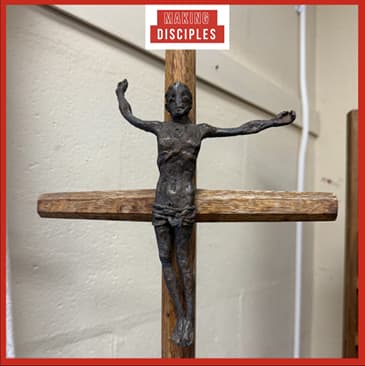
[00:00:37] Now and in the church is a cross and this particular cross, the first time I saw it, my honest opinion was this is just a bit weird. And let me just try imagining the cross for you but I will, I'll try to make the episode image, the image of the cross so you can kind of see it.
[00:00:58] But the image of the cross is a wooden cross and there's a metal, black metal, steel, handmade Jesus. And what you'll notice when you look at the cross is there's two things going on. One is Jesus' arm is bent, like somebody has clearly dropped this thing. And rather than the arm going straight out as Jesus hangs on the cross, it's kind of going upwards.
[00:01:27] So it looks like Jesus is waving from the cross. And then the other thing that you'll notice is that Jesus is, the beam where Jesus' arms would have been nailed, is not coming kind of across his shoulders but actually it's coming across his waist. And it's even low, it's really low waist across his groin.
[00:01:50] So Jesus is essentially, if this was full size, would be three feet higher up the cross than really what he should be if he's being crucified on it. So his arms aren't nailed to the cross at all. They are out wide and up but they're not on the beam. So you look at it and go, this is really weird. And I thought to myself, the first time I saw it, I thought, gosh, somebody has broken it.
[00:02:17] And rather than putting Jesus on where he should be on the cross, they've kind of stuck him on too high. So it just looks ridiculous. I was like, that is a really ridiculous cross. Now, how I have a thing about the cross is that Jesus, you know, I believe in the life, death and resurrection of Jesus. Therefore, I don't really like seeing a crucified Jesus on a cross because he's not crucified any longer. He's resurrected. So, you know, I don't mind. I absolutely love having a cross at the front of church.
[00:02:48] But I do struggle when I have a cross with Christ being crucified on it. And there's lots of theological reasons why you might do that. But for me, the resurrection is really important. Jesus isn't a man who just died. He is a man who resurrected. And therefore, I want to see a cross that's empty because the cross, yeah, the cross is empty because Jesus is crucified. You know, the tomb is empty. You don't see Jesus in the tomb. But on this cross, you've got Jesus on the cross.
[00:03:16] And he's not kind of attached to it where he should be. He's too high up the cross. And you think, this just looks really weird. And when you look at it, I went to see it. I thought, well, somebody's definitely put him on in the wrong place. But when I went out and looked, I noticed that there is a metal pin coming out the back of Jesus. And the metal pin goes into the cross. So Jesus has not been put back on the cross by somebody who didn't know where to put him. But the manufacturer, the maker, the person that made this with their hands, has chosen to put Jesus on the cross there.
[00:03:46] And I was like, that is just weird. And I'm telling a friend about this. This is a really weird cross. Let me show you this. You know, it's really bizarre. It's like Jesus is waving from the cross at you rather than being crucified. It's really bizarre. And we got a message back. And the message back said, well, Chris, I think you need to go and research this a little bit more. And he says this is a particular form of church cross.
[00:04:11] It said in the message, instead of depicting Jesus defeated, slumped and hanging heavily by nailed hands. This style of cross intentionally positions the arms high and wide. The arms are raised above the physical wood to symbolize the resurrection and the ascension and the ultimate victory over death. I'm like, I misunderstood this cross.
[00:04:37] This is not a cross of Jesus being crucified where Jesus's arms are bent. Neither is this Jesus waving from the cross. This cross is demonstrating an empty cross and Jesus's ascension. Jesus is ascending into heaven rather than hanging on the cross. He's ascending. I'm like, this, that's cool. I'm like, I really like that.
[00:05:00] Now, bearing in mind, many of us, we know what to do with Jesus's incarnation. We know what to do with Jesus's death. We even know what to do with the resurrection. But we don't actually know what to do with the ascension. Many of us ditch the ascension. It's not important. In many really traditional or high churches or Catholic churches, they would have a service on ascension to celebrate Jesus ascending into heaven. We don't do that in many of our churches.
[00:05:30] Many of us would celebrate Christmas. We'd celebrate Easter. We'd celebrate Good Friday. And then we'd celebrate Easter Sunday, Resurrection Sunday. But when it comes to the ascension, we wouldn't do a great deal with it. But yet this cross celebrates all of those moments. His life, death, resurrection and ascension. And this is where the topic of this particular week's podcast comes in.
[00:05:58] So a little while ago, I was asked a question by a listener that I didn't quite know what to do with it or where we would place it. And I thought this is a great place to place it. Because in the question, they said, well, you know, a friend of mine goes to a particular church and they celebrate the ascension. What is so important about the ascension that means we might celebrate it? You know, isn't this just the moment that Jesus leaves? So why are we celebrating this leaving moment? So that's a really good point.
[00:06:27] So I've got the cross. I've got this listener's question. And I think one of the things that I really want to look at today is these four moments. The incarnation, the death, the resurrection and the ascension of Jesus. Because all four of these really matter. And if you were to remove any one of them, you actually miss out on who Jesus Christ is.
[00:06:53] So if you remove the incarnation, God moving off the throne into neighborhood, the boy next door puts on flesh, you remove that. Then you just have a man essentially who is dying. And the crucifixion is about a religious man. If you remove the death of Christ, then there's no sin that is appeased. If you remove the resurrection of Christ, then Jesus is just dead.
[00:07:20] And if you remove the ascension, you have a similar problem. And that's what we're going to look at today. We're going to look at these four areas. Because I want to argue that these four areas are not simply just moments in a story. But they are four essential moments that sharpen what we believe about God. It changes what we believe about God, about ourselves, about salvation and the whole world that we are living in.
[00:07:48] See friends, Christianity is not just about believing that Jesus existed or even that he died for our sins. It's more than that. It's about understanding the whole story that God has done through Jesus, what God is doing, and how this changes absolutely everything about the way that we live. And so that's what I want to explore today. So we're going to look at these four moments really briefly. The incarnation, the death, the resurrection, and the ascension. And what does it teach us about God?
[00:08:17] What does it teach us about us? What does this teach us about the world that we're in? So let's dive in. This is theological in the sense that we're looking at three important theological ideas. But actually it's transformative because it actually changes us as we realize who he is and what this means about God and us. It changes how we understand God, which is theology. So I would argue it also shapes what you would call your missiology, your understanding of the mission of God.
[00:08:44] What is God doing in the world and how do we partake in that? So that's what we're going to look at today. So I'm going to have to move quite quickly because I've got a whole bunch of points for each of these that I want to fly through. Beginning with scripture, but then what does this mean for us? So let's dive in, friends, as we look at the incarnation, the resurrection, the death, the resurrection, and the ascension of Jesus.
[00:09:16] So let's start with the incarnation, shall we? So in John 1, 14, the word became flesh and made his dwelling among us. The incarnation, God came to live among us. As in the incarnation, the God, the creator of the universe, leaves that holy sanctuary space in the heavenlies and comes to encounter us in the dirt.
[00:09:43] The incarnation means that God, the son, became human in Jesus Christ. In other words, God does not remain distant from humanity. He doesn't just send instructions from heaven to us, but he enters the world and he takes on human flesh and he becomes like us, the boy next door. So this incarnation is really important because it locates God with us and among us. God is not distant from us.
[00:10:12] So, friends, what is it we believe? We believe in a God who has entered the human story and made himself known to us. In other words, God is not distant and that God is now known through Jesus Christ. The unknowable God is now knowable. The God who's in the heavenlies that's hard to know is now among us and we can get to know him as a person. So we don't have to guess what God is like anymore, do we?
[00:10:40] We see him in the character and the nature and the life of Jesus. God is not distant, but he's shown himself to us. In other words, the implication of all of this is that human life has dignity and value. If God was somewhere else, where you place yourself and put yourself tells you what you value, doesn't it?
[00:11:03] And I know as a vicar, end of a church service, depending on who I go to sit with will tell the congregation who I value the most. So one of the things that I would spend a lot of time doing is I'd make sure I'd go around the congregation. I would always go and sit with some of the elders from the church. If we had a bunch of elderly folk there, I'd go sit with them because it tells the congregation who I think is important when you go and sit. So I wanted the congregation to know I absolutely love the young people.
[00:11:31] I absolutely love the families, but I really honour the elderly. So there's something about sitting and being that tells you what is honoured, what here has value and dignity. And God does the same. When he comes and puts on human flesh, Jesus affirms the goodness and significance that's embodied in human life. That God thinks we are good. That God loves us. He's not holding us at arm's length because we can't cope with them. They're so sinful.
[00:11:58] He comes with us because our bodies, our relationships, our everyday experiences, this matters to Jesus. And so coming and sitting among us, coming and walking among us, tells us what Jesus values. And he values his people. So in other words, God understands the human experience. He's walked with us. He's sat with us. So Jesus experienced hunger, exhaustion, friendship, grief, temptation, all of this stuff.
[00:12:28] And he's come to know intimately what it means and feels like to be human. So God is affirming humanity. And essentially our faith in Jesus Christ is this understanding that God puts his presence among us. He doesn't put information among us. He doesn't just put a holy book among us, but he puts the person of Jesus, the son of God, placed among us.
[00:12:57] So this isn't about information. It's about presence. So if God came to dwell among us, then disobeyed, in other words, means learning to be present with others, particularly those that are overlooked, those that are marginalized, those that are suffering. So the change then for me is, you know, we move from imagining that God has someone far away or something far away that he thinks is more important.
[00:13:24] You know, God doesn't have somewhere else in the heavenlies that's more important to him. No, he places himself among us. So we begin to see if God moves close to those that are unseen humanity, then we do the same. You know, our ordinary lives become about placing ourselves with those that are often overlooked. So this shapes, this theology of the incarnation shapes us. It shapes how I behave now because we're invited to be like Christ in the world, be like Jesus.
[00:13:52] And therefore, if Jesus moved among us, then we move amongst the world. We don't hide away, we lean in. So the first thing about the incarnation, God came to live among us. The second thing then is the life of Jesus. And this is basically God deals with sin and reconciles us to God. So you go to 1 Peter 2 24, it says, He himself bore our sins in his body on the cross.
[00:14:22] The crucifixion of Jesus is bearing and carrying the sins of the world. A little while ago, I went out for a family walk and we had a rucksack. This rucksack had all the cups and all the drinks and all the cakes in it for the walk that we had. And I had it on my back. And I'm like, this is heavy. I'm carrying the cup that my wife's going to drink, my son's going to drink, the cake, the coffee.
[00:14:52] Burner that makes the coffee with all this stuff, the water. Carrying it. I'm carrying the burden of this group of people on my back. This is what Jesus does in his death on the cross. He bears our sins. So friends, the cross is where we see the seriousness of our human sin. And we also get to see the extraordinary love of God. If you want to know what love looks like, 1 John 3, isn't it?
[00:15:21] If you want to know what love looks like, then Jesus. Jesus is the one that gives us the definition of love. So the cross is where we see the seriousness of human sin. But we also see the extraordinary extravagance of God's love. And in Jesus, God acts to deal with sin, bringing forgiveness and reconciliation to us. It's in Christ's death that we are forgiven. It's in his death that he bears our sins and he takes it to the cross.
[00:15:52] And ultimately, the direction of travel from the cross, you read in Peter, epistles, is hell. Jesus is going to hell because of our death on the cross. And so actually, the cross is one of those, you know, he is sent to hell. And also what we see in Peter is, well, whilst he's in hell, he does a whole preaching tour. He then kicks the door of hell down and he leads those out of hell that have been imprisoned by hell.
[00:16:19] So he bears the sins that he might die to lead this resurrection parade, which is a beautiful language from Corinthians, isn't it? Leading the resurrection parade, it says. So the cross is where we see the seriousness of our sin and the extraordinary, extravagant love of God. So why is this important to us as Christians? Well, number one, it tells us that sin is real and it matters. Sin matters.
[00:16:45] You cannot pretend that sin doesn't matter. Oh, it doesn't matter to God. Sin matters to God. Yeah, but God loves me, so my sin doesn't matter. No, you are misunderstanding. If we ever think that sin does not matter because God loves us, then we've misunderstood love and we've misunderstood sin. Our sin separates us from God. But the love of God goes beyond that to die for us, to reconcile, to reconnect us to God. Sin matters.
[00:17:15] Love matters. You can't just say, God loves me. I love God. No, it doesn't matter what I do. Yes, it does matter what you do because sin matters. I think there's a thing that's been happening in recent years, I think, in the church where we have lost the sight that sin really does matter. And that Jesus' death is because of sin, not just because he loves us. It's not just a symbol of love.
[00:17:43] It's not like Jesus dying on the cross was his version of sending a single rose to somebody to show that he loves them. The death of Jesus on the cross is because sin mattered. And he deals with sin because he loves us. So sin is real. And it matters. The second thing is forgiveness is a gift of God's grace. The cross, you know, what happens in Jesus' death. It's a gift of his grace.
[00:18:08] We do not earn anything other than what Christ Jesus has done for us. It's not about performance. It's not about moral achievement. It's about what Jesus has done for us. And therefore, just connecting this sin really matters. It destroys. Let's link this now with love.
[00:18:30] God's love is real, but it's also costly to him as well as being costly to us. So the cross reveals a love that does not turn away from human rebellion, from violence and suffering. But this love allows us to enter into a new place of redemption with him. Love is costly. It costs Jesus everything.
[00:18:59] Love is costly. But also, friends, love is costly to you. It's a problem in modern culture where we've got cheap grace. Jesus loves me. I love Jesus. It doesn't matter what I do. It does matter. Love costs Jesus. And friends, love costs you something. What does Jesus say? If you want to be my disciple, pick up your cross and follow me. Die to self.
[00:19:25] There's a cost to receiving freedom from our sin. And the cost is following Jesus Christ with everything that we have got. You cannot receive Jesus' grace and at the same time carry on sinning. Because if you do that, you've not understood love. You've not understood sin. And you've not understood the cost of that forgiveness with Jesus. And the cost then that is back to us.
[00:19:51] So friends, we are called to be people of forgiveness and people of reconciliation. We are called to receive the love of God. To accept that love. To be transformed by it. To leave sin behind. And to become people like Jesus. We're going to carry on in a minute to look at the resurrection. But understanding the death of Jesus is essential. We rush so fast to the resurrection without really understanding the consequences of death.
[00:20:19] Jesus, the son of God, died on the cross. He was dead. It's not like Jesus was dead on the cross but yet somewhere else. He died. He was gone. It was the life of the resurrection that brought him back to life. So, I think this must change how we believe and how we behave. We move from believing that we must make ourselves acceptable to God.
[00:20:49] To trusting what Jesus has accomplished for us. We become people who live from forgiveness. Rather than constantly trying to earn forgiveness. Let me say that again. We become people who live from forgiveness. Rather than constantly trying to earn forgiveness. To the incarnation, God draws near. The death of Jesus, God deals with sin. Then, thirdly, the resurrection. So, what does this teach us about Jesus?
[00:21:18] Death does not have the final word. 1 Corinthians 15. Love it. But Jesus Christ has indeed been raised from the dead. The first fruits of those who have fallen asleep. The first fruits. In other words, there's going to be more of this going on because of what Jesus has done. So, the resurrection is not simply a happy ending to a really tragic story. It's God's victory over death.
[00:21:47] And it's the beginning of a new creation. The old is gone and the new is coming. And Jesus, he was raised in the bodily form. And I think this is really important to understand. Jesus wasn't spiritually risen. He was physically risen. There are Christians. And this is heresy. There are Christians who say, I can't quite believe in the resurrection of Jesus. But I can believe that his spirit came back. That his spirit came back. I heard a number of years ago somebody preaching who said, I don't really believe in the resurrection.
[00:22:16] But what I believe is that the spirit of Jesus came back and he went into another body. And that's why the disciples didn't recognize him. So, it was Jesus' spirit in somebody else's body. It was like puppeting this person. I'm like, dude, that is heresy. That is heresy. We believe in the death of Jesus. But we also believe in the resurrection of Jesus. Now, we do believe the resurrected body was different. For a moment, they didn't recognize him. You know, the men on the Amish Road, they didn't recognize him.
[00:22:46] It wasn't until he broke bread. It was revealed there's something different about Jesus in this resurrected body. But it's still Jesus and it's still his body. So, Jesus is raised in the body and his resurrection gives us hope for our own resurrection and the renewal of all things. So, if Jesus rose from the dead and he's the first fruits, then we will join him in our death and in a new life resurrection. So, why is this important to us as Christians?
[00:23:15] This is really important. You know, we don't just believe that you're forgiven. We believe that Jesus died to forgive you from our sins. But we also believe that Jesus died to raise again and that we would have a new resurrection life. So, our faith rests on a living Jesus. If Jesus just died and there was no resurrection, friends, I would say, forget it. He's just the same as everybody else. Everybody dies. It's the fact that he rose from the dead that makes this guy different. So, our faith rests on a living Jesus.
[00:23:45] Christianity is not simply a set of teachings that are kind of left behind by a dead religious teacher. You know, he's not like Gandhi and he's definitely not like Mohammed. Jesus didn't leave behind teachings. He left himself, you know, the resurrected Christ. So, we believe Jesus is alive and he's now present with us. So, in other words, death is not the end.
[00:24:15] We have a future hope and that goes beyond survival as just a soul thing. It's a physical resurrection. So, this idea, again, heresy. When you go to heaven, you're going to be these embodied, disembodied souls floating around. Angelic beings like floating around with your wings. Friends, you are not going to be that. You are going to be a resurrected person. Flesh. Blood. Person.
[00:24:41] The death of resurrection and the resurrection of Jesus tells us that the flesh has to go, but also the flesh will rise again. That actually in heaven, we will be fleshy. We're not going to be a spirit floating around. We're going to be fleshy. So, there's a future hope that goes beyond the survival of our soul. It's the survival of all of us, every bit of us.
[00:25:06] So, God promises resurrection and the restoration of life and the renewal of the whole creation. And, friends, our failures don't have to be the final word. The resurrection tells us that beyond death, beyond our failures, there is something new to come. A resurrection where we leave behind sin. We leave behind shame. We leave behind death, which is ultimately defeated. And we can come into a new hope.
[00:25:35] A living hope. So, in other words, you matter. Your skin matters. The world around you matters. Because it's the restoration of it, not the destruction of it. If you are somebody who believes that there will be a second coming with all of this wiped away, we're going to go float up to heaven somewhere. You're missing the point of the book of Revelation. Revelation does not talk about a disembodied thing. He talks about a flesh thing. The restoration of the created order thing. Now, pause. Side quest for a minute.
[00:26:04] You may go, yeah, but Chris, how is that going to work? Because if we're all resurrected and the planet is only so big, how are we all going to fit on it? Friends, I think that's the least of our concerns. If Jesus is able to resurrect from the dead, how we'll get everybody to fit, I think that might just need to be left to work out. It's above each of our pay grades, in other words. So I really wouldn't worry about it. But in other words, this life matters. The world matters. Your work matters.
[00:26:33] The people around you matter. Because God intends to renew this creation. This place is important. So the change should change how we believe, not only about before life, but after death. So we move from seeing death, failure, suffering as the ultimate reality. But we're moving to this living hope reality where God renews creation. It's all redeemed and restored.
[00:27:00] So that's the incarnation, the death and resurrection. And now I want to come to the ascension. The one that many of us, many evangelicals do kind of like pass by this. We don't see why it's important. But this tells us something really essential. The essential thing about the ascension, do you like that? Is that Jesus reigns and that we are sent out on his behalf. That Jesus reigns. That he's now in the heavenly realms. That he's sat on the throne.
[00:27:29] Acts 1, 9, 11. He was taken up before their very eyes. And a cloud hid him from their sight. He was taken away. The ascension is Jesus' exaltation to God's right hand. He's exalted in this moment. He's lifted up. He's raised up. This doesn't mean that Jesus has abandoned the world. It's not that he's gone from this world. But it tells us that he is reigning as Lord.
[00:27:58] In other words, this indicates for us that he is the high king of heaven. I love that. Be thou my vision. The high king of heaven. I love it. It reminds me of Narnia with the high kings. And Jesus is now the high king of heaven. He's reigning in the heavenly realms. And in this, he sends the Holy Spirit to empower us. In other words, the church.
[00:28:27] The ascension leads to the church. And the mission of God lived out through the church. The church comes about because of the ascension. Jesus has now ascended. The church is now the body of Christ in the world. We are now living out. So we believe in the death. Jesus died. We believe in the resurrection. The physical resurrection. He came back in the flesh. We then believe that he ascended into heaven.
[00:28:55] And in doing so, he leaves the church now. Of which is the flesh, the body of Christ. Living in the world. Revealing the ascended Jesus to the world. So we are now the incarnation. The incarnation. The incarnate living ones embodying Jesus. So the ascension of Jesus is the exaltation to the right hand of the Father.
[00:29:24] So why is this important to us as Christians? I think a whole bunch of things. But number one, Jesus is Lord over all things. Our ultimate allegiance belongs to Jesus Christ. Christ not to political powers, other cultural expressions, personal ambition or the approval of others. We are now living for the exalted king. The high king of heaven.
[00:29:50] We are living out the kingdom for the king that now sits on the throne. That is exalted in that moment of ascension. So Jesus has not abandoned us. Although we no longer encounter him in the same bodily way that the disciples did. But we trust in the continuing reign, presence and incarnation of Jesus. Jesus is still embodied.
[00:30:16] He's still living out his ministry through the church. The church become the expression of this incarnation. We are not Jesus. But we are the body of Christ. So two things can be true. We are now not somehow God. And that the church is in God and we can do whatever we like. We're now God. No.
[00:30:41] We are now living out something of the mission and ministry of Jesus to the world. Living out the incarnation put in hands and mouths to the work of the king. So with the church that came because of this ascension. We are empowered for this mission by the work of the Holy Spirit.
[00:31:04] So Jesus sends the Holy Spirit to equip the church to witness, to make disciples, to participate in God's purposes for the world. And we have a calling while we wait for his return. So the high king of heaven that ascended will return. And in that waiting moment between the ascension and the return of the king. In this moment we are living out and waiting. We're waiting for him. We're living out what he has called us to.
[00:31:33] So the ascension is not an invitation to stand looking at the sky. The ascension is not an invitation to stand looking at the sky. It sends us into the world to live and speak as the witnesses to the life, death and resurrection of Jesus Christ. So friends, this should change how we live. It should change how we believe and behave.
[00:31:57] We move from seeing the church as a community that simply gathers around the teachings of Jesus to understanding ourselves as the people sent by the reigning king Jesus. We're empowered by the spirit to make disciples. So these four events, the incarnation, the death, the resurrection and the ascension are really important because it not only changes how we see Jesus. God is now among us. He's dealt with our sin. He's defeated death. There's new creation.
[00:32:26] Jesus now reigns and he sends the Holy Spirit to tell us about who Jesus is. It tells us something about us. So we now know the character of God. We know how he values human life. We receive grace and learn to extend that forgiveness to others. We receive the grace and we extend that grace. We live with hope and we join in God's remaining work in the world as we become the flesh, the hands of Jesus Christ in the world.
[00:32:53] And we live under Christ's authority. We're living under King Jesus's authority to participate in the ministry of the kingdom of God. We're living out this kingdom. So the question is not simply do we believe that these events happened? It really challenges us to go, are we not only believing? Are we living under it? Are we living by it? Are we living it out?
[00:33:20] So we can believe in the incarnation and we can still treat people as though they have little value. We can believe in the cross and still refuse to forgive. We can believe in the resurrection and still live as though there is no hope. We can believe in the ascension and still behave as though the church exists for us. It doesn't. These four events should change how we live.
[00:33:46] And the ascension should change how we live as Jesus ascends. We now live out the life of Christ. We become the hands and feet of Jesus in the world. So the Christian belief here in the incarnation, the death, the resurrection and the ascension should change us. It should shape us and it should form us. And I would argue this. The incarnation tells us that God has come close.
[00:34:14] The cross tells us that God has dealt with our sin. The resurrection tells us that death does not have the final word. And the ascension tells us that Jesus reigns and sends us now out into the world. We become sent people because of the ascension. As he ascends up, we get sent out. These four events should tell us who God is. Should tell us what he has done for us. Should tell us what the future holds.
[00:34:43] And it should also tell us how we are called to live today. So friends, I'm really loving this cross. This Jesus that's kind of ascending off the cross. He's not waving. He's doing a Superman pose. He's kind of going into the heavens. Friends, I hope that as we connect the incarnation, the death, the resurrection and the ascension of Jesus together, it gives you a more robust understanding of who Jesus is.
[00:35:13] He's not just your saviour. He's your risen king ascended into heaven who rules over your life now. And the question is, are you going to live your life for that king and under that king as somebody who is sent out? So I'm going to leave that with you. Friends, until next time, grace and peace. Have a blessed week and I will see you soon.