
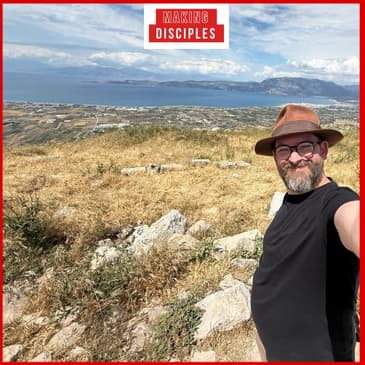
285. Live from Corinth - 1 Corinthians 11
In this episode, Cris is live from Corinth, exploring one of the most debated passages in Paul's letters, 1 Corinthians 11 and the question of women, head coverings, and long hair. Standing in the city where Paul wrote to a church struggling with status and identity, Cris looks at how the culture of ancient Corinth might help us understand what Paul was really saying, and what it means for us today.
Support the podcast with a coffee.... https://www.buymeacoffee.com/crisrogers
Check our Cris' new book - Stuck In The Upside Down.... https://amzn.eu/d/0lyuuzT
To get a copy of The Bible Book By Book head here...
https://www.eden.co.uk/christian-books/bible-study/bible-study-reference-books/bible-background/the-bible-book-by-book/
Rev Dr Cris Rogers is a church leader at allhallowsbow.org.uk and Director of Making Disciples. Chair of the Spring Harvest Planning Group. For more information, check out wearemakingdisciples.com #Heart #Hands #Heart
[00:00:11] Friends, welcome to another episode of Making Disciples. My name is Chris and I am your host. This is the final third episode where I've been recording here in Greece. We've been in Athens the last couple of episodes and now we find ourselves in Corinth. So we've travelled by train
[00:00:32] from Athens to Corinth which is about an hour on the train and now find ourselves here in Corinth. We spent most of the day here in Corinth and I have now, we've got, having looked around ancient Corinth, I'll tell you a little bit about that in a minute, but I've been around ancient Corinth. We then got
[00:00:54] a taxi about 10 minutes up to what is called Acro-Corinth, Acro-Corinth and it's a mountain that kind of sits behind Corinth, so overlooks Corinth and then once the taxi dropped us off, I then did an hour hike from the car park all the way up to the top of the mountain
[00:01:20] where I then have caught my breath and then sat here and I'm looking out over Corinth in front of me and you've got the Gulf of Corinth in front of me as well. And I'm sat here and I'm at a really interesting location on the Acro-Corinth which is the Temple of Aphrodite which is just an interesting place to kind of get here. I'll tell you more about the Temple to Aphrodite and how it might
[00:01:47] help us understand, might help us understand something that Paul says in the book of Corinthians. So we're live again and I'm hoping these podcasts have come out okay, you know, recorded them on my phone here live. So I hope that they're, you know, we've been good. So my name is Reverend Chris Rogers, if we've never met before. Nice to meet you, I lead a church in East London and Becky, my wife and I have just been on holiday
[00:02:17] here in Greece doing some Bible studies out on location and so it'd be really good to do these live recordings from the location. So there you go. Anyway, so one, one welcome to you if you're a visitor of the podcast, one welcome to you if you're a long-term listener, one, one, one welcome to you. It's really nice. And it's been really nice kind of being able to share these moments with you guys and so I hope you've found them as much of a blessing as I have to just stop, pause and record and just think about what I'd like
[00:02:46] to say from these different locations. So we're now late in the day. This is, well I'm saying late in the day. It's four o'clock which is not late but it does close. So Aquacorinth does close so I do need to get back to the bottom before it shuts. So we're going to crack up with this episode. Just exploring
[00:03:07] Corinth, Aquacorinth and particularly Aphrodite and what Paul has to say about head coverings. So let's dive in. Let's dive in. So I'm going to be focusing on the location and I'm going to be
[00:03:35] focusing on a passage from 1 Corinthians 15. So while we're here, so I'm sat at the top of the Aquacorinth. I'm actually sat on a stoned area which is exactly where Aphrodite's temple was. Now some of the stones have been taken, they've been used to rebuild the thing so a lot of the stones are missing. I'm looking out, I'm looking out over the Gulf of Corinth. It's a little distance away but you can see
[00:04:00] it there on the horizon. Right in front of me I've got ancient Corinth. So Bex and I have had a good look around ancient Corinth. Really lovely to go and see the entranceway, the walkway into Corinth to see where Paul would have made his tents. He was a tent maker while he was in Corinth and we've looked around all there. We've been to see where Paul was on trial and we can see the actual footing,
[00:04:26] the property where Paul was on trial there in Corinth. So it's been a really good little walk around to get a sense of the area and the space. I mean Corinth is massive. A few things about Corinth that you know it's just helpful to know about is that Corinth was incredibly wealthy and as a space Corinth was full of trade, it was on a major trade route. It would be often full of traders, sailors who
[00:04:55] brought produce in off the Gulf of Corinth had come up to Corinth to trade and sell. It was a major sale route marketplace. The Agora here was large for selling the produce that had been found. So Corinth was this multi-cultural but yet deeply religious place and it's kind of like what Paul is speaking into in a little bit like you know some of the places we've been in Athens, deeply religious.
[00:05:23] Lots of other religions around, worship to other gods but yet Paul is bringing the gospel in and he's writing in one Corinthians to a church that that met here. How big that church is not entirely sure but one of the the issues here so the city's full of visitors, it's full of traders, it's full of sailors, it's all about income. Status was a major issue here you know how people saw you, how you were seen,
[00:05:50] how you were perceived, major a piece of life here to be seen as glorious, to be seen as wealthy, to have status and then in the church that really became about being seen to be religious, being seen to be holy, seen to have a kind of religious status, holy behaviors that would set you apart of others.
[00:06:15] This is very much a part of the culture at the time. So Corinth there in front of me, just a phenomenal ancient city and now as I said in the intro I've traveled and hiked all the way up to this temple to Aphrodite. Now one of the interesting things is Aphrodite is known as a goddess that was
[00:06:39] worshipped with sex, very often with temple prostitutes. Prostitutes would have shaved heads because having a shaved head indicated that you were available and that's what you were there for. So women and men would have these shaved heads as well as communicating that essentially they were temple prostitutes. And these prostitutes would go down into Corinth where they'd find the traders,
[00:07:09] they'd find the sailors, the city visitors and they would sell their bodies for sex, they get paid for having sex in Corinth and then they would take the money that they've made in Corinth back up to the temple to Aphrodite where it was given as an act of worship. So that's very much the landscape that we're looking at and as I'm looking at it's been really hot here. It's not much green, it's very brown and
[00:07:39] grass is very scorched so it's very hot and that's kind of affecting the landscape. But that's the idea, so on top of the mountain and on the Acrocorinth on the mountaintop you've got a temple to Aphrodite, you've got the village at the bottom full of trade and it's into this place that Paul then speaks. So in 1 Corinthians 11, I'm going to read from 1 to probably 6 or 7, let me just read this through.
[00:08:09] So follow my example Paul says as I follow the example of Christ. I praise you for remembering me in everything, for holding you to the traditions, just as I pass them on to you. But I want you to realise that the head of every man is Christ. Now the word their head is like the head of a river and so there's a flowing going on here. So head does not necessarily
[00:08:39] mean control or authority in the way that we naturally think. I'm going to walk you through, but I want you to realise that the head of every man is Christ, the head of the woman is the man, and the head of Christ is God. Every man who prays or prophesies with his head uncovered dishonours, he says, it kind of goes on. Let me just explain this head bit for a second because that gets
[00:09:03] snickers in a twist. What is Paul saying? Well actually he's talking about wisdom, authority, he's talking about the teachers of God, but you know from God through Christ and into the man. So culturally the head of the household would have been male in that culture. So what you've got going on here isn't about control and it isn't about power, it's actually about you know the head of a
[00:09:30] river was where life flew. So life flows from the head of the river through the river and out, bringing life to the river. So in the same way the man is the head of the river of which Christ is the head of him. So this sacred water, the flow of the Holy Spirit is essentially flowing from upstream down through the man into the family. So when Paul is talking about the head, you've got to understand
[00:09:57] this idea of the flowing of is from one to the other, to the other. I don't think that we're meant to take this as a universal teaching, this is particularly from the culture at the time, but it's really talking about wisdom and the Spirit of God and how all of that flows like a river, bringing life. So the man is meant to bring life to the woman and to the household, bringing life, not control, not manipulation, not power, but life. Then it goes on, every man who prays or prophesies
[00:10:27] with his head uncovered, so his head covered, dishonours his head. But every woman who prays or prophesies with her head uncovered, dishonours her head. So this whole thing about head coverings going on here when praying in church. For if a woman does not cover her head, she might as well have her hair cut off. But if it is a disgrace for a woman to have her hair cut off or her hair unshaved, then she should cover her head. So this is the whole thing about head coverings and it's often
[00:10:56] being used as a way of controlling women. And I think the location does help us understand how to understand this particular passage. So I want to take you just back a bit. So in Song of Songs, 4 verse 1, it's about women's hair and it says, their hair is like a flock of goats descending from the hills of Galead. So women's hair is like a flock of goats descending. It's meant to be something
[00:11:22] beautiful here. This is something beautiful. Song of Solomon 7.5 describes her hair again. So it says, your head crowns you like Mount Carmel. Your hair is like a royal tapestry. Long hair was seen as a thing of beauty. It was a thing of dignity. And if you had long hair, you were dignified. You hear the phrase, long hair is her glory. This is where it's kind of coming from. It's this idea
[00:11:49] that long hair was a sign of dignity. Prostitutes would have their hair cut off because they were not holy. They were not clean. And it was a sign that they were available. So you've got this interplay here between long hair being glorious, a head shaved, a head bringing disgrace. And it's into that that Paul is speaking. So you could say, well, why does Paul care about hair? Why are women particularly singled out? And is this still
[00:12:17] relevant today? What does this mean for our modern churches? Well, underlining, I think this is a cultural thing. I think it's a cultural thing. So I think it's another way, a number of ways of seeing this passage. Firstly, there's what you would describe as the universal command. Is this for everybody? And I really, this is just taking text at face value, not really understanding the context. I think when we do that, you see it as a universal command that everyone everywhere,
[00:12:43] every woman everywhere should have their head covered in church. And I would argue, I don't think it is that. I think this is a cultural verse, understanding the culture of the time. And the challenge is that most of our churches, we would never practice this. We'd never dream of practicing this. So I don't think it's a universal command. I think it's a command that Paul is giving to the church in Corinth. I think there's a reason for it. So we'll get to that in a minute.
[00:13:08] The next bit of this is that, is it a timeless principle? And I'll say no, I don't think it's a timeless principle. I don't think this was for all of time. Women, when they pray, should cover their heads. I don't think it's that at all. I think it's a cultural one. And it's a cultural expression of worship in that locality in Greece. I think within that culture, women covering their heads was a cultural one. So it's not timeless principle. I think it's within time.
[00:13:39] And I certainly think it's a cultural thing that was happening at that moment in time. And I think it was about honour. I think it was about modesty. And I think it was about appropriateness at that time in worship. I think there's something else going on here. I think this is about levelling out.
[00:14:07] So what was happening at the time, you had these women that were coming from the temple of Aphrodite with their shaven heads, converted into Christianity, but their heads were shaven. And it would take them a long while to grow their hair. You've also got women who are very proud of their hair. And one of the issues here was they didn't want to wear their hair covered because they wanted to be able to show off, look at my hair. Look at how amazing my hair is. I've got really long hair. I don't want to cover
[00:14:35] my hair because my hair really is a sign of glory. It's a sign of my holiness. So you had this cultural moment where women with long hair wanted to show off their hair because it was something they were proud of, linked to their faith, modesty stuff. Then you've got these women who had got shaved heads. Their heads are shaved because they're prostitutes. They're unclean. So I think there's something else
[00:15:01] going in here. I think, personally, I think there's a local problem happening in Corinth that was happening around at the time. This is where it comes from. I think Paul is addressing a specific issue and it's not about putting fabric on your heads. I think it's about behaviour within community. Because I think one of the things that was happening was you've got women who got very glorious hair, long hair, didn't want to cover up their hair. They wanted to be seen as holy.
[00:15:24] And they didn't want to be like those other women that had shaven heads who were coming from the temple of Aphrodite, coming to faith, coming down with their shaven heads. And they didn't want to be seen to be like them. So I think as I sit here at the Acre of Corinth, as I sit here in this temple to Aphrodite,
[00:15:51] I think it starts to give us a little bit of an idea of what was going on culturally that Paul might be speaking into. So Paul keeps addressing some of these social markers that were around at the time. He's talking about rich versus poor, particularly talks about this in the Lord's Supper. The rich felt that they should get better seats. There's spiritual gifts being used as status symbols. And there was favourite leaders
[00:16:19] that had some of their own tribal identities that they wanted to keep. And these social markers that talks about honour. And Paul's trying to level all of this off. I think what Paul is trying to do is level everybody. So we are all equal, no matter where you're from, if you're a slave or a free man, if you're a male or you're female, Paul is levelling everybody here. And that's what's going on with
[00:16:45] this head covering, I think. I think it's a symbol that Paul is using to level women all as equal. And I think really, I think the whole letter to Corinthians is about the gospel dismantling status games that were happening at the time. Therefore, when Paul talks about covering the hair, he's actually talking about women with long hair being humble enough to cover up their hair.
[00:17:12] The hair does not bring you glory. The women with no hair being levelled so that they didn't have to feel like they were being noticed for not having hair, being unclean. I think that's what he's trying to do. He's trying to pull it all together, levelling everybody. So my reflection really from this Aqua Corinth here with the temple to Aphrodite is that Paul is trying to level the playing field.
[00:17:41] And where hair was being used as a status symbol, Paul is trying to level it all out. And where people are using their hairstyles as a way of being a status symbol, Paul is freeing us all from that. So he's, and this whole thing about hair being, communicating sexual availability, Paul is levelling all of that. It doesn't matter who you are, if you're hair or not,
[00:18:09] if you're in the sex industry or not, as you meet Christ, we are all even. So I think Paul is challenging the practices here that created first class and second class citizens in the church. I think that's what this is actually about. Paul is challenging the practices that create first class and second class citizens, second class Christians. So you could say whatever the issue
[00:18:39] was, hairstyles, head coverings, social status or something else, Paul is levelling it in his letters to the Corinthians, he is making us all equal. So therefore the gospel is creating a different kind of community, not one that is built on status symbols, but it's one that's actually built upon
[00:19:04] Christ. We're all equal in Christ. We're all the same. We're all one in Christ. And you're rich and poor, you know, we stand together. The Jew and the Gentile, we stand together. The slave and free, we stand together. Men and women, we stand together. Paul is levelling the system, the system of status
[00:19:23] and hierarchy. Paul is levelling the lot. Yeah, you know, it's this idea that we're not all identical, but all equally valued. That's who we are. So just returning back here to the mountain then, as I sit here, where the temple of Aphrodite once was, as it looked over the city,
[00:19:51] whatever Paul meant by his head coverings, I don't think it was about fashion and I don't think it is about oppression. I think he was making a deeper statement. I think when people gather to worship Jesus, they were elevating themselves, making themselves more important. They wanted to be honoured as one
[00:20:16] who stands out. I think Paul is levelling all of that, making us all one in Christ. So I think this is relevant to us. Wherever we find ourselves, whatever town, village or city we find ourselves in, it's not about the hair coverings. It's about making sure we are a church where everyone is equal and that there is no one that's more important than anyone else. And I think this issue
[00:20:44] is not just an issue that Colin found 2,000 years ago. It's an issue that we have today of importance, making some people more important than somebody else. So the challenge, friends, of 1 Corinthians 11 might not actually be about wearing head coverings or not. I think the challenge is about making sure there's no visible markers that are separating people out so somebody is more
[00:21:09] important than somebody else. And I think that discussion is one that's worth having today. It's not just one that affected Corinth. I think it's one that affects us today. Do we do this? We as the church, church. And I'm interested by, I think something really interesting when I look on social media at church leaders with designer clothes. I think there's a way of using designer clothes as a way
[00:21:35] of signifying importance and trend, being on trend. I think there's something going on there. I think there's something about people coming to church in their Sunday best often was about showing what they got, what money they had or status they had by what they wore. One of the things I love about the church that I lead here in East London, we're not worried if somebody turns up in a t-shirt or
[00:22:00] turns up in a shirt. We really don't care. You are who you are and it doesn't matter who you are, what you wear. You are welcome and you're going to play your part here. So I think there's something about recognising all of that and recognising where does the church have status symbols that we don't, is there a particular place that some people can sit that makes other people feel more important? I remember when I first got involved with Spring Harvest years and years and years ago,
[00:22:29] this is a long time ago now, we used to have chairs on the dais, on the stage, and that those that were leading the service would sit on the stage. I remember when I got invited to host the big top, as it was at the time, and I got to sit on the stage in front of everybody. It was the most awkward thing I'd ever experienced in my entire life. You're sat there in front of everybody. It was horrible.
[00:22:52] I hated it. But there was really something that was in that about importance and status and being able to be invited onto the stage to sit at the front. When me and my team got involved with Spring Harvest, I think it was like 2011, we did away with it. One of the first things we got rid of was sitting on the stage. Now sit at the front, on the front row, because it's easy to get up. But even then you have status. Who gets to sit on the front row? So then you do get a whole load of
[00:23:20] knock-on effects there, don't you? But it's just worth thinking about what is their, you know, where can somebody sit? What clothing do they wear? What is communicating status in your church community that Paul might actually be changing here when he's talking about head dressings? He's actually levelling the playing field between women with long hair and women with shaved heads. And I just think that's a really interesting thing to reflect on. So friends, I'm going to say goodbye here. I'm going to have to make my way down to the bottom of the Acro Corinth before we can get a
[00:23:50] taxi back to the station, get back to Athens. So I'm going to head out before I get locked in. Look friends, something to reflect on, isn't it? From this amazing location of Corinth about status and identity. Friends, until next time, grace and peace. Next time's episode, I'm back in the studio. Bless you. See you soon. Bye.