
283. Live from Athens - Acts 17
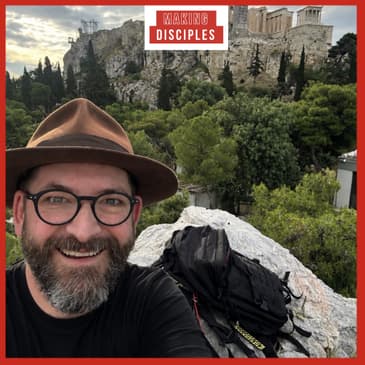
This week’s episode is recorded in Athens, specifically from Mars Hill, the place we encounter in Acts 17. Join Cris as he explores the city of Athens, reads the Scriptures on location, and unpacks Paul’s message in the very setting where it first unfolded. Recorded early in the morning from the exact place where Paul preached to the philosophers of his day, this episode brings the biblical story and the ancient world together in a fresh and vivid way.
Support the podcast with a coffee.... https://www.buymeacoffee.com/crisrogers
Check our Cris' new book - Stuck In The Upside Down.... https://amzn.eu/d/0lyuuzT
To get a copy of The Bible Book By Book head here...
https://www.eden.co.uk/christian-books/bible-study/bible-study-reference-books/bible-background/the-bible-book-by-book/
Rev Dr Cris Rogers is a church leader at allhallowsbow.org.uk and Director of Making Disciples. Chair of the Spring Harvest Planning Group. For more information, check out wearemakingdisciples.com #Heart #Hands #Heart
[00:00:10] Good morning friends, welcome to Making Disciples. My name is Cris Rogers. Friends, it is early for me, I don't do mornings. But just before 7pm, I'm here in Athens. If I sound a little bit breathy, gosh I've just climbed a massive hill because I wanted to film or record this episode today right here from Athens.
[00:00:38] And I'm looking at the Parthenon right in front of me. So right in front of me now, you've got the amazing Acropolis. I've just got the theatre, direct in front of me to my right, I've got the Acropolis itself.
[00:00:58] And I've got the Parthenon kind of looming over the top of me. It's a massive, beautiful Greek temple. And as you walk around, it's just a phenomenal sight. If you've never been to Athens, friends, let me just give you a little glimpse of what it's like here.
[00:01:26] So as you walk around, I'm just approaching now another little site, archaeological dig, where you've got the pillars of yet another temple. This little Roman temple. This one's post, probably post-Paul. But you get this sense that there are temples after temples as you walk around. I'm now looking back up at the Agora.
[00:01:54] And what you know, sorry not the Agora, that's the marketplace. As we look up the Pantheon, in the walls you just see these little niches, these little holes where you would go and you'd put your little idol. And they'd have these little idols that would go in their homes, idols that would go in their pockets. And what they would do is they would put them in these little niches to charge them. They're all in the walls.
[00:02:23] And if I now look over to my right here, you do see the Agora, which is the marketplace. And the marketplace of Athens is just a phenomenal sight. You've got temples and these altars to gods upon gods upon gods. And what's interesting was, I didn't quite understand, you'll hear me say this in the episode, but there's more gods in Athens than there was humans. And I could never quite get my head around that.
[00:02:51] Now, one of the reasons for that is, so let's go with Zeus. You'd have Zeus of Athens, but then you'd have Zeus of Thessaloniki and you'd have Zeus of Philippi. And these were all slightly different versions of the same gods. So there was so many of these gods, so many of these temples, so many of these altars, that as you walk around, you really do get a sense that Athens is the city of the gods.
[00:03:18] It's partly because of the way it's built, this amazing acropolis, and around it all of the altars, all of the temples. But as you walk around Athens, generally, there's just altar after altar after altar, kind of repeating itself. And of course, this is where Paul, in Acts 17, walks.
[00:03:42] As he's walking around the city, it says in Acts 17 that he notices just the number, sheer quantity of temples to the gods, altars, places to burn, little offerings, incense. And I've just walked past a little incense burner, what would have been.
[00:04:06] Imagine a squarish rock with a hole in the middle, and they'd put the incense in there, that's where they'd burn the incense. And this is just all out. Everywhere you go, you'd see these. Now, the top of the, where the Parthenon is, it's just a phenomenal sight around the city. You look out and you see the entire city around you.
[00:04:36] And the temple there is to Athena. To Athena. Athena was the god, really one of the main gods here in Athens. But certainly not the only god here in Athens. So, what we're going to do in today's episode, I'm just making my way up to the Acropolis. And I'm going to find a site just to sit. And I'm going to read from scripture.
[00:05:05] Read from Acts 17. And I'm just going to tell you what I see. And how it might help us understand that particular passage. So, it's a morning Bible study here in Athens. At the site that Paul would have walked. And friends, the street that I'm walking on now, it's kind of swinging round. It's kind of curving round to the front of the Acropolis. And where the Pantheon is at the top.
[00:05:35] And as it's swinging round, on the left-hand side, it's about to emerge a huge rock. A huge rock. And this rock is the centrepiece of the reading today. So, I won't tell you much more about that. But why don't I go find a seat? And we'll sit down and we'll open scripture together. So, good morning. Welcome to Athens. It's good to see you. If you're not a normal listener, I'd love you to subscribe.
[00:06:05] I'd love you to listen to some of the other episodes. A couple of years ago, or a number of years ago, I did some similar from Jerusalem. From Galilee and from Jerusalem. And both who are the same Bible studies. Kind of on the site of the locations that these things happened. So, you might want to listen to those ones as well. Friends, good morning. Welcome to Making Disciples. My name is Cris. Let's dive in and read together Acts 17.
[00:06:33] Right here, in the city of the gods. So, here we go. The city is actually starting to wake up a bit now. So, I'm up on the Acropolis, which... Well, to the side of the Acropolis. I'm on a place called the Aeropagias. We often know it as Mars Hill.
[00:07:03] The Aeropagias. We'll see why that name is important in a second. But I'm here. It's a massive rock formation. Natural rock. During Paul's time would have been a building on top. A temple. A meeting place. An ecclesia. A gathering point. So, an ecclesia. A gathering point. We now know it as a church. It wasn't the Christian church as you know it. But it was a gathering point for philosophy thinking. Debate.
[00:07:29] They want to really understand the world. The universe. Everything. You name it. And this is right at the foot of the Acropolis. With the temples to Zeus and Artemis. And Athena. The main god here. Athena. So, let me just walk you through this for a second.
[00:07:55] So, in Athens you had the Epicurean, the Stoic philosophers. And they loved debating. And the Aeropagia. They were the council. So, the Aeropagia were the council of elders really. They used to meet in this ecclesia here on top of Mars Hill. And Paul walked this city and just saw the sheer number of altars. So, to my right is the Marketplace.
[00:08:24] And that is where you see more temples, altars all over the place. You name it. Every god is there in some shape or form. You've also got the Market Square. Which has been kind of reinstated or rebuilt in recent years. I mean, just to see it is this epic. I would say, I mean, off the top of my head. You'd be somewhere like a 200 metre long colonnade. Market stalls inside. Indoor market.
[00:08:54] And that's where people would be there selling their wares. And you'll see that that comes up in the passage I'm about to read to us in a minute. So, you've got these locations very close to each other. And where I'm start, I can just see here some old altars, bits of chipped rock, which really were the old, you know, broken bits of altar. And that Paul walked past as he walked around the city. Now, I've been to a lot. I mean, all over Turkey, the seven churches of Revelation.
[00:09:24] I've been to Jerusalem. You name it, Galilee. You don't see what I'm seeing here in Athens in terms of the sheer number or quantity of gods. These guys collected gods. And one of the things that I read a little while ago was they were so keen to make sure that they didn't miss out a god that they sent people. It was somebody's job to go out around the world looking for more gods to bring back just in case there was one that they'd missed. And 400 years before Paul, there'd been a plague here
[00:09:53] and a quarter of the population had died. And they'd given sacrifice to the gods and there was no reprieve. The sickness continued and we think it was typhoid. And they got to the point where they didn't know what to do. The gods weren't helping. So they got sheep and they sent the sheep out, let the sheep roam. And where the sheep died, they knew that those gods weren't healing gods.
[00:10:21] But where the sheep went that didn't die, they knew that there must be a god there that was protecting them. So they gave altars and created altars. And on those altars they wrote to the unknown god. We don't know which god this is or who you are, but you seem to be doing something. So I'll give you an altar. And it was called the altar of the unknown god. Now you actually see these all over. Now there isn't any altars to the unknown gods left. The Christians destroyed them.
[00:10:47] We were very good at getting rid of pagan gods, smashing their faces off. But there is one in Rome. If you ever get to visit Rome, there's a museum in Rome, the Rome Museum, and they've actually got an altar to the unknown god. In Latin on the front it says the unknown god. So Paul had walked the city, he'd seen these altars, and he'd seen the altar to the unknown god. A couple of phrases, I mentioned it before, but Athens was known as having more gods here than men.
[00:11:17] Because they collected gods. And they knew that there was a god out there that maybe they didn't know. So they were looking at collecting more and more. So Athens was known as the city of gods or a place where there was more gods than there were men. And this plague had happened in 430 BC. And these altars were then built, extra altars to the unknown god. And Paul walks around and he, you're going to read the reading,
[00:11:46] but you're going to hear him say, I see you are very religious. Is there anything else I want to tell you? Yeah, as we walked around, I did not, you just noticed the number of idols in the walls, the shrines, the sacred imagery. And there were statues of gods and altars to gods and incense to gods. And a lot of that you still see as you walk around.
[00:12:12] So let me read to us together, Acts 17, 16 onwards. So Paul was waiting for his friends in Athens. He was greatly distressed to see that the city was full of idols. So he reasoned in the synagogue with both Jews and God-fearing Greeks. Now they've not dug up the synagogue. They've not found the synagogue. They possibly could find the location, but they haven't dug it up because they've only dug up a small proportion of the historical site of Athens.
[00:12:41] Because there's properties here, you can't dig up underneath the property. But they have found remnants of Jewish symbols and fragments that show a menorah candle on there, the Jewish candles. So we do know that there was synagogue somewhere not far from the marketplace, the Agora. So Paul reasoned in the synagogue with the Jews and God-fearing Greeks as well as in the marketplace. That's the Agora that I've just talked about day and day and day.
[00:13:09] With those who happened to be there, a group of Epicurean and Stoic philosophers began to debate with him. Some of them asked, what is this babbler trying to say? Others remarked, he seems to be advocating for foreign gods. They say this because Paul was preaching the good news about Jesus Christ and the resurrection. Then they took him and brought him to a meeting of the Aropagius. Now that's right where I'm here, Areopagus Hill.
[00:13:42] We now call it Mars Hill, but its name is the Areopagus Hill. Where they said to him, may we know what this teaching is that you are presenting. You are bringing some strange ideas to our ears and we would like to know what they mean. All the Athenians and the foreigners who lived there spent their time doing nothing but talking about listening and listening to other ideas. So what they would do here is they would gather just to hear about the new things.
[00:14:12] The new technologies, but the new technologies of gods. You know, what do we now know about a god that we didn't know about God? And they'd come here to learn these latest ideas. Paul then stood up in the meeting of the Aropagius and said, People of Athens, I see that in every way you are very religious. I love that. It's the politest way of saying, gosh, you've got a heck of a lot of gods. See, very religious.
[00:14:40] For as I walked around and looked carefully at the objects of worship, I even found an altar with the inscription to the unknown god. So you are ignorant of the very thing that you worship. And this is what I'm going to proclaim to you. The God who made the world and everything in it is the Lord of heaven and earth and does not live in temples built by human hands. And he is not served by human hands as if he needed anything.
[00:15:09] Rather, he himself gives everyone life and breath and everything else. For on one man, he made all the nations that they should inherit the whole earth. And he marked out their appointed times in history and the boundaries of their lands. God did this so that they would seek him, perhaps reach out for him and find him. Though he is not far away from any one of us. For in him, we live and move and have our being.
[00:15:38] As some of your own poets have said, we are his offspring. I love that. He's quoting their own poets. Poets kind of back at them. So, therefore, since we are God's offspring, we should not think that the divine being is like gold or silver or stone. An image made of human design and skill. The past God overlooked such ignorance. But now he commands all people everywhere to repent.
[00:16:07] For he has set a day when he will judge the world with justice. By the man he has appointed. He has given proof of this to everyone by raising him from the dead. When they heard about the resurrection of the dead, some of them sneered. But others said, we want to hear you again on this subject. Out that Paul left the council. Some of the people became followers of Paul and believed. Among them was Dionysus, a member of the Areopagus.
[00:16:35] Also a woman named Damaris and a number of others. So, Paul's gathered on this rock that I'm on and he's debated in probably this little ecclesia, this gathering point is debated with them and some have come to faith and some haven't. Well, Paul says, I see you are very religious. One thing I'm just reflecting on as I walk around Athens is this.
[00:17:03] Paul has realised that the altar was a way of edging their bets. Edging their bets. They want to make sure that they've at least pledged their allegiance to the right God at some point. And to pledge and to edge their bets. They're building altars after altars, temples and burning incense. And it's their way of just kind of going, oh, I hope this is enough. I hope this is right. I hope this is the right one.
[00:17:29] And it's almost like the phrase, I hear it a lot in East London, say one for me, Vicar. Vicar, say one for me. And it's like edging your bets. You know, give me a prayer just in case it's helpful, just in case it's good, but I won't bother doing it myself. When people say to me, Vicar, say one for me. I often respond back to them saying, I'll say one with you. I'll do it with you. Let me come over and I'll pray now. Same for me.
[00:17:57] The other thing where we edging our bets is going to church at Christmas, going to church at Easter and nothing else. Edging our bets just in case this is actually something important. I'm going to go. But it's not that important to me because if it was, I'd be there every week. So I'm edging my bets. I'm going to come just when it kind of suits me. They are edging their bets. Friends, where are you edging your bets?
[00:18:26] I had a conversation recently with someone who claimed to be a Christian. And as I talked to them, what I realized was they believed that Jesus is Lord and Savior, but they also believed that Allah was God and Lord and Savior. The Buddha was Lord and Savior. They were basically universalists. And although they went to church, they said, I believe all roads lead to God.
[00:18:55] And that's edging your bets. That's saying, I'm just in case one of these others is away. I say they're all away. And it's a way of edging your bets. All religions are the same. And friends, they are not. Jesus claims to be the only way, the way, the truth and the life. And if Jesus is the only way, there's not a similar way found in Islam or in other religions.
[00:19:24] There's not a similar way. Jesus is the only way. And I think it's a challenge to me about where are we edging our bets? Where are we hoping that we might be able to broaden the scope just in case there's another way of getting into heaven? So Paul says, I see you are very religious. Let me tell you about the unknown God. This God that you've got the altar to. Paul says, let me tell you about him.
[00:19:53] So there's three responses as you read in the text. In verse 18, you have mockery. What is this babbler saying? I love all that phrase. What is this guy, what are you going about? Like, what an idiot. Verse 18, one of the responses is mockery. Sometimes when we share our faith, like Paul, there's mockery. You're an idiot. Who do you think you are? You're a fool. Who make, you know, what makes you think that you know that you know more than I do? That mockery.
[00:20:21] Verse 18, what is the babbler saying? Then in verse 20, the next response is what I call curiosity. We want to know what you mean. They say we want to know what you mean in verse 20. Some people respond with, what are you talking about? Others respond with curiosity. Hmm. I want to know what you mean there. You know, give me a little bit more. I'm curious. I'm interested.
[00:20:51] I want to know more. And one of the things I've noticed is there's been a lot more people surrounding me at the moment where there's just curiosity. People are curious about faith. And then verse 34, you get another response. And I entitled this one, belief, I think. You know, a few of them became followers of Paul and gospel. Wow, you hear that? That's the church. What a beautiful bell.
[00:21:20] And actually, this is funny, I'm just turned left and walking now down the, from the Acropolis, you've got about 10 military officers with guns. Anyway, sidetrack. So, three responses to Paul preaching the gospel here in the Aropagius on Mars Hill. Mockery, curiosity and belief.
[00:21:47] Now, friends, more often than not, you'll get mockery. I'm finding at the moment quite often I'm getting some curiosity. And then if the spirit is at work and the person is ready, you might get belief. And that's what Paul sees here. I think there's something encouraging for us, isn't there? In that Paul preachers and not everybody comes to faith. Because he might often say, well, you know what? If Paul was here, he'd have converted my friend. Eh, not necessarily.
[00:22:16] I think there's something about Paul that made him a little bit bonkers. A little bit bonkers. So let me just end this thought. Paul's filled with passion. Filled with passion. He preaches the gospel. He gets brought up here to the Aropagius, Mars Hill, right in front of the Acropolis. Some people laugh at him. Some people are curious. Some people come to faith.
[00:22:46] I was reading the other day that Greece is now 80% Christian. Now, how much of that is Christians who really, really love Jesus? I don't know. But from a city where there's thousands of gods to a city that now claims to follow Jesus. It was all because of a man called Paul who brought the gospel here.
[00:23:07] I was willing to debate in the Aropagius, in the Ecclesia, the town kind of square for thinking of philosophy. So here's my last thought. The people of Athens were giving sacrifice to the unknown God. What they didn't realize was that this God had already given sacrifice for them. How often are we seeking out God to find that God has already sought us out?
[00:23:36] We look for God for answers and God has already given us an answer. We look to God for a saviour and he's already given us a saviour. The people of Athens were giving sacrifice to the unknown God. What they didn't realize was that this was, that this God had already given sacrifice for them. Shall I pray? Heavenly Father, we thank you that your gospel is rooted in real places, in real times.
[00:24:07] We thank you, Lord, that we can experience your word in these places differently. And Lord, where we're ignorant, where we edge our bets. Lord, would we turn to you fully, turn our hearts to you fully.
[00:24:28] And Lord, for our day ahead, would we not be surrounded by the unknown, but would we be surrounded by you? The one of which we live and breathe and have our being. I pray that in the risen name of Jesus and all the saints said, Amen. Amen. Friends, have a great day. I'm going to go now and explore Athens a little bit more.