
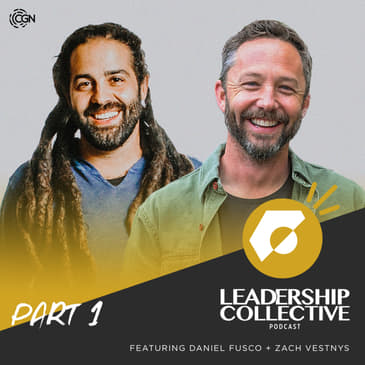
Rob Salvato is joined by Daniel Fusco (Crossroads Community Church) and Zach Vestnys (Calvary Petaluma) to talk through building a flourishing culture of partnership and collaboration amongst our church and ministry and teams.
---
Crossroads Community Church - crossroadschurch.net
Calvary Petaluma - calvarypetaluma.org
[00:00:00] This podcast is a part of CG and Media, a podcast network that points to Christ. We are supported by listeners like you to help us create more great shows, visit cgmedia.org slash support.
[00:00:12] Welcome to Leadership Collective, I'm Rob Savato and I'm hosting solo today as my co-host at 11 Worth had an emergency situation he had to deal with, but we have two great guests on the show today,
[00:00:25] joining us for a return visit is the man with the cool dreads, Pastor Daniel Fusco, pastor of Crossroads, Community Church in Vancouver, Washington. And joining us today for the first time is one of the most humble and encouraging pastors I know,
[00:00:42] Pastor Zach Vestnys of Calvary Chapel, Petaluma, California. And today we're going to be talking about building a collaborative culture in your church team. What is it? What is a collaborative culture? Is that a biblical concept? What does it look like?
[00:01:00] What are the advantages and challenges of developing that kind of culture in your team? So, we're going to be talking about that and more and so now here is my conversation with Daniel Fusco and Zach Vestnys.
[00:01:16] When you have different personalities in there, you get a view of all those different things assuming that your team that you're talking to is not homogenized. And I think that that's a very powerful thing. Welcome to the program guys!
[00:01:32] Man, it's so good to be with you Rob and with Zach, oh man, it's so good to see you guys. It's great to have you. Thanks for having us. Good to see you, Daniel. Good to see you Rob.
[00:01:42] Absolutely. This is going to be a great conversation. Two of my favorite guys here, so this is awesome. And let's start by talking about how long that you have been pastors of your respective churches and maybe how big your staff is. Daniel, why don't you go first?
[00:02:01] So I've been here across the community church in Vancouver, Washington in the Portland Metro area. Now for 12 and a half years I've been the lead pastor for over 11 years now. And there is about 48 full-time employees at Crossroads. Is that just church? Just church.
[00:02:22] When I got here we had a school associated at that point. Our staff was 140, but then we separated the school off. I guess about eight years ago. But you know, 48 for just the church staff.
[00:02:37] And Zach, I was just up at your church a week or so ago meeting with your staff, which I think is an amazing group of men and women. But you have eight full-time staff people in one part-time staff person who is your wife who actually works.
[00:02:56] Does the work of a full-time person? Is that an accurate description of your staff? Yeah, exactly. Yeah, so great group, a little bit of a difference there. I like this a different perspective and we're right in the middle.
[00:03:12] We have a full-in part-time about 20 on our staff at Calvary Business. So we'll hit all the spectrum here. So let's start. We're talking about collaborative culture and why don't you give me a definition of what that means to you? Let's say or what you think.
[00:03:34] How would you describe collaborative culture? I'll go first. Yeah, so I was looking up collaborative just the definition. It means people working together for a common purpose. Yeah. And so I think about what that looks like in our church.
[00:03:54] It's not just different people doing different parts but I think it's people contributing to each other's art. So in ministry, I have ministries that I'm directly responsible for and then people that I work with that are responsible for other ministries.
[00:04:13] So in a collaborative culture, I want people who are not involved or responsible in my ministry still to speak into it. That's what I really look at as collaboration. Well you Daniel, how would you describe collaborative culture?
[00:04:29] Yeah, the same way as Zach, I always try and think about it in the biblical terms of where one body with many members and each member plays its part.
[00:04:39] And so I think the idea of collaboration is allowing all the different giftings and skill sets within the body of Christ to be able to work together. What be it as, you know, the totality of what a local church can be but also at the individual ministry level.
[00:04:57] There are people who are visionary and there are people who have the gifts of administration and there are people who are really interested in how things look the aesthetics of it.
[00:05:07] So there's all these different facets to ministry and so really creating cultures within churches where all the different giftings can play a part. And that'd be not only endured but welcomed something that we champion were excited about.
[00:05:28] Daniel, when you first came to Crossroads, did it have a collaborative culture? When you arrived there, I know it had been a church for like 30 years prior to you coming. Did it have a collaborative culture at that time?
[00:05:47] Yeah, when I got to Crossroads, I mean Bill Richie our founding pastor, Pastor the church for 36 years before I arrived started in Founder.
[00:05:54] And it was collaborative. He had an executive team that he worked a lot with, but I think at the time that I got here, Bill, if you know Bill Richie is uniquely brilliant, he's kind of a force of nature and he's like a one man creativity thing tank.
[00:06:13] It's really incredible to talk with him still and to see how God uses him. So, but it was a collaborative environment, but ultimately I think at that point because he was such a force of nature,
[00:06:28] it's like people would collaborate and then we get to Bill and Bill would make all the choices.
[00:06:32] And so for me, I got to walk into a collaborative culture, but my goal was really, I wanted to be collaborative across the board that I wasn't the end of the funnel where I had to make the decision,
[00:06:43] where I just really want everyone to be working together and it happens outside of my influence as lead pastor or my authority as lead pastor. And it just becomes a pervasive part of the culture.
[00:06:55] Are there any instances in the culture there where you do have that final say and exercise that or do you just keep it pretty broad?
[00:07:09] So, I mean, I always like to tell our staff that if something goes great, I'm going to get the credit but I don't deserve it. If something goes wrong, I'm going to be the one who's in trouble for it.
[00:07:18] And so, but for me, I'm allowed to sign off or I'm all just like something or I don't prefer saying, but the team that I have is incredible and they've been a like for my executive team has been together for eight years.
[00:07:33] And so, everyone kind of knows how things, you know, how we want things to go. And so the team is so good and we've done so much work to really make sure that we're all happy with where things land and how they land.
[00:07:45] That now I mean, like, I haven't been in a hiring interview for somebody in seven years. So I like people get like, I came back from a summer break about four years ago or five pre-pandemic. They hired ten people all.
[00:08:03] And I'm like, am I going to know anybody on our staff? Oh yeah, you're the guy here. And so, so, but I really wanted my team to be really empowered and I realized that unless I was hiring somebody, especially the way we're structured given so many employees.
[00:08:19] There's only so many people who are on my immediate team. And obviously if I was hiring someone who's going to work directly like in my, you know, my executive team, I would definitely be a part of it.
[00:08:29] But I would never hire that those positions from the outside because it's just you need someone who already gets the culture gets what we're trying to do.
[00:08:36] And so, yeah, so I mean, our goal is full empowerment and collaboration that happens and mostly I'm just like, oh, that sounds great. Oh, that's wonderful. Oh, who made up that? That's a great idea. You know, it's not as pretty much outwards now.
[00:08:49] You know, Zack, you've been the lead pastor at Cal Repetalumina for 20 years. And that was just incredible because you're only 30 years old. If you could see Zack, he's he's a young good looking dude. Anyway, but I'm sure I'm.
[00:09:10] Yes, he's not lying. He's not. I have no. I was Google in Zach right now. He's actually 44 right 44 or 46 44 44 44. But he he looks like he could be 30.
[00:09:27] But I'm guessing that your staff culture has looked a bit different over the years, especially. I mean, you started as a senior pastor really young and taken over that church. How long did it take you to create the kind of staff culture that you wanted?
[00:09:49] That's a great question. I mean, when I got hired the guy who planted the church here in Petaluma said, hey, I might not see you for a month.
[00:09:59] I'm not talking to you, but I'll know if you're doing your job because I'll see the fruit and so that was kind of the culture that I walked into. And a lot of freedom in one sense and it was a church plant too for all intents and purposes.
[00:10:14] So, but to answer your question, I think it's it's just been a work in progress all along the way. It's something I knew I wanted right away because I was 24 when I was handed the responsibility of this church.
[00:10:29] So, I knew I need people that have experience in wisdom and knowledge that I don't have. So, but I would say that I think seeing the value of collaboration ideally.
[00:10:45] And then actually doing it in reality are two very different things, right? There's a gap between the ideal and the practical or the reality. So I think it's still something that we're working on here diligently to have a healthy collaborative culture.
[00:11:04] And what's challenging is that each season of ministry, each new staff member changes the dynamic. So you kind of are constantly readjusting and it's just a work in progress. I'm happier than I've ever been with it after 20 years, but it just still feels like an ongoing work in progress.
[00:11:28] It's interesting, Daniel, I was just up at Zax Place doing a leadership training for them and they're leading me back to the area where the staff works.
[00:11:39] And I'm expecting to walk into this space where I see all these different offices. It's one long table and everybody's sitting around the table.
[00:11:49] I was blown away. I was like, this is where you guys work all the way around a table. I thought that's incredible. I don't know if I could do that. I think you're pretty far along and a lot of people in that collaborative culture aspect, Zax.
[00:12:09] But let me ask you guys, what are the benefits and challenges of having a collaborative staff culture? For me, the benefit is two heads are better than one. There's wisdom in a multitude of counselors.
[00:12:28] And every point of view is a view from a point. Everybody sees things differently. Everyone has different things that they enjoy, don't enjoy. I'm also getting older or more aware that different people are looking for different things from their church.
[00:12:44] Some people are looking for communities. Some people are looking for an experience. Some people are looking for counseling and friends. Some people are looking for quiet spaces. Some people are hoping for a more contemplative space to use the lingo.
[00:12:59] And other people are looking for something else. When you have different personalities in there, you get a view of all those different things, assuming that your team that you're talking to is not homogenized.
[00:13:11] And so I think that's a very powerful thing because we use the idea of that we have an idea meritocracy, which means we don't care who the best idea comes from. We just want it.
[00:13:26] And so whether it's somebody who works in our maintenance department or whether it's a pastor doesn't have to come from me or an executive pastor, I just want the best ideas. I don't care where they come from.
[00:13:37] So by creating environments where brainstorming is normal, nobody gets made fun of for the most absurd ideas and I'm grateful for that because I'm that guy with like what if we just think about this the most crazy way to do it this way.
[00:13:50] And I was like yeah, pastor, we may not want to do that for these five reasons and I'm like oh, yeah that makes sense.
[00:13:56] And so I think that's the benefit of collaboration when people are working together. Also, I mean like we bring in our accounting and finance team operational people because oftentimes I think what pastors do is we just want to we want to see the end
[00:14:09] We want to get to a spot and then the operation people like well listen in order to do that you need X number of dollars is going to take this amount of time there's permits that are needed and you're like oh really I don't know that.
[00:14:20] I know that like oh yeah totally we have to get it we have to talk for lawyers about that because you know like oh great to know and so having all those voices in there.
[00:14:29] It makes us smoother process and then and also everybody owns it then it's not one person only it's everybody owns it when you have that high ownership man would we're one can drive back a thousand and two could drive back 10,000 it's like I want that.
[00:14:44] What about you exact what are some of the benefits that you see. Yeah, and I think I think Daniel covered it so well just picking up where he left off.
[00:14:55] Just saying it saying it a little different way I think the more people help build something the more buy in. They have the more belief they have in something that they help build and so think that's a huge benefit.
[00:15:08] I think it also increases unity when people are involved and not just sort of being told this is what we're doing. There is a greater unity in the body.
[00:15:18] I think it helps with communication to collaborate because people aren't just hearing the end result but they're involved in the process along the way. And yeah, I think that I think in a indirect way it helps build relationship and trust which which are so vital.
[00:15:39] In search and in our community is to have solid strong relationships and trust in one another and I think the process of collaborating to build something. Really indirect way that relationships are built up in a beautiful way.
[00:15:57] You know, I was thinking about what Paul wrote in Philippians chapter two when he says, There are four if there's any consolation in Christ, any comfort of love, any fellowship of the spirit, of any affection and mercy.
[00:16:11] For fill my joy by being like minded, having the same love being of one accord in one mind. Nothing be done through selfish ambition or conceit but in loneliness of mind that each esteem others better than himself and that each of you look out.
[00:16:29] Not only for his own interest but also the interest of others and I love that passage because it really hits on this idea of, you know, one that the Lord's desire that we would be of one accord and that we would be of one mind.
[00:16:46] In order to do that you sort of have to do the second part of what Paul says, to lay aside your own ambition, lay aside conceit to be humble to a steam others to realize, you know, maybe my idea isn't going to be, you know, the best idea in this particular situation.
[00:17:10] But that can be challenging, can't it, in order to try to establish that amongst a group of people, especially the bigger the group is, the harder it seems, what are some of the challenges maybe that you guys have seen in developing this culture and maybe if you could give some ideas on how you've dealt with some of those challenges.
[00:17:36] Any thoughts on that, Daniel? Yeah, I mean I think the biggest challenge to collaboration is flesh and ego and insecurity.
[00:17:46] One of the things that we've done is we laid a foundation that, you know, collaboration is part of our staff values but we said that all plans are written in pencil.
[00:17:56] And what that means is that we can erase it and change it because what happens sometimes is people really love their ideas. Yeah.
[00:18:05] And, and it's kind of like don't mess with my baby or if we've, you know, especially, you know, as all the churches that we lead are more established, especially if there's some history of success with an event.
[00:18:19] Then it's like whatever you do, like don't mess with this because, you know, back in the 90s, this thing was crushing the world, you know.
[00:18:26] And so we can't mess with this thing and so that, that, the pride, the insecurity also I mean I think, you know, for more senior leaders, you know, the stereotype of the autocratic pastor who their ideas can only be the one that we do, their ideas is always the best.
[00:18:45] You know, I think when people roll that way at some point you have people don't have anything to say. They don't want to collaborate because they don't that their time isn't going to be valued and their input is going to be poo pooed for no good reason just because the senior pastor didn't come up with it.
[00:18:57] Now, you know, and so I think all of those things are hinderances to collaboration.
[00:19:03] And so, um, I think the idea then is like you have to create an environment that say because we're going to collaborate on this, you have to come in with your ideas, written in pencil, knowing that when,
[00:19:14] if we do it, it may not look exactly the way you think it's going to look. But we can trust one another and even if none of us get everything we want, we're going to see what we do, we're going to, we're going to, we're going to,
[00:19:28] God's going to move and we're going to after action at after and see what went well, what didn't go well, what do we need to change?
[00:19:34] And that's also part of the collaboration process after you do an event sitting down looking at what you did, did it work, did it hit the things we were trying to make it hit it and how why did it fail.
[00:19:44] And oftentimes we'll find that the reason it failed is because someone's good idea didn't get action, for favor of something else for another reason. And then when the next time you go to do it, we just put that good idea in because we realize we were missing it.
[00:19:57] And so for me, I think just really human emotions and insecurities and ego and flesh and pride really getting away. Well, I'll use that. We're some of the challenges you see.
[00:20:12] I think efficiency is a huge challenge to collaboration. People just feel like it's an inefficient process if you can just, you know, make a, a system or something that just hammers it out automatically.
[00:20:25] It will be more efficient. I would argue it might not be better or also always produce a living thing and so I think I think efficiency is a challenge. I think collaborating feels like more work sometimes.
[00:20:41] It feels like we could just go get more, like, so productivity. We could just go get more done if we now sit around talk to other people about it. And then I think that I think that the relational work that's required when you're seeking to collaborate.
[00:20:59] It just feels like twice or three times the work. It's like, okay, what we're doing the work, but then trying to do it with other people is creating more work because this guys tweaked about that or, you know, this person's rubbed the wrong way by them.
[00:21:13] And I would argue, this is, this is hard still for me to see, but I would argue, oh, that actually is the work.
[00:21:21] You know, whatever we're doing is part of the work also, but all that little interrelational stuff is probably pastorally more the work than even the product itself if that makes sense.
[00:21:36] I love that, that's such a great point. And Zach, you, we kind of talked about this a little bit when I was up with you guys of
[00:21:45] sometimes when you're whole team is trying to collaborate on something, you guys have experienced a little bit more of that frustration than when you maybe narrow things down. At least at the start to a smaller group of people.
[00:22:06] How have you guys thought about that since we talked about that a couple weeks ago? Yeah, we have a couple of principles I think that have helped us because in the beginning we would just round table every single thing and it would just get so bogged down.
[00:22:25] And so one I think we use this principle criticism kills creativity. So when we're in the brainstorming phase, the whole goal is just get as many ideas out as possible and we're not criticizing any of them along the way.
[00:22:41] Because the minute you start to critique people start not putting their ideas out there because they don't want to feel dumb or they don't want it to get shot down.
[00:22:50] So that's one principle and then I think another principle when it comes to the whole group, we try to invite people to bring proposals.
[00:23:01] And then that there's a really clear distinction, okay if we're brainstorming more in one year where there's no criticism we're just trying to get as many ideas we can fill the border the paper with.
[00:23:13] But on the other hand, if you're bringing a proposal then you've already thought through a lot of this you're actually proposing it and all we're really looking for is hey are there any holes that aren't being seen or is there any maybe.
[00:23:28] And then we're trying to find our improvements that could be suggested but all that's done with an open hand.
[00:23:34] Because by the time someone's coming at the proposal they're carrying a lot of responsibility for it so we're not deciding by committee at that point we're just offering up the best I love what Daniel said if.
[00:23:45] If you can get a group of people that are really truly chasing the best idea.
[00:23:51] Because what happens and we all do it is we we get our value tied to our ideas and if my idea doesn't get selected then my value is diminished and that's just that's something you don't want to creep into your culture or you won't get the best ideas.
[00:24:09] I like that that's really really good.
[00:24:12] I think that's a thing to that another challenge might be with an ideas that some people on your team know that this idea is maybe going to affect their workflow in a way where like they're going to have to work harder and maybe a little bit more it might mean oh you know I've got some Saturdays to put in if we're going to do this and so.
[00:24:37] You guys are refined that to be a challenge absolutely. Yeah, well I mean every project there's a time component but I think the beauty also of when you have a collaborative environment is you have to be better planned.
[00:24:53] And I think that's one of the things that and I didn't know this when I was church planting before I got to crossroads you know because they just you know the father son the Holy Spirit the Bible a lot of caffeine and me.
[00:25:05] And it was fun and kind of crazy but like when you have like a people and there's you know there's staffing and their families and you care about their families so you're not looking as like grind them out and you want them to do a good job.
[00:25:19] That is absolutely a factor in what we do how we do it why we do it and what do we and and sometimes in the collaborative environments that we're creating sometimes a big look if we want to do that then what are we going to move off of the church calendar.
[00:25:35] And that's like and that's like an important discussion because what it ends up doing is you have to ask yourself like what really is the most important of what we're doing.
[00:25:45] And so like one of the things that we do like right now it's you know as we're recording it it's it's almost June and so we're already you know, so technically it's totally like halfway out the 25 church calendar.
[00:25:59] Because a lot of the stuff it's not because we're so organized, it's just like Easter is Easter, Christmas is Christmas the fasting leading up to Easter is happen at all these times and then we know when our ministries are launching and when
[00:26:11] they're taking breaks and all this stuff, we know new series, all these things. They're kind of etched in the calendar and then we know when our women's conference is going to be, we know when this is going to happen.
[00:26:20] We know that we always do this at this time. So we're starting to plan that out so that we can with our ideation brainstorming times, we can say, well, look, if we're going to do that, we should probably look at doing it
[00:26:33] in this time frame or else it's going to run over this thing or this thing or this thing. And we really want our staff to be healthy and not just doing a lot of work and then burning out. Yeah, that's good.
[00:26:44] Does your team collaborate on everything and in every ministry or is it just bigger events and special events that happen? How's that work for you guys? Zach? For us, I would say we collaborate on everything to a degree.
[00:27:05] So for instance, when our kids ministry team is going to add new volunteers to the ministry, they just bring it to the team and say any red flags. Because there's different layers of relationship throughout the body.
[00:27:24] And so it's not necessarily that if there are red flags, they can't move forward or any of that. But we just want as much feedback and crossover as possible. And so that's to the degree.
[00:27:35] I would say we do invite collaboration on just about everything, but only to a degree and not everything to the same degree. So there are some things that we do, some events that would require the whole team to be involved to pull it off.
[00:27:54] That would be an obvious, obvious collaborative situation. There's other things where each individual ministry, like I said, we just want input. We want visibility, we want accountability. One transparency, but we try to tune it in a way where it's not going to unnecessarily frustrate or bog people down.
[00:28:17] But just open up the systems a little bit. So there's fresh perspective, fresh, fresh insight. What about for you? Daniels, do you guys collaborate on everything? Or, and every single ministry does everybody get to speak into everything going on there? Is it more separate?
[00:28:36] I know your church is a little bit of a bigger church than our church and Zach's church. Was that look like it, crossroads? So yeah, there's a difference between collaborating to start an event or to do something
[00:28:49] fresh and then collaborating of the stuff that we're doing all the time. So because we value collaboration, there's a lot of touch points. So when it comes down to starting an event, we'll normally put together an ad hoc team of different people. But let me give you example.
[00:29:06] So our discipleship-based ministries, men and women and young adults, celebrate recovery and all these things. That's our discipleship team, we call it our team. And in that team there's four pastors, there's four administrators. So like them, that's like a person brainstorming team.
[00:29:27] And they're living in the life of that ministry. And so obviously they could just iterate and brainstorm and collaborate on their own. But then as it relates to other things, they'll bring in different things. And so I mentioned the after action.
[00:29:43] Anything we do, we actually have an after action meeting for it. So every Sunday, we have an after action with people from our worship arts department, our tech department, pastoral staff, all the key stakeholders to talk through what happened
[00:29:58] on Sunday, what was good, what needs to be adjusted, what did we break, what we surprised worked well. Because we are constantly wanting people to be speaking into something that we do every Sunday, Sunday morning.
[00:30:11] And so we do the same thing for our midweek, all of our events, we plan an event. And then we after I, so like let me be example, like we're going to have our vacation Bible school, we normally have about 750 kids at our VBS.
[00:30:25] And it's, and it takes 300 volunteers and the whole thing. It's like, it's a campus, what all hands on deck. So we've been doing VBS obviously for a long time, like most churches. It's like our summer Bible camp.
[00:30:39] And so but each time we do it right after we, after action, we put in place next year we're going to make sure we do this. We're going to, we have to adjust this. We document all that stuff.
[00:30:49] So when it comes time for the next VBS, we pull out our most recent documentation on what we learned last year and the last couple years. We keep it all. And then we're like, okay, how do we want to do this? We have all this.
[00:31:01] Do we want to change anything? So we're constantly always looking to make incremental improvements on everything. I mean, like literally everything that we do, we're never content just to keep doing it the way we're doing it. We're always looking just small tweaks, sometimes major overhalls.
[00:31:21] That's always happening at crossroads. And so for our folks here, we always say like when people are wanting to come on staff or we'd like, look, do you like a collaborative environment? Like I was like, we know everyone says, yes, but like do you really like it?
[00:31:33] Because if you don't like it, you will not like it here. Because like even like my, you know, my sermons, I get after action material from my team and from people on staff about like, hey, you know this or this piece or
[00:31:45] hey, we have to be a little careful with this. You know, because we want they could just make it better culture. It's a, it's a, it's a, this is key. If God's going to be glorified by it and if we're going to take the time to do it,
[00:31:56] we want to have the most impact, we want it to be the best we know how to do it. And that just takes constant, constant work. And so that's kind of how we, so we're trying to bake it into everything. Like nothing's off limits.
[00:32:11] Nothing, nothing is like we can't talk about that. Anyone can speak into anything. So if I'm hearing you write down, you're saying that that group of 48 is broken up into different teams that collaborate together. Probably rarely do you have 48 people at one time all going after something.
[00:32:35] Because that just seems like that would take forever to get even some ideas. And then in the midst of those different teams, are there leaders then that come together and maybe share the ideas from the teams that they oversee? Is that kind of how it works? Yeah.
[00:32:55] I mean, so obviously like the more staff or or key volunteers you have, the more you have to structure what you do. So obviously like having a 48 person collaboration session would, you know, after I record
[00:33:07] this we're going to go into our all staff meeting and, you know, and we're all going to pray together and that's really fun. And so I'm worshiped together. But yeah, so the way we're organized is we have multiple teams.
[00:33:19] We're primarily organized into kind of three departments, ministries, operations, and creative arts. Okay. You know, and so you have, you know, and then the ministry teams is organized. We have our discipleship team, you know, which is men's women's young adult celebrate recovery.
[00:33:35] We have emerging generations, which is nursery kids and then middle school high school. So we call it emerging gen's. Then we have our care department, which is all pastoral care, counseling, chaplaincy, benevolence, all that stuff.
[00:33:53] And then we have our, we call it love now, which is our mission's department. You know, and so that's under there. And then if you go into the finance department, then we have HR, we have accounting and finance,
[00:34:03] building services, you know, and then on worship, we have worship tech and IT. Okay. And then so each one of those has a department, like a director or a pastor who oversees all of those departments, you know, and then they have people on their teams as well.
[00:34:20] And then we have an executive team, which is me, our chief of staff, and our two executive pastors. And we put all of them together. So we want all the teams and kind of our structure and our flow is that there's constant collaboration.
[00:34:36] I think on a previous podcast, I talked about the four by three is that every, you know, every three months, every department has to give us four initiatives that they're going to upgrade their ministry or their department with over the next three months.
[00:34:50] And then we've been doing this for years. So there's constantly their pitching to their, you know, direct, you know, overseer. These are my four upgrades for the next three months. And so, and then as long as everything fits together, everyone's good with it.
[00:35:04] And then, and then, as things become more global than we talk about it, because for us, a lot of it is just trying to all the pottoid fit all the puzzle pieces into a seven day week.
[00:35:14] And, and how do we message it and what needs to be messaging, what doesn't, and all this stuff. So, but that's kind of how we get at it. But we want, we want, like, if our building services, if they're like, hey, look, you know,
[00:35:25] if, you know, can we do an LED light upgrade? It's going to save us, you know, X number of dollars over this amount of time. Like, I want, you know, the folks who are looking at that and changing those bulbs, I
[00:35:35] want them to tell me what's the best way to do it, just because we've had these old bulbs, doesn't mean we should use them going forward. And so, we just work constantly soliciting, hey, get together, what's a pressure point?
[00:35:46] What do you, if you're like, hey, what's one thing I can change that if this one thing change, it make my job infinitely easier or even remotely easier. We want to know those things and we want to work on them. Yeah.
[00:35:59] So let me ask you this question, I'm guessing that there are maybe some people on your team or there have been, maybe not now, but there have been some people on your team that didn't, or something, so they say, some that love collaboration, like, they're just
[00:36:14] all about it. But then there may be have been some others who kind of tolerate it that they, maybe feel like it slows things down or even puts them behind. I'll be just transparent here with that to be honest. Wait, wait, can we guess? We didn't know.
[00:36:35] I wasn't a fan of this kind of culture at first. I've grown to appreciate it, but definitely, it wasn't the culture I grew up in in ministry at all. I mean, we just didn't even talk about this type of thing and sometimes I can definitely
[00:36:55] feel like, man, this is too many meetings, it's too much discussion that doesn't seem like it's going anywhere. And I don't know if it's partly because of my sports background where, you know, I play basketball and football and baseball.
[00:37:10] And in the sports context, I wouldn't say that there was a lot of collaboration. It's more like everybody has a task and a duty and a responsibility. And if everybody's doing what they're supposed to be doing, you know, it's going to work.
[00:37:28] But, you know, we're running a sweep right in football. And the right guard doesn't get a collaborate. He doesn't get it. He doesn't get it. And so, you know, how he thinks it should go.
[00:37:39] It's just like the coaches saying, hey, this is the way it's going to go and everybody. If we're all pulling in the right direction and doing our part, it's going to be attached down or whatever. And so that's kind of the way I came into ministry.
[00:37:53] And I think some of my funnest times in ministry to be honest were times when I had, you know, a whole group of type A guys that were just all about what they were doing.
[00:38:03] They didn't need anything except we'd get, you know, we get together and kind of talk about how to go, you know, and they would be, oh, it was amazing. And then, all right, let's go, you know, we'd get out, you know.
[00:38:15] And so at first when I was kind of introduced to this, I'd be on, to be honest, I struggled with it. So my question for you guys is how as a leader have you navigated, you know, the people?
[00:38:31] Well, I know Daniel when you came on board as the lead and crossroads. You know, there were some older guys there who had been there a while who, you know, maybe thought a little bit differently. You know, I know Zach and your context as well.
[00:38:51] How have you guys navigated that? Yeah, I mean, I think for me, the sports analogy is pretty, there's a lot of teeth to that because if you think about it, and I realized that different leaders in different
[00:39:04] generations, like in basketball, there was a time when it was like a superstar was on a team. Like Larry Burr was on the Celtics and Dr. J was on the sixers and you know, and then when
[00:39:16] the when like LeBron and Dwayne Wade and Chris Bosch got together, everyone's like, I would never have done that. Like we don't really care for the number one guy on the team. We just want to win championship.
[00:39:26] And so they were willing to give up some stuff so that they could win more. And I remember watching the dynamics of how everyone felt about that and I'm like, oh, so the culture has changed a little bit.
[00:39:36] And even if you think about the club from football, it used to be the coach calls to play. Now the coach calls to play, but it's a run pass option and depending on what the quarterback sees and it's like, so the thing is evolving.
[00:39:47] And so I know for me what I realized because like, I'm a type A personality. Like if they're just like Daniel, what's the real? Yeah, it's like, it's the off the new jersey. I mean, like, you know, they only spit out type A people in the jersey.
[00:40:02] Like, like, Zack from Southern Oregon, I remember when I moved to Southern Oregon, I'm like, everyone's like, are you okay? And then he's like, yeah, I'm okay. They're like, you're really intense right now. I don't really feel that intense. Right? And it's like, it's, it's really fun.
[00:40:17] And then when I was in the Bay Area, I was like, normal again, especially, you know, Marin County, it's like, oh, yeah, dude. Like I run marathons. I do ultra marathons and I run a tech company and I'm on five boards. And you're like, oh, this is great.
[00:40:30] You're my people. But like what I've learned is that, you know, there's an old saying. I don't know who said it, but it says if you want to go fast, go alone. And if you want to go far, you go together. Yeah.
[00:40:42] And as somebody who could go fast, you know, I started realizing like, it's actually more fun when I'm when I have people around. It's more fun when I got, you know, gifted and anointed people.
[00:40:56] And I love Rob that you were willing to say like, hey, when this first started, it was hard. You know? But now you look at it and you're like, oh, this is actually beautiful. Like, I'm happy I did this even though the change was a challenge.
[00:41:13] And I think, you know, once we all embrace the fact that, you know, change always begins with an ending. It always invites us to something a little bit unknown. It causes us to exercise, you know, kind of relational and leadership muscles that we've never used before.
[00:41:31] And that's really where the growth comes. Yeah. I think it's a really beautiful journey. Yeah. And I think the like, Zack said earlier, I feel like at Calorie Vista were in a process as it relates to this.
[00:41:47] And part of the thing that can be challenging though, and this is where I was, you know, kind of wanting to get some input from you guys is, I'd say the ones on our staff that may
[00:41:59] be struggle with this are the ones who are in the older generation. And, you know, who maybe thought a little bit more the way that I did about things. And so, you know, there's a lot of massaging.
[00:42:17] I find there's a lot of massaging that has to happen in order to get everybody, you know, on board. And there are, you know, some great guys and gals on our staff who I can tell at times
[00:42:32] in a meeting that they're just tolerating, you know, people being there. And sometimes maybe I hear from them later on like, that was ridiculous. You know, whatever. But have you guys experienced that? You know, Zack, have you experienced that? Yeah. For sure.
[00:42:50] Yeah, I think I love listening to you guys. I feel like I'm learning and what I'm observing is there's a distinction between collaboration and teamwork. You know, I think Rob, what you were describing initially is teamwork.
[00:43:05] And, you know, that you can have a good functioning solid team and team player that says, hey, I'm just going to do my job and do it well and do it excellently. I don't need to know about everybody else's job or every other thing.
[00:43:19] And I think that's a great observation to say, hey, they can still be a great team player. And I do think that this idea of collaborating is newer. I think it's a cultural shift. It is distinct from just teamwork.
[00:43:38] And so I think the patience and maybe even the skill as a leader to see like, hey, that just wasn't a school you were shaped in or it wasn't valued when you were coming up and really laying the foundation of your job or your ministry.
[00:43:57] Still where I use the word massage Rob, I think. Where I'm constantly wanting to invite those people on my staff that I can tell, hey, they're not into this. It doesn't come naturally for them. They probably even think a lot of it's a waste of time.
[00:44:13] I think pastorally, I'm always just trying to point in back to its people. Its people. That is the work. You know, that what we're building in a sense is not a widget or a factory but a living plant and organism.
[00:44:31] You know that it has to do with all these interrelationships of people. Yeah, the process can be frustrating in different people can approach it from different strengths. But I think we have to just keep putting that out in front is, hey, not just the people
[00:44:49] you're working to serve but the people you're working with those relationships are important too. So I love that. And I think that really goes along with what we, that verse I read from Paul of steaming others and being concerned about others.
[00:45:09] But it's interesting what you said about that analogy of teamwork and the idea of like I have my job and I'm focused on doing my job and I would even add some to think this way and I don't even really care about what they're doing in that department.
[00:45:26] But doesn't concern me, that's up to them, that's between them and whoever's over them. I'm just focused on my thing and what's interesting is I find that some people love to live in that space but I'm finding that a lot of the younger generation not only do
[00:45:47] they want to know what's going on in all the other departments but they also want to have a voice. They want to speak and do what's happening in the other departments. And so yeah, that can be a little bit challenging and I've even found myself at times
[00:46:11] like asking the question, why is it concern you so much? What's happening over there? At the same time, it's not a bad thing. It's a thing of just really having a sense of, you know, and we want everything we do
[00:46:29] here to be marked by an excellence because we know that glorifies God when he's getting our very, very best. And so I love what you said earlier, Dan, I think it was where you said about there, you didn't put it this way but there's no bad ideas.
[00:46:47] That's just, or, you know, Zach, what you mentioned about criticism kills creativity. So right now we're just throwing ideas out. There's no criticism here and that's a beautiful thing to see happen. And I feel like at times when that is happening, you learn things about people.
[00:47:08] Some people say something and the compass was something and all, I'll just be like, man, I had no idea they had that in them. I mean, you know, that just blows my mind and then suddenly you're realizing, wow, this person's more creative than I thought they were.
[00:47:21] And, you know, that sort of thing. Rob, could I add one thing to what you're saying? Yeah. You know, I think you're right. I don't want to stereotype but I think there is a legitimate observation that there might be an old school new school thing going on.
[00:47:37] A lot of times it's some of the older guys who work with their more used to and we're more trained by, hey, just do your job. And there's a lot of respect and honor that should go with that.
[00:47:48] And if you're leading any organization, there's probably a lot of gratitude. You prior to grateful for people just, they're just, yeah, exactly. But what I would say, you know, Paul tells Timothy, hey, don't review can older man but admonish him as a father.
[00:48:03] That there's something I think really biblical in Paul's description and Corinthians about the body where he says, hey, these many diverse members of the body with their really unique functions, he says, you know, the one cannot go to the other and say I have no need of you.
[00:48:23] Like that's how Paul describes the way that we're supposed to be related. So I want to be on guard in our culture and in my heart against saying, like, I don't care about what you're doing. I'm just here to do my job.
[00:48:35] I'm a part of a body that I can't say to the other members. I have no need of you. I desperately need you. Yeah. So, and I think with that what you're saying it's so true, I think the idea of people
[00:48:51] doing their jobs is an important thing as well. So like I know here at Crossroads, like Pastor Ralph Castle's been on staff here for 40 years. Wow. And so, and still on staff now.
[00:49:01] And he was one of the people who loves the collaborations, like man, this is super fun. I love the way we're doing. I love the way we're getting out this stuff. And I think with the younger generation, sometimes if you say, hey, listen, you actually
[00:49:16] have a job to do. And so like if you do your job then we have time to talk about some of these other things. And dumb as other people have tasks they have to do and get, and so we can't just
[00:49:28] because you're curious today that we're all going to stop what we're doing because we do have deliverables that we all have to bring to the table. And so, and some of that, and one of the things that we like to use is that we just
[00:49:41] phrase that clarity is kind. So if someone is really loving like, hey, well, why don't we do this in accounting? And it's like if they're not getting their job done, like hey listen, you need to stop thing about accounting. You need to start thinking about kids ministry.
[00:49:57] Like, you got to crush that first and then we can get to you talking about it. Like hey, and if you want to learn some things about accounting like you should go talk to our CPA who's on staff and like they'll put you to sleep with accounting practices.
[00:50:10] You know what I mean? So there is some of those dynamics where sometimes the younger generation, as a younger leader, I'm always reminding you, I'm not all that old, but just because you think you have an idea doesn't mean you belong having a serious conversation about that.
[00:50:28] And I'm like, and that's not me being rude. I might have the best idea in the world that I want your idea, but like you have, just because you watched a TikTok video on risk management doesn't necessarily mean
[00:50:42] that our lawyer is going to want to spend money so you can talk to our lawyers. And I'm being exaggerating a little, but there is some of that going on in our culture
[00:50:53] today where it's like, I watched a YouTube video and now we need to change our policies. And it's like, well, on his back and like, you know, like if you want to talk about
[00:51:01] the what the policy is, if you want to talk about what we can do that, but make sure you're getting your, like what we're actually, and what we've employed you for. Like that actually does need to get done.
[00:51:11] Yeah, I'm glad you mentioned that because there are some people who will, they'll just would love to sit and collaborate all day long five days a week and talk about a lot of ideas and nothing gets done. And there is, there are deliverables that need to get done.
[00:51:28] So I think that's a really, really great point. And we've had people on staff like that where it's like, they love the idea of ministry in their head. You know, and it's like, and I don't knock it.
[00:51:38] I mean, although I love like thinking about it and designing it, but like we're always like to say like, hey man, like the ministry, it's for God's glory and it's for the blessings of people.
[00:51:48] So it's like it's not about us taking time and hey, I'm going to go blue sky this thing and I'm going to work this thing out as I know like it actually has like there's stuff we have to get done. Yeah.
[00:51:56] Like we can spend five years figuring out how to eradicate food insecurity with kids in our community, but like if we're actually not handing out granola bars like tomorrow, they're still hungry. Yeah. No matter how cool of a project you come up within your head. Yeah.
[00:52:10] And so it is like, and we really in our collaborations, we have a strong bent towards the very practical like rubber meets the road street level where it actually happens. Because sometimes you can really get lost in a creative environment that actually nothing gets done.
[00:52:30] And would you say that maybe in some ways the having that collaborative voice almost needs to be earned a little bit and maybe be invited, that it's not necessarily just because I know what you're
[00:52:48] saying. Like sometimes there's people who have very little experience, but they can come across like they think they're an expert and I feel like you need to let people get to know you, they need to
[00:53:02] watch you, they need to see you because that's going to give a lot more weight to what you're saying than just some idea, the idealism that can come into a situation. All right, well that concludes our episode for today and thanks so much for tuning in.
[00:53:23] And if this podcast has been a blessing to you, we would love for you to like it and subscribe it and share it with a friend. We love to bring this content to you and earlier in
[00:53:38] showing the feedback that we're getting, we'd love to hear from you if you have any comments or thoughts on what we're talking about or maybe something that you would like to hear us address on this podcast. You can email us at leadership collectivepodcast at Gmail.com.
[00:53:58] And we would love to hear from you and we look forward to next time, God bless.