
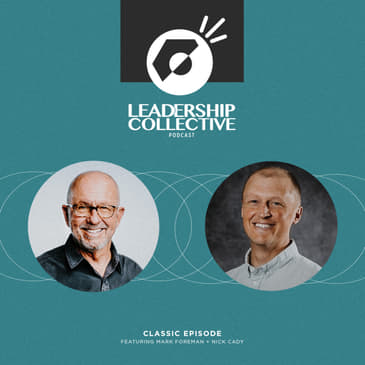
Pastor Mark Foreman of North Coast Calvary in Carlsbad, California joins Pastor Nick Cady of White Fields Community Church in Longmont, Colorado to discuss the topic of vision.
----
North Coast Calvary Chapel -- northcoastcalvary.org
White Fields Community Church -- whitefieldschurch.com
[00:00:00] Welcome to the Leadership Collective Podcast. I'm Rob Savato, and on behalf of Ted and myself we want to thank you for tuning into this podcast and we hope that it encourages you in your leadership and in your ministry.
[00:00:13] Today we're going to be airing what we're calling a classic episode of the Leadership Collective Podcast. This is one of the early episodes that was aired before many of you even knew about our show.
[00:00:27] Today's episode is actually episode number two, and it was on the subject of vision. Our guests were Nick Cady, Pastor of Whitefield's Community Church in Longmont, Colorado,
[00:00:40] and Mark Foreman, pastor of North Coast, Calvary Chapel in Carlsbad, California. The thing that I love about this episode is that Nick and Mark are both great leaders who approach a vision in completely different ways.
[00:00:55] And Ted and myself found this episode to be very helpful to us personally and worth re-airing as a classic episode.
[00:01:04] So, if you enjoy today's show and if you have any questions or topics that you would like for us to tackle on the Leadership Collective Podcast, you can email us at leadershipcollectivepodcast at gmail.com
[00:01:19] And so now, here is our classic episode on vision with Nick Cady and Mark Foreman. The overall vision of the church we communicate probably three out of four Sundays a year, where person welcoming people is telling them who we are.
[00:01:45] We're so glad you're here, this is who we are. And then what we'll do is we'll feature one of our ministries.
[00:01:53] Today on the Leadership Collective Podcast, we're doing a bonus episode and our guests today are Pastor Mark Foreman of North Coast Calvary Chapel, Carlsbad, California, and Pastor Nick Cady of Whitefield's Church in Longmont, Colorado.
[00:02:10] You know, last week we had a great conversation with Ed Taylor and Nate Holdridge that centered around vision. And if you missed that conversation I really want to encourage you to go back and listen to it.
[00:02:20] Nate and Ed brought some incredible insight in dealing with how they set vision for their churches, how they cast vision, and how they remind the body of the vision, and also who's involved in that whole vision setting process.
[00:02:34] Yeah, Rob, there were so many great takeaways from that conversation. And you know the thing I've been chewing on all week has been the importance of involving your key leaders.
[00:02:44] Working as a team to strategically shape your general vision to a specific application and specific programming throughout your platform, getting your women's ministry, your men's ministry, your children's ministry, and so on.
[00:03:00] All unified in a common thread and also in that process of enlisting your key leaders to help in casting that vision to the church body.
[00:03:10] Yeah, they did an excellent job in laying all that out. And I really loved how what Nate shared about the need to constantly remind the body of the vision and how he goes about the different ways that he goes about doing that.
[00:03:23] I found just to be extremely helpful. Yeah, that's so true. You know the contrast between Ed and Nate was also really interesting to observe.
[00:03:32] That's the thing about leadership. There are so many different leadership styles and so many different ways to approach setting and casting vision for your church. And you know, really that's the goal of the leadership collective altogether. It's to share these diverse lessons, these diverse perspectives from guys,
[00:03:54] pastoring large churches, pastoring small churches and you know everywhere along with spectrum. Yeah, Ted, you're absolutely right. And that's why we're doing this bonus episode on vision today. And Pastor Mark and Pastor Nick are two great leaders and vision castors ministering into radically different cities and environments.
[00:04:16] Pastor Mark Forman is the pastor of North Coast Calvary Chapel in Carl's bed California. And so church that prior to the pandemic had close to 4,000 people attending at their weekend services. And North Coast Calvary is an amazing church that is making a huge impact in their community.
[00:04:36] But being a mega church, they have a staff of like over 150 people. Yeah, Pastor Nick Katie, Pastor's Whitefield's community church and it's a growing church of about 3 or 400 people in Longmont, Colorado.
[00:04:51] And they're making a huge impact in their community. But you know, as you said Rob Nick has a different environment that he's working in. He has a different experience than Mark. He operates with a comparatively smaller church and a much smaller staff than then Mark is working with.
[00:05:09] Yeah, and you know, I've known both of these men for over 25 years. Mark and I minister in the same area of North County, San Diego. And Mark has 50 years of pastoral ministry experience. So I just love picking his brain on things he has such wisdom.
[00:05:26] And I met Nick when he was on the mission field, pastoring a church that we helped plant in Egar Hungary. Nick married a sweet girl from our church and was really really I was so blessed in watching him lead there in Hungary.
[00:05:42] And I've been equally impressed to see him lead the church there in Colorado. My wife and I were just there in October, and I was really really impressed with what God was doing.
[00:05:52] Yeah, he's neat guy and just his killing it and what he's doing. This is going to be a great bonus addition, I think. Let's get to it as we welcome Pastor Mark Forman and Pastor Nick Katie. Hey, welcome to the conversation guys. It's great to be here.
[00:06:10] Yeah, it's great to be here. So we're talking about vision and how you guys process vision, how you cast vision who's involved in setting the vision for you church. Mark, let's start with you.
[00:06:24] Describe the process of setting your vision or maybe even before that, you know, seeking and really clarifying your vision. Such a great question to it. I think as a pastor we're always looking to scripture to find out why we do what we do, you know.
[00:06:45] And so for me personally, it's evolved over the last 50 years of pastoring as I'm trying to boil it down to why do I do what I do?
[00:06:56] And it has the process of asking for the purpose of you do this for the purpose of and when you can't answer beyond that, you probably come close to your vision. Okay.
[00:07:12] So so it's first of all, biblically, you know, and then and then secondly is is contextually where am I at? Am I in Denver? Am I in Carl's bad California? And then and then thirdly, who am I in my gifts?
[00:07:30] And who am I uniquely so that I begin to do my vision in that context? And then finally I want to ask the question of how do I articulate this to other people?
[00:07:45] So if there's a nice little slogan or something that actually makes that easy to remember, that's awesome. Okay. Excellent. And how far ahead are you looking when you're going through this this vision setting vision seeking process?
[00:08:01] Yeah. For me, what I just described, I'm looking for my whole life, you know, what why am I on this planet and looking at, you know.
[00:08:09] But I think that every time we move or there's some unique thing happening, I think every pastor coming out of this pandemic should be asking what's it all about healthy? Why am I doing what I'm doing? And then I do it annually. Okay.
[00:08:28] As a process, I look at it to say, you know, is that working? Is that working for me? Do I need to fine tune it?
[00:08:37] You know, I heard Gordon McDonald recently being interviewed by Kerry Newoff and he was talking about just the stepping back in the re-evaluation of things. And he thought every, you know, seven to ten years that regardless of where you were at that it was. Yeah.
[00:08:57] It's probably not good to do it more often than that. It's called interest-spection. Yeah. So, what do you involve in your vision, you know, establishing your vision process and articulating that vision?
[00:09:16] You're seeking the Lord, you're getting some clarity on your vision. What's the next step in terms of involvement? Well with our entire staff we do it every year.
[00:09:29] I call it prayer planning. We do it three or four off sites for a half day one all day, I mean overnight. And I take them through a series of questions where we come back in.
[00:09:44] We talk about it in small groups and then they go off and they seek the Lord. They're trying to really hear from God. They're taking a list of inventory assessments of both our community out there
[00:09:58] and our church looking at the needs and then looking at how they've thought before and how would they redo this. And they go back to their kind of advisory group and try to communicate.
[00:10:11] It's just this whittling away. They're looking three years, but then out of that they create the five or six objectives that they have for this one year. Okay. So they're looking down for three years, but they're creating goals and objectives for this year.
[00:10:29] Now you said that you bring you give them some questions. Can you give us an idea of what those kind of questions are that you might pose to them? Yeah, well the first is an intake.
[00:10:40] And so in the intake it's I would have them go off with Jesus and a piece of paper and just as you look at your,
[00:10:52] your ministry. Let's say it's junior high. What's working? What's not working? What are the needs of your students and they just make the laundry list and maybe it's 15, maybe it's 21. Come back and share it. Talk about it and then send them off again.
[00:11:11] Take a look at North Coastal region of San Diego. And how is that changed? How was the church meeting things? What are we missing? And so they do an intake there.
[00:11:25] And then out of that, I send them off again and say, okay, you can't do all of this. You're limited. How would you do four or five six at the most of these things? Maybe only three.
[00:11:43] And you know, over the years they keep adding objectives. You know, so it's not like they're throwing things away. But also they become they come away with a purpose statement, a vision statement for their ministry and it has to fit under the umbrella of the church vision.
[00:12:02] I love that. I love that. Now when you are going away with your staff, you guys have a large staff. So are you going away with just the ministry leaders or everybody? Well, just pastors and directors. Okay. So that's that's like 30.
[00:12:22] You know, the first get away is with our spouses and I ask them to set aside the ministry. I don't want to hear one word about ministry for 24 hours. This is about you and Jesus because if you're not well, there's no point.
[00:12:40] And and all often gets some outside presenter to come and minister to our souls, our marriages. And then we start the process. The whole idea is to be able to come to September and have a budget that I'm presenting to the board.
[00:13:00] So it's a purpose-based budget that started with this is what I want to do in this and then eventually by summer.
[00:13:09] Not only do we have the objectives, but we have the dollars. Okay. This is what it's going to cost to do this and then obviously Bob McKinsey and see him.
[00:13:19] I was going to look at this and say, we can't do this or what can we do? And we will it that way. So so that when we're presenting to the board. It's great. It's got a purpose behind it.
[00:13:30] So Marka, I love what you're saying. How far ahead? So you're trying to get this all together by September. How far in advance is your staff getting together and you're having them process and think about this. Yeah. So they're turning in their budget by June.
[00:13:47] So because it's a ministry is big in the summertime. So you just work backwards and so that means we have a sole care marriage care get away. The end of January, then before Easter we have a half day get away and it's all about needs assessment in takes.
[00:14:10] The next one after Easter is boiling those needs that you're seeing down to three to five and then. And each time they have to go back to their team and communicate like they're a lead pastor. This is what I'm seeing and see.
[00:14:28] And then by June we get to the budget. But the beautiful thing is I'm not driving them. They're creating. I'm not I'm just pulling out of them. Right. And in the fact that they're prayer planning. I love that.
[00:14:42] You know, it's just doing what Proverbs talks about in terms of vision casting. I love that. Nick, what about you? Let's let's turn and what is your process look like as it relates to setting vision for the church and how far are you thinking.
[00:14:57] And who's involved in your vision setting process? Yeah, I think our vision process is quite a bit different than Marks. But I really love what Mark's saying. I'm going to be taking some notes.
[00:15:11] But yeah, our vision process essentially focuses begins with primarily our pastors and elders in this process. And you know, we're looking at a couple different things. So we're looking 10 years out, then we're looking three years out and then we're looking at one.
[00:15:28] So we want to be looking at all three of those at the same time. And one of the ways that I've thought about vision in the past is I've always found it.
[00:15:36] I've always found it sometimes to be a little bit of a difficult word to really define. I find it sometimes when people use the word vision. They sometimes are meaning different things by it.
[00:15:47] So one way that I have kind of instructed our leaders to think about vision is to say that for me when I use the word vision, I would define it as a desired outcome.
[00:15:59] And when I think that you define it that way, it just makes a little bit more tangible, a little bit more easy to work with. You know, what is the desired outcome?
[00:16:08] And what do we want or hope or believe that God wants our church to look like in 10 years? And then we apply that of course to all our different ministries.
[00:16:17] And so we start big and then go smaller kind of like concentric circles, right? So here's the big idea of 10 years from now, here's what we envision or believe that God wants to spread this higher doubt, confirm our church.
[00:16:30] And then what does that look like, you know, broken down into different ministry areas where that's you, whether it's men's women's ministries, community groups teaching ministry, et cetera.
[00:16:41] So that is basically how we do it. Now a couple of years ago, we had a man attending our church who his job was to did strategic planning for the University of Colorado and Boulder.
[00:16:53] And so he kind of said, hey, you know, what would that look like in a church setting? You had never never done that outside of, you know, big university setting. But he said, okay, let's give it a shot.
[00:17:04] And so we put together a strategic plan and that's become a major part of how we do vision here at our church.
[00:17:13] And so what that looks like is that we started by defining, you know, what is our vision for a church like our purpose statement like mark was saying, I'm going to go and then what does that look like in three year blocks right?
[00:17:26] So if we believe that in 10 years we should look like this or in 20 years things should be like this.
[00:17:33] We break that in the three year blocks and then what does that look like, you know, going down in really practical ways. And we set measurable goals. I think that's really key.
[00:17:44] But we want to set measurable goals that focus on the things that we need to do meaning, you know, it's sometimes you know if you set your goal, meaning that you want to have a certain number of people or a certain amount of money.
[00:17:57] So that's a bit misguided in as far as that the goals need to be things that you can measure and that you can actually have some sense of control over.
[00:18:06] And I think a good example of this is, you know, ASAP's Fables has this this parable or this Fable about the goose in the golden eggs.
[00:18:15] And the idea was that they kept feeding the goose and as I said, the goose produced golden eggs but at one point they became greedy and they decided to kill the goose so they could pull all the gold megs from outside of it.
[00:18:27] And by killing the goose of course not only did they not get any aids from inside of it, but they didn't have a goose to produce gold eggs in the future.
[00:18:35] And the idea is that if you keep feeding the goose so to say, I mean, doing the things that you're called by God to do and doing them well and defining what those things are, then ultimately, you know, it will continue.
[00:18:50] You know, God will continue to bless what he's called you to do. So again, measure of goals and things that you actually have some control over. Deca, here you use in the terms we and our.
[00:19:04] And it seems that like in contrast to to Marx approach where he's getting away and has the really the overall umbrella kind of vision that your process is beginning really more with.
[00:19:20] With your I'm assuming your your pastors and your elders it's more collaborative from the beginning is am I am I sensing that writer is there a step before that with you and the Lord.
[00:19:32] Yeah, I think it begins with me in the Lord obviously you know when our setup I would be considered kind of like the first among equals in our in our system but.
[00:19:42] Definitely from from that moment on there's there's probably a lot of deferrence to me just as a pastor and as a senior leader, but I would say that yeah we try as much as possible to define it collaboratively better than. Being primarily driven by just myself.
[00:20:03] And in terms of communicating that vision to to your staff and this will be a question for both of you guys but Nick I'll I'll start with you. Communicating your vision to your staff. What is that process look like for you.
[00:20:20] Yeah, so that's done through our weekly staff meetings and and then the next level down from our staff is on ministry leaders and so three to four times a year we have what we call a ministry leaders.
[00:20:31] I think that's how to where we have lunch on a Sunday afternoon and share vision with them make sure that they're bought in make sure that we communicate everything that.
[00:20:41] It needs to be communicated to our leaders you kind of go in that that's that it begins with our pastors and elders. Then it goes to our staff and then it goes to ministry leaders before it goes to the conversation.
[00:20:52] So Nick what I'm curious of is your process for communicating first to that that first circle of leaders pastors that you have that are on staff or key elders.
[00:21:07] And then from there disseminating that information to that vision to your staff and through the you know the leaders in the down line so to speak so. Could you could you articulate that process.
[00:21:22] So Nick he's wanting to know how you went and told all your leaders that you wanted to have a church with 10,000 people right.
[00:21:31] I just told them sure. Yes, so what the process looks like is that we create we end up creating a doctor's man it's kind of a living document where we're editing it we revisit it once every six weeks we have just an hour long meeting or sit down with.
[00:21:47] The person who kind of does the coordinates of strategic planning that is to them with their elders we go through check our metrics we check them against what we hope that they would be.
[00:21:57] And then we take that document and that document is made available to all of our ministry leaders and and then beyond that to even to people in the church so they can see you know what is it that where is this church going you know what what is the ultimate.
[00:22:14] Our destination over where we're leading them to so what are some of the metrics that show up in that document.
[00:22:21] Yeah, I've got an in front of me here's we have some of the metrics one of them is increasing congregation engagement and so some of these are a little bit hard to measure but so for example we try to measure.
[00:22:35] How what are congregation sizes and then how much of our congregation is engaged in activities with our church beyond Sunday morning so that would mean community groups mental and mental studies etc. So we also measure the number of local outreach as we do every year.
[00:22:52] We we have a metrics surrounding our org chart number of ministry leaders mentoring successors to keep track of that and we have a certain percentage of that needs to reach in order for us to say that we're doing what we should be doing.
[00:23:10] Another one is we have a what we call Bible learning center here at our church and so there's a metric related to the number of classes and the number of people participating in those classes. So those are just a few of them got it.
[00:23:24] Mark same question for you when you you get away with the Lord and the Lord's given you a sense for this is as you put at the umbrella of our vision and and also how.
[00:23:38] How do you go about articulating that to your pastors and that first group of leaders that you would be meeting with. Yeah, I want to jump in for a second because Mark I know you guys have been you've been there 30 years now right.
[00:23:52] So I'm kind of hearing you earlier and correct me if I'm wrong is it's almost like the overall vision has sort of been set and it sounded like what you're doing.
[00:24:03] I think that's what you're doing is getting together with your leadership and kind of encouraging them to come up with a vision for the year that goes with the overall vision is that correct kind of how you're approaching it. Yeah, and probably to next point.
[00:24:19] You know, we're what we're doing annually is we're really talking about measurable goals and objectives. Reassessing the overall vision that fits under the overall vision of the church. But I think that there's qualitative and quantitative course corrections.
[00:24:39] As you see, okay, this is what's needed now and what's needed now. To your question Ted, we right now are actually reassessing everything.
[00:24:51] You, yeah, you do. So well, I mean, I'm involved in a succession plan, okay, you know, because you know, I'm now 29 and I and I want to that's really important to me. I think the success of a leader is only known after you stop leading.
[00:25:09] And so I want to really hand this baby off well. So I'm bringing around me an advisory group of pastors that are kind of inter circle leader kind of guys amongst our pastors.
[00:25:28] And inviting them to rethink the overall vision where do we want to go now over the next 30 years, where what needs to change what need the other thing I would just mention is that in my mind, when I think of vision for all the different ministries,
[00:25:48] oftentimes I'll step up to a chalkboard and draw a stick figure because that's the best kind of person I can draw. And I'll say, okay, this is what pops this is the widget person that pops out of your ministry after three years.
[00:26:04] What does that look like? What characteristics do you want this person to have? We're really talking about discipleship building. Excellent. And you start writing down and there are often different per ministry, which is disturbing because you wouldn't think that, you know, we all have the same Bible.
[00:26:23] But just think about the cultural shift that we've gone through this year and the church introspecting about, well, how are we doing about penetrating America with the gospel?
[00:26:38] Are we just a veneer church that is a 60-minute thing that happens on Sunday? And ask ourselves a lot of tough questions and then out of that begin to fill in who we want this person to be.
[00:26:55] And then out of that begin to think programmatically, to next point of just saying, well, how involved are the people? You know, if you have people on the average only coming 2.1 times a month and that's a committed Christian in America.
[00:27:15] How are we going to move towards this discipleship person? And where does that happen? Is it online and you begin to ask yourself the programmatic questions and then out of that, the dollars questions.
[00:27:32] So yeah, it's quantitative but it's also qualitative. And is this something that's going on like all through the year and your staff means, or your staff means weekly or how do you do that?
[00:27:45] Well, yeah, our staff meetings are weekly and then I have this advisory group that meets monthly.
[00:27:54] And I formed it just as a way of discipling them into the things that a senior pastor has to think through. And this is like five, seven years ago and I started discovering that their wisdom was it was a 2A street. I needed their insight and wanted to have more of a team ministry.
[00:28:16] So, you know, like next I'm a leader among leaders. I always have the ace card up.
[00:28:24] All right, let's shift now to the whole idea of once you have this vision, you feel like the Lord's given you for the year in place. How do you go about communicating that then to the church?
[00:28:38] When do you do that? Is it something that you do more than once? Is it something that happens, you know, often and Nick, we'll go ahead and start with you on answering that question.
[00:28:49] Yeah, so what we do is we started doing this last year and what we do is it's like a year in review document and we put it out to the whole church. We actually send it out without giving statements every year.
[00:29:00] And what it outlines is on one side, it outlines kind of some of the accomplishments from the previous year. And then on the other side, it has some goals for the next year that upcoming year.
[00:29:13] And it has what we call like areas of focus, you know, so they're within our overall vision and they're kind of a, I guess you could call them steps in the process that would lead us to that place that we believe they got wants us to go to.
[00:29:25] So we outlined some of those and the reason we do that is on the one hand, or it kind of keeps us accountable to the congregation because they've got a stack, you know, after a few years of these papers.
[00:29:37] And they can kind of see did we actually do what we said we were going to do.
[00:29:42] And I don't know about you guys, but for me it really helps to actually put things down and have them be measurable and have to have some accountability. I guess you're myself and probably there's that's a perfect word.
[00:29:55] Now here's what we do, you know, here's what we said we were going to do and did we actually do it. And by God's grace, you know, we have been able to do that over the last couple years. I think that also.
[00:30:08] You know, encourages people that they can trust us as leaders and that we are doing what we say that God is called us to do so that's the one way we put out this document. We make that available throughout the year.
[00:30:20] And it's very popular. You know, we actually have it out in our lobby and church and we just have to keep printing more of them because people keep picking them up and taking them. We tell them we tell people play over these things and get on board.
[00:30:34] The other thing that we do is that we do a vision series and we used to do that. It's kind of random times throughout the year whenever it should in between Mike one of our book studies.
[00:30:43] But more recently what we started doing is we started doing it just at the beginning of the year. And the vision series is kind of the refresher on some of our core values.
[00:30:54] And but, but also we give concrete and detailed things like this years what we're going to be doing this year and focusing on.
[00:31:03] It occurs to me that's not unlike, you know, when you keep a prayer journal and you have the occasion to reflect back on it and it and build your faith. You can see God's faithfulness in the things that you're doing.
[00:31:15] And in a real tangible way that sort of serves a similar thing for your body and you're doing that. And I use it throughout the year to actually make sure that we're staying on track, you know?
[00:31:30] That's great. I love that. And how long is the vision series usually how many weeks? This week was this year was three weeks last year was three weeks. So I think that's kind of how we're moving forward is keep it short.
[00:31:43] I think that you can kind of tire people out with all your talk about vision. And so I like to keep it short and keep it really, really clear and distinct and kind of tell people, you know, here's what we're going to be talking about each week.
[00:31:57] Yeah, that's great. Mark, what about you? How do you go about communicating this the idea of your vision to the body area? Yeah, we kind of do it differently. I used to do it the way Nick was describing first three weeks in the beginning of the year.
[00:32:12] So this is our business outreach ministry. This is our sport outreach ministry, our missions or young adult youth.
[00:32:23] And so what happens, at least I believe, is people who have an affinity to that area of ministry. They're hard, it's grabbed and we say we're going to be outside between services. We'd love to get to know you'd love to meet you.
[00:32:40] And there they come and they pick up some literature or some collateral. And the relationship begins. And then we have video messaging almost, probably two or three weekends a month where they're seeing some aspect of our ministry going on.
[00:33:04] So they're hearing the umbrella, but they're also hearing the different unique aspects of how does that play out among children. How does that play out in these various areas?
[00:33:17] Now, it's interesting that you brought up the video messages because I think all of us right now are experiencing this new phenomenon. It's always been there.
[00:33:29] I think it's bigger for all of us of these online attenders. And I think that's probably become a little bit more of focus for all of us. I know it definitely has for us.
[00:33:40] And one of the things that we're wrestling with because a big part of our vision is discipleship and so we've been thinking about like, okay, how do we disciple people online?
[00:33:48] Right. So I'm just wondering, and I'll let you start with this mark is in your is your vision or plan different for those who are online versus those who are actually attending and how are you approaching that?
[00:34:04] Yeah, I think you have to assume the best, you know, the moment you start assuming the worst in people. It doesn't play out good for the past or so you're assuming the best and so if they're there two weekends a month in person that they're on a business trip, they're on a family vacation or a sporting event and they're going to check out online what's going on.
[00:34:29] I don't know that that always happens so that I think we have to think in terms of communicating more, so where as you maybe did an announcement once, you know, you do it three times.
[00:34:45] Now knowing that it's going to gradually connect with them. And I think discipleship is the same way. I think it's a very hairy world out there and we can't assume bad hearts about them. They're just trying to follow Jesus and keep their family together and run a business and so we have to keep up with them and make discipleship possible for them in every way of match it will come up with creative.
[00:35:14] Coming up with creative ways to do that. What about with you Nick, is your vision or plan different for the online audience versus those who are actually attending?
[00:35:26] No, it's not different. I mean, I think it's based on principles, you know a lot of it is based on principles that are somewhat flexible.
[00:35:34] But I would also say, you know, one of our big focuses lately has been that we want people who view online to really know and feel that they're just as much part of the conversation as others.
[00:35:46] I don't think that this is going the way. I think this is going to be the new normal where you have people who are part of your church and they maybe don't attend maybe even at all in person.
[00:35:59] And I think that we need to come up with creative ways using online tools and resources to really bring them into that process, whether it's discipleship, whether it's prayer. I think we have to be thinking both and all the time when it comes to impersonal online.
[00:36:17] That's excellent. You know, I want to talk to you guys about when you pivot and the need for pivoting and insert the laughter act there for
[00:36:28] 2020. But before I do, I just before before we get away from this because this idea of communicating vision and mark as you were talking, you were kind of articulating this idea of all of the different ways that we're communicating vision to the body and the different venues.
[00:36:48] I'm curious about the role of like a new members class in orientation, that kind of thing. I would imagine you have them and that that's a big part of your casting your vision. Yeah, yeah, both a welcoming event and then a newcomers, new members kind of series.
[00:37:13] And so the welcoming event is just a taste. It's just a flavor of sampling of the leadership.
[00:37:22] It's letting them hear the vision and it's letting them hear particularly the values. We haven't talked about values, but values are the cultural flavor that you feel when you go to this country, this country or this church and this church, both churches are evangelical, but there's a totally different flavor you feel and they want to know why is that because that's why they've come.
[00:37:48] And then the new members is if you only had three weeks, which we give ourselves, how do you compress in three weeks.
[00:37:59] And then to have even at the end of that three weeks, there's a six week class now available to you and you're thinking of how do we keep them engaged so that they don't just now kick back in their easy chair.
[00:38:17] And eventually you want them now you're plugged in to the women's ministry, children's young adults, whatever. It's all leading to something but they have the DNA of the church flowing through them as they move out.
[00:38:35] Yeah, as Craig Groshell talks about how culture is a combination of what you create and what you allow. Yeah, so yeah I call it the red light green light. Right. What exactly? Yeah. Nick how about for you same question about casting vision through orientation.
[00:38:55] You know, Mark years is really given a three week process of orientation with then those those pointers to the six week event. Getting people plugged into regular events. How about how's it work for you Nick?
[00:39:12] Yeah, you know that is an area where we have had to really change a lot since the pandemic when we first started we did every few weeks we had kind of a new commerce welcoming events.
[00:39:26] And that's just something we haven't been able to do mostly because of space you know requirements now that don't want churches hanging out food and refreshments at all. So we've had to really rethink the whole process and what we've done is we've gone online with with it.
[00:39:43] And so we do an in person version which is for us it's four weeks. We've been in person version it's recorded and each week those are put online as unlisted YouTube videos that we send out to the people who sign up and on able to come in person.
[00:40:00] Well, that's excellent you handle both you talk about your orientation and what you did to pivot and so it's back to you Mark in terms of pivoting in terms of your casting vision and and all.
[00:40:12] Yeah, we've had to pivot as well and so we obviously have pivoted online but we also have begun to do outdoor welcome. Okay, and that is kind of like in the last month an experiment.
[00:40:31] How do we do you know how many people came to that and felt comfortable at that is it's not a food.
[00:40:39] You know like Nick said usually it's this big all the desserts you've ever imagined right and now it's like well it's just us with the mask on you know, right but you know we actually have been surprised at how many new people we've had. In person.
[00:40:58] Yet at our outdoor services that that has been you know mean you get the online thing of someone. Messaging you from Ohio or South Africa and you're kind of intrigued by that but when you have walk ons.
[00:41:13] To an outdoor campus that really intrigues me what how did this even happen you know. Yeah, that's fantastic. The idea of experimentation you brought it up and I love that because sometimes when it comes to vision.
[00:41:31] The jury's out and we're like I don't I don't know if if this is actually going to be a thing that works and so so I really appreciate you.
[00:41:40] A big fan of experimentation you know not not to the degree that you risk the baby with the bath water but you know the fact that you know there's some things out of humility I just don't know.
[00:41:55] Yeah give it a whack and are you are you pretty forth for threat with your congregation in those situations where you just say hey we're just going to give this a shot we're just going to leaving it open for.
[00:42:06] I think the DNA of our church is artists and surfers okay. And so that lends us a lot of freedom right you know. That's fantastic. Hey same same question for you Nick in terms of experimentation.
[00:42:21] Yeah, you know actually I used to be a lot more worried about it I used to be worried about you know doing things that failed and then the congregation losing trust to have leadership.
[00:42:32] And my friend Pastor Ed Taylor here I remember talking to him on the phone two years ago and he really changed my opinion about how to handle that.
[00:42:42] Here's what he told me said look it's their church you're there later and what you need to do is bring them along on the journey and bring them with your your failures and your successes because you're in this together.
[00:42:55] And actually even your failures can build a sense of camaraderie like in bringing people together unifying force behind even your failures and another phenomenon you know Greg O'Pen.
[00:43:07] He always used to talk about when we would have Sunday church he's like you know what it's like it's like Gil Gow back in the book of Joshua right it's a place that you return to after your victories and your defeats and after your victories you celebrate but after your defeats right we come as a right together.
[00:43:24] And you prepare for the next battle and I I really learned to do that over the last couple of years is to bring people into the process and communicate a lot and say.
[00:43:34] Hey look here's our vision here's what we're up against here's the challenge and so here's what we're going to do and we're going to try it out in this excales.
[00:43:42] Now we're going to come back and we're going to try something else but let's be in this together and it really by communicating in that way and saying hey we're doing this together.
[00:43:51] Here's what we're facing is what we're up against and just saying hey we're on the team together and of course we've got leaders but we want you to be part of this and know about it. Pray about it.
[00:44:04] I found that to just be a very unifying thing and I feel like people really really appreciate it rather than just having somebody come out of out of the room and say you know like surprise here's where we're going to do.
[00:44:16] Then if it fails I think you do end up having having that whereas if you bring them along in the process I think it's a lot better.
[00:44:22] I love the idea that you guys are talking about communicating in that type of way and saying in a sense like hey, you know we're going to try something here we're not sure but we're just sort we're feeling led and it sort of I think takes away that sense of like what you're supposed to be hearing from the Lord you know.
[00:44:41] But I think there's some mitigating issues one is the fact that if you're a pastor that's been there two years or 20 years. There's there's certain amount of equity you build over time.
[00:44:55] Great point as you communicate if you say we everyone wants to know who's the least the most are those are those the mystical nuns in Zurich Switzerland or who are they you know and if you say you know we've we've prayed about it.
[00:45:11] Amongst our pastoral staff the board is prayed about it. We're we're then they they feel the deeper keel of like well okay they're using the word experiment but there's a lot of people that are kind of in on this thing right.
[00:45:28] The one downside that you just have to be aware of your you are going to get a lot of emails. Of just saying have you ever thought of my own my own.
[00:45:39] You know and and you people mean well but they're they're all hearing that that experiment at different levels and and you just smile. Right I think that's such wisdom and what you just said mark about building equity.
[00:45:57] And for anybody who's you know new in planting or you know you're new and taking over I remember I heard Pastor Chuck say this that if you are taking over a church that is doing well don't change anything for three years you know and I thought there was such wisdom in that and I know when I.
[00:46:17] I became the lead pastor here at Calre vista. I really followed that I mean all the any changes that I made were really things that the congregation.
[00:46:27] Never saw it was all behind the scenes you know type of things that were happening so yeah along the same lines John Maxwell talks about. Having changing your pocket a leader who has changed in his pocket because if he's got some change in his pocket from.
[00:46:41] Some faithfulness through the ministry and some successes through the ministry that people give him the latitude to make those. Oh, well thanks. Great picture. Yeah. I love that. Well guys we're coming to the end of this conversation and really having enjoyed your guys insights.
[00:46:59] I have one final question for you and that's as it relates to this crazy year that we just had and we're you know we're still in the midst of it things you know are not normal and that probably never going to be normal again like what's we're trying to figure out what's the new normal going to be.
[00:47:15] But what's been your biggest challenge that you faced in trying to carry out your vision in 2020 to the present. Yeah, start with you Mark. I would probably say the the political and the divisive climate. At least that's at least personally painful.
[00:47:38] Big time to me, you know, I think a blue and red both count cancel very well. And when Christians cancel Christians. Yeah. You know it just hurts more.
[00:47:53] So there's a strange filtering process going on in every church where people are filtering themselves out of your church because you're not enough this or you have too much of that or when are you going to do this and.
[00:48:08] People have always done that, you know I've always called California Christian Disneyland. You know like I'm tired of the matter horn. I've gone there three years. I'm just going to you know and that's always bothered me, but now it's it's intensified and compressed.
[00:48:27] And I don't know how it's going to land. I think that a lot of people will eventually migrate back to their home churches. There's been a huge musical chairs going on. And I just hope that all these people still fall a Christ in land at a good home.
[00:48:45] Yeah, I think there's been more biting and devouring amongst the body of Christ than I've ever seen in my lifetime and so much of it out in the public eye.
[00:48:55] In fact, I was sharing with our church just a couple weeks ago about this and I said I think the devil's laughing at us because we're like doing his job for him.
[00:49:04] You know it's like he's looking going who's going to want to join them. They can't even get along you know just Christian spining with one another and then I said and I think the Holy Spirit is screaming at us that's not who you are, you know.
[00:49:16] So I'm with you my heart just really, really breaks. I think that's been a really, really big challenge. What about you Nick? What's been the biggest challenge that you've faced in trying to carry out your vision in 2020 to the present?
[00:49:30] Yeah, it's related to what you are both saying and what Mark's saying. I think it gets maybe another aspect or angle of it is the fact of discipleship right people are being disciples by so many different channels now perhaps more than they were in the past
[00:49:46] You know you think about different media sources whether it's podcasts or their TV news channels or radio stations. There's so much of that that it's shaping people shaping the way that they think.
[00:49:58] So the point where you know as a pastor I only have only one of many voices. Oh, that's right here in being chased by and that kind of bothers me and it worries me and I think it's it's again that's not going away. That's a challenge that we're going to have to face.
[00:50:18] The other part of it would just be the challenge of pastoring a congregation that's both online and in person.
[00:50:25] And I think that that has, that's not like it suddenly happened overnight but it certainly ramped up and it became, I guess it was an accelerator right that's what we've been saying about this pandemic.
[00:50:40] And so I think that's a really serious challenge that we're facing right now and especially if you have many of you leaders, you know trying to lead leaders who are not coming in person. I think that's very challenging.
[00:50:54] Yeah, agree and a big part of that change is you know you would mention that having you know big part of your church that that is, you know, not physically with you and that part that is physically with you.
[00:51:07] So now we have to think almost in two distinct ways that okay, you know we're we're gearing up for our Easter services as an example and we're going to do baptisms during our Easter service as we always did.
[00:51:20] And part of our creative meeting was to consider, you know, how can we care for the portion of our body who's at home.
[00:51:30] You know, actually finding those ways that you can, you know if you have a smaller church you can just call people up who you know we're at home and say hey, you know have you all been baptized because we're going to be doing baptisms and we can, you know, accommodate your baptism class online or you know we, you can, you can.
[00:51:46] I appreciate it baptism at home and film it. We'd love to include that in our services so that the bodies all together, but in for a larger church finding as well those creative ways to be able to say how can we baptize people who are at home and in isolation because of.
[00:52:03] And we're going to hope that you're going to be able to make sure that you're going to be able to be able to incorporate COVID restrictions, but you really have to think about that in that is a challenge so I hear what you say in there next.
[00:52:10] Yeah, like never before, I think we're thinking about two different congregations. Yeah, yeah, for sure. Well guys, thanks so much for being on the program today and really enjoyed your insights and this conversation with us, so thank you for being here.
[00:52:29] Well that's going to conclude our conversation for today and we hope you enjoyed this bonus episode on vision with Mark Forman and Nick Katie. And if you enjoyed this episode, would you please leave a review and subscribe on whatever podcast platform
[00:52:52] you're listening on? Our goal on the Leadership Collective is to help you lead well through all seasons and challenges of ministry life. And we look forward to being with you next time on the Leadership Collective.