
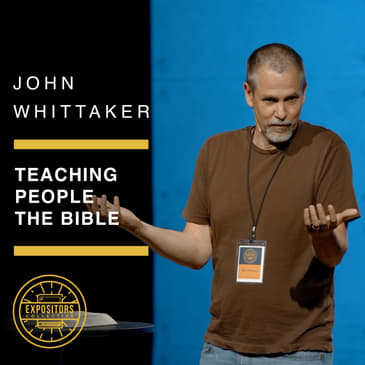
John Whittaker speaks about the need to hone our homiletical skills so that we can connect with our congregations as complicated individuals, rather than a block of abstract "listeners." Homiletics is the study of how to effectively communicate the message of the Christian faith through preaching and teaching. It involves understanding the biblical texts, the needs and concerns of the audience, and the use of language and other communication techniques to convey the message in a way that is meaningful and impactful
John Whittaker is a preacher, teacher and pastor. He holds theology and ministry degrees from Boise Bible College, Cincinnati Bible Seminary, and a doctorate in preaching from Gordon-Conwell Theological Seminary - the only reason for all of that is to help bring God's word into the lives of people more effectively. John has been serving in ministry for 30 years. He has served as a Professor of Preaching and New Testament at Boise Bible College for 19 years. During that time, he also helped plant a church in Kuna, Idaho, where he led the adult education ministry and preached for 11 years. He has taught classes for Eternity Bible College and taught and preached in various places around the country and the world. Most recently, he served for nearly 4 years as one of the teaching and campus pastors at The Pursuit, in Boise and is currently on the preaching coaching team at Calvary Boise.
You can learn more about John Whittaker at https://www.johnwhittaker.net/
Additional Resources:
Listeners Bible Commentary: https://www.listenerscommentary.com/
The Listener’s Commentary provides clear, accessible teaching through each book of the New Testament in audio format so you can learn and live the Bible.
Tucker Maile: https://www.expositorscollective.com/podcast/2022/10/3/getting-your-sea-legs-and-finding-your-own-voice-with-tucker-maile
Douglas O'Donnell : https://www.expositorscollective.com/podcast/2022/7/30/the-beauty-and-power-of-biblical-exposition-with-douglas-odonnell
Eric Cartier : https://www.expositorscollective.com/podcast/2021/12/7/sermon-prep-involves-time-work-and-prayer-eric-cartier
Resources Mentioned:
Jim Wilson's message from earlier in the day https://cgnmedia.org/podcast/expositors-collective/episode/expository-preaching-enables-transformative-encounters-with-god-himself
Wesley Towne's message from earlier in the day https://cgnmedia.org/podcast/expositors-collective/episode/the-journey-from-the-ancient-text-to-the-contemporary-culture
Connect:
Join our private Facebook group to continue the conversation: https://www.facebook.com/groups/ExpositorsCollective
For information about our upcoming training events visit ExpositorsCollective.com
The Expositors Collective podcast is part of the CGNMedia, Working together to proclaim the Gospel, make disciples, and plant churches. For more content like this, visit https://cgnmedia.org/
Donate to support the work of Expositors Collective, in person training events and a free weekly podcast: https://cgn.churchcenter.com/giving/to/expositors-collective
[00:00:00] We're not just dumping information from the Bible, we teach people the Bible.
[00:00:06] Real people with real stories, real struggles, real issues, real baggage, real backgrounds,
[00:00:11] real questions, real needs. And when we forget that, it completely changes everything
[00:00:18] about what we do in our sermon.
[00:00:22] Hey, welcome to the Expositors Collective podcast.
[00:00:25] This episode 346, I'm your host, Mike Neglia, and you're in for a treat.
[00:00:31] Because you're about to hear from Dr. John Whittaker.
[00:00:35] John is a preacher, a teacher, a pastor. He has degrees from all over, including a doctor
[00:00:43] in preaching from Gordon Conwell, theological Seminary.
[00:00:47] In the past, he's been a professor of preaching at Boise de Bible College, and he's distilling
[00:00:53] so much of that education, content and experience into a short and powerful talk on how to communicate
[00:01:02] the Bible to real people. So if that's what you want to do, if you want to teach the Bible
[00:01:08] to people in a way that it actually makes an impact. This episode is I would say required listening.
[00:01:15] Well, we've just finished up from a great preacher, training, conference in Campalla, Uganda.
[00:01:24] If you don't follow us on social media, this is your opportunity or your reminder to go
[00:01:29] find us on Instagram, our Facebook or Twitter and you'll be able to scroll back and see
[00:01:35] some of the photos of what's taken place over those past few days in Uganda. We've been crowd sourcing
[00:01:43] funds to make sure that we could sponsor rural Uganda and bring them into the city for this time of
[00:01:51] equipping and training. For those of you that have donated, thank you so much. You'll be able to see
[00:01:57] some of the photos of some of the Bible teachers, church leaders, pastors and preachers
[00:02:03] that you have helped equip. Well, that's there and then here and now, you're about to listen to
[00:02:11] John Wittaker on teaching people the Bible. We don't just teach the Bible. We don't just teach
[00:02:25] the Bible. We teach people the Bible. That's three out of the Colossians chapter two,
[00:02:37] no, no, Colossians chapter one. Do we have that? Did you get that text in there? Maybe not
[00:02:43] Colossians chapter one, verse 28. There it is. We proclaim him. We've talked about that. The focus is
[00:02:49] Jesus, but notice what it says. Edmonishing every person and teaching every person with all wisdom.
[00:02:57] So the remains of the present, every person, completing Christ. Notice the reference to persons.
[00:03:04] We emmonish every person. We teach every person so that we might present every person
[00:03:13] complete in Christ. We don't just teach the Bible. We teach people the Bible and the reality is
[00:03:23] when you stand on a stage on a Sunday morning and teach people or when you sit in a small
[00:03:30] Bible study and teach people or when you stand in a Sunday school classroom and you teach people,
[00:03:36] right? You've got a gamut of people, a whole range of people. And that whole range of people
[00:03:43] shows up on that particular moment with all sorts of different experiences in their life,
[00:03:48] whole different backgrounds. Maybe things that just happened that morning and that's who you're
[00:03:52] talking to. And the goal is not for you just to take this information and dump it on them. The goal
[00:03:58] is for you to bring those people to completion, maturity and Christ. We don't just teach the Bible.
[00:04:06] We teach people the Bible. And you never know where people are at. I preached this past Sunday.
[00:04:17] We're doing a series out of Proverbs and it was on wisdom for parenting out of Proverbs this past
[00:04:24] Sunday. Literally sitting during Wesley's talk got a Facebook or Instagram message from a gal who said,
[00:04:30] I so appreciated your message last Sunday. I wish I would have had it three years ago when my kids
[00:04:36] were small but I know God's grace is good, right? You have people like that. You have people
[00:04:41] that are sitting with brand new babies, right? You have people that don't have kids yet and when I
[00:04:47] set up that sermon I'm aware of all of that in the room. And I knew I needed to do a little
[00:04:53] preparation for that. And so when I announced the topic and what we were going to talk about after
[00:04:58] of the introduction, I said no, if you're in here and you're like me, you're in your mid 50s or 60s
[00:05:04] or 70s and you don't have kids at home, why sent through a sermon on wisdom for parenting?
[00:05:10] I dressed their issue. And I said, maybe you're 13, 14, 15 or 18, 19, you're not even dating.
[00:05:17] Why sent through a sermon on parenting? I had a dad tell me at lunch on Wednesday that
[00:05:23] it's 14 year old son was in the service and said, you know, that was actually helpful.
[00:05:29] I'm not a parent yet but I figure I might be someday and I had told him that in the introduction.
[00:05:35] So he was prepared to listen and he listened with that in mind because I said the best time
[00:05:39] they developed a battle plan before the battle begins. So as a 15 year old, he could think that through
[00:05:43] we teach the Bible to people across the gamut and they show up on Sunday morning at all different
[00:05:49] stages of life, all different stages of spiritual growth, all different experiences.
[00:05:56] I got a text Monday morning from a really good friend of man I baptized 20 years ago
[00:06:01] and disciple for two or three years. My son and lot works at his mechanic shop. I got a text
[00:06:07] Anthony died on the weekend. Anthony is his 35 year old son who just died in his bed and they
[00:06:14] don't know why. Right? There's a person. They're going to show up at church on Sunday
[00:06:23] with tears and heartache. That's who we're talking to. We're not just dumping information
[00:06:33] from the Bible. We teach people the Bible. Real people with real stories, real struggles, real issues,
[00:06:39] real baggage, real backgrounds, real questions, real needs and when we forget that it completely changes
[00:06:47] everything about what we do in our sermon. And so if we forget that we're teaching people the Bible
[00:06:54] we think all we're supposed to do is teach the Bible. If we do that then our sermon might sound a
[00:07:01] little something like this. Well you know we've been going through the book of Romans over the last
[00:07:08] handful of weeks here at church in this week where at the end of Romans chapter three. So
[00:07:13] turn it in your Bible, the Romans chapter three and then we jump into the sermon as I said so
[00:07:18] the Romans 3 23. If familiar verse if you've been in the church for a while for all have
[00:07:22] sent and fall short of the glory of God. Notice it says all have sent that's every one of us you,
[00:07:26] me, all of us have sent and it says we fall short of the glory of God. What does it mean to fall
[00:07:30] short of the glory of God? Well scholars are kind of divided on what it means to fall short of the
[00:07:35] glory of God. Something the glory of God is God's own character and glory and we don't measure
[00:07:42] up to that. Some things is the glory we were created with as human beings when God first made us
[00:07:47] either way the point is that since we're all sinners we don't measure up to God's glory.
[00:07:52] And then text goes on in verse 24 and says being justified as a gift by His grace. Now justified
[00:07:58] is an important biblical word, a big theological word it's a legal term. It was used in the
[00:08:03] law courts of the Apostle Paul's day and it means the idea of like being declared not guilty or
[00:08:12] given a pardon being declared right standing with the law. That's what justified means and it says
[00:08:16] we're justified as a gift by His grace. If you've been around church for a while you've probably
[00:08:21] heard the word grace, it means something like undeserved kindness undeserved, favor and something
[00:08:26] like that. And so we're declared not guilty as a gift of grace God's undeserved kindness and that
[00:08:34] happens it says through the redemption which is in Christ Jesus. What does redemption mean? That's
[00:08:41] another one of those big Bible words, those big theological words and it wasn't used in the
[00:08:46] court it was used in the marketplace and it means that you're redeemed your prices paid so that
[00:08:53] you can go free and Jesus is the one who paid that price for us. Now all that's true right? All
[00:09:01] that's biblically true, theologically accurate but the reality is it may not like directly connect
[00:09:09] with where you're at and it may not resonate with you right now. The reality is I've sat through playing
[00:09:15] Bible studies and sermons like that maybe you have too. What's missing? Here's what's missing
[00:09:22] at what's missing if we put on the screen is a point and a purpose. That's what's missing
[00:09:30] that's just random Bible facts that doesn't necessarily have any hooks to hang on right it's
[00:09:37] true information but it means we thought we were just supposed to deliver Bible information
[00:09:42] we forgot we were talking to people real people that really have real needs and so as a result of that
[00:09:49] we we lack the point and we lack the purpose. So the message wasn't going anywhere and didn't take us
[00:09:57] anywhere we lack the point and a purpose. The reality is if we will remember that a sermon is being
[00:10:07] addressed to real people with real lives who have real needs all of a sudden it takes all that
[00:10:13] information and it focuss it and it energizes it and it helps us deliver it in a way that might
[00:10:18] connect more with the kinds of stuff that people might actually be wrestling with. And so if we
[00:10:25] remember that we're actually preaching the Bible or teaching the Bible to people then our sermon
[00:10:32] will sound different and feel different and so a sermon on the same passage might go something like this
[00:10:39] when I first became a Christian I became a Christian when I was a sophomore in high school
[00:10:44] and when I first became a Christian I so desperately wanted to follow Jesus. I wanted to please
[00:10:50] Jesus in every way I could I was deeply convicted by the spirit and I really wanted to honor Jesus in
[00:10:57] being way and I tried so hard. I labored so hard and when I was doing really good reading my Bible
[00:11:04] and praying and not sending it in any of the big ways that I knew you weren't supposed to send it
[00:11:08] I felt so good about myself but then all sudden something would happen to him to say she would
[00:11:14] come my way and I would screw up and I would feel so bad about myself and I would beat myself up
[00:11:21] with oh and you call yourself a Christian and you say you're going to buy a book college
[00:11:24] and you say you want to please God so bad you just did that again you just lost your
[00:11:29] temper again you just looked at that again can't believe it John and I struggled so desperately
[00:11:37] with this desire to please God and bouncing between beating myself up feeling really good about
[00:11:44] myself beating myself up feeling really good by myself have it need you ever been there have
[00:11:50] you felt that way can anyone resonate right feel the same way well guess what Roman chapter 3
[00:11:59] has some really good news for you if you've ever felt that way and if you can relate to my struggle
[00:12:04] Romans 3 says this for all have said every one of us there's not a single person in the room
[00:12:11] who hasn't done something wrong who hasn't made some mistake who hasn't some way dishonored and
[00:12:17] pleased God every single one of us have done that you have but guess what I'm up here on stage
[00:12:23] with a Bible and I've done that too all have sent and fallen short of the glory of God each and
[00:12:31] every one of us have fallen from the standard that God had for us from the design that God
[00:12:36] created for we've all fallen short what did God do about that to God leave us to wallow in the
[00:12:48] house no look what God did we've all fallen short of the glory of God but we are justified as a gift
[00:12:57] of his grace we didn't we didn't deserve it we didn't earn it we weren't good enough for it
[00:13:08] we had all done wrong and that didn't keep God from us he justified you and me what does it mean to
[00:13:16] justify well it means that that the almighty all holy God the perfectly pure God who has never done
[00:13:24] anything wrong when he looked at you and he saw you he saw that you indeed were guilty but what did he do
[00:13:33] he pounded down the gavl and he said not guilty no penalty for you and you're like wait hold on how
[00:13:42] you do that God because certainly I know I'm guilty I feel it I'm struggling with this and I know
[00:13:48] what I've done wrong and he says not guilty no penalty for you how can he do that well look what
[00:13:56] it says being justified as a gift you don't have to buy it you don't have to pay for it it's a
[00:14:06] present it's the best gift you could ever get as a gift of his grace motivated by sheer
[00:14:15] graciousness love that stoop to help those who can't help themselves this kindness that we we couldn't
[00:14:22] earn we couldn't be worthy of and yet because of his great love force he stoop to help us even when
[00:14:29] he can't help herself and so he says no penalty for you you are justified as a gift of his grace
[00:14:36] how like how can a just God do that a holy God how can he justify people that are justified
[00:14:45] of the guilty look at the text says through the redemption which is in Christ Jesus what is redemption
[00:14:55] even me it means to pay a price to set someone free it was regularly used in the marketplace of
[00:15:04] of the apostle Paul's world and in the marketplace of Paul's world you would always find the
[00:15:08] slave market and these were people who had debts they couldn't pay and there was no chapter 11
[00:15:13] bankruptcy so what do they have to do sell themselves into slavery to work off their debt and Jesus
[00:15:20] instead of making you work off your debt paid your debt for you so that you could go free that's
[00:15:27] what it means the redemption which Jesus provided is paying a debt so you could go free from both
[00:15:33] the penalty and the power of sin that held you into slavery that's good news and then the text
[00:15:42] even amplifies that further and it says whom God displayed publicly Jesus he displayed Jesus
[00:15:48] publicly as a here's a word that we don't use every day as a propitiation when was the last time he
[00:15:57] is that word as a propitiation through faith and his blood you know what a propitiation is something
[00:16:03] you husbands may know what a propitiation is any of your husbands ever done anything that made
[00:16:08] your wife angry you were at work something happened right and also she's angry at you and you
[00:16:16] know you gotta go home in a couple hours and face her right hey man right and so now you got a
[00:16:22] face her and so you you know her favorite things are whatever they are right maybe maybe her
[00:16:28] favorite thing is this kind of coffee from this coffee shop with these kind of flowers and this
[00:16:33] other little gift and so on your way home you swing by and you get the coffee you get to the flowers
[00:16:39] you get to the gift and you now have them with you in the car and when you get to your house
[00:16:44] you take the gifts you prepare yourself you go to the house you knock on the door you don't
[00:16:52] go in because you don't go in this is a important moment so you knock on the door and and then
[00:16:59] you get down on one knee and then the door opens and it's your wife and she sees you and you say to her
[00:17:07] oh my love please please accept my propitiation right what's a propitiation a propitiation is an
[00:17:18] offering to turn away anger we were legitimately guilty and God and his justice had the right to be
[00:17:26] angry towards us but instead of pouring out his anger on you he displayed his son as an offering
[00:17:34] to deal with his own just repayment for sin and you take care of his anger and so now God
[00:17:42] because he did that he can look at you and he can look at me and he can look at us with favor in his eyes
[00:17:51] he can look at us with grace in his eyes and he can say no penalty for you come on in
[00:17:58] your my son you're my daughter and there's no penalty for you now we keep going through the text
[00:18:05] but my guess is that the second version of the sermon through Romans three feels a different than
[00:18:10] the first version of the sermon through Romans three and the reason is because there's now a point
[00:18:16] and it purpose aimed at real people and that's what when we teach the text we don't just teach the
[00:18:26] text we teach people the text which means we have to aim it on target to real people who have real struggles
[00:18:33] and so as we meditate on the text and study the text we do so with with people in view even
[00:18:40] even creating this I'm sitting in my suns old bedroom by myself at a microphone and I have people's
[00:18:48] faces in mind it's not a sermon doesn't do everything we've talked about today it's a commentary
[00:18:52] but I'm still teaching the Bible the people and there's people I know and the kinds of
[00:18:57] questions they have because it's people who God ultimately cares about it's people who last forever
[00:19:04] and so we teach the Bible to people and that changes everything it gives the sermon direction
[00:19:11] and shape and energy and a point and a purpose and that makes the whole thing different now how can we
[00:19:17] do that real quick let me just give you four quick steps that summarize pretty much everything we've
[00:19:25] said today so we're just I'm just wrapping everything up all right so four four stages for putting
[00:19:30] together a message that will help us put it on target all right so stage one is this identify the
[00:19:37] point as we're putting together a message right we're studying the text we've already talked about
[00:19:42] all of that studying all the background all the literary background all the the words and the
[00:19:48] connections all the stuff we've talked about we're looking even at the big theological angle
[00:19:52] and looking at it crystallologically all that at some point we got to narrow down the point what is
[00:19:57] the point of this text we got to put it all back there I said okay here's what this text is about
[00:20:02] got to have a point if you don't have a point then your sermon is pointless all right simple so I
[00:20:10] can't find a point stage two clarify the purpose you got to have a point in a purpose so at this before
[00:20:16] you're ready to actually begin to organize the message what and the reason why are you preaching it
[00:20:21] why are you teaching it like this is what we begin to meditate not just something text we begin to
[00:20:27] meditate on people and the world and life and all of that and so we as we try to relate these two to each
[00:20:33] what was this text doing here and what does it got into do with it here right clarify the purpose why
[00:20:42] am I going to preach this message if this if this sermon were a success how would I know
[00:20:49] good question for us you don't just right you don't just you know get out your bow and arrow and shoot
[00:20:54] if they decided to the barn and then draw the the target around it you put the target out
[00:20:59] and then you aim at the bull's eye do you have a bull's eye for your message that's the purpose
[00:21:04] if your sermon actually hit the mark what is the mark try to announce see it that as a result
[00:21:12] of this message these people will or whatever right and like announce it somehow what are we trying
[00:21:18] to achieve as we said earlier today that should be based on the original purpose of the passage
[00:21:22] so clarify the purpose stage three at this point now we're now we're ready to actually begin to
[00:21:30] shape the message is what brand was that about outline it right shaped the message and all of us do
[00:21:35] this differently it's just beyond us all right some people they're like they're like you know full on
[00:21:41] fundamental outlines you know Roman numeral one a you know then little eye and then you know little
[00:21:48] a right some people are full on outline people freaks me out that doesn't the way my brain works right
[00:21:54] other people I'm I'm more like a visual sort of learner so when I think of a sermon
[00:22:00] I think of boxes boxes like what's on the screen as when I when I preach I have usually
[00:22:10] have little to no notes unlike Ryan I have little to no notes um I have the text in larger print
[00:22:19] because my 54 year old eyes need bigger fonts but other than that I don't really have too much right
[00:22:24] but I have boxes in mind and on a really busy week where I've had extra meetings and extra few
[00:22:29] and roles and extra weddings I might just bring a piece of paper up with like four or five boxes
[00:22:34] and each box will just have the main idea of the message and maybe the illustration that goes with it
[00:22:40] right how are you doing that's what we mean by shaped the message organized the material how
[00:22:45] to achieve uh this purpose with this point from this text to these people as effectively as I can
[00:22:52] you got to map all that you got to be going somewhere you got to be organized so that you're
[00:22:58] taking people on a journey with you so map the message shaped the material right organized all
[00:23:03] of that there's different ways you can do that and then stage four is communicate with the people
[00:23:13] because it's it's not a written moment it's an oral event at some point you got to put
[00:23:21] away the notes put away the details put away the research face the people and say here's what
[00:23:28] God has said to me through this text and I think it's what he wants to say to you and you just
[00:23:34] end and communicate with the people and just talk to the people heart to heart soul to soul right
[00:23:40] my last prayer virtually every time I preach my last prayer before I go on stage just lord
[00:23:47] help me just to be present to you and present to these people in this moment just so I could be here
[00:23:54] with with them with you in the presence of God together taking this and just saying here's what
[00:24:00] I'm saying to me and for me that's why I use little to no notes because I found they got they got in my way
[00:24:07] for some people they were great for me they don't everyone always asks what happens if if I forget
[00:24:13] something right if you have a little to know notes then in fact studies have shown
[00:24:18] that a person who preaches with little to no notes usually remember about 80 to 85% of what
[00:24:24] they prepared but people remember about 80% more of what they say that the impact of speaking with
[00:24:31] little to no notes is and that's across the board that's not just sermons that's all all kinds
[00:24:36] of speaking coaches and all that studies have shown that well what happens if I forget stuff here's
[00:24:42] the reality you don't know have I forgot anything in this talk you don't know and I sit down
[00:24:55] and maybe some of the guys you preach regularly know she's sitting down and I forgot to say
[00:25:00] but no one knows so it doesn't matter no it doesn't necessarily matter because if I
[00:25:09] communicate the point from the passage as effective as I could in that moment with with the passion
[00:25:14] of Jesus for the purpose of God then God can take that and do something within people's lives
[00:25:20] right doesn't have to be perfect doesn't have to be beautiful it has has to be you know me
[00:25:27] Jesus and the Bible all of us together and so communicate with the people that stage four at
[00:25:34] some point you just stand in deliver and you share what God has said to you through the text
[00:25:38] the best of your ability with people and you trust it the Holy Spirit will do something beautiful
[00:25:43] with it and my experience has been he's pretty good at that pretty good when I try to manage it
[00:25:50] get it all right but the Holy Spirit there's times where I think I botched that whole thing and
[00:25:57] then I'll say and I get an email where it's like you don't know what that did for my wife and me
[00:26:04] it's times where I think how man I crashed and burned in that sermon and someone says
[00:26:10] that's the Sunday I came to faith in Jesus so God's pretty good at taking His word and using
[00:26:16] people's lives if we will humble ourselves before Him before His word before His people dig in right
[00:26:25] do all the things we've talked about and then let up fly in Jesus name and just stand and communicate
[00:26:31] with the people genuinely teach the Bible to people and God takes that and uses it for His glory
[00:26:36] and they're good when we'll do that for His honor and so that's our challenge that's our encouragement
[00:26:43] to you is take all this stuff work at it hone your skills get better but really what you're
[00:26:50] after is you're simply there to take God's word and teach it to people effectively as you can
[00:26:56] well thanks for listening all the way to the end I know this is a stirring and encouraging message
[00:27:04] and for those of you that want to go deeper make sure to check out the show notes you could find
[00:27:10] out more about John Whitaker you can also find a link to his amazing listeners Bible commentary
[00:27:17] and I've interviewed him in the past and so there are actually a few links to conversations that
[00:27:25] John and I have had that you can find in the show notes if you just need more John Whitaker in your life
[00:27:32] alright well I will see you next Tuesday this podcast is a part of C.G.N. Media a podcast
[00:27:41] network that points to Christ we are supported by listeners like you to help us create more great
[00:27:46] shows visit cgnmedia.org slash support