
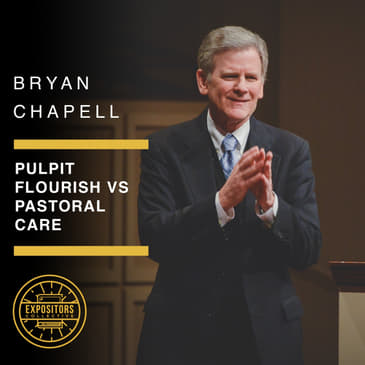
In this rebroadcast of a classic episode (from September of 2022) of the Expositors Collective Podcast, Dr. Bryan Chapell joins Mike to discuss the vital role of pastoral care and the irreplaceable power of love in pastoral ministry.
Dr. Chapell is an internationally recognized preacher, teacher, and author who currently leads the Administrative Committee of the Presbyterian Church in America. He serves as Pastor Emeritus of the historic Grace Presbyterian Church in Peoria, Illinois, and President Emeritus of Covenant Theological Seminary in St. Louis, Missouri. In addition, he teaches on the faculties of numerous seminaries and Bible colleges worldwide and leads pastors’ conferences across the globe each year.
Dr. Chapell is also the founder and host of Unlimited Grace, a Bible teaching programme heard across the United States and in over 80 countries, and available online. His many books, including Christ-Centered Preaching, Holiness by Grace, and The Hardest Sermons You’ll Ever Have to Preach, have established him as one of the foremost homiletics instructors of this generation.
Join us as Dr. Chapell shares his passion for communicating the transformative truth of God’s grace, which brings joy and peace to those who embrace it.
Dr. Chapell and his wife, Kathy, are blessed with four adult children, a growing number of grandchildren, and lives filled with faith, friends, and fishing.
Additional Resources:
Grace at Work: Redeeming the grind and glory of your job https://www.crossway.org/books/grace-at-work-tpb/
Preparation and Delivery of Sermons Course: https://www.bryanchapell.com/course-sign-up-prep-and-del
Application for Empowered Preaching : https://www.bryanchapell.com/course-sign-up-application-for-empowered-preaching
Principles and Practice of Sermon Writing and Delivery, Exploring the Unifying Aspect of Grace that Binds all of Scripture Together : https://www.thegospelcoalition.org/course/christ-centered-preaching/
Recommended Episodes:
Pastoral Ministry Beyond the Pulpit: https://cgnmedia.org/podcast/expositors-collective/episode/pastoral-ministry-beyond-the-pulpit-brian-brodersen-kike-tores-richard-cimino-manolo-matos
Calvin Wittman: https://cgnmedia.org/podcast/expositors-collective/episode/anchoring-truth-from-reporting-the-news-to-preaching-the-good-news
David Jackman : https://cgnmedia.org/podcast/expositors-collective/episode/impository-preaching-and-how-to-avoid-it
—————
For information about our upcoming training events visit ExpositorsCollective.com
The Expositors Collective podcast is part of the CGNMedia, Working together to proclaim the Gospel, make disciples, and plant churches. For more content like this, visit https://cgnmedia.org/
Join our private Facebook group to continue the conversation: https://www.facebook.com/groups/ExpositorsCollective
Donate to support the work of Expositors Collective, in person training events and a free weekly podcast: https://cgn.churchcenter.com/giving/to/expositors-collective
[00:00:00] Learning what it meant to love people, to care for them, to see the word change them when they were facing grief or sin or hurt, loss of loved ones.
[00:00:12] I had no idea how to do that.
[00:00:14] And what I learned was pulpit flourish is not nearly so important as pastoral care.
[00:00:23] That's how I needed them more than I knew and in a sense more than they knew.
[00:00:29] Hey, welcome to the Expositors Collective podcast, episode 360.
[00:00:34] I'm your host, Mike Neglia.
[00:00:35] The voice that you just heard is that of our guest, Dr. Brian Chappell.
[00:00:41] He's someone who, to some degree, needs no introduction.
[00:00:46] If you are at all familiar with the contemporary homiletics scene,
[00:00:51] or if you've been through any seminary or Bible college class about the preparation and delivery of sermons,
[00:00:59] Dr. Chappell literally wrote the book on Christ-centered preaching.
[00:01:04] So for that reason, I was really excited back in 2022 to get a chance to speak to him via Zoom.
[00:01:14] And so I'm re-releasing this episode today.
[00:01:18] Now, this is scheduled to come out on the 26th of December.
[00:01:22] And I, like many of you, have had some time off.
[00:01:27] And so I didn't want to chase down someone and make an episode and interview someone fresh.
[00:01:35] So dug into the archives, went into the greatest hits.
[00:01:40] And as a Christmas gift to you, I am re-gifting you this episode with Brian Chappell.
[00:01:47] We speak about what it means to live Christianly in the secular workplace.
[00:01:54] We do speak about Christ-centered preaching.
[00:01:57] But much of this conversation and what I think what makes this episode really shine
[00:02:02] is just conversation about pastoral care and the importance of loving your congregation.
[00:02:10] So hopefully this is inspiring and encouraging and set you up into a good 2025.
[00:02:18] All right, here's my conversation with Brian Chappell.
[00:02:22] All right.
[00:02:29] Hey, Dr. Brian Chappell.
[00:02:31] Welcome to the Expositors Collective Podcast.
[00:02:35] Thank you, Mike.
[00:02:36] I'm glad to be with you and glad to talk about preaching and expounding God's word.
[00:02:40] Oh boy, what a treat.
[00:02:41] Here's a question.
[00:02:42] When we started the Zoom call, you were eating something.
[00:02:45] What was that?
[00:02:47] A Mr. Goodbar.
[00:02:51] Because I'm late for lunch and didn't have lunch.
[00:02:54] So I thought I just need a little burst of energy.
[00:02:56] So here comes just a couple of bites of a Mr. Goodbar.
[00:02:59] Wow.
[00:02:59] Well, I hope the calories really help this.
[00:03:02] Yes.
[00:03:02] It's an energetic conversation.
[00:03:04] And I must say, of all the podcasts I've done, you're the first one who has asked that.
[00:03:10] Well, I'm curious.
[00:03:12] So that's your most recent meal.
[00:03:16] Next, I want to ask kind of the common question that we ask on this podcast, but what was your first sermon that you ever preached?
[00:03:26] I have no recollection of the text.
[00:03:30] I more remember what I was trying to do.
[00:03:32] So I'd had a lot of background in public address.
[00:03:39] So in my high school and college years, I had done a lot of competitive debate and public address and that sort of thing.
[00:03:47] So somehow in my mind, the first sermon was going to be the best oratory the world had ever heard.
[00:03:54] And so I preached something that had a lot of rhetorical flourish to it and was surprised when my homiletics professor said, you know, that's wonderful.
[00:04:07] It has absolutely nothing to do with the text in front of us.
[00:04:10] And that was my kind of understanding of, oh, it's not just about my flourish.
[00:04:15] It has something to do with being faithful to the word.
[00:04:19] And that was kind of a good comeuppance for me, I'm sure.
[00:04:22] Yeah.
[00:04:23] Was that public feedback or was it private?
[00:04:27] Were you pulled aside like Aquila and Priscilla or were you rebuked to your face like Paul and Peter?
[00:04:32] No.
[00:04:33] No.
[00:04:33] Actually, the professor was quite kind in the class setting.
[00:04:39] It was more my peers who let me have it afterwards because I think they knew that I knew that I was really something.
[00:04:49] And so they were not reserved afterwards in kind of letting me know that it had little to do with scripture and a whole lot to do with rhetorical flourish.
[00:04:59] So I think they enjoyed letting me in on that.
[00:05:03] And not cruelly, but certainly I was my friends let me have it for their own entertainment for a bit.
[00:05:10] And the fact that I remember, let me think how long ago that was.
[00:05:14] So that would have been.
[00:05:17] That would have been like 45 years ago, and I still remember it.
[00:05:21] So I had to be good for me.
[00:05:22] Yeah.
[00:05:23] Yeah.
[00:05:24] Wow.
[00:05:24] Yeah.
[00:05:24] Faithful are the words of a friend.
[00:05:26] So I'm glad that you heard that.
[00:05:28] And then probably instantly were changed forever and only preach good sermons from then on out.
[00:05:34] Right.
[00:05:35] Of course.
[00:05:36] I'll let you know the untruth of that.
[00:05:38] But yes.
[00:05:39] Yeah.
[00:05:40] Okay.
[00:05:40] Well, yeah.
[00:05:41] Thank you for that.
[00:05:42] I mean, this is kind of a secondary follow on question from that.
[00:05:46] But do you recall, let's say your first like church sermon, the first time that you preached
[00:05:51] on a Sunday morning without the homiletics professor there to give you feedback afterwards
[00:05:58] or even to.
[00:05:59] Yeah.
[00:05:59] So when was your first real one?
[00:06:01] If I might ask that.
[00:06:03] Sure.
[00:06:04] And that would be a bit of a mix.
[00:06:06] So I have to say it two ways.
[00:06:08] So I started out from that point, kind of learning to preach, I will say actually by teaching.
[00:06:14] So I started doing Bible studies, even among my peers in the seminary setting.
[00:06:21] And I think that was probably very good for my heart because it was small settings, but
[00:06:25] still I was preparing from the word and getting oriented that way.
[00:06:30] So at the end of my first year of seminary, there was a little country church that asked me
[00:06:37] to come and be their preacher.
[00:06:39] And the first, you said, do I remember the first sermon?
[00:06:42] That was the first sermon in a church setting.
[00:06:46] And so the first one was actually my candidating sermon for them.
[00:06:50] So this was a little church of probably 25 people or so, an hour away into the rural districts
[00:06:57] of Illinois from where our seminary was.
[00:07:00] And I preached and I have no idea what the subject was or what the text was.
[00:07:06] Uh, I do remember, uh, thinking, man, I hope that went okay.
[00:07:11] Um, but, uh, later on I was learned, I was voted upon by the congregation as to whether they
[00:07:17] wanted me to come.
[00:07:18] Now, this is an interesting little sidebar.
[00:07:21] They almost voted me not to come.
[00:07:24] And why?
[00:07:26] Because this was a church that had been training.
[00:07:29] Um, it viewed its mission.
[00:07:31] I mean, even those only 25 people, they viewed their mission as getting these young seminarians
[00:07:36] ready for future pastoring.
[00:07:38] So they could not afford their church.
[00:07:40] Uh, they could not afford a pastor with this little church, but they, they viewed their mission
[00:07:45] as getting seminarians ready by, uh, during the remaining two or three years that they around
[00:07:51] seminary to preach weekly.
[00:07:53] And, uh, and they, they thought I, this is going to be odd sounding.
[00:07:58] They thought they couldn't help me.
[00:08:00] Uh, they, they thought that I was kind of beyond, um, what, what they needed.
[00:08:05] Now I desperately needed them.
[00:08:09] I knew so little about, um, pastoring.
[00:08:13] I, you know, could I stand on my feet and present a good oral message?
[00:08:16] Of course, you know, I, I'd done that for a number of years, as I said, even in competitive
[00:08:21] type settings, but learning what it meant to love people, to care for them, to see the
[00:08:28] word change them when they were facing, uh, grief or sin or, uh, hurt loss of loved ones.
[00:08:37] Uh, I had no idea how to do that.
[00:08:44] And, uh, that's, that's how I needed them more than I knew.
[00:08:53] And in a sense, more than they knew, uh, I, I came from a very shattered family background
[00:08:58] and learning to love people and be loved by them and actually let the spirit do that.
[00:09:04] You know, that it wasn't just a formal occasion or a formal rhetorical message of performance,
[00:09:10] actually ministering to people.
[00:09:12] I desperately needed to know what that was about and then fell in love with it.
[00:09:17] Um, it kind of opened a part of me again, I had kind of a shattered family background.
[00:09:21] So when I began to know what it meant to pastor people and be loved by them, it opened a dimension
[00:09:29] of my heart that I didn't even know much about.
[00:09:32] So I, I was exceedingly grateful for, uh, and remain to this day grateful for that, a
[00:09:39] little church of people who thought it was their job to train future pastors.
[00:09:43] Wow.
[00:09:44] And, and they did, they did.
[00:09:46] Well, so following on from that, I guess I'd love to hear about like, how have you grown
[00:09:52] as a, as a teacher and preacher and pastor, uh, since, since then?
[00:09:57] I mean, are there things that you did in those early years that you no longer do or, or vice
[00:10:02] versa?
[00:10:02] Have you, um, stopped doing things that you used to do back then?
[00:10:08] Uh, let me, let me start maybe again with the, with the heart things.
[00:10:12] I, I had to learn that preaching was not a performance, but actually trying to minister
[00:10:20] Christ to his people.
[00:10:22] And that had much less to do with, as I said, rhetorical flourish as connecting the truths
[00:10:31] of God word, God's word to the hurts or the sins or the desires or the dreams of God's
[00:10:38] people.
[00:10:39] How, how do I take that, that word and help people to sense that Christ himself is ministering
[00:10:46] to them through his word.
[00:10:49] And for someone who'd been trained in a kind of competitive debate, I, there was that hard
[00:10:56] transition of going from, um, how to, how do I reach people with the gospel, for instance?
[00:11:02] And there was a time in my life I thought, well, if I can just defeat them in argument,
[00:11:05] you know, I'll just convince them of the truth.
[00:11:08] Then, then of course they'll become Christians.
[00:11:10] And that, that put me in the mode of, I'll just crush their arguments.
[00:11:14] And then of course they'll believe, well, you, you, you know how effective that was.
[00:11:19] Um, I, I had to learn what it meant to, to love lost people, uh, when, when they were angry
[00:11:26] at God, angry at me, angry at the church to actually love them beyond their barriers.
[00:11:32] And to try to say, this is how Christ actually wants you to hear, uh, his word.
[00:11:38] And I, that's not just lost people.
[00:11:40] I mean, that's, that's people in the church who have their own barriers up often.
[00:11:44] And I, it was not, it was not my instinct.
[00:11:48] Again, I coming from a shattered, uh, kind of family background, my calloused soul was
[00:11:54] well-hardened against feeling much or becoming very vulnerable.
[00:11:59] And I, I confess, I, I think I knew a lot about public speaking and very little about, uh,
[00:12:08] the pastoral care that God needed.
[00:12:12] So what, what did I have known over time?
[00:12:14] I think over time I became less formal.
[00:12:18] Um, there, there was a time I was sure that the, you know, the best argument was, uh, the
[00:12:23] most convincing argument.
[00:12:24] I, I actually believe at this point, the argument that people feel most connects their heart to
[00:12:32] God's word is what is most convincing.
[00:12:34] And that's, I'm not talking about not ministering from logic or mind, but I'm saying it's very
[00:12:40] much identifying how does this reach you?
[00:12:44] And, um, I, I became so much more concerned for that, but that's, that's always, uh, a growth,
[00:12:51] uh, uh, aspect.
[00:12:53] I think one of the neat things the Lord did in my life was even though I've had a lot of
[00:12:57] different aspects of my career, you know, being kind of a church executive, being a seminary,
[00:13:02] a professor or president, I, I've, the Lord has always kind of looped me back into the
[00:13:07] church at different points in my career.
[00:13:10] And I think that has been for my soul's correction because each time I'm tempted to just kind of
[00:13:17] make this a task, um, the Lord kind of takes me back to saying, you know, if you're not really
[00:13:25] connecting to the hearts of people, then however ornate or accurate may be your message, it's not
[00:13:34] really what Christ can use best.
[00:13:38] So you're aware, Mike, I mean, I do a lot of writing of what best communicates.
[00:13:42] So I, I certainly know those factors.
[00:13:43] I have a PhD in that material.
[00:13:45] Um, but I, I'm still getting my PhD in pastoring and, and believing what that means.
[00:13:52] And it seems as if that first church that you pastored, they're like deliberate vocalized
[00:13:57] mission was to help prepare these young men for a lifetime of service.
[00:14:03] But maybe are you saying that like, to some degree, every church has its role to play and
[00:14:08] like the sanctification and the encouragements, uh, and the formation, I suppose of, of leaders,
[00:14:13] whether they state it or not, like it's, it's a two-way street.
[00:14:16] No question.
[00:14:18] And, and I think sometimes people don't know that.
[00:14:21] And sometimes pastors don't know that we were going kind of deep here fast, but I actually
[00:14:25] grieve for a lot of young pastors that I see because of something they struggle with that
[00:14:32] I didn't when, when I was the agent.
[00:14:34] And that is what, what is their role, particularly with media and internet communication.
[00:14:40] And I, I look at young pastors who spend hours every day, um, on the internet critiquing
[00:14:47] other people and identifying where other people are making mistakes or where their denomination
[00:14:54] is errant or whatever.
[00:14:55] I listen, I'm, I'm not saying some of that isn't needed and right, but I see those who think
[00:15:00] the main job of the pastor is to engage in correcting other people distant from them.
[00:15:08] You know, I'll, I'll identify that church executive, that ministry leader, that famous
[00:15:13] person, whatever it is.
[00:15:14] And, and all of their foibles, flaws, hypocrisies.
[00:15:19] And, and I think how sad that, that you're, you're kind of locked into that role.
[00:15:26] And I'm thinking, are, are there no widows in your congregation that need comfort?
[00:15:30] Are there no hospitals to visit?
[00:15:33] Because your own soul will be comforted, healed, built up, strengthened by ministering
[00:15:41] to other people in their weaknesses and in their hurts, rather than just identifying where
[00:15:47] other people are, are problems.
[00:15:49] And, and we, the, the internet has made that a, in my mind, a trap for many, a young pastor
[00:15:56] that they, they just get caught in the critique mode of, of what the internet allows us to
[00:16:02] do these days.
[00:16:03] And the echo chamber chamber is pretty effective.
[00:16:06] You can find lots of other people willing to make your critique and stay online with you.
[00:16:10] And, and, uh, so I, I, I love trying to talk about helping young pastors grow as pastors.
[00:16:18] And you and I are talking about preaching and how do I say it in some ways, that's the easiest
[00:16:23] aspect.
[00:16:25] Um, because you, you, you learn, you learn, how do you outline in text?
[00:16:30] How do you present it?
[00:16:31] How do you present it?
[00:16:32] Well, those are learnable skills.
[00:16:35] Um, they, they are also skills that can be divorced from your heart if you're not careful.
[00:16:41] Yeah.
[00:16:42] Uh, wow.
[00:16:43] Okay.
[00:16:44] Yeah.
[00:16:45] I'm, I'm tired today because I had a really late night elders meeting last night and, and
[00:16:49] we were dealing with some frustrating issues and obviously you didn't ask, and I'm not
[00:16:55] going to get into what, what the issues are, but one of our elders, um, Mark Ryan, he's
[00:17:00] like, you know, we got to push through it.
[00:17:02] We got to, we got to push through this hard issue.
[00:17:04] He's like, and he reminded us here's what it's all about.
[00:17:07] And he, and he just said, you know, a couple of days ago, I was able to go, you know, visit
[00:17:10] a widow and I got to, you know, listen to her, pray with her.
[00:17:14] We got to buy her groceries and like, and that's what church is about.
[00:17:17] And we're, we do this other stuff.
[00:17:19] We push through this X, Y, and Z, all these other issues so that we can be there, you
[00:17:24] know, for, for that widow and for others, others like her.
[00:17:27] And I I'm so glad to hear you say even something similar that they there's not only is there
[00:17:33] the internet out there and be careful.
[00:17:35] I don't mean to alarm you, Dr.
[00:17:36] Chappell, but we're on the internet right now, but like there's the problems of the internet
[00:17:40] out there, but then also there's the other flotsam and jetsam and just ongoing crises
[00:17:45] and frustrations of church life.
[00:17:48] But I was thankful for Mark last night.
[00:17:50] And then you even right now, just reminding us of, of that truth.
[00:17:54] It's, it's that widow.
[00:17:54] It's those people.
[00:17:55] Well, I, I remember Mike, when, uh, some, some poor, poorly dressed, uh, uh, malformed
[00:18:06] in appearance, young women began attending our church years ago.
[00:18:10] And, um, we were involved in some controversies as a, as a church at the time.
[00:18:15] And, um, at some point, one of these young women tried to take her life.
[00:18:22] And I got very involved in, in trying to minister to her and so forth.
[00:18:26] And I remember at, at our elders meeting afterwards, um, one of our elders, uh, just
[00:18:33] began to, uh, to weep and say, what, why didn't we even notice these young women who've been
[00:18:40] coming to our church who were in such need?
[00:18:42] And another elder, um, and another elder very honestly said, the reason we did not notice is
[00:18:48] because it was not to the advantage of any of us to pay attention to them.
[00:18:52] And that was, that was a time of repentance and honest confession, but nothing was better
[00:18:59] for us as a church say, here's this controversy of powerful people competing with one another
[00:19:04] to see who wins this argument.
[00:19:06] But what brought us to tears, broke our hearts, um, in some ways broke our pride to minister
[00:19:12] was to say, here's the calling of the church.
[00:19:15] Yes.
[00:19:15] Is it to be pure in doctrine?
[00:19:17] Yes.
[00:19:17] It is to be well-organized.
[00:19:18] Yes.
[00:19:18] But, but if it does not come from a heart that truly desires that the Holy spirit minister,
[00:19:25] the spirit of Jesus to his people in all their hurts and all their pains, then what we're
[00:19:29] doing is really foolishness.
[00:19:31] Yes.
[00:19:31] And, um, I, um, I keep learning what that means.
[00:19:36] I keep learning what that means.
[00:19:38] Um, uh, uh, listen, I love talking about Christ-centered preaching.
[00:19:43] I love talking about how is grace unfolding in every text and why is that important?
[00:19:47] And, and, and, but what I sometimes grieve about is we just get into some hermeneutical
[00:19:53] debate.
[00:19:53] Well, Jesus is there this way.
[00:19:55] He's not there.
[00:19:55] Oh, you did it right.
[00:19:56] You did it wrong.
[00:19:57] And I try to say it to, you know, listen, I know I'm supposed to be the exegete of exegetes
[00:20:02] here as the teacher, but I don't care a lot.
[00:20:05] You know, I don't, I, what, what I really want to know is if you help Jesus, have you
[00:20:10] helped people to experience the reality of the Lord in their lives today?
[00:20:15] And sometimes you'll get the text, right.
[00:20:16] Sometimes you won't believe me.
[00:20:18] If you're trying, if you'll get it right, most of the time, not all the time, all of
[00:20:23] the time, you'll get to stand up in the pulpit sometimes, read the text and go, oh no, I
[00:20:26] didn't see that was there until this very moment.
[00:20:30] But I really want to know that you have discovered the grace of God for your heart.
[00:20:36] And it's flourishing now in such a way that not only is he humbling you, but it's making
[00:20:41] you grateful.
[00:20:43] And it's that gratitude for the work of Christ that you just, you just are compelled to tell
[00:20:48] people, look at the grace of it.
[00:20:49] Look how God is taking care of broken people, sinful people, rebellious people, prideful
[00:20:55] people.
[00:20:55] Look what God is doing here in all his grace.
[00:20:58] And I just got to tell you that.
[00:20:59] Yeah.
[00:21:00] And part of that's because it comes out of our own brokenness.
[00:21:03] Cause if, if it doesn't mean a whole lot, if it was not making you terribly grateful, then
[00:21:08] you won't feel that compulsion and it's that gratitude that drives that sense of, man, I
[00:21:14] just want you to know what, what God has done to help my heart here.
[00:21:18] Yeah.
[00:21:19] Yeah.
[00:21:19] I, I, I'm a correspondent student with a Western seminary and this is something I think that
[00:21:25] their outgoing president said, John Johnson, I think is his name.
[00:21:29] Forgive me if I've got it wrong, but, but he said in, in talking about preaching, he was
[00:21:33] saying, well, preaching and pastoral ministry.
[00:21:35] He says, um, you know, I don't really care if you can show everyone Christ in the passage,
[00:21:41] people need to see Christ in your life or is that it's, it's worthless.
[00:21:45] If you can show Christ in every single verse, but like, if he's totally absent from your life,
[00:21:49] your manner, the way you're caring for people.
[00:21:51] And, and that's, that's stuck with me.
[00:21:53] And I, I want to do both.
[00:21:56] And I'm, I'm glad to hear, I'm, I'm glad that you're saying it's, it's not either or
[00:21:59] because listen, you're torpedoing this whole interview.
[00:22:02] Cause I'm not talking to you about preaching, but I'm, I'm also totally happy to follow your
[00:22:06] lead.
[00:22:07] Um, what's, what's okay.
[00:22:09] Maybe just addressing this.
[00:22:11] Like, so I know when I discovered this whole Christ centered preaching thing, I was super
[00:22:16] excited and it became my kind of obsession.
[00:22:19] Like, you know, I read your book, listened to so many of your lectures and then, and then
[00:22:23] others as well.
[00:22:23] Um, just like getting into it.
[00:22:25] And is this maybe a common thing that you see where, where young, young preacher preachers
[00:22:31] discover the insight that you kind of, you and others have helped people to see.
[00:22:35] And then where it becomes almost at the risk of being like almost too important, or does
[00:22:42] it loom too large in people's minds at the expense of something else?
[00:22:46] Well, the answer has to be yes, but I want to, I want to be careful to say where do, where
[00:22:50] do all of us start?
[00:22:52] Almost all of us start as preachers about, I call the D and the D okay.
[00:22:56] Duty and doctrine.
[00:22:57] You know, I want to tell you either this text tells you what you should do or what you should
[00:23:02] know.
[00:23:02] Uh, here's how you should perform or here's better doctrine for you.
[00:23:06] Now I'm never going to say that the text is not relating what you should do, or the text
[00:23:12] is not relating what you should know.
[00:23:14] Both are absolutely necessary.
[00:23:16] Um, but if part of that, here's what you should do.
[00:23:21] And here's what you should know.
[00:23:22] If that is taking me only to here's more of what you should do and more of what you should
[00:23:27] know, then the, the contextual message of all the scriptures is actually unraveling.
[00:23:33] What was the contextual message of all the scriptures from Genesis three, 15, four, the
[00:23:37] messages, you are not your redeemer.
[00:23:40] You are not your redeemer.
[00:23:42] God must supply him.
[00:23:44] And so if my message as a preacher is here's more for you to do or more for you to know,
[00:23:48] then the implied message is, if you do enough, if you know enough, you'll be okay with God.
[00:23:53] Well, if your duty and your doctrine or what make you okay with God, who is your redeemer?
[00:23:58] You are your redeemer, right?
[00:23:59] You just perform better or no more, you know, and you'll say, well, I'm not perfect, but
[00:24:03] I'm better than those people down the street.
[00:24:05] And my doctrine may not be perfect, but it sure is better than those Baptists or those
[00:24:09] Methodists or those, whatever I'm not right.
[00:24:11] Right.
[00:24:11] And you say, I tease about it, Mike.
[00:24:14] I say, I'm Presbyterian and we Presbyterians are absolutely sure that you are not saved by
[00:24:19] good works, but we're actually pretty close to sure that you are saved by good doctrine.
[00:24:24] And I say, actually, you're not.
[00:24:27] You're saved by Jesus Christ and him alone.
[00:24:30] And what that means is, yes, we work on duty and doctrine, but if Christ is absent, if Christ
[00:24:37] is absent, then ultimately people depend upon themselves and that is to their great harm.
[00:24:44] Yeah.
[00:24:44] So Christ-centered preaching is, as you know, not trying to make Jesus magically appear in
[00:24:49] every verse.
[00:24:49] It is saying every verse is showing you your destitution and God's provision.
[00:24:54] Every verse is in some way saying the one who said he would provide a redeemer is showing
[00:24:59] you an aspect of his character and grace, and he's showing you an aspect of your need of
[00:25:04] that.
[00:25:05] Yeah.
[00:25:05] So, you know, my little buzzword is fallen.
[00:25:07] There's a fallen condition that's here and God is addressing it.
[00:25:11] And the solution is not you.
[00:25:14] The solution is not you.
[00:25:16] Now, there are ways you are to respond to his solution with duty and doctrine and growing
[00:25:22] in knowledge and faithfulness.
[00:25:23] Yes.
[00:25:24] But God is telling you here in some measure that you are in need of a redeemer and that
[00:25:30] he will provide one.
[00:25:31] So, I don't mean to go into all that code and take over your interview here, but that's
[00:25:38] what Christ-centered preaching is.
[00:25:39] It's not taking out your decoder ring or your magic wand and making Jesus magically appear.
[00:25:45] It's reminding ourselves of the end, the telos, the goal of scripture, which is you are not
[00:25:52] your redeemer.
[00:25:53] God must provide him.
[00:25:54] And somehow God is showing you his character and yours right here.
[00:25:58] He must provide what you cannot.
[00:26:00] Yeah.
[00:26:01] Yeah.
[00:26:01] And so, preachers should spend time with their nose in the book, discerning, deciding, I
[00:26:09] guess, to some degree uncovering, but not too much because it's just right there.
[00:26:15] But going back to what you were saying earlier on, that also needs to be coupled, you know,
[00:26:21] with time with people or showing this care and love or even realizing that this sermon that
[00:26:28] we're working on for X amount of hours per week, it actually is to address real people's
[00:26:33] real needs and to give them the good news that it's not up to them to redeem themselves.
[00:26:37] But then, yeah.
[00:26:38] So, what do you see the connection between like the diligent work of sermon preparation
[00:26:45] and then also how this connects even to pastoral care for people?
[00:26:49] Yeah.
[00:26:50] Great question.
[00:26:51] So, let me tell you, when I began teaching in seminary, I'd been pastoring for a few years.
[00:26:57] The school in which I had graduated asked me to come back and even while I was pastoring
[00:27:02] in the area, come back and start teaching preaching.
[00:27:05] Now, when I'd been in seminary, one of the professors who had impacted me used to say,
[00:27:12] preach to needs, identify what people are struggling with, preach to needs.
[00:27:16] And I came back and I said to seminary students, I said, one of the things I've learned is you
[00:27:21] have to preach to needs.
[00:27:22] And I was surprised that they were ready to tar and feather me.
[00:27:25] And, you know, I did not recognize that in my time from leaving school, going to the pastor
[00:27:32] and coming back, that there had been a lot of discussion in the theological world about
[00:27:37] preaching to or identifying felt needs and preaching to them, which, you know, in our theological
[00:27:43] jargon, we now call anthropocentric preaching.
[00:27:46] Anthropocentric, yeah.
[00:27:47] Right?
[00:27:47] So instead of being theocentric, you become man-centric.
[00:27:51] And the start and the goal of my sermon is to address the human need.
[00:27:56] And for all of us of kind of good biblical reform theology, we know that's wrong.
[00:28:01] You know, this is no longer God glorifying, it's just human-centered.
[00:28:05] So, you know, I said to my students, well, what do you want me to say to you?
[00:28:09] Okay, don't preach what people don't need.
[00:28:11] Don't preach to their needs.
[00:28:12] Preach what they don't need.
[00:28:13] Well, they didn't want that either, of course.
[00:28:14] So I had to kind of go back to that.
[00:28:17] What am I actually saying?
[00:28:18] What am I believing theologically?
[00:28:20] The Bible from Genesis 3, 15 forward is addressing people in a fallen world, fallen creatures
[00:28:28] in a fallen condition.
[00:28:29] So instead of saying preach to needs, which could go into felt needs, anthropocentric,
[00:28:36] I said, all right, identify the fallen condition the Holy Spirit is addressing.
[00:28:41] I mean, the Holy Spirit just didn't say, oh, here's just some information for you.
[00:28:46] It has no purpose, but here's just some, you know, there's a purpose.
[00:28:50] So identify the fallen condition and then say, how is the Holy Spirit showing God's answer
[00:28:56] to that fallen condition?
[00:28:57] Now, you asked me, how does that connect to human needs and what we do as pastors?
[00:29:02] Well, what I recognize is that people often say, people who are kind of gospel or in a grace-oriented
[00:29:10] preaching, every sermon is the same.
[00:29:12] God says you should do something.
[00:29:13] You can't do it, but he'll forgive you.
[00:29:15] Try better next week.
[00:29:16] You're someone who can.
[00:29:18] Yeah.
[00:29:19] Actually, that's not what I'm saying.
[00:29:21] What I am saying, it's not just a general concept of grace every week.
[00:29:26] I'm saying the Holy Spirit wrote this text to identify a specific fallen condition that the
[00:29:34] grace of God is addressing.
[00:29:37] And Romans 15, 4, everything that was written in the past was written for us so that through
[00:29:43] endurance and the encouragement of the scriptures, we might have hope.
[00:29:46] So I want to look at that text.
[00:29:47] I'm going to say, what is the specific aspect of fallenness that was written for us so that
[00:29:53] I'm not just in a general way saying there's sin and grace.
[00:29:56] I want to take that specific aspect of human fallenness and say, how does the grace of
[00:30:02] God deal with that specific aspect of fallenness, which you and I share?
[00:30:06] Now, my goal as the pastor, not just the exegete, is to say, I've got to do the hard biblical
[00:30:13] research and exegesis of saying, what is the fallen condition of this text?
[00:30:18] What's going on there?
[00:30:19] And then I've got to say, how are we like them?
[00:30:23] There is something in, you know, look at Thomas, you know, what a terrible disciple.
[00:30:28] Aren't you glad you're not like Thomas?
[00:30:30] Such a doubter.
[00:30:31] Well, Thomas is not in the Bible so that we'll be glad that we're not like him.
[00:30:35] We doubt too.
[00:30:37] We've had the resurrection.
[00:30:38] We know about it.
[00:30:39] We have the witness of the scriptures, the testimony of Christ, and our child gets leukemia
[00:30:45] and we wonder if any of this is real or true.
[00:30:47] And we doubt.
[00:30:48] We are a lot like Thomas.
[00:30:49] We have a falling condition we share with him.
[00:30:52] And if I will do that, if I will, to your point, if I will do the hard exegesis of saying not
[00:30:58] just what general sin or general problem, but I will say, what is the specific fallen condition
[00:31:04] the Holy Spirit is addressing here that I share?
[00:31:07] I'm like those people, like that man, like that apostle, like I share something with, or the
[00:31:14] Holy Spirit wouldn't have put it there.
[00:31:15] So then when I identify that now, my exegesis is not just saying, here's facts for you to
[00:31:21] know.
[00:31:21] It is here's situations that you share, sin that you share, pride that you, whatever it
[00:31:27] is, here's a fallen condition that you share so that I can show how the grace of God deals
[00:31:32] with that.
[00:31:32] Now I'm not just telling people biblical facts, right?
[00:31:36] Here's my data dump.
[00:31:37] I'm actually pastoring people in the way that I approach the text.
[00:31:41] Here's a fallen condition.
[00:31:42] You share it.
[00:31:43] Here's how the grace of God was helping those people.
[00:31:47] And remember, you're like them.
[00:31:48] Here's how the grace of God is going to be applied to you too.
[00:31:51] It will culminate in the work of Christ.
[00:31:53] But what I need to show you is how God is showing you his grace for your fallenness by the way he's
[00:32:00] dealing with this text.
[00:32:01] It's hard exegesis that keeps the diamond of grace showing its many, many, many, many,
[00:32:07] many facets.
[00:32:08] It's not the same thing every week.
[00:32:11] It's detailed, hard exegetical work with a pastoral heart behind it.
[00:32:17] Yeah.
[00:32:18] You distinguished a few minutes ago.
[00:32:19] You said that you're not just an exegete.
[00:32:22] You're a pastor.
[00:32:23] And that's, yeah, A, I believe that.
[00:32:26] Then B, I just want that to be not even notable.
[00:32:29] I want everyone to always do this.
[00:32:32] You know, first me, but just that this can always just be something that is, it's more
[00:32:35] than just, you know, emerging from our studies with our pristine, truthful, honest, Christocentric
[00:32:42] declaration.
[00:32:43] But that it's connecting and it's really impacting people in their hearts, you know, where they
[00:32:49] live and where they work.
[00:32:52] Yeah.
[00:32:52] And for that reason, you actually have to pastor, right?
[00:32:54] I mean, you and I, at some point, always thought, you know, if the church that calls me someday
[00:32:59] will just give me 40 hours a week to work on the sermon, I will be able to produce masterpieces.
[00:33:04] It will be, and the reality is you couldn't.
[00:33:06] Because if the sermon is not connecting to people, then it may be wonderful.
[00:33:12] I like your word pristine and theology and organization, all that, but it will not touch
[00:33:16] their hearts because you don't know them.
[00:33:19] Right.
[00:33:19] And you don't know how to phrase what they are struggling with or how to connect the scriptures
[00:33:24] to what they are struggling with, or maybe don't think they're struggling with.
[00:33:28] How do you connect it to calling them to repentance?
[00:33:31] How do you connect it to their comfort?
[00:33:33] Whatever it is, it's living among God's people.
[00:33:37] So if you're just kind of isolated in your office, preparing these masterpieces, they may
[00:33:44] be good for prose, but they are not good for pastoring.
[00:33:48] That's good.
[00:33:49] So you mentioned, yeah, it's where people live and work.
[00:33:52] Your latest book that came out really, I think, aims at and achieves that goal.
[00:34:00] Your latest book is called, as you know, Grace at Work, Redeeming the Grind and Glory of Your
[00:34:06] Job.
[00:34:07] So you really bring to bear this pristine theology, et cetera, into the workplace situation.
[00:34:15] And then even into questions about like earning money, spending money,
[00:34:18] these types of things that are so common to the lives of our congregations.
[00:34:24] And then often don't really get addressed too much in our sermons and in our preaching.
[00:34:30] I guess, what prompted you to write that?
[00:34:33] And then how can you help us preachers to maybe consider doing something similar in our own pulpits?
[00:34:40] Oh, thank you.
[00:34:42] You know, Mike, a little bit of my story.
[00:34:44] When I began preaching, I've said to you, I was out of a shattered background, out of a debate
[00:34:50] performance mode.
[00:34:52] And most of the sermons I early did were just telling people, straighten up, fly right, do
[00:34:57] better.
[00:34:58] Until that preaching crushed me because I couldn't fly straight enough or do better enough for a
[00:35:05] holy God.
[00:35:05] And I knew that.
[00:35:06] My sermons crushed me.
[00:35:09] And the Lord brought me to an understanding of His grace that is my strength and my hope
[00:35:15] and my encouragement.
[00:35:17] And that grace that the Lord was teaching me ultimately became not only healing to my heart,
[00:35:28] but became what I wanted to tell people about in every aspect of their lives.
[00:35:33] So everything that I've written from that early time of just telling people, duty and doctrine,
[00:35:38] duty and doctrine, duty and doctrine, hitting them with duty and doctrine, but helping them
[00:35:42] understand how the grace of God enabled them.
[00:35:45] In fact, gave them the joy that is their strength.
[00:35:48] That everything I've done since those early days of my hard shell ministry have been to say to
[00:35:56] people, how does grace make a difference in your home, in your marriage?
[00:35:59] How does grace make a difference in your prayer life?
[00:36:01] How does grace make a difference in having to fight the hard fights of the gospel?
[00:36:06] How does grace make a difference in pastoring?
[00:36:09] And finally, how does grace make a difference in work?
[00:36:11] Every book that I've written since that time has been trying to help people see how does grace
[00:36:15] make a difference in this aspect of your life?
[00:36:18] So most people think, you know, well, you know, what does God call me to do at church,
[00:36:24] at work?
[00:36:24] Well, you know, I'm supposed to not lie, not cheat, not steal and witness on my lunch hour
[00:36:30] if possible.
[00:36:31] That's right.
[00:36:32] But what if you actually believed that what God has called you to do, his vocation, your
[00:36:37] calling was actually to take his grace into your workplace, into the community, into your
[00:36:45] family by the way that he is helping you deal with the glory and the grind of your job.
[00:36:50] Yeah.
[00:36:50] And he's actually displaying his grace through you.
[00:36:53] And that's, that's his purpose in hard times, as well as an easy to hard places, hard bosses,
[00:36:57] easy bosses, easy.
[00:36:59] That is really the, the grace of God that you're displaying that work is actually worship and
[00:37:06] that I can begin to perceive it that way.
[00:37:08] Even the hard stuff, even the grindy stuff, you know, is actually part of my worship.
[00:37:13] And it's a response to his grace that he's showing through me.
[00:37:19] So what I'm trying to do in grace at work is, is yeah, you know, recognizing Sunday is
[00:37:24] for Monday, you know, it's, it's not just something isolate, but I'm really wanting people to begin
[00:37:29] to be able to rejoice in the grind as well as the glory.
[00:37:33] See, there's purpose in what God is doing in your life.
[00:37:36] And there's, there's, there's glory in even the hard stuff that God calls you to do.
[00:37:41] If you can see it from a gracious perspective.
[00:37:44] Yeah.
[00:37:45] I read John Piper's book, Don't Waste Your Life when I was back, back when it was a new
[00:37:50] book and I was a young man and it, and it really impacted me as it did, as it did many.
[00:37:54] And there's a chapter in there, I think making, making much of Christ from eight to five.
[00:37:58] And, you know, in typical Piperian fashion, it's like a list of 12 things that you could
[00:38:02] do or something like that.
[00:38:04] And number 12 was evangelize at your work, you know, and, and he, he drew out 11 other,
[00:38:12] I don't have the numbers in front of me, but whatever.
[00:38:14] It was notably the last on the list where in my mind, it's like, how do you glorify Jesus
[00:38:19] at work?
[00:38:20] I would just put number one evangelize and that's the end of the list, but he just really
[00:38:24] helped me.
[00:38:24] And then your book is an expansion of this kind of notion that there's so many ways to glorify
[00:38:29] God in addition to the obvious low hanging fruit of don't sin and preach the gospel.
[00:38:35] Yes.
[00:38:36] I mean, you know, it's, it's, uh, uh, Dorothy Sayers, you know, who writes, you know, Jesus
[00:38:41] didn't make bad tables as a carpenter.
[00:38:44] Why not?
[00:38:44] Because it was a testimony in so many ways of, uh, God's provision for him of demonstrating
[00:38:51] the excellence of crap that God had given him the skills to, to provide the materials
[00:38:56] where God's provision, everything was an aspect of the grace of God that when well handled
[00:39:01] was showing God in his dimensions of character and provision to the world.
[00:39:07] And, you know, what does God call us to do in our workplace?
[00:39:10] Well, the chief thing he calls you to do is do a good job.
[00:39:12] Yeah.
[00:39:13] Um, and now if that's a burden to you, if it's something that's dishonoring to God, well,
[00:39:19] that's not going to be helpful.
[00:39:20] But if you're saying every job has its garbage detail, we know that every job, even pastoring
[00:39:25] has its garbage detail.
[00:39:27] We, we know that, but if what I'm doing with the late last night at eldest.
[00:39:32] And what am I doing?
[00:39:33] I'm trying to help a church deal with hard things so that people can worship, you know, if
[00:39:37] I can see the, the end of what I'm accomplishing.
[00:39:41] And I know we're running close on time here, Mike.
[00:39:44] So I just, I just think I give that example in the book that made such an impact on me.
[00:39:47] I went to a cheese factory one time.
[00:39:50] That sounds so silly, but I did, you know, just these, these, and I watched a man sit
[00:39:54] by conveyor belt and his one job was about every 10th block of cheese that went by.
[00:39:58] He had to straighten it.
[00:40:00] So it would go right into the packaging.
[00:40:01] And I thought, oh, I'm glad that's not my job.
[00:40:04] Now, I don't know anything about him or his intellect or abilities or skills or interests,
[00:40:09] but I have to think if he would do what I encourage all of us to do.
[00:40:13] And that's, and that is take the George Bailey test from that old, old movie, you know, of
[00:40:18] the Chris Simpson movie.
[00:40:19] It's a wonderful life.
[00:40:21] And Clarence, the angel is winning his wings.
[00:40:23] I'm not defending this theology.
[00:40:25] Wonderful theology, by the way.
[00:40:27] But, but what does George Bailey see?
[00:40:29] He sees what would have happened had he not lived.
[00:40:32] Yeah.
[00:40:33] And I think what would happen if that man were not straightening those little blocks
[00:40:36] of cheeses, they wouldn't fit right in the packaging.
[00:40:38] They would get bacteria.
[00:40:40] They would poison people.
[00:40:42] They'd get sick.
[00:40:44] People would die.
[00:40:45] The company would close.
[00:40:46] The community would not have industry.
[00:40:48] The families would not have provision.
[00:40:50] But because he does his job well, the grace of God is flowing.
[00:40:56] And if he's able to understand that and to express it, then the job becomes an aspect of
[00:41:02] worship for the world to see and for we to experience.
[00:41:07] Yeah.
[00:41:08] Yeah.
[00:41:09] Well, okay.
[00:41:09] Well, thinking about that cheese organizer.
[00:41:12] And I remember when I, when I read that story in your book, I think, yeah, you said that
[00:41:17] you thought you didn't want that job.
[00:41:19] And I thought, oh boy, I would love that job.
[00:41:22] Especially after your last night's meeting.
[00:41:25] Exactly.
[00:41:25] Exactly.
[00:41:26] Especially after your last night's meeting.
[00:41:27] I just want some headphones and I just want to adjust cheese and that's it.
[00:41:30] And, but anyway, I'm, it can glorify God in every profession.
[00:41:34] Um, so maybe just as a final question.
[00:41:38] Um, so Dr.
[00:41:39] Chappell, how are you trying to, to improve?
[00:41:43] So like you still preach sermons and you probably want them to, to be on an arc getting better
[00:41:49] and better.
[00:41:49] What's, what's like an issue or two that you're still working on right now?
[00:41:54] So I'll say two things and, and you must know, uh, I mean, my job has recently changed.
[00:41:58] So I got rocks in my heads here.
[00:42:00] So, and the rocks in my head, I, I was pastoring a wonderful church for the last decade.
[00:42:05] And, uh, and then at some point, um, some leaders in our denomination, uh, ask if I would,
[00:42:14] uh, uh, take the position of leading in the denomination.
[00:42:17] So I went from trying to lead one church to trying to lead 2000 churches.
[00:42:21] So that's why I said, I got rocks in my head, but, um, here's, here's what I know is important.
[00:42:29] I, I have, I have to go into churches where I don't know people and speak about common needs
[00:42:37] so that I'm not just doing performance things again.
[00:42:40] How is God ministering to this people?
[00:42:43] I'm also trying to steer, can't overstate that, but provide right values and priorities
[00:42:50] at a denominational level and have people pull together when we're actually being pulled apart
[00:42:57] by lots of polarities and lots of political differences.
[00:43:00] Sadly, our people tend to know their politics better than they know their theology.
[00:43:05] And how do, how do we unite around the gospel, be charitable to people we differ with and actually
[00:43:13] still encourage ministering to the hurting and reaching the lost?
[00:43:18] I must tell you, I find that very hard.
[00:43:21] Um, I, I'm learning, I think better to do it, but I'm still learning what it means to
[00:43:28] minister individually and corporately at the same time.
[00:43:32] That's my current challenge.
[00:43:34] I know that's not everybody's, but I think there's some dimension of that for everybody,
[00:43:38] wherever you're pastoring, you are trying to, to reach individuals and corporately at the
[00:43:44] same time, create health.
[00:43:47] And you, you can't neglect either, right?
[00:43:51] So in your messages, you have, you have to speak to individuals, but you have to reach
[00:43:55] the body and actually in some ways, try to bring values to the body at the same time.
[00:44:01] You can overdo either, right?
[00:44:03] I'm just going to talk to hurting people.
[00:44:05] And then the church begins to wander, right?
[00:44:08] What are we supposed to be thinking and doing?
[00:44:10] Or you can just talk as the CEO, right?
[00:44:13] We're just going to corporately accomplish.
[00:44:14] This is the vision for this year.
[00:44:16] These five things we're going to do.
[00:44:18] And, and I mean, you and I know the mantra of kind of moderating pastoring, you know,
[00:44:22] of how you're supposed to have the vision values and mission.
[00:44:26] Um, and all that's necessarily important, but not at the expensive and in every sermon,
[00:44:33] something to reach the hurting.
[00:44:36] And in every sermon, something to give us direction as a body and, and that I'm still learning to do.
[00:44:44] Yeah.
[00:44:45] Okay.
[00:44:45] Well, it's a, it's a unique position that you are in, but, um, I definitely, what a, what a unique
[00:44:51] challenge.
[00:44:51] Yeah.
[00:44:52] Connecting back all the stuff you're saying at the first part about how preaching is an
[00:44:56] expression of pastoring a local group of people.
[00:44:59] And then, and then now the challenges of probably being a serial guest preacher.
[00:45:04] Um, but you're up for the challenge.
[00:45:07] And, uh, I heard someone say that, uh, there is a unlimited grace.
[00:45:12] So, uh, I beg you draw on that further.
[00:45:15] Thank you so much for your time.
[00:45:16] I really appreciate that.
[00:45:17] I hope you can go eat a more nutritious lunch right after this.
[00:45:20] Thank you, Mike.
[00:45:21] And I hope you find grace at your work too.
[00:45:24] Yeah, it's there.
[00:45:26] Hard elders meetings.
[00:45:27] Yes, it's, it's there.
[00:45:28] It's there.
[00:45:29] Well, cool.
[00:45:30] Thanks.
[00:45:30] Um, I hope that this episode and all the way to the Expositors Collective helps you to grow
[00:45:34] in your personal study and public proclamation of God's word.
[00:45:38] Thanks, Dr. Schavel.
[00:45:39] Thank you, Mike.
[00:45:41] Well, thanks so much for listening all the way to the end.
[00:45:44] Wasn't that an encouraging conversation?
[00:45:46] Uh, maybe you've been a long time subscriber to the show.
[00:45:49] Maybe you listened to this, uh, back in 2022 when it first came out, or maybe this is your
[00:45:56] first time hearing this, uh, episode from the vaults, but I'm glad you did.
[00:46:00] Hopefully it encourages you.
[00:46:02] And hopefully as you are planning for what ministry in 2025 looks like, that these types of insights
[00:46:10] are never far from your heart and your mind.
[00:46:14] Well, in these final days of 2024, uh, perhaps you're looking for places that you can be generous
[00:46:23] to, uh, may I humbly suggest that the Expositors Collective is a noble cause for you to consider
[00:46:30] as you think through your year and giving.
[00:46:34] Uh, we're part of the Calvary Global Network, a registered charity.
[00:46:38] Uh, we are far more than just a podcast.
[00:46:40] We're a traveling preacher equipping ministry.
[00:46:44] We've recently been in Uganda.
[00:46:47] We're making plans towards Mexico.
[00:46:49] We've been in Eastern Europe in Serbia earlier in 2024, and we'll be in Colorado in 2025 and
[00:46:58] more locations to come.
[00:47:00] So we're investing into the next generation of Christ-centered biblical expositors.
[00:47:06] If you'd like to help us, uh, pay the bills and put out these podcast episodes and travel
[00:47:12] and equip and encourage, well, you can visit our website, expositorscollective.org.
[00:47:18] On the left side of the page, there is a support or a give button, and that will bring you into
[00:47:25] a portal where you're able to make a once-off donation at the end of the year, or maybe even
[00:47:32] a standing small donation throughout the year.
[00:47:35] Heck, how about a standing large donation?
[00:47:38] Um, but anyway, thanks for considering it.
[00:47:41] I hope that what we do here and what we do in our various capacities on Facebook and Twitter
[00:47:48] and Instagram, that they're all just these little encouragements to help you grow in your
[00:47:54] personal study and your public proclamation of God's word.
[00:47:58] See you next year.
[00:48:01] This podcast is a part of CGN Media, a podcast network that points to Christ.
[00:48:05] We are supported by listeners like you.
[00:48:07] To help us create more great shows, visit cgnmedia.org slash support.