
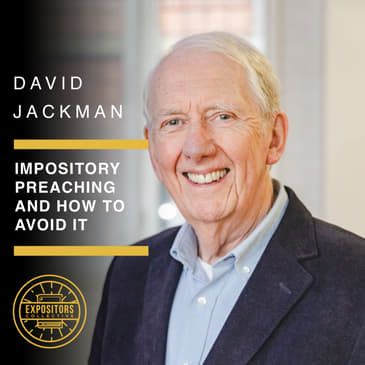
In this episode of the Expositors Collective podcast, Mike Neglia interviews David Jackman about his preaching journey and insights from his book Proclaiming the Word. Jackman recounts his early preaching experiences and the influence of mentors like J.I. Packer and Alec Motyer. He emphasizes the balance of hard work and dependence on the Holy Spirit, stressing the importance of thorough sermon preparation. Drawing on the impact of influential figures like John Stott and Chuck Smith, Jackman discusses the growth and challenges of expository preaching and the need for biblically centered sermons.
David Jackman shares practical insights on staying "on the line of the text," ensuring that Scripture remains central, and contrasts this approach with preaching styles that either add to or subtract from the Bible. The discussion also touches on Chuck Smith's and Stott’s commitment to letting the Bible speak for itself. Jackman discusses the global spread of expository preaching and its ongoing relevance in addressing cultural challenges.
Biography:
David Jackman, born in 1942, studied at Downing College, Cambridge, and completed theological training under J.I. Packer and Alec Motyer at Trinity College, Bristol. He served as senior minister at Above Bar Church in Southampton before founding the Cornhill Training Course in 1991 under Dick Lucas, training evangelical preachers in exegesis and communication. Jackman has also written several expository works and served as president of The Proclamation Trust. He currently teaches at Oak Hill Theological College and continues to contribute to evangelical preaching through books and conferences.
For more resources, visit:
- Cornhill Training Course : https://www.proctrust.org.uk/cornhill.php
- Crossway - Proclaiming the Word : https://www.crossway.org/books/proclaiming-the-word-tpb/
- Proclamation Trust: https://www.proctrust.org.uk/index.php
- Christopher Ash Interview : https://cgnmedia.org/podcast/expositors-collective/episode/seeing-christ-in-the-psalms-avoiding-burnout-and-pastoral-preaching-with-christopher-ash
- Mentoring the Next Generation of Bible Teachers: https://cgnmedia.org/podcast/expositors-collective/episode/from-age-to-age-mentoring-the-next-generation-of-bible-teachers
Support the work of Expositors Collective: https://cgn.churchcenter.com/giving/to/expositors-collective
For information about our upcoming training events visit ExpositorsCollective.com
The Expositors Collective podcast is part of the CGNMedia, Working together to proclaim the Gospel, make disciples, and plant churches. For more content like this, visit https://cgnmedia.org/
Join our private Facebook group to continue the conversation: https://www.facebook.com/groups/ExpositorsCollective
[00:00:00] Impository Preaching is where the preacher's own thinking dictates what the passage is saying, or his own thinking becomes more important than what the passage is saying.
[00:00:11] So that, you know, the passage is then used to support a particular line that the preacher is taking.
[00:00:19] And that I think it may be a perfectly good biblical line, but it isn't it doesn't have the same authority and unfolding of the intention of the passage itself.
[00:00:32] So I think what you do when people come in, you know, and they preach a sort of topical idea and they use a passage to back it up.
[00:00:40] It is biblical, but it's not exposing onto the text the ideas that the preacher wants to convey.
[00:00:46] And I think that always has less authority than the Bible speaking for itself.
[00:00:52] Hey, welcome to the Expositors Collective podcast, episode 355.
[00:00:57] I'm your host, Mike Neglia.
[00:00:59] The voice that you heard is that of our guest for this week.
[00:01:03] It's David Jackman, and he is a real heavyweight in the world of English speaking expository preaching.
[00:01:10] David has trained countless preachers through the London-based Corn Hill training course, which he founded in 1991 and was involved with up until 2009 when he retired and passed it over to Christopher Ashe.
[00:01:31] In this conversation, we'll be exploring like the heart of his ministry, focusing on the importance of staying on the line of the text when preaching.
[00:01:40] David also introduces the concept of impository preaching, where the preacher imposed their own ideas on the text rather than expository preaching, which is letting the Bible speak for itself.
[00:01:55] That was one of my favorite insights from his book published by Crossway, Proclaiming the Word.
[00:02:00] We're going to talk about that and a few other things about what this means for modern preachers.
[00:02:04] So whether you're a new preacher, thinking about perhaps a call to the ministry or what it might mean for you to teach the Bible, or if you're a seasoned expositor, this episode is going to inspire you to make sure that Scripture remains at the center of each message.
[00:02:23] So without any further ado, let's dive into this thought-provoking discussion with David Jackman on the danger of impository preaching.
[00:02:38] All right. Hey, welcome to the Expositors Collective Podcast.
[00:02:41] I'm really excited to be speaking with David Jackman, a man that I want to be like when I grow up.
[00:02:48] I am just so thankful to have an opportunity to speak to somebody who has invested in preachers for so many, many decades.
[00:02:55] So David, good afternoon. Welcome to the show.
[00:02:58] Good afternoon, Mike. Thank you very much for the privilege of being with you.
[00:03:02] My pleasure. Well, I'm not the best at small talk or opening banter.
[00:03:08] So a way that I think our listeners can get to know you a bit is I love hearing about your first Bible teaching you ever did.
[00:03:17] It's kind of a way to kind of get into your story and get to know you a little bit. Do you remember?
[00:03:21] Yes, I do remember a long time ago, but I do remember.
[00:03:25] I think I was about 18, just starting out at university.
[00:03:29] I should say that I was brought up in a Christian family.
[00:03:34] My grandfather was an itinerant evangelist and my father was a lay preacher.
[00:03:38] And so it was sort of assumed that I might do some preaching at some stage.
[00:03:43] And I preached for the first time in a little village chapel in the south of England, probably had 30 or 40 people there on a Sunday evening.
[00:03:54] As I said, I was about 18 and I chose as my text, John 7, 37.
[00:04:00] Jesus said, if anyone's thirsty, let him come to me and drink.
[00:04:04] And it's imprinted on my memory because I was very nervous and I had a sense of responsibility and, you know, what was going to happen?
[00:04:12] Was it going to be all right?
[00:04:14] But it was during, I think, the autumn season.
[00:04:17] And they had a coal fired stove at the back of the hall on which they would put a kettle towards the end of the service so they could have cups of tea before people went home.
[00:04:27] And as that stove was functioning, it got hotter and hotter.
[00:04:32] I was thirstier and thirstier.
[00:04:33] The text was, if any man is thirsty, let him come to me and drink.
[00:04:38] And really, it was a matter of survival for the last few minutes.
[00:04:41] But that was my first experience.
[00:04:43] And the people were predictably very kind and encouraging.
[00:04:46] And I did get the cup of tea.
[00:04:48] But I do remember very well that experience.
[00:04:53] Yeah.
[00:04:53] Yeah.
[00:04:53] Well, I live in Ireland.
[00:04:55] We have a phrase here, gasping for a cup of tea.
[00:04:57] Would they say that over there?
[00:04:59] You're gasping for it?
[00:05:00] Yes.
[00:05:01] Well, I'm glad that you got it.
[00:05:02] That's right.
[00:05:02] What's happening?
[00:05:05] Yeah.
[00:05:06] So apart from, yeah, the heat, the thirst, et cetera, like that night when you went to bed, how did you feel?
[00:05:14] Did you kind of feel like this is in my blood?
[00:05:16] This is something I must do?
[00:05:18] Or was it like, ah, well, I tried.
[00:05:20] I think it was more the former, really.
[00:05:23] I think I knew that, you know, there was going to have to be a lot of improvement.
[00:05:28] But that I felt that this was something that I wanted to do.
[00:05:32] I've been brought up under a very good teaching ministry in our church.
[00:05:36] The pastor really expounder.
[00:05:39] The pastor really expounded the Bible, and that had given me an appetite for it.
[00:05:43] So yeah, I was thankful and didn't know where it would lead.
[00:05:48] But that's how we started.
[00:05:50] Yeah.
[00:05:51] So that was when you were 18.
[00:05:52] And it's been a little bit of time between now and then.
[00:05:56] 60 plus years.
[00:05:58] Well, you don't look a day over.
[00:06:03] So I know that you've grown and improved since then.
[00:06:07] What are some of the significant items or that?
[00:06:11] What have you intentionally put work on growing over these past 60 years?
[00:06:17] Well, I think when I was a theological student, I heard John Stott at a conference.
[00:06:24] And he was talking about preaching.
[00:06:26] That was the theme of the conference, actually.
[00:06:28] And somebody asked in the Q&A, you know, Dr. Stott, what is the secret of your worldwide ministry?
[00:06:34] And he said there are three.
[00:06:36] The first secret is hard work.
[00:06:38] And the second secret is more hard work.
[00:06:41] And the third, you guessed, is more hard work.
[00:06:44] And you could sort of hear the conference deflate.
[00:06:46] But it really got through to me that because I greatly admired the way in which he taught the Bible.
[00:06:52] And I thought, well, if he says it's through hard work, let's see what we can do about that.
[00:06:58] So I think over the years, I've become increasingly aware of how dependent we are on the ministry of the Holy Spirit in preaching to illuminate the text and to help us to explain it and to apply it to ourselves first and then to others.
[00:07:18] But there's always been this sense of it alongside that divine enabling.
[00:07:23] What is he enabling us to do?
[00:07:24] And it's to work hard at the text to give our time and our energy to it.
[00:07:29] And I think over the years, that's something that's become much more ingrained in me.
[00:07:35] And I think the implication of that is that I don't have to do something with this text in order to make it engaging.
[00:07:44] What needs to happen is that the text does something in me.
[00:07:47] And then as the text works in me, my mind, in my heart, in my will, so that I seek to put it into practice, then I've got a message that is actually part of my whole being rather than I've now sat down and written a sermon.
[00:08:05] And I think over the years, that's what's been progressing, thank God, due to his grace more and more.
[00:08:14] Yeah, yeah, yeah.
[00:08:16] Hey, this is a question I was actually going to ask you towards the end of the interview, but based on what you just said, I hope you don't mind.
[00:08:21] So preaching takes hard work.
[00:08:25] So if John's thought is right, and he usually is, it takes a lot of hard work.
[00:08:31] But yet it also, it's like a gift from above or it's a grace from the Lord.
[00:08:37] So how do these things reconcile, or if it's a gift from above, well, then how can it take hard work down here?
[00:08:46] Yeah, yeah, right.
[00:08:47] Well, it's a gift.
[00:08:48] The gift from above is the empowerment to work hard.
[00:08:53] So first of all, it's the Holy Spirit who's the energy.
[00:08:56] You know, there's a great verse at the end of Colossians 1 that says,
[00:09:00] Him we proclaim, and then it says, with all the energy which he mightily inspires within me.
[00:09:07] So the Holy Spirit's the energy, but we do have to work hard at it because God has given us minds to think.
[00:09:13] And, you know, Scripture itself has to be worked at, doesn't it, to understand it.
[00:09:19] So the hard work on its own will produce perhaps an academic talk, but the Spirit's enabling us to work hard at the text will produce a message which can be life-changing in the experience of those who hear.
[00:09:35] So I think the two things really do go together, not just go together, they're actually dependent upon one another because that is how God uses channels like us.
[00:09:48] Yeah, yeah, well said.
[00:09:50] Yeah, I tried to lob you something.
[00:09:54] Yeah, so for, and I know that you believe that it's hard work connected with, you know, God's gifting.
[00:10:03] And I know that in your ministry since like 91, you've been working with, or you started up the Cornhill Trainings Course, which actually is to like enable called preachers, gifted preachers to work hard.
[00:10:19] Some might say, well, listen, you're either called or you're not, or there's no, there's no, nothing you could do.
[00:10:25] You could put lipstick on a pig, but it's not going to make it into anything more than that.
[00:10:29] So did, like, is that a particularly like American objection in the UK?
[00:10:34] Do people think that way as well?
[00:10:35] No, I don't think it's particular to any one culture.
[00:10:39] I mean, when I was at that stage of 18, I didn't know what I was going to do.
[00:10:44] I went to university and did another, I didn't do theology to start with.
[00:10:49] And then I was a school teacher for a few years.
[00:10:52] But during that time, I became more aware of God's call to ministry.
[00:10:56] And people said to me from my own church background and independent evangelical background, you don't need to go to a college.
[00:11:05] You don't need to train.
[00:11:06] You don't need to, you know, God has given you a gift.
[00:11:09] Get out there and get on with it.
[00:11:11] But I knew that I did need it.
[00:11:13] I needed help.
[00:11:14] I needed to learn from people already gifted and enabled.
[00:11:21] And, you know, I really began to think I need input from outside.
[00:11:29] OK, you can read books, but it's not quite the same as interacting with godly people.
[00:11:35] I was very privileged to have time at college with J.I. Packer.
[00:11:41] He was my tutor.
[00:11:42] And Alec Motia, who was a finding Irish Old Testament.
[00:11:48] One of our best.
[00:11:49] Yeah.
[00:11:49] They were very great men of God.
[00:11:52] And I am so thankful to God for the opportunity of learning from them.
[00:11:56] Not that you want to be them or be like them.
[00:11:58] You've got to be yourself in Christ.
[00:12:00] But they have so much to contribute, whether it was in things like the biblical languages or systematic theology or biblical theology, all the sorts of things that colleges try to do well.
[00:12:15] The reason why we started Cornhill was because young people didn't have any way of proving their gift.
[00:12:24] They might be allowed to speak occasionally in their home churches.
[00:12:28] But there were young men who were believing that God might be calling them to the ministry.
[00:12:33] But at that stage, this is 1990 in England.
[00:12:37] You had to sort of sell up and go to theological college, as it were, for three years.
[00:12:42] And people were saying, but I'm not sure if that's right.
[00:12:45] Is that for me for the rest of my life?
[00:12:48] And so we decided through the Proclamation Trust to put on the Cornhill course, which is one year's training initially, four days a week, one year.
[00:12:58] But the genius of it, I think, was that it relates what goes on in the classroom with what you do in the church.
[00:13:05] So everybody had a local church placement in which they were practicing the things that they were learning in the classroom teaching.
[00:13:13] And I think that combination of bringing the two together was really why Cornhill took off and why so many people wanted to be doing it, because it gave them the opportunity to get some good Bible teaching we trust.
[00:13:29] But really to prove, is this my gift?
[00:13:32] Is this what the Lord wants me to do longer term?
[00:13:36] Yeah, yeah.
[00:13:37] And I have friends over the past couple of years that have gone through it and have benefited from it so much.
[00:13:41] So again, thank you for doing the hard work of getting that going.
[00:13:45] I suppose I'm asking because myself, you know, as part of like the Calvary Chapel family of churches, you know, there's a big idea of, you know, it's not about, what's the phrase that we say?
[00:13:59] God doesn't call the equipped, he equips the called.
[00:14:02] And there is a bit of a, like, you know, sometimes in some circles, in some angles, in some circles, kind of a suspicion against like, you know, getting, going away and getting trained or even staying local and getting trained.
[00:14:17] Again, like, you know, if the Lord's with you, you're going to succeed and you'll improve.
[00:14:22] If you pray enough, you'll start preaching better.
[00:14:25] And yeah, again, thoughts on that?
[00:14:29] Well, all those things I think are true.
[00:14:31] You know, I mean, yeah, none of the training is designed to replace that.
[00:14:38] Yeah.
[00:14:38] I think what we want to be is the best that we can be for God.
[00:14:42] And I do think that for many of us, training from some other pediatric training, being an apprentice to a pastor with time set aside to be studying under some sort of guidance, doesn't have to be going to a seminary necessary.
[00:14:58] But I do think that everybody needs that.
[00:15:02] You see, I agree with you.
[00:15:03] You can't make a preacher, but you can train the gift that God has given and develop that gift.
[00:15:10] And we who maybe have that gift, then we are responsible to God for being workmen who don't need to be ashamed.
[00:15:18] And so from that point of view, I think let's use all the resources we can to be the best workman for God that we can.
[00:15:26] Yeah.
[00:15:26] Yeah.
[00:15:27] Well, thank you for taking that diversion.
[00:15:29] No, that's funny.
[00:15:30] Yeah.
[00:15:31] Again, I just, you know, I know that, yeah, Calvary Chapel folk, which is my tribe, which I love.
[00:15:37] But yeah, sometimes even as we aspire with Expositors Collective, you know, largely within Calvary circles to have intentional short-term training, there is the thought sometimes like, well, again, you either have it or you don't.
[00:15:53] There's, yeah, some images.
[00:15:54] So going back to the scheduled conversation, there's some images in your book, like two images that I actually really, really loved.
[00:16:01] And I'd love if I could just, yeah, kind of pull on those threads a bit.
[00:16:04] You spoke about like staying on the line of the text.
[00:16:10] What does that mean?
[00:16:11] What does it mean to stay on the line of the text?
[00:16:14] Well, another way of saying it is to teach the truth, the whole truth and nothing but the truth.
[00:16:19] So the line of the text is the statement of scripture, whether it's a verse or a section or a chapter or a book or whatever.
[00:16:27] But it's staying on the line means that I don't go above it and add to it and I don't go below it and subtract from it.
[00:16:35] So we are very familiar as evangelical believers with the liberal theology that subtracts from scripture and says, you know, the supernatural didn't really happen or all of that.
[00:16:48] We don't need to go into that.
[00:16:49] We know that.
[00:16:50] But often evangelicals go above the line and they promise more than the scripture promises or they demand more than the scripture demands.
[00:17:00] And sometimes that's in terms of, you know, you could have perfect peace, perfect sanctification in this world.
[00:17:08] You could have, well, the prosperity gospel is a prime example of it.
[00:17:13] And all of these things are adding to what the scripture is actually saying in terms of God's self-revelation in scripture.
[00:17:23] So I think staying on the line is just saying, reckon that God knows better than you what it is he's trying to say.
[00:17:30] Listen to him.
[00:17:31] Try and understand it as fully as you can.
[00:17:34] And don't deviate from it by adding your own preconceived ideas or, you know, subtracting from what it says.
[00:17:43] Yeah, what a great, simple, clear, memorable image.
[00:17:49] And then there was another one.
[00:17:51] You spoke about, you used like the interior of a car to describe, I guess, other like ways of viewing the biblical passage.
[00:18:03] And yeah, you believe the Bible should be in the driver's seat.
[00:18:07] And could you kind of like walk us through the inside of a car to explain the different ways of viewing the Bible and preaching?
[00:18:15] Well, I think all Christian churches would say, oh, yes, we use the Bible.
[00:18:21] Sometimes it's very little of it read and so on.
[00:18:23] And I think of it in terms of either the ministry of a local church or the minister's own attitude towards what he is doing.
[00:18:31] For some people, the Bible's in the boot of the car, the trunk.
[00:18:35] It's been forgotten.
[00:18:36] Nobody knows it's there.
[00:18:38] Sometimes it's a bit like a backseat driver who can be an irritant to the person driving the car.
[00:18:45] But for most evangelical Christians, I think for many anyway, the Bible is in the passenger seat and it's useful as a companion on the way.
[00:18:54] It can show you the way.
[00:18:55] It can be a useful conversation piece.
[00:19:00] But what I'm trying to say in the image is that if the Bible is in the driving seat, then God is in the driving seat because it is the living and enduring word of God.
[00:19:11] And therefore, we want to make sure that the sermon and the church's life is driven by Scripture and not by the pastor.
[00:19:22] The pastor is to be under the authority of Scripture and he will take on leadership roles, but he's not actually in the driving seat.
[00:19:28] So I don't have to construct the sermon.
[00:19:31] I have to let the Bible loose in my own thinking and allow it to dictate the content and the focus and the purpose of the sermon.
[00:19:43] Yeah, well, thank you.
[00:19:44] I mean, and each of those images, the line and then the car, like they're there.
[00:19:49] I'm just kind of kicking myself that I didn't think of them.
[00:19:52] They're so plain, so clear, so obvious.
[00:19:54] Yes, but yeah, you're right.
[00:19:57] Like there's over and under and behind all the wrong spots for biblical authority to be.
[00:20:03] Well, yeah, thank you for just like highlighting something that's – and again, the more simple the image is, hopefully the easier it is to kind of even check our own hearts or check our own sermons.
[00:20:15] Where is the Bible in this sermon?
[00:20:17] Is it in the boots?
[00:20:18] Is it in the back seat?
[00:20:19] Is it in the passenger seat?
[00:20:20] Or is it actually driving?
[00:20:22] Driving the car.
[00:20:23] Yeah.
[00:20:23] Yes.
[00:20:24] Yeah, and I think in that section, you used a phrase – you spoke about – you talked about expository preaching, which is bringing out the message of the passage, and then impository preaching.
[00:20:38] Yeah, what's impository preaching?
[00:20:41] Very good turn and phrase.
[00:20:43] Impository preaching is where the preacher's own thinking dictates what the passage is saying, or his own thinking becomes –
[00:20:53] becomes more important what the passage is saying.
[00:20:55] So that, you know, the passage is then used to support a particular line that the preacher is taking.
[00:21:04] And that, I think, it may be a perfectly good biblical line, but it doesn't have the same authority as the unfolding of the intention of the passage itself.
[00:21:16] So I think what you do when people come in, you know, and they preach a sort of topical idea, and they use a passage to back it up.
[00:21:24] It is biblical, but it's not exposing onto the text the ideas that the preacher wants to convey.
[00:21:32] And I think that always has less authority than the Bible speaking for itself.
[00:21:38] Yeah.
[00:21:38] Yeah, we may title this episode The Dangers of Impository Preaching.
[00:21:44] It's a stark warning to us.
[00:21:48] So going from impository preaching back to expository preaching.
[00:21:53] So you've been like a prominent voice or a strong advocate for expository preaching for decade upon decade upon decade.
[00:22:04] Maybe we could start with the positive and then end with the negative.
[00:22:07] But what's giving you hope for the worldwide movement of expository preachers and teachers?
[00:22:13] It seems to me that there's maybe more now than there was in the 90s, but I wasn't paying attention in the 90s like you were.
[00:22:22] Am I right in assuming that there actually is kind of a growth, or is that just me and my little world seeing my things?
[00:22:30] No, I think there is a growth.
[00:22:32] I think things have become rather more polarized.
[00:22:36] I think in some branches of the Christian church, there is more hostility towards expository preaching.
[00:22:44] Oh.
[00:22:45] Because the liberal agenda has become more and more culturally conditioned.
[00:22:50] And that means that the Bible is more and more embarrassing to that, really.
[00:22:54] But amongst Bible-believing people, across the world, I think, it's partly that the apprenticeship ministry has grown.
[00:23:03] And now many churches have young people who are serving short-term apprenticeships and appreciating what it is to learn skills of how to expound the Bible well,
[00:23:17] whether it's in a youth group to start with, you know, or small Bible study groups, whatever.
[00:23:22] So I think that gives more appetite for Scripture.
[00:23:25] But I think what happens is that where expository preaching is central, churches grow, people get drawn to them.
[00:23:33] They want to know what is it that makes the difference.
[00:23:37] And then gradually that spreads so that people begin to see, well, you know, I mean, we have people coming to our church where I am at the moment who are really looking for a biblical ministry.
[00:23:49] They're looking for exposition of Scripture.
[00:23:52] Some of them have been Christians for decades, but they have lacked teaching.
[00:23:56] And I think the challenge of the secular environment is such that people know they've got to have really what the Bible says.
[00:24:07] And when they hear exposition, people tend to think, ah, yes, this is what I've been looking for.
[00:24:14] And then I think the other thing is that with the World Wide Web and the opportunity of so many people listening to preaching that they would never have heard before,
[00:24:24] there's an appetite now for more exposition and for more training in exposition.
[00:24:30] And so I think that I think the modern means of communication have been incredibly helpful in spreading the appetite, as it were, developing it around the world.
[00:24:43] Yeah. Yeah. Yeah. So, yeah. OK. Thank you for that positive.
[00:24:47] And then now from there to go downhill, what do you think there are certain challenges or what do you see in the again in the big, big world of the challenges of expository preaching?
[00:25:00] Yes. Well, I think I think culturally we are in a situation.
[00:25:06] Let me speak about England. First of all, we are in a situation where people are not reading.
[00:25:11] Young people, particularly are not reading. So whereas once upon a time in a youth group, it might be accepted that the Christian youth group,
[00:25:21] at least saying they were trying to read the Bible at home.
[00:25:24] Now, Bible reading, even in good churches, is a pretty low ebb.
[00:25:29] A lot of people don't read the Bible from week to week or very rarely during the week.
[00:25:33] So I think what we then have is that combined with shorter attention spans, combined with the impact of the mass media, you know, the instant impression, the quick.
[00:25:48] Things are challenging to really hard graft in terms of enabling people to understand what the scripture is actually saying.
[00:26:01] So I think the challenge for us is to get through that and to I think the way that we do that is by good quality exposition.
[00:26:14] So, you know, it's not people say expository preaching is boring.
[00:26:19] I say, no, it isn't. Expository preachers can sometimes be boring.
[00:26:23] And it's up to us as the preachers to make sure that we are not.
[00:26:29] As possible, which doesn't mean entertaining people, but it means thinking hard and praying hard about how to make this message relevant to them so that they really get hooked on it.
[00:26:40] And I think the negative side of it is that lots of the pressures in the culture are against that.
[00:26:47] But I don't believe that people can't concentrate for 20, 25 minutes.
[00:26:53] It all depends on the motivation.
[00:26:57] And as well, the presentation is made.
[00:27:00] So, yeah, there are big challenges, but there's nothing wrong with the seed.
[00:27:05] You know, the seed will produce the harvest, even though there may be thorns and thistles all around.
[00:27:11] Yeah. Yeah. Amen.
[00:27:14] How can someone, and I realize that maybe this is subjective, but how can the preacher be engaging without, yeah, dipping into mere entertainments?
[00:27:30] Or, yeah, trying to grasp for attention.
[00:27:34] There's probably a bad way to do that and a proper way to grab and command attention.
[00:27:39] Thoughts on that?
[00:27:42] Yes.
[00:27:43] I think the temptation is to go hunting for illustrations, to use the Internet for stories.
[00:27:51] And they may be appropriate from time to time, but that's not the main thing in preparation, is it?
[00:27:56] The main thing is to immerse ourselves in the text that we're going to be preaching and for it to become a part of us, as I was saying a little bit earlier.
[00:28:06] And that, I think, means that we need to have a structure of how we do our preparation in preaching.
[00:28:14] So I would say it's quite important to have, in my own mind I have this, a sort of series of stages that I'm working through that ensure that the Bible is in the driving seat in each stage.
[00:28:31] So the exegesis is obvious at the beginning, and I try to come to always start with a blank sheet of paper and to work through the text in as much detail as I can.
[00:28:43] And I'm really sure that I know what the meaning of the text is, and to be able to express that in a sentence or two, which will govern the way that I preach.
[00:28:54] And similarly, with the exposition of the text, you move from the meaning to the significance of the text.
[00:29:02] Why is it here? What's it doing?
[00:29:04] And I think we need to give adequate time to that, but also to the structure and the strategy of how do we get it across.
[00:29:13] So many, I mean, for many years, I think I spent much more time on the exegesis than on the structure and strategy.
[00:29:21] So then you can end up with a well, you know, well-furnished exegesis of a passage.
[00:29:28] But so what does that mean for the people who are listening?
[00:29:32] How is it going to get across the bridge to them?
[00:29:34] The phrase that I use these days is what's the transformational intention of this passage?
[00:29:40] How is it designed to change us?
[00:29:42] And I think it's all of those things that keep us at it and keep us working, doing the hard work, but hopefully doing it effectively, because we are working towards a logical structure, which in the end produces a talk which is relevant to the people who are listening.
[00:30:06] It isn't just, but it impacts their lives.
[00:30:10] Yeah, yeah, thank you.
[00:30:12] And so maybe a decade or two ago, the word like relevant, like if you wanted to be relevant, it meant you had to be pulling in quotes from films or, but your relevance that you're looking for is actually, how is this going to change your life?
[00:30:29] So it's more than, it's not connecting to like broader pop culture, but connecting with the people who are listening to you.
[00:30:35] Yeah, because I don't think that the things from the culture are going to convince people to listen to scripture.
[00:30:42] But scripture is going to convince people to listen to scripture where it is properly expanded.
[00:30:47] So I think from that point of view, yeah, I mean, I'm not saying don't illustrate and don't have contemporary reference, not saying that at all.
[00:30:56] But I'm saying that's not what's driving the sermon.
[00:30:59] The Bible is driving the sermon.
[00:31:02] That is what will make, what will show people how it engages to their lives.
[00:31:07] And that idea of transformation, I think I've only come to, I used to call it pastoral intention.
[00:31:14] But I think transformational intention is perhaps stronger that, you know, no passage of scripture is there simply to give information.
[00:31:23] All scripture is profitable for correction and rebuke and training in righteousness and so on.
[00:31:28] So therefore, what's the transformational intention?
[00:31:33] And if we can get that right and across and related to life today, it will change people's lives because the spirit is at work.
[00:31:40] Yeah. Yeah. And in a previous or an offline conversation, you mentioned Pastor Chuck Smith from the Calvary Chapel world who didn't use a ton of cross-references to the contemporary culture, although he was very much embedded in the culture.
[00:32:02] But yet there seemed to be that draw.
[00:32:05] What were you saying about that?
[00:32:07] Yes. I mean, I got to know him a little bit when he came to England to a big Christian conference that we call the Keswick Convention in England, which has been going for over 100 years to deepen the spiritual life.
[00:32:21] And he came from California and he was to our crowd in England.
[00:32:26] This would be in the 1980s, I suppose.
[00:32:29] You know, there was a sort of exotic Californian ring to things.
[00:32:33] But the thing about him that struck us all, I think, was how scripture was central to everything that he did and how he had confidence that the word of God would do the work of God.
[00:32:49] I once was able to go to Calvary Chapel when I was in California one Sunday night.
[00:32:55] He was sitting on a good stool expounding Deuteronomy 5, which he did just brilliantly.
[00:33:02] And it was the word of God that gripped this hundreds and hundreds of people who were there.
[00:33:06] And it just confirms to me what I think in other ways have been confirmed, that where the word of God, the spirit of God takes the word of God to do the work of God.
[00:33:16] And he was a great example of that.
[00:33:20] Yeah, certainly not the only one.
[00:33:23] And we don't want to be hyping just that.
[00:33:26] But yeah, a recent example of if the Bible's in the driver's seat, not the passenger seat, then it can grip the attention and the hearts of many.
[00:33:37] And they actually have that transformational intention on many.
[00:33:41] And I'm even downstream from that.
[00:33:43] I'm a result.
[00:33:45] I'm fruit from that.
[00:33:46] And I'm, yeah.
[00:33:47] Thanks for highlighting that.
[00:33:48] Yes.
[00:33:50] Well, last question.
[00:33:52] So the very first question was about your very first sermon.
[00:33:56] So a hot, steamy room, John chapter 7.
[00:34:02] And you've grown since then.
[00:34:04] But I often end these conversations by asking, like, your next sermon.
[00:34:10] How do you want to improve?
[00:34:12] Or, you know, I have learned from you.
[00:34:15] Many people have.
[00:34:16] But, like, what are you trying to improve even now?
[00:34:19] All the time we need to be, don't we?
[00:34:21] I think in a word, it's getting it under the radar is what I'm trying to improve on.
[00:34:27] Because, you know, lots of people even have our own radar screen to sort of intercept incoming missiles.
[00:34:40] And I want to try and get my sermon under the radar.
[00:34:44] Now, when you preach in a local church, I've been in the church I'm in now for three or four years.
[00:34:49] I preach once a month, which is a huge privilege.
[00:34:52] I'm getting to know the congregation now.
[00:34:55] I begin to understand what the radar screens are, where the objections are, where the response is, yes, well, it's all very well to say that, but.
[00:35:06] And what I'm trying to work on is to do it persuasively.
[00:35:12] That's how the apostles did it.
[00:35:14] In Acts, you know, they persuaded people, verbs used quite often.
[00:35:19] And so persuasively to bring the transformational intention of the text through the radar or under the radar so that people suddenly realize, oh, this is this is for me.
[00:35:34] This is about me.
[00:35:35] I need to listen to this.
[00:35:36] And that's what I pray for.
[00:35:39] And that's what I try and work on more consciously now, I think, than perhaps I did at one time.
[00:35:46] And so, yeah, I think in that sense, one is always learning.
[00:35:52] People come up to you with questions afterwards which show what they didn't understand, which you thought was absolutely clear.
[00:35:58] Or they come with, you know, how does that really apply questions?
[00:36:05] And that's been stimulated because they've been listening to the word of God.
[00:36:10] So, I mean, my next assignment is this coming Sunday.
[00:36:14] We're preaching through the book of Malachi at the moment in our church.
[00:36:19] And it's a challenging book in every way.
[00:36:23] Teaching Old Testament prophecy through the lens of Christ is always an exciting but a challenging thing to do.
[00:36:33] And so I've got Malachi chapter 2, which may not be familiar to everybody listening because Malachi is not a very well-known book.
[00:36:41] But in the second chapter where Malachi is God's spokesman to dialogue with the people over the ways in which they are grieving God and rebelling against God,
[00:36:55] there's a section about the unfaithful priests who are despising God's word and about the unfaithful husbands who are divorcing their wives to marry pagan women.
[00:37:06] Yeah, they're crying at the altar.
[00:37:08] Yeah, yeah.
[00:37:10] Those two things are in chapter 2.
[00:37:15] And they're both, of course, examples of covenant breaking.
[00:37:18] So the unfaithfulness is to the covenant.
[00:37:20] And I think the big picture is about Judah generally being unfaithful to the covenant.
[00:37:25] Now, for me, how are we going to get that under the radar?
[00:37:28] Because we're not, we don't have any priests.
[00:37:31] Well, we're all priests in that sense.
[00:37:33] But we do have a great high priest who is the supreme teacher of the Torah, his Torah, his instruction to us.
[00:37:42] If you love me, keep my commandments and all of that line.
[00:37:45] And we do have a husband who is the bride, the bride's husband.
[00:37:50] The church is his bride.
[00:37:51] So you've got your Christological references there.
[00:37:55] And then it's a matter of seeing that we have been brought into a new covenant, the covenant that's made through his blood.
[00:38:02] And that our job is to be faithful to the covenant, faithful to our Lord and husband, the Lord Jesus.
[00:38:10] But faithful to the kingdom of priests who share his word with the world, which desperately needs to hear it.
[00:38:16] So I think the applications come Christologically through the study of the passage.
[00:38:23] And then it's a matter of trying to get that across in a way that people can relate to.
[00:38:28] I don't think the primary application is preserving our own marriages, though that is actually, of course, part of our covenant faithfulness.
[00:38:35] But it's much more about not being squeezed into the world's mold and thinking that there's something worthwhile and lasting outside of our relationship with Christ.
[00:38:48] So that's Malachi 2 in process at the moment.
[00:38:52] And what I'm trying to do is to get it to a stage where it does get through the radar.
[00:39:00] Yeah.
[00:39:00] And the listeners need to know it's Monday afternoon.
[00:39:05] I wish that on a Monday afternoon I had that much thought through about Sunday.
[00:39:10] Yes.
[00:39:11] But I am tired.
[00:39:12] And you preach once a month.
[00:39:14] I only preach once a month.
[00:39:16] So I've had some time to think about it before Monday afternoon.
[00:39:20] Yeah.
[00:39:21] Yeah.
[00:39:21] Well, thank you very much.
[00:39:22] I mean, you have such a way with the images, you know?
[00:39:25] So, like, on the line, in the driver's seat, under the radar.
[00:39:30] You love positions, I suppose.
[00:39:33] Over, under, behind.
[00:39:35] Yes.
[00:39:37] Yeah, yeah.
[00:39:37] But, yeah, you're connecting very well in a way that works with my brain very, very well.
[00:39:42] Well, yeah, this has been a real delight.
[00:39:46] Again, thank you for your, like, decades-long investment into Expository Preachers.
[00:39:51] You know, this isn't planned, but, like, would you mind praying?
[00:39:56] Would you mind praying for the listeners and those of us that have Sundays coming?
[00:40:02] Or we have our, you know, women's Bible study or youth group coming up?
[00:40:05] And we just, we want to carry these principles into our next teaching opportunity.
[00:40:11] Yes.
[00:40:12] Well, let's do that.
[00:40:13] I'd love to do that.
[00:40:14] Yeah.
[00:40:15] Heavenly Father, we do thank you for your word that exhorts us to be workers who do not need to be ashamed, rightly handling the word of truth.
[00:40:25] And, Lord, you know that's our heart, that we want to be effective servants of you who have served us by loving us and giving yourself for us on that cross.
[00:40:37] And through your Holy Spirit indwelling us and bringing to us the risen life of the risen Lord.
[00:40:42] And so we pray for all of us, Lord, who've been speaking or listening, that you will keep us with our eyes fixed on you, that you will help us, Lord, in our preparation.
[00:40:54] Please give us diligence.
[00:40:55] Please give us skill.
[00:40:57] Help us to discover in your word the truth that you have revealed about yourself and about us and about the relationships and about living in your world as citizens of heaven.
[00:41:08] And, Lord, we do pray that you will go on instructing and teaching all of us.
[00:41:13] And we pray for the growth of expository ministry.
[00:41:16] We thank you for this.
[00:41:19] This just at this moment and for the way in which it goes out to so many different people.
[00:41:24] And we thank you that all over the world, the gospel is bearing fruit and growing.
[00:41:28] And so we pray that your word may speed on and triumph in many, many hearts and lives.
[00:41:35] And we just commend to you one another in the next sermon that we will preach, the next talk we'll give, the next study we'll lead.
[00:41:42] Lord, in your mercy, would you enable and equip us by that Holy Spirit so that we may be faithful ministers of the living word of the living Lord.
[00:41:53] Lord, thank you that it is a living and enduring word.
[00:41:57] And we pray that you keep us faithful and that you would use us for your glory so that Jesus may be made known more and more around the world.
[00:42:07] And so that your church may be built up as we wait for your return.
[00:42:11] We ask it all in your name and for your glory.
[00:42:14] Amen.
[00:42:17] Well, hey, thanks for listening all the way to the end.
[00:42:20] I really enjoyed speaking with David and I trust that it was a pleasure for you to listen to as well.
[00:42:28] In the links in the episode show notes, you can find how to purchase David's book, Proclaiming the Word, as well as links to the Proclamation Trust and Cornhill.
[00:42:40] And then also an episode from a few weeks ago where I spoke with Christopher Ashe, David's successor over there at Cornhill Training Center.
[00:42:49] So if you enjoy, if you are benefited, if you are helped by this, I would like to highlight a way for you to get involved.
[00:42:57] We are accepting donations.
[00:43:00] If you'd like to make a contribution towards this type of ministry, highlighting and introducing and cross-pollinating the world of expository preaching.
[00:43:11] Well, in the show notes, there's a link to our giving page through the CGN website.
[00:43:18] You can scroll through to Expositors Collective and make a one-time donation or even a standing monthly donation to the ministry that we're doing.
[00:43:29] If this is your introduction to Expositors Collective, we are so much more than just a podcast.
[00:43:36] I think the podcast certainly has the largest worldwide reach, but we also do two-day preacher training events across the world.
[00:43:47] We've done them in Africa, in Europe, and in North America.
[00:43:51] And we want to do what we can to help the next generation of Christ-centered Bible expositors have confidence in the Word of God
[00:44:00] and communicate it with clarity and authority to their generation.
[00:44:04] And if you would like to help us out, we'd appreciate your prayers and we'd appreciate your financial donations.
[00:44:11] Well, I look forward to seeing you next Tuesday for the next episode of Expositors Collective.
[00:44:15] See you then.