
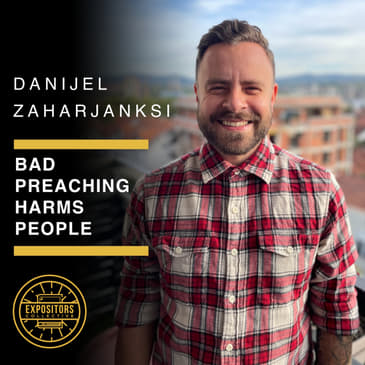
In this open and candid episode of the Expositors Collective podcast, Danijiel Zaharjanski shares his remarkable journey of being called by God to remain and serve in his homeland of Serbia, despite his initial plans to leave. Danijiel recounts how he and his wife, Wendy, planted a church in the city of Kragujevac, Central Serbia, where they’ve been living since 2012. Their church is one of only a very small handful of Protestant congregations south of the Danube River, which drives their mission to plant even more churches in the surrounding towns and villages in this under-reached region.
The conversation explores Danijiel's reflections on American preachers, offering unique insights into cultural differences in preaching styles. More profoundly, Danijiel discusses the harsh reality that bad preaching and misguided theology can cause genuine harm to people’s lives. His reflections highlight the importance of sound, gospel-centered preaching in ministry, particularly in a place where spiritual needs are great.
Danijiel, Wendy, and their son, Tadija, continue their faithful work in Serbia, helping to bring the gospel to a region that desperately needs it.
Recommended Resources:
Dr Jeremy Treat on the importance of learning from global Christianity: https://podcasters.spotify.com/pod/show/expositorscollective/episodes/Preaching-Teams--The-Treat-Sheet-and-Global-Christianity-with-Jeremy-Treat-e2c61sd/a-aakqvk4
Dr Timothy Keller on Gospel Centered Ministry (aka the podcast that changed Mike's life) https://www.youtube.com/watch?v=R3MO7CtP6WU
Theology for the People episode featuring Wendy Zahorjanski discussing her book Hard Is Only Half the Story: Real Adventures from My Journey into the Unknown https://nickcady.org/2024/04/24/hard-is-only-half-the-story-the-role-of-taking-steps-of-faith-spiritual-growth-with-wendy-zahorjanski/
Read more about her book here: https://calvarychapel.com/posts/new-book-hard-is-only-half-the-story-real-adventures-from-my-journey-into-the-unknown/
For information about our upcoming training events visit ExpositorsCollective.com
The Expositors Collective podcast is part of the CGNMedia, Working together to proclaim the Gospel, make disciples, and plant churches. For more content like this, visit https://cgnmedia.org/
Join our private Facebook group to continue the conversation: https://www.facebook.com/groups/ExpositorsCollective
Donate to support the work of Expositors Collective, in person training events and a free weekly podcast: https://cgn.churchcenter.com/giving/to/expositors-collective
[00:00:00] There was a dark season of depression, major depression that I went through a few years ago.
[00:00:08] And to cut the story short, I realized a lot of that depression comes from listening to bad sermons, honestly, about God and who He is.
[00:00:17] From the denomination that I used to go to.
[00:00:19] Yeah. And I came to this really dark place in my life and I thought God was beating me up even more as I was laying there on the ground.
[00:00:27] You know, that, you know, He's either on the other side of the bridge that when I get over myself and I get there, you know, He's waiting for me there as, you know, like kind of a teacher or just like somebody who's kind of upset with you because you're kind of in your own mess.
[00:00:43] And I was like, man, sermons are really powerful, man. Like they really are powerful.
[00:00:49] Hey, welcome to the Expositors Collective podcast, episode 350.
[00:00:54] I'm your host, Mike Neglia.
[00:00:56] And the voice that you just heard is that of our guest this week, Daniel Zahirjanski.
[00:01:03] You're going to hear an honest and an open conversation that touches on the damage that bad theology and bad preaching can have on people in the pews,
[00:01:15] as well as the good news and the exciting spread of the gospel in Danny's native country of Serbia.
[00:01:22] There is a lot of work that's being done and a lot of work yet to be done.
[00:01:29] In January of this year, I got to visit Serbia and myself and Nick Cady.
[00:01:38] We put on a one day mini Expositors Collective event.
[00:01:43] And Danny was the real moving factor in causing that to take place.
[00:01:49] So I loved partnering and working with Danny in the past, and I loved this conversation with him.
[00:01:55] So hopefully you enjoy this 350th episode of the Expositors Collective podcast.
[00:02:07] Hey, welcome to the Expositors Collective podcast.
[00:02:10] I am thrilled to be speaking with Daniel Zahirjanski.
[00:02:14] And I, yeah, I've met Daniel in person.
[00:02:18] So Danny, great to see you.
[00:02:20] Thanks for coming on the show.
[00:02:21] I'm excited to talk to you about teaching the Bible.
[00:02:25] Oh, thanks so much for inviting me, Mike.
[00:02:26] Love to be here.
[00:02:27] Love your show.
[00:02:28] It's like my, one of my top three podcasts for sure.
[00:02:32] What's number one and two?
[00:02:34] Oh, man, I think Bible Project would be like number one.
[00:02:39] And yours would be like up there with Nick's podcast for sure.
[00:02:43] The Theology for the People.
[00:02:45] So shout out to Nick also, if you're listening.
[00:02:48] I'll get that 50 bucks from you later.
[00:02:52] Nobody needs to shout out Bible Project because everybody knows about it already.
[00:02:57] But yeah, I love Theology for the People with my friend and colleague, Nick Cady.
[00:03:02] And glad to be in that trio, that triunity of podcasts that you listen to.
[00:03:10] Okay, so you listened.
[00:03:11] So you know I'm not good at small talk.
[00:03:14] So I love getting to know the guests and kind of as a way of introducing yourself.
[00:03:20] When was the first time you ever taught the Bible in public, Danny?
[00:03:25] Yeah, so I think I was about 17 years old.
[00:03:28] And I started going to that church because I didn't have any like teenagers to hang out with in the church that I was going.
[00:03:34] And the pastor really kind of looked at me as maybe like the future potential leader or whatever.
[00:03:40] So he actually gave me the pulpit.
[00:03:43] And I remember I was teaching on Philippians 2 about humility, just kind of a pretty much a generic sermon.
[00:03:49] And yeah, I mean, I don't know.
[00:03:51] I wasn't never trained in how to teach, but I gave my best.
[00:03:56] And it was probably like 12 to 14 minute sermon.
[00:03:59] So it was very short.
[00:04:01] It was very, very short.
[00:04:03] But what I do remember about it is that the pastor after that came up and he said,
[00:04:08] you know, I'm going to I'm just going to sharpen Danny's sermon.
[00:04:12] And those words kind of like hurt my feelings a little bit because it made me feel like my sermon was dull.
[00:04:17] Oh, he didn't say that to you afterwards.
[00:04:21] He said that to everybody else.
[00:04:22] Yeah, to everybody else.
[00:04:24] So that kind of that I did not feel good about that as a seven year old, 17 year old.
[00:04:29] It kind of hurt my feelings, but we never talked about it.
[00:04:32] But I was, you know, I often remember that comment.
[00:04:35] Like, I'm like, don't make your sermon dull.
[00:04:37] Don't make your sermon dull.
[00:04:38] So that's not very many happy memories, but about my first sermon at least.
[00:04:44] But yeah, no, it's been I don't know how many years since then about 20 years.
[00:04:48] So but yes, that those are my memories of my first sermon.
[00:04:52] Yeah.
[00:04:53] Yeah.
[00:04:54] Yeah.
[00:04:54] Okay.
[00:04:55] All right.
[00:04:56] Did you teach at that youth group again?
[00:04:59] Yes.
[00:04:59] So that was the Sunday morning.
[00:05:01] That was Sunday morning.
[00:05:02] But I also thought at youth group of like occasionally from time to time.
[00:05:06] So, yeah.
[00:05:07] Okay.
[00:05:07] Well, all right.
[00:05:09] So how how have you grown since since then?
[00:05:12] I mean, to put it kind of bluntly, like, are your sermons still dull?
[00:05:16] Do you still need somebody to come up afterwards to sharpen them up?
[00:05:20] Yeah, man.
[00:05:21] Well, you know, like definitely it has increased in the last two or three years, I think just by I mean, obviously listening to your guys's podcast and listening to your teachings and you guys came to, you know, Serbia to do Expositors Collective.
[00:05:34] It really impacted me a lot.
[00:05:37] You know, I even listened to kind of, you know, Nick, Katie also on his church website and just kind of seeing how to make a Jesus, how to make Jesus the hero of my sermons, basically.
[00:05:51] And that's that's really like that was really impactful.
[00:05:54] So when I start preparing it, when I finish preparing it, it's always like, did I make him the hero or did I make a goal the hero or did I make a thing to do a hero?
[00:06:05] Or is Jesus really the hero?
[00:06:07] So I think that's kind of like a big switch for me from 17 year old first sermon to yesterday when I taught my last sermon.
[00:06:15] So, yeah.
[00:06:16] Yeah.
[00:06:16] And by the way, thank you for coming on the show on a Monday.
[00:06:19] It's your day off.
[00:06:20] I appreciate this.
[00:06:22] Yes, man.
[00:06:23] It's my cross to bear.
[00:06:24] So, yeah.
[00:06:25] Now, OK, I have a thought about what you said and then a further question.
[00:06:31] So you yeah, you talked about how you want to make Jesus the hero and to not make like a goal the hero or a principle the hero.
[00:06:40] Yeah, that's a that's a powerful shift.
[00:06:42] And then I've also kind of found that when a when a goal is the hero, actually what that's doing is that's making the hearer, the listener turns into the hero.
[00:06:53] Because if you can simply do this, if you can simply, you know, dare to be a Daniel, if you can simply to, you know, do these things, then actually then you achieve it and then you become the hero as well, too.
[00:07:03] So, yeah, it's just kind of refocusing who we're actually preaching about.
[00:07:06] Are we preaching about Jesus and his good news or essentially like you and your tasks that you have to accomplish?
[00:07:13] Oh, yeah.
[00:07:13] I couldn't have said it better, man.
[00:07:14] I really agree with you.
[00:07:16] That is so true.
[00:07:17] Yeah.
[00:07:17] Jesus has to be.
[00:07:18] Yeah.
[00:07:19] Or else you just come out like disappointed or discouraged or you'll be discouraged a few days after you try to be yourself, like you said.
[00:07:27] Yeah.
[00:07:27] So, yeah, I think it's for sure.
[00:07:30] So my question is like, yeah.
[00:07:31] So when did you when did you kind of have that dawning realization or you kind of said two or three years ago?
[00:07:39] So was there like a like a moment when that when that kind of hit you?
[00:07:44] Yeah, that's a really good question.
[00:07:46] You know, I never really got a lot of feedback for my servants from people.
[00:07:50] And then I asked my wife, which I it can be a it can be a very, you know, daunting thing to do.
[00:07:58] And I think maybe she is the one that kind of like, you know, she does say like, oh, this was really good.
[00:08:03] This was really maybe not good or you that you weren't really clear communicator with this.
[00:08:08] And so I think, yeah, just like there was a point where I was like, man, what am I like trying to accomplish with my sermons?
[00:08:16] Am I just trying to.
[00:08:18] Yeah.
[00:08:19] Like, am I trying to make people like read their Bibles?
[00:08:24] Is that what my point is?
[00:08:25] Is it to encourage them?
[00:08:27] Is it to, you know, like you guys said in your training, is it to put more rocks in their backpacks or something?
[00:08:34] And I mean, like maybe if there was like one very significant like moment, it was when I heard this example.
[00:08:41] And it could have been your podcast.
[00:08:43] It was example.
[00:08:45] I'm hoping it is.
[00:08:46] All right.
[00:08:46] So it was an example of a couple.
[00:08:49] Yeah.
[00:08:49] Going into the church in the morning.
[00:08:51] Right.
[00:08:51] And they came out and they were like, man, what a great sermon.
[00:08:53] That was such a good sermon.
[00:08:54] And then they went to another church that evening and they walked out of the church saying, wow, what an amazing savior.
[00:09:02] So I think that was like maybe my most impactful moment.
[00:09:05] It was like, am I making people say like after my sermon, are they like, man, that was really that was really well said.
[00:09:11] That guy should preach more.
[00:09:14] Or I never thought about that in the Bible or everything.
[00:09:17] Or, you know, I wish, you know, I'm so thankful for the historical insights that he gave me.
[00:09:22] Or am I just telling them like, wow, man, this is am I provoking that in them to just be like, man, I'm so in love with Jesus now, even more than when I walked into the church.
[00:09:32] So, yeah.
[00:09:33] Yeah.
[00:09:34] Yeah.
[00:09:35] In English, there's a hymn, you know, Hallelujah, what a Savior.
[00:09:39] And yeah.
[00:09:40] Yeah.
[00:09:40] We don't want it to be Hallelujah, what a preacher or Hallelujah, what a sermon.
[00:09:45] But Hallelujah, what a Savior.
[00:09:48] Yeah.
[00:09:49] Yeah.
[00:09:49] I do have to give credit.
[00:09:51] Yeah.
[00:09:51] You mentioned the rocks in the backpack or the bricks in the backpack.
[00:09:56] That's a Brian Chappell line.
[00:09:58] So I do want to be careful that I want to give credit.
[00:10:01] That's a line that I took from Brian Chappell.
[00:10:04] So that's great.
[00:10:06] Just got to be careful.
[00:10:07] Don't want to be don't want to be fact checked and plagiarized.
[00:10:10] Count for plagiarism.
[00:10:11] Awesome.
[00:10:12] So, okay.
[00:10:13] That's so that's really, really special.
[00:10:16] I've you know, and I've I've talked about this plenty, but for me, it was like it was a sermon that I listened to in 2006.
[00:10:24] So it was a long time ago, but I was listening to a talk.
[00:10:29] I think it was from like the very first, like the inaugural Gospel Coalition conference.
[00:10:34] It was before it was like a thing back.
[00:10:36] I think it was just kind of a series of lectures at Trinity Evangelical Divinity School.
[00:10:43] And Tim Keller just kind of gave like a talk about gospel centered ministry.
[00:10:48] And then he had a sub point in there about gospel centered preaching.
[00:10:52] And he was, yeah, essentially saying that a lot of times people use Jesus in their sermons to make their points or they use him as a character, a minor character to get to the main point, which is you guys need to start doing this.
[00:11:05] You need to read your Bibles more or something like that.
[00:11:08] And and like the spirit just convicted me like so much.
[00:11:13] And I was like, that's exactly what I've been doing.
[00:11:15] I've been using Jesus as a as a prop or as a minor character.
[00:11:19] And actually, I got on my knees and like was really like, I am, you know, I want to repent.
[00:11:27] And Lord, I want to change.
[00:11:28] And if you'll let me keep preaching, I want to like I want to change from this moment on.
[00:11:33] And and I have and God's, you know, changed the way that I look at the Bible, the way that I teach the Bible.
[00:11:39] And then now years later, the way that I'm able to like teach other people how to teach the Bible.
[00:11:44] So that was just like, I think, one of the most like pivotal moments in my life.
[00:11:47] And it was through a podcast.
[00:11:49] And I'm now I'm just like, so that's why I'm sometimes sometimes podcasting can be a little bit laborious.
[00:11:56] You know, it's a kind of a weird experience.
[00:11:59] You're just talking to nobody, you know.
[00:12:01] But I as I as I start to every once in a while, kind of like, is this kind of worth it?
[00:12:07] What is it?
[00:12:08] What's the point of this?
[00:12:09] I actually think back to like, OK, you know, remember, Mike, in your office, 2006, everything changed.
[00:12:15] So I do want to facilitate those types of meetings.
[00:12:20] OK, sure.
[00:12:21] And I mean, your podcast is making a difference in my life.
[00:12:23] So I'm hoping.
[00:12:24] Yeah, that's that's I hope that counts for something as well.
[00:12:26] OK, enough about me.
[00:12:29] So your context is is is quite unique.
[00:12:32] You know, your context.
[00:12:34] So, again, I got to I got to meet you in your home turf.
[00:12:37] You are ministering in a unique setting.
[00:12:40] Your accent is different than mine.
[00:12:41] Do you want to tell us a little bit about like where you were born, where you were from and then also where you're serving now?
[00:12:48] Yeah.
[00:12:49] So I was born in Western Serbia.
[00:12:51] I'm Serbian born and bred.
[00:12:53] And then I went to Bible college because I really wanted to grow in the Lord.
[00:12:59] And my goal was to leave forever Serbia because the Protestant church and evangelical scene in Serbia is looked down upon.
[00:13:07] It was it's pretty much looked as a sect and a cult, a dangerous one that kind of brainwashes people.
[00:13:13] And so we're that was kind of my experience.
[00:13:15] And as a teenager going to church that people were not very like nice to me or my dad was very just abusive.
[00:13:23] Even when he found out that me and my family, my three sisters as well are going to, you know, a dangerous cold, cold, a Protestant church.
[00:13:32] And so I left to Bible college and I was like, man, I'm going to marry myself a American girl and I'm going to go to America.
[00:13:39] You know, I'm going to go.
[00:13:41] Yeah.
[00:13:41] Be like there's a reason why God gave me an ability to speak English as well.
[00:13:45] So surely it is to move to America.
[00:13:48] So at Bible college, he at one point just kind of like broke my heart and the hatred that I had for Serbian people, for my own people because of like just their ignorance and stiff neckness.
[00:13:59] He kind of like turned towards Satan and he's like, man, if you need to hate somebody, hate Satan.
[00:14:03] He's the one that blinds your people.
[00:14:06] So that was really a powerful shift for me.
[00:14:08] And I was like, OK, man, I'm not moving anywhere.
[00:14:10] I'm going to after I graduate, I'll come back to Serbia.
[00:14:13] And so we did come back.
[00:14:17] I did get married to an American.
[00:14:20] But we did, yes, check that one off the list.
[00:14:22] And then we served in Calvary Chapel in Subotica, which I believe is like the first Calvary Chapel in Europe for a year and a half.
[00:14:29] I served there as a worship leader and helped with translation and some other like huge stuff.
[00:14:34] And then God just broke our heart for like central parts of Serbia that do not have any missionaries or churches or anything like that.
[00:14:42] So we prayed about the city where we are right now, the city of Kraguewatz.
[00:14:47] It's a city with about 250,000 people.
[00:14:50] And at that point, there was just one small home group meeting in an attic.
[00:14:54] So it was probably about like five grandmas meeting in an attic to just, you know, like pray and to like listen to a Bible study.
[00:15:02] There was a pastor who was traveling every week to do a sermon and then go back to his hometown.
[00:15:09] So we came here and we're like, man, this is this is just like completely different ballgame from North Serbia culturally and everything.
[00:15:19] So in 2012, so that was 12 years ago, we moved here to plant the church and we did plant it.
[00:15:24] And right now this is where we are currently me, my wife and our six year old son.
[00:15:29] And we're not planning on going anywhere else.
[00:15:32] The city of Kraguewatz is kind of like a university central of this part of Serbia.
[00:15:37] So we get people from villages and towns traveling to come and study here all the time.
[00:15:41] So we don't really have to go out as much.
[00:15:43] They come to us.
[00:15:44] So, yeah, so that's kind of like a very short version of how I am where I am in Serbia.
[00:15:51] Yeah. And you mentioned, yeah, that's myself and then Nick Cady and then some other guys from my own church in Cork.
[00:15:58] We were able to visit and I was a little bit Nick Cady particularly.
[00:16:04] We were disappointed that we didn't get to do it in Kraguewatz, that we were in Novosad instead.
[00:16:10] Nick is just crazy about that town, that city and your work that's going on there.
[00:16:16] He was a lucky one. He got to preach at your church the following Sunday.
[00:16:20] Yeah.
[00:16:21] But it's just very exciting.
[00:16:23] How many other Protestant churches are there in your city?
[00:16:28] There is only one more. Yeah, one more.
[00:16:31] So two Protestant churches in the city of 250,000 people.
[00:16:36] Okay. Yeah.
[00:16:37] And so are they your competition or are they your collaborators and co-workers?
[00:16:43] Yeah, for sure. Co-workers.
[00:16:45] I mean, we kind of have different, should I say like demography of people visiting us, you know,
[00:16:50] the other churches, more like older people kind of geared towards.
[00:16:54] And obviously I'm a young guy, so I attract a lot of young people and students.
[00:16:57] So our church is more young.
[00:17:00] So we like each other, but we, yeah, when we partner, when there needs to be partnership.
[00:17:06] But other than that, it's kind of like, hey, if you're old, you're kind of going to that church.
[00:17:10] If you're younger, come into our church, which I like.
[00:17:13] Yeah, there's good and bad things about that.
[00:17:15] But yeah.
[00:17:16] Wow. Well, yeah.
[00:17:17] Well, yeah.
[00:17:18] Bless you for doing that.
[00:17:19] And we hope that the, yeah, the work of the gospel is extended in your city.
[00:17:23] And then, I mean, to talk about Serbia a little bit.
[00:17:27] But yeah.
[00:17:27] So are there other cities of a similar size that maybe have only one or perhaps even zero
[00:17:34] gospel preaching churches?
[00:17:37] Yeah.
[00:17:37] So Kranweevac is the fourth largest city.
[00:17:40] So Belgrade would be the first one.
[00:17:42] There's plenty of churches, good churches in Belgrade, the capital.
[00:17:44] And there's Novi Sad where you guys did your expositors collective, the second largest.
[00:17:49] I would say two, three for sure.
[00:17:51] Amazing churches and a bunch of like churches, other churches.
[00:17:55] And then the city of Nish would be the third one.
[00:17:57] And there's also a couple of really cool churches.
[00:18:00] That city, I think, has about maybe 300,000 people.
[00:18:03] So and then, yeah, just us and the cities around us that have like 50,000 to 100,000.
[00:18:12] There's not much going on, man.
[00:18:13] Like it's a really, you know, Serbia is not your like missional.
[00:18:18] Like people don't move to Serbia so much, you know.
[00:18:20] I don't know why.
[00:18:22] But we're not your like hot location to come move to.
[00:18:26] And you can tell.
[00:18:29] So we visit a few more cities.
[00:18:32] We try to create a home group in one city that's 50,000 people, another city that's about 70,000 people.
[00:18:38] And it's a Muslim city as well.
[00:18:40] And then another city that's about 60,000 people.
[00:18:44] But there's like no Christians, like no missionaries.
[00:18:48] It's only like small pockets of believers, three, four believers, somewhere five or six.
[00:18:52] And we try and visit them because they're like an hour away from us.
[00:18:54] But yeah, not much gospel influence south of Danube.
[00:18:57] If you look at Serbia on the map, we kind of say that Reformation never really hit south of Danube.
[00:19:03] We kind of reached Belgrade and then it never got down in 500 years.
[00:19:08] So it's Eastern, you know, Serbian Orthodox.
[00:19:11] A little bit of Catholics here and there.
[00:19:13] But yeah.
[00:19:14] And then Muslims as you get closer to Kosovo and Albania.
[00:19:17] So yeah.
[00:19:18] Yeah.
[00:19:20] Now, I know that you can't speak from experience in this.
[00:19:24] But, you know, from what I know, I know that there was kind of a real renewal or a real revival in the 1990s.
[00:19:35] And again, you were not around then.
[00:19:39] But what kind of changed?
[00:19:41] Or what was the, you know, at least north of the Danube?
[00:19:45] What were the sort of things that were happening?
[00:19:47] Yeah.
[00:19:48] Yeah.
[00:19:48] So yeah.
[00:19:49] I don't really know the exact names of people that came from Costa Mesa to, you know, plant the church.
[00:19:56] And they went to the, you know, fountain in Subotica and they shared the gospel.
[00:20:01] And it was like this massive, like revival of really young people started getting saved.
[00:20:05] So as you said, I wasn't there.
[00:20:07] So I wouldn't be comfortable talking about that.
[00:20:09] But what, you know, the change they brought is this, you know, there's this English word that I have trouble pronounciating.
[00:20:16] I think it's entrepreneurship.
[00:20:19] Did I say that right?
[00:20:20] I would say entrepreneurship, but that's pretty dang close.
[00:20:25] What Mike said.
[00:20:26] Yes.
[00:20:27] Yes.
[00:20:27] That word.
[00:20:28] You know, I think the, like the American missionaries that came, they brought that, you know, so maybe in moments where, you know, us Serbian believers were kind of more realistic and said, this is never going to work.
[00:20:40] This is, you know, this is not, you don't do this here.
[00:20:42] You know, they like dumb Americans came with their, you know, spirit of like, let's just give it a shot.
[00:20:50] Like, we're going to be dumb, but let's give it a shot.
[00:20:52] Let's go.
[00:20:53] Let's go.
[00:20:53] Yeah, let's go.
[00:20:54] Right.
[00:20:55] And I mean, yeah, I do remember hearing that these missionaries were 18 or 19 years old.
[00:21:01] So, you know, just even that, the fact that, you know, you, you know, Chuck Smith or whoever was bold enough to send, you know, a bunch of like, basically teenagers to, you know, Yugoslavia back then.
[00:21:14] And it was, yeah, pretty crazy.
[00:21:16] So I think that's what kind of brought like the Calvary missionaries brought in with themselves is like, hey, let's, we're going to look dumb, but let's just try it.
[00:21:24] And if it doesn't work, then we just look dumb.
[00:21:26] But if it works, then great, let's keep moving.
[00:21:29] So I think that is really, that's something that really changed.
[00:21:33] All right.
[00:21:34] So young and dumb, young, dumb surfers from Southern California come and, and the Lord use them.
[00:21:43] So, okay.
[00:21:44] Yes.
[00:21:45] So that was, yeah, that was there and then.
[00:21:47] And then here's the thing.
[00:21:48] So here and now there's actually not a lot of young, dumb American missionaries leading churches, maybe as they, as they once were.
[00:21:57] And again, with all, with all due respect, you know.
[00:22:00] Yeah.
[00:22:01] And, and I'm a formerly young and dumb missionary to Ireland.
[00:22:05] I came, I came here when I was 20, you know, so I was like a little bit older.
[00:22:08] Exactly.
[00:22:09] But we do have that.
[00:22:10] Yeah.
[00:22:10] Like, I don't, yeah, a real, yeah.
[00:22:12] Entrepreneurship is a good word.
[00:22:13] I don't know.
[00:22:15] Optimism, you know, confidence, confidence that can sometimes be misplaced.
[00:22:20] You know, like we have confidence in God.
[00:22:22] We all have confidence in God.
[00:22:24] And then we have a hope that God will bless our endeavors.
[00:22:26] And God's not obligated to bless our endeavors.
[00:22:29] Sometimes he does.
[00:22:29] Sometimes he doesn't.
[00:22:31] But anyway, so, so that first kind of wave of church planters and evangelists, they're no longer there.
[00:22:39] And so now, like, speaking of the Kaveh Chapel influence in Serbia, it's, it's pretty much exclusively led by locals now.
[00:22:50] How has that kind of shift been?
[00:22:53] Hmm.
[00:22:54] Yeah.
[00:22:54] Yeah.
[00:22:54] It's, it's all locals now.
[00:22:56] And I mean, Taiba, the Nigerian who lived here since the 80s is basically Serbian, you know?
[00:23:01] So, yeah, it's been, you know, I think it was a really healthy move.
[00:23:05] I think the major shift from what I know happened maybe at the end of 90s when maybe like the last American missionary pastor left and kind of gave over.
[00:23:15] And then kind of let us, you know, figure things out on our own.
[00:23:19] So, I think it was, you know, a good timing from what I've like realized is that, you know, there was a time when we needed missionaries and we needed all these people and, you know, the training.
[00:23:29] And then it was kind of like, okay, now it's time to learn to fly yourself, I guess.
[00:23:35] So, yeah, it's been, it's been, I think it's been a really healthy kind of transition.
[00:23:40] Yeah.
[00:23:40] And so Expositors Collective, and there's probably other podcasts out there that are really focused on missiology and church planting and these types of things.
[00:23:51] We have a pretty narrow focus on the pulpit and on preaching.
[00:23:55] In your observation, what are the ways that Serbians preach that's maybe different than the ways that Americans preach?
[00:24:04] Hmm.
[00:24:05] Yeah.
[00:24:06] I, you know, the first thing that comes to my mind is just the individualistic maybe spirit of the Americans.
[00:24:12] And I mean, the culture, right?
[00:24:13] It's very individualistic.
[00:24:15] Serbia is everything but individualistic.
[00:24:17] It's very much, you know, honor and shame culture and collectivistic in nature.
[00:24:21] So, you know, I think maybe one of the biggest things that I see in sermons here and in sermons there would be just that focus on maybe like one person or focus on, you know, making one person.
[00:24:38] Yeah.
[00:24:39] Yeah.
[00:24:40] Just like focus on you kind of this is what you have to do or this is what, but not so much like we as a church have to do this, you know, better.
[00:24:48] Um, so I understand there's some callings in the Bible or like, um, exhortations in the Bible that are very individual.
[00:24:55] Yeah.
[00:24:55] Uh, but there is also some of that are just kind of like, Hey, let's do this as a, you know, uh, family or community or whatever the buzzword is, you know, that everybody likes.
[00:25:04] Uh, and yeah, so I see a lot of like, Hey, this is, you know, you know, if you're, if you're a father, uh, you need to do this as a, you know, a father, but it's kind of like, Hey, we as fathers in this church, we could do this better.
[00:25:17] Uh, or we as mothers, we can do this better or, um, kind of an, yeah.
[00:25:20] So I, I like that a lot better that in sermons, at least in our church, for sure, we try and focus on, you know, those kinds of things.
[00:25:29] And even like, uh, you know, when I talk about Paul's epistles and stuff, you know, I make sure that I throw in that he was like traveling with people while visiting this, or, you know, that, uh, it was like a collective effort to write this epistle because he says, you know, Paul and Timothy or Paul and Titus or whatever, you know, just starts his epistle.
[00:25:47] So it's like, okay, so it's not just one person. It was, you know, maybe potentially two people or three people. And there's a person that brought the letter in. So that kind of collectivistic more mindset other than just, uh, yeah, being, um, yeah, this is what you got to do kind of thing. So that is for sure. For sure.
[00:26:05] What a great observation. And I appreciate that it's nuanced. You know, you are like, you're saying that there are stuff in the Bible about you and your, you know, there is individuals that are addressed and there's callings for
[00:26:17] individuals. Um, but that's not the only thing that's present. Not at all. I'm trying, I'm trying to, um, there's a book on my bookshelf on your grab.
[00:26:28] Okay. Yes. Yeah. So this is a book that I read, um, earlier in the year. It's actually called, uh, Paul and his team. Uh, what the early church can teach us about leadership and influence. It's by Ryan
[00:26:39] Locke-Smo. And yeah, it's just, it's actually expanding on what you're talking about a lot that we think about Paul,
[00:26:46] the individual, the kind of solo apostle who shows up to a place and, but yeah, that he travels with a team.
[00:26:53] He works as a team. Essentially he is, um, to some degree in his letters, he's, he's like the spokesman for
[00:27:01] the team. He's, um, he's got his own apostolic calling, but he is, he's writing, you know, with
[00:27:07] Silvanus and with Barnabas. And these, these people are communicating like together and maybe he's the one
[00:27:13] who's better at writing. Uh, so yeah. And actually I've made a note. I want to interview him. So Ryan
[00:27:19] Locke-Smo, if you're listening, uh, I'm going to, I'd like to talk to you one of these days about what
[00:27:24] this means for the pulpit. Uh, thank you. Yes. But I think, I think, yeah. And also to like
[00:27:32] individualism in like Americans in general and American preachers, I think, yeah, it's a,
[00:27:36] double edged sword. Like on the one hand, if those 19 year olds didn't kind of feel a sense
[00:27:43] of individualism, then maybe they never would have bought a flight to go out to Serbia. Um,
[00:27:50] so there's, there's strengths and then also accompanying blind spots that come with that.
[00:27:55] Yeah, I absolutely agree with you. Yeah, for sure. And I mean, even for Serbians now, uh, you know,
[00:28:00] as I mentioned, anybody coming to our church is going to be considered a cultist. So you do have to kind
[00:28:06] of separate a little bit yourself out of that culture of like collectivism, you know, you do
[00:28:10] need to be like a little bit of individual, but then you are joining a new family in a way, um,
[00:28:15] that is the church, you know? So even though you're maybe rejected by your physical family,
[00:28:20] you have another family, but there needs to be that sense of like, okay, I can't just like rely on what
[00:28:24] other people think and, you know, those kinds of things. And yeah. Yeah. And also you married one of
[00:28:30] us, so you can't be. Yes, yes, yes. Yeah. Yeah. Wendy's amazing. She,
[00:28:36] she, she shows me all these like blind spots about our culture. I show her blind spots about
[00:28:39] her culture and I think we're a great team. Yeah. Sound like a great power couple. Yeah.
[00:28:44] Um, all right. So, uh, kind of, you know, last two questions. So we've mentioned a couple of times
[00:28:50] that, you know, that, that we've, we've worked together, that we came out and, you know, we put
[00:28:55] on this, uh, one day, uh, expositors collective kind of one day intensive. And you were really the,
[00:29:02] the, the, the powerhouse behind that you were like making it happen and you organized it all. Um,
[00:29:08] essentially why'd you do that? And then also, uh, what'd you think of it?
[00:29:14] Yeah. Yeah. Oh man. Well, yeah, I, I did it because I saw it in my own life. Um, something that,
[00:29:20] uh, I, I realized I need training, you know, and the more, the older that I get, the more I realized
[00:29:25] the need for a mentor, it's, you know, I, I realized how much I don't know. So, uh, just
[00:29:32] like listening to expositors collective and I can't just like listen to one podcast or kind of like
[00:29:38] listen to your guys's teaching that you guys did and be like, okay, I've completely changed.
[00:29:42] Uh, my brain is so moralistic in preaching that it needs like time. I feel like I'm going to,
[00:29:49] it's going to take years for me to come to what you guys like would love to see, uh, happen,
[00:29:55] you know, just, uh, it's, it's, um, and I see that in other people's lives. Um, there was a, um,
[00:30:01] you know, a dark, dark season of depression, um, major depression that I went through a few years
[00:30:06] ago. And, you know, uh, to cut the story short, I realized a lot of that depression comes
[00:30:13] from listening to bad sermons, honestly, about God and who he is, um, from the denomination that I
[00:30:19] used to go to. Yeah. And, uh, you know, and, you know, I came to this really dark place in my life
[00:30:23] and I thought, you know, God was beating me up even more as I was laying there on the ground,
[00:30:27] you know, that, you know, he's either on the other side of the bridge that when I get over
[00:30:32] myself and I get there, you know, he's waiting for, for me there is, you know, like kind of a,
[00:30:36] a teacher or, um, or just like somebody who's kind of upset with you, um, because you're kind
[00:30:42] of in your own mess. Um, but then, uh, and I was like, man, the sermons are really powerful,
[00:30:47] man. Like they really are powerful. And then seeing so many, uh, born again believers in our
[00:30:54] city, uh, in our church, coming to our church, uh, every single local person in our church,
[00:31:00] uh, is a first generation believer. And I was like, man, I gotta do this, right? Like I gotta,
[00:31:05] I gotta do this, right. I can't just kind of be like, Oh man, let's, you know, let's open up to
[00:31:10] this, you know, chapter and I'll, I'll do my best to, you know, do, uh, you know, the inductive
[00:31:15] Bible study out and everything. Now I'm like, man, I, I can, I can really mess people up.
[00:31:19] Like people have messed me up and, uh, I could have gone through that depression way faster.
[00:31:24] If I was, if, you know, I listened to the right picture of God, of who God is from the pulpit,
[00:31:31] it would have helped me tremendously. So I didn't want to make that mistake. So, you know,
[00:31:35] found you guys through, I don't know who, but I started listening to you guys and I was like,
[00:31:39] Oh man, this is it. Like, this is really it. But then, uh, so I wanted to bring you guys in
[00:31:44] because I know, you know, there's going to be even maybe some people, uh, in Serbia who could
[00:31:49] use that kind of training. And it was a great turnout. I think, uh, it was more than I expected.
[00:31:54] I think it was like double more than I expected. So it was so cool that people came and, uh, the,
[00:31:59] the feedback was, man, it was just really amazing. People were just kind of like,
[00:32:04] like running back home to, uh, like study their Bibles again with kind of a fresh new lens. Um,
[00:32:09] and yeah, and I'm, I'm kind of sad that you guys are unique in that, at least in my like resources
[00:32:15] that I have, I wish that I could be like, Oh, I can recommend expositors collective and 10 other
[00:32:20] people or like, um, you know, trainings or whatever. Uh, but then it's, it's not the reality,
[00:32:25] at least in my context, you know, so I really appreciate what you guys are doing. So it was,
[00:32:29] it was really cool. It was really cool to have you and Nick here.
[00:32:32] Uh, well, what a, what a joy. I love to love to hear that. And yeah, as I said, I, I've been so
[00:32:38] helped, you know, and so love to, to pass it on. And, and then, but then I, I, you know, here's the
[00:32:43] thing. I can't communicate with Serbian speakers. And so you were our voice, you know, and I kind of
[00:32:48] had kind of felt sorry for you because you were the one and only translator all day. And so like
[00:32:55] Nick and I took turns getting up there doing, you know, doing a session and, and then I'd get to sit
[00:33:00] and rest and rest my voice and you were constantly up there. So, uh, I don't know how beneficial the
[00:33:07] day itself was for you since you were spending and being spent. Uh, but hopefully it's a gift to,
[00:33:14] to your community. Yeah, no, for sure. I can remember things better if I translate them on
[00:33:19] spot. So yeah, it was actually the best thing for me to just translate for you guys. Oh, ah,
[00:33:24] surprisingly enough. Yeah. Yeah. Okay. Um, that's that wonderful. And
[00:33:31] so kind of the, the question that we, we like, well, I was going to actually go into the next,
[00:33:37] okay. But like, uh, can I go back a little bit without probing too much into the dark night
[00:33:42] of your soul? Um, like, yeah, like, uh, bad theology hurts people. You know, it really,
[00:33:51] really does. And, uh, or even, even like good ish theology communicated in the wrong way can,
[00:33:59] can cause harm. So what are the, like, do you have any like advice or warnings? Like you're talking to,
[00:34:07] you know, a couple thousand preachers right now. What do you want us to know that can prevent us from,
[00:34:14] yeah, causing harm to like the, the good people who are coming to church and,
[00:34:18] and are having our views of God shaped by what we're saying?
[00:34:25] Man. Yeah, that is a really, really good question. Um, yeah, I mean, uh, obviously like relying on the
[00:34:33] spirit and being open to hearing what the spirit has to say, because I don't think he's going to say
[00:34:37] bad things about himself, uh, like would be obviously prayer and stuff, but practically just,
[00:34:43] um, like understanding that, um, your words really do have power and, um, that maybe your seasons that
[00:34:51] you're going through as a preacher, um, it shouldn't affect your, the truth of God's words so much.
[00:34:57] Um, you know, because if I listen to preachers who are really like feel beaten up by God, uh, in
[00:35:03] certain seasons because of maybe failures or anything, and, you know, their sermons are going
[00:35:07] to reflect that and something, and it's going to reflect me because I'm like, oh man, God wants to
[00:35:12] beat me up as well. Um, and, uh, and I can, I can see that I did the same mistake as well. Just like
[00:35:17] the, if I'm, you know, thinking about God is happy God, you know, I'm, it's going to, my, my sermons
[00:35:22] are going to be full of that, you know, just like God's happy grace, mercy, and everything. Um, and then
[00:35:28] if I'm going through just a really, I messed up in, in, you know, just like, um, some, you know,
[00:35:33] depression or, or some, some of those things, uh, man, it's like, oh, well, God is, you know,
[00:35:39] God's kind of not so, you know, like he, he understands, but again, he doesn't understand.
[00:35:44] And, you know, um, so I think, you know, what I'm trying to just like, when I approach the text
[00:35:49] before I teach is I try to do my best to just like preach the text, um, and not kind of like put my,
[00:35:56] my feelings into it, um, which I've done numerous times. And I think that's what really, uh, messed
[00:36:02] me up is just that, you know, accents of, of, of, of a God who is just very vengeful, very, uh, not,
[00:36:11] um, yeah, almost not loving, you know? So I guess the best picture would be, um, you know,
[00:36:17] when I imagine God, he was just like distant light. This was the talk that I had with my therapist.
[00:36:22] So, you know, the sermons that I listened to, um, you know, they, uh, they led to me thinking about
[00:36:29] God as like, you know, like a white light. If I close my eyes, I think about God, it's white light
[00:36:34] and it's very distant and not emotional as in, um, you know, I don't know if he's smiling. I don't
[00:36:40] know if he's upset with me. I don't know if he's really angry with me. I don't know. I just don't
[00:36:44] know anything. He's just white light. And my therapist told me like, actually that's like,
[00:36:49] maybe not, not very biblical, you know? Uh, so, you know, and yeah, so, but yeah, I don't know if I
[00:36:56] gave you the answer. Uh, cause that's a really good question, man. And I have to ponder it honestly,
[00:37:01] like how, how do you prevent that? How do you prevent that? Yeah. Yeah. I ambushed you with
[00:37:06] that. It's, and it's, it's a very big and deep and perhaps the listeners, you know, this is maybe
[00:37:11] starting a journey in our own minds thinking about that. Um, there's a quote it's, I've heard it,
[00:37:16] I've heard variations of it from so many different authors, but just the reminder that there's like a,
[00:37:21] there's a broken heart in every pew, every, every seat, you know, is kind of occupied. Well,
[00:37:27] every row of seats, you know, there's somebody in there going through such a hard time and,
[00:37:32] you know, they're coming to church, you know, looking for, looking for hope. And if, you know,
[00:37:39] yeah, if, if we're just in a, in a bad mood or if we're just grumpy cause tithes are down and
[00:37:43] these, these people aren't given enough and you know, why am I the only one sacrificing here? And then
[00:37:51] that's yeah. So we need to have a, we'd be the, you know, the truth of God's word needs to go out
[00:37:56] no matter what. And also the tone of the passage should be, should be influencing the tone of the
[00:38:02] preaching, but also, you know, there shouldn't be a week that goes by without a bit of hope being,
[00:38:08] being put out to people. All right. Now here's the actual last question. Thanks for that,
[00:38:14] that diversion. So we start, we start every sermon, sorry, we start every conversation asking
[00:38:20] about your first sermon and then we end every interview by asking about like, how are you
[00:38:26] trying to improve? So like your next sermon, so next Sunday, assuming you're preaching next Sunday,
[00:38:32] how, how do you want to be a little bit better? What's your hopes for next week?
[00:38:38] Yeah. Yeah. Well, something that I've really implemented in my life is, um, I, I stopped listening
[00:38:43] only the American voice in, in the commentaries, uh, in the books that I read or like the podcasts
[00:38:49] that I listened to, or, um, it was just very much, you know, I, I mean, I'm, I'm like a blue letter
[00:38:54] Bible guy. I'm a David Guzik guy, you know, all these like, kind of like, yeah, you just like,
[00:39:00] we all love those. And I still go back to them. But then, you know, as I was studying in Western
[00:39:05] seminary, like some professors, like named a few people who are not American. And I was like, okay,
[00:39:12] I'm going to read their book. Um, and it was just very impactful because I feel like, you know,
[00:39:17] if you're only listening to the, you know, American voice, or for me, maybe a Serbian voice,
[00:39:22] it can really cripple my like growth as a preacher. Uh, it can cripple my growth as even a Christian.
[00:39:28] Uh, because I, again, we, we all believe that we're like a multinational family of God. And then,
[00:39:34] but if you're only listening to one nationality, and I understand that again, Americans have kind of the,
[00:39:39] uh, disability of like only knowing English, maybe not any other language. So you can't really,
[00:39:45] but, uh, you know, that's something that I've been really, uh, impactful, impacted by, um, and,
[00:39:52] and kind of like learning to grow in, in my sermon prep is like, what do other people,
[00:39:57] what do Africans say about this text? Or what do Asians say about this text? Or, you know,
[00:40:02] Eastern European and, you know, not like Australians or, you know, English or Irish, or, you know,
[00:40:06] it's just, uh, not like the Western world, but it's like somebody completely out of my context.
[00:40:11] And, and, you know, and sometimes I disagree with them, like, but I still like here, okay,
[00:40:16] so they're coming from this angle. So I'm not saying it's like, oh, like, oh man, it's all good,
[00:40:21] but it's like, okay, I could, I could, you know, but then just listening to a brother from South
[00:40:26] America, like think through the same text, uh, and just the conclusions that he comes through is
[00:40:31] like, oh my gosh, this is so good. Uh, I never thought about that because again,
[00:40:36] heavily influenced by Western culture because they studied at Bible college. It's, you know,
[00:40:40] predominantly American and then Western seminary. I was going to say, what's, what's the name of
[00:40:44] the seminary you're going to right now? Yes. Western. So I finally graduated there. I got my
[00:40:50] master's degree at Western seminary in Portland. Yeah. Um, so yeah, but yeah. And I mean, I think
[00:40:57] we all have been influenced even in Calvary chapel circles by, you know, Watchman Nee, like the,
[00:41:01] the, um, the Chinese pastor. Uh, I think everybody who went to Bible college, any form of Bible
[00:41:07] college in Calvary chapel had to read his books or the, uh, Dietrich Bonhoeffer, you know? So
[00:41:12] one voice that I love listening to today is this guy called Ajith Fernando. So A-J-I-T-H. Yeah.
[00:41:20] Yeah. My wife is reading one of his books now. Yeah. Oh my goodness. I really liked, he wrote a lot of
[00:41:26] books. Um, and you know, and I told you this in the interview before, uh, before our interview,
[00:41:31] uh, is I, I just Googled kind of logos, like 20 most famous authors and they're all American.
[00:41:36] And again, I think it's not kind of like, Oh, it kind of sucks, but it really can like cripple you in,
[00:41:42] in, in some ways of just like, man, you should like really try harder to see what other people are
[00:41:48] saying about, you know, either commentary about the text or way of doing ministry even, uh, it really,
[00:41:53] so I feel like I'm growing in that as a preacher is just by listening to different voices and, uh,
[00:41:59] that are not only like, Oh, my favorite go through, these are my favorite three commentaries.
[00:42:04] I read them all the time. My favorite three authors, but like, Oh man, like expanding it. So yeah.
[00:42:09] Yeah. That's, that's excellent. Um, I, I particularly notice this, like when I was in
[00:42:17] Nova Saad with you, um, during the, the panel discussions, because during those times, anyone
[00:42:24] can ask any questions and the questions people have are of course influenced by the life and
[00:42:30] the ministry that they, they have. And this is for me, this is even fresher for me is just,
[00:42:34] you know, last week I was in Uganda and we had, you know, we had, instead of cramming everything
[00:42:41] into one day, we actually stretched everything out into three days. So that means we had more time for
[00:42:47] longer panel discussions every day. And, you know, the, the questions that were coming from the
[00:42:55] cultural context and the church settings, you know, influenced by a completely different set of life
[00:43:02] circumstances. Um, you know, people ask these questions and I'm just like, I'm just going to
[00:43:08] shut up and let the Africans answer this because they have been thinking about this for a long time.
[00:43:14] And yeah, so it's not only just like the answers given, but the kind of questions that are being
[00:43:17] asked are, are different as you would expect in an international or a worldwide context, people have
[00:43:24] different kinds of questions. Um, and this came up, um, there's an, an interview. I'll put a link in
[00:43:31] the show notes that I did with Jeremy Treats. Now, you know, he's in LA, he's a U S guy, but we had
[00:43:36] quite a, quite a, a section of the conversation talking about the ways that he, you know, again,
[00:43:42] most of our listeners are to this podcast are Americans and guys, there's nothing wrong with
[00:43:46] being an American, but, um, he, he talks as an American, how is he, how is he putting a lot of
[00:43:51] work into, um, making sure to listen and learn from, uh, the worldwide community of God instead
[00:43:57] of just the top 20 American authors. Yeah. And I mean, since you're saying that I am speaking to,
[00:44:05] you know, um, American pastors right now, I just want to like exhort like everybody listening to
[00:44:10] this podcast to also let maybe like, you know, locals come to your church, uh, like, um, foreigners
[00:44:16] come and teach at your church who are pastors in their country of origin. Um, because I think it
[00:44:22] can really benefit your church. Um, something that I, as a missionary, when I come on my furlough
[00:44:26] to America do is, you know, we do have these, like whatever you call it, missions moments and
[00:44:30] everybody wants to hear fun stories about, you know, what we're doing. And it's like, it's part
[00:44:34] of our, you know, job support raising and everything. But, uh, you know, I also have master's degree
[00:44:39] in seminary. And I think, you know, um, I see that, you know, American church can view foreigners
[00:44:46] more like cutesy people who, you know, come entertain us, tell us about your life over there. What is it
[00:44:51] like to live in a hut? You know, and like, what's the weather like, you know, have you ever seen a
[00:44:55] rattlesnake? I don't know, you know, but it's like, we can offer more to your church than that.
[00:45:00] Um, and yeah, so like, I just maybe encourage you to have a missionary come into your church who is,
[00:45:05] uh, not American missionary, but like lives, is from that country, you know, just like have him share
[00:45:10] a sermon too. And I know it's kind of complex. Maybe there's like a schedule and it's like yearly
[00:45:15] in advance, you know, who's teaching. And I, I get that, but just like an exhortation, I think you'd
[00:45:19] be surprised, uh, just to hear, you know, a different aspect. Uh, and I'm sure the sermons may
[00:45:25] not be well-crafted or linear as you guys love it to be in the Western world, but, uh, you know,
[00:45:32] but there's just like this great strength because we are your brothers and sisters. So like also learn
[00:45:36] from us, um, you know, not only kind of like, Hey, let me help you out and come to a missions moment
[00:45:41] real quick and entertain us, but like, Oh, also teach us like, cause you're, you know, we're also
[00:45:45] smart. So I'm speaking for all the foreign or non Western, uh, preachers out there. So yeah.
[00:45:53] All right. I hope you guys heard that. That's yeah. Yeah. Again, it's more than, yeah, more than
[00:45:58] a missions moment and more than just like, yeah, having your kid come up there dressed and like
[00:46:02] traditional Serbian clothes and everyone thinks it's cute. Um, but yeah, yeah. So yeah. Oh yeah.
[00:46:09] I'll, I'll let that linger. I'll, I'll let that, I'll let that hang, let the listener understand.
[00:46:15] Um, all right. So yeah. So Danny, thank you so much for, again, it's been great to be a partner
[00:46:20] with you in the ministry earlier in the year. And as I mentioned, you know, we've, you know,
[00:46:25] you are the translator for all those sessions and probably in the next couple of weeks, we're going
[00:46:30] to start releasing some of the audio from, uh, Nova sod. So this is a great opportunity for us to
[00:46:35] maybe even get you, get to know you, that you're more than just the translator, uh, for, uh, Nick and
[00:46:40] Mike and for the panel discussion. But I think this will be on the one hand is an opportunity
[00:46:44] for the listeners to, to do exactly what you're saying, which is to be learning from, uh, local,
[00:46:51] local leaders, sorry, international leaders, everyone's, everyone's local somewhere, but,
[00:46:55] uh, a different locality than, than to you. So yeah, sure. All right. Well, yeah. Thanks,
[00:47:01] Danny. And, um, for the listeners of this podcast, I hope that this conversation helps you grow
[00:47:06] in your personal study and your public proclamation of God's word. Hey, how do you say that in Serbian?
[00:47:12] Can you? Oh man, you ambush me again. Yeah. Personal, personal study, public proclamation of God's
[00:47:19] word. Uh, all right. Well, thanks for listening all the way to the end. Uh, a few minutes ago,
[00:47:31] I referenced an interview that I did with Dr. Jeremy Treat. And so you could find the link to
[00:47:38] that episode in the show notes. And if you want to get connected in a deeper level with Expositors
[00:47:45] Collective, here's a few different ways to do that. Uh, we have a YouTube channel. Sometimes that
[00:47:50] features full high quality videos of the whole episode. Sometimes it's a 10 minute clip or even a
[00:47:57] 60 second short little reel. Uh, if you would just subscribe, whether you watch it or not,
[00:48:04] it actually helps the algorithm if you are actually just subscribed. So check us out on YouTube. Also,
[00:48:10] we're present on most social media. You could find Expositors Collective on Twitter and Instagram
[00:48:16] and Facebook, uh, sharing quotes that can inspire and give a bit of, um, yeah, a bit of a lift to the
[00:48:24] preacher's heart and soul and mind. And also if you're on Facebook, we do have a private Facebook
[00:48:32] community. There's, uh, currently 701 preachers that are in there. We talk about episodes of this
[00:48:40] show. We talk about other things that are connected to life and ministry. Uh, if you're on Facebook,
[00:48:47] I think that's a good group for you to join. There's plenty of room for more. And then also one
[00:48:53] other way that you can be involved in what we're doing with Expositors Collective is you can give a
[00:48:58] one-time gift or a standing monthly gift to help us pay for the podcasting equipment, to pay for
[00:49:07] editors, to, um, host the website and also to make travel possible so that we're able to travel to
[00:49:16] places like Serbia and elsewhere and put on events that are at no cost to the local population.
[00:49:22] And it's something that we can be involved in sponsoring or upholding. So connect with us on
[00:49:30] social media, perhaps support us financially, uh, guys, 350 episodes. It's been fun. Thanks for
[00:49:37] listening. And next week there is a, uh, a workshop audio, uh, between myself and pastor Brian Broderson
[00:49:45] from Calvi Chapel, Costa Mesa talking about the seven necessary steps in sermon preparation process.
[00:49:54] So a phenomenally practical step-by-step journey from the text to the page coming out next Tuesday.
[00:50:02] I hope that this episode and all the 349 other episodes have helped you to grow in your personal
[00:50:09] study and public proclamation of God's word. This podcast is a part of CGN media, a podcast network
[00:50:16] that points to Christ. We are supported by listeners like you to help us create more great shows.
[00:50:21] Visit cgnmedia.org slash support.