
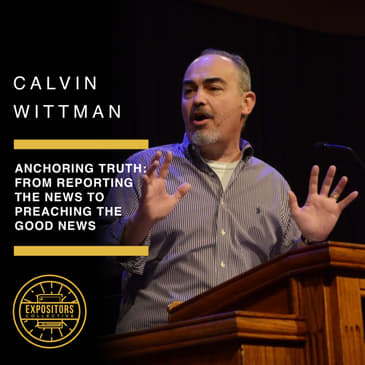
In this episode, Mike Neglia sits down with Calvin Whittman, the pastor of Green Valley Baptist Church in Henderson, Nevada, to discuss his unique journey to the pulpit and his approach to gospel-centred preaching. Calvin reflects on how his diverse experiences—from serving in the Navy to working as a television and radio news anchor—shaped his communication skills and informed his preaching style.
They explore Calvin's emphasis on expository preaching, his disciplined preparation process, and the importance of connecting every sermon to the gospel. Calvin shares practical insights on crafting sermons that are both theologically rich and engaging, including the role of conciseness, transitions, and structure in maintaining audience attention. He also speaks candidly about allowing the Word of God to convict him personally before delivering it to others.
Throughout the conversation, Calvin highlights the centrality of the Bible in his preaching, reading full passages to allow Scripture's power to shine through. Whether you're a preacher or someone interested in learning how to communicate with clarity and purpose, this episode is filled with wisdom and encouragement.
Bio for Calvin Whittman
Calvin Whittman is the pastor of Green Valley Baptist Church in Henderson, Nevada, where he is known for his clear, gospel-centred preaching and his commitment to expository teaching. Calvin felt called to preach at the age of 12, but his journey to the pulpit took him through diverse experiences, including serving in the Navy and working as a television and radio news anchor. His time in broadcast media sharpened his skills in communication, conciseness, and audience engagement—qualities that now define his preaching style.
At Green Valley Baptist, Calvin preaches through books of the Bible sequentially, focusing on exposing the truth of the text, connecting it to the gospel, and applying it to contemporary life. His sermons combine thoughtful exegesis, theological depth, and practical application, with a strong emphasis on Christological connections. A disciplined writer, Calvin prepares detailed sermon manuscripts, carefully structuring his messages to ensure clarity and flow.
With over 25 years of preaching experience, Calvin continues to grow in his craft, blending theological conviction with engaging delivery. He is passionate about helping others see the power of God’s Word to transform lives, always pointing to the ultimate provision of salvation in Jesus Christ.
You can listen to Calvin's sermons here: https://mygvbc.com/
For information about our upcoming training events visit ExpositorsCollective.com
The Expositors Collective podcast is part of the CGNMedia, Working together to proclaim the Gospel, make disciples, and plant churches. For more content like this, visit https://cgnmedia.org/
Join our private Facebook group to continue the conversation: https://www.facebook.com/groups/ExpositorsCollective
Donate to support the work of Expositors Collective, in person training events and a free weekly podcast: https://cgn.churchcenter.com/giving/to/expositors-collective
[00:00:00] If I faithfully preach God's Word and I go through books of the Bible, I find that God communicates to His people everything they need.
[00:00:09] And I don't have to be clever and I don't have to be, you know, the smartest guy in the room.
[00:00:14] I just have to preach God's Word. And if I do that, He'll take care of the rest.
[00:00:18] Hey, welcome to the Expositors Collective Podcast, episode 357. I'm your host, Mike Neglia.
[00:00:26] Well, I'd like to introduce our guests for this week by telling you a story.
[00:00:32] Earlier in 2024, I was in the beautiful state of Colorado for a Calvary Global Network leadership huddle.
[00:00:42] And as I was returning home to my adopted homeland of Ireland, I was standing in an airport, actually on a transport bus.
[00:00:52] Myself and Kyle Curry, who pastors a great church in the Franklin, Tennessee area.
[00:00:59] We were on the bus standing, being transported from one area of the airport to the other.
[00:01:06] And then this confident and friendly man walks up to us.
[00:01:10] He had spotted the Expositors Collective stickers that were on our carry-on luggage.
[00:01:16] And he came up and started talking about the wonder and the power of expository preaching.
[00:01:22] That man is Dr. Calvin Whitman, and he's our guest for this week.
[00:01:27] Hope you enjoy this conversation.
[00:01:35] Well, welcome to the Expositors Collective Podcast.
[00:01:38] I'm excited to be speaking again to Pastor Dr. Calvin Whitman.
[00:01:43] Good morning.
[00:01:44] How are you doing?
[00:01:45] Doing fine.
[00:01:46] Thank you, Mike.
[00:01:47] Hey, what time zone are you in currently?
[00:01:48] I'm in the Pacific time zone, so it's a little after 8 in the morning here.
[00:01:52] But you're like, yeah, physically or mentally, what time zone are you in?
[00:01:56] Yeah, I just got back a couple days ago from Thailand.
[00:02:00] And so about 17 hours different.
[00:02:03] And yeah, my body is waking me up real early in the morning.
[00:02:07] Yeah.
[00:02:09] Eager.
[00:02:10] Eager to get the day going.
[00:02:12] Absolutely.
[00:02:13] Well, so yes.
[00:02:15] Speaking of airports, I do have my opening question that I want to ask you about your first sermon.
[00:02:19] But I just think it's worth mentioning that the way that we met each other was at an airport, right?
[00:02:25] Absolutely.
[00:02:26] I was in Denver Airport with my friend and colleague, Kyle Curry.
[00:02:31] And I think you struck up a conversation with him about the hat that he was wearing, right?
[00:02:37] Yeah.
[00:02:37] You guys had all this gear on the set, expository preaching.
[00:02:40] And I'm like, this can't be a coincidence.
[00:02:46] Yeah.
[00:02:47] Yeah.
[00:02:47] So you just like meandered your way over on the bus and said hello.
[00:02:53] And yeah, we were just like so thrilled, so excited to be speaking to somebody who's actually done a doctorate in expository preaching.
[00:03:01] Just randomly, quote unquote, randomly meeting together in Denver Airport.
[00:03:05] And I said, I've got to keep in touch and want to talk more with Calvin.
[00:03:10] And I'm sure that you have something worthwhile to say to the listeners of the podcast.
[00:03:14] Well, let's hope so.
[00:03:15] Time will tell, actually.
[00:03:16] Yeah, time will tell.
[00:03:19] Okay.
[00:03:19] So now that the listeners know how our path is providentially crossed at an airport, by the way, does that happen often?
[00:03:27] Do you often collect friends and colleagues at airports?
[00:03:31] You know, I like what D. Martin Lloyd-Jones says.
[00:03:35] He says, if you're going to be a shepherd, you better like the smell of sheep.
[00:03:38] And so pastors should like people.
[00:03:40] And when I see somebody that is an expository preacher and they're not ashamed of that, I am going to say something because that's a very, very strong connection.
[00:03:52] Yeah.
[00:03:53] Well, you weren't wearing any preacher gear.
[00:03:57] No, no, no.
[00:03:59] Incognito.
[00:04:00] Yeah.
[00:04:00] Yeah.
[00:04:01] Okay.
[00:04:02] Okay.
[00:04:02] Well, so we've established that each of us love expository preaching.
[00:04:06] So I always start every episode by asking, when was your first Bible teaching?
[00:04:12] When was your first sermon that you gave?
[00:04:14] And then maybe a specific thing for you.
[00:04:16] Was it expository?
[00:04:17] Was your first sermon expository?
[00:04:19] Well, I grew up in a home where my grandfather was a vocational evangelist, had been friends with Billy Sunday.
[00:04:26] And my father was a bivocational pastor.
[00:04:31] And so I literally grew up in the church.
[00:04:35] Before I had any formal education, I didn't know any better than to just preach what the Bible said verse by verse.
[00:04:43] And so I probably was about 16 or 17 in my youth group at the church.
[00:04:48] I grew up at Castle Hills Baptist in San Antonio.
[00:04:52] And I remember they asked me if I would go to a nursing home and preach.
[00:04:57] And, of course, I said yes.
[00:04:59] And I think I took a passage from one of the Gospels and I just walked through it.
[00:05:04] I didn't know how to do anything other.
[00:05:08] That just seemed what you should do.
[00:05:10] If you're going to preach, you should just explain the Bible.
[00:05:14] Yeah.
[00:05:16] Well, I'd love to circle back and talk more about the definition of what true exposition is.
[00:05:23] But before we get into the nuts and bolts, the nitty gritty of it, how did it go?
[00:05:29] How did the nursing home residents receive this young preacher?
[00:05:33] Well, I mean, some of them were sleeping.
[00:05:35] And I had to get used to that.
[00:05:39] But, no, they were very kind.
[00:05:41] And it was a foray into a lifelong relationship with struggling with the text and trying to be clear and trying to find the central truths and expound upon them and find application for those in people's lives.
[00:06:00] Yeah.
[00:06:01] Yeah.
[00:06:02] So you said this was the beginning of a lifelong journey.
[00:06:04] Did you know it when it happened?
[00:06:07] Now, I know that you have preachers in your blood.
[00:06:12] But on that day, did you kind of feel like this is the beginning of a long journey for me?
[00:06:16] Or was it kind of like, well, that happened?
[00:06:18] Yeah.
[00:06:18] When I was 12, I knew God was calling me to be a pastor.
[00:06:21] And I really didn't want to be one because I'd seen what my grandfather and my father had kind of dealt with.
[00:06:26] And so I decided I was going to do something else.
[00:06:29] I got out of high school.
[00:06:30] I joined the Navy.
[00:06:30] I'm out in the middle of the Atlantic Ocean in the Navy.
[00:06:34] And God's like, Calvin, don't forget.
[00:06:37] I got my hand on you.
[00:06:38] And so it was something I had to come back to, to surrender to that call.
[00:06:45] But I did know, I did know since I was 12 that I was called to be a pastor and a spokesman for God.
[00:06:54] Well, I'm glad that you, yeah, yielded to that call.
[00:06:57] So as promised, so you said that you kind of worked your way through a text.
[00:07:04] You explained your way through one of those gospel passages.
[00:07:09] Yeah.
[00:07:10] Is that what expository preaching is?
[00:07:14] Well, I mean, in a very simplistic sense, because now, of course, I understand context.
[00:07:20] I understand literary genre.
[00:07:22] I understand, you know, how each passage is interpreted by all passages.
[00:07:28] And I have, obviously, a lifetime of experience and perspective that I did not have then.
[00:07:35] But I think at its most rudimentary level, expository preaching is exposing the truth of the text in such a way that people are able to see it clearly.
[00:07:49] And the Holy Spirit works within them to convict them or, you know, grow them through that.
[00:07:57] And then there's always, as Haddon Robinson says, so what?
[00:08:01] There's always an element where application has to be a part of it.
[00:08:08] Otherwise, you're just a hearer of the word and not a doer.
[00:08:13] Yeah.
[00:08:13] And so you've dropped the name of Haddon Robinson.
[00:08:16] And obviously, there was like a journey of discovery and learning since then from 16 up until today.
[00:08:24] You look a smidge over than 16.
[00:08:27] But that was 50 years ago.
[00:08:29] Yeah.
[00:08:29] OK.
[00:08:29] So what are the yeah.
[00:08:31] How are the ways that you've like intentionally put work into into growing since then?
[00:08:36] Or did you have a coach or a mentor or somebody who showed you that it's more than that?
[00:08:44] It's not less than explaining verse by verse, but that there's more to it than then.
[00:08:49] So how have you kind of grown and who's helped you grow?
[00:08:51] You know, unfortunately, I grew up with a lot of topical preachers and in that whole I'm a Southern Baptist.
[00:08:58] And so I grew up in that revivalistic kind of of of genre of preaching where it was sometimes a lot more thunder than theology.
[00:09:08] And I really I did a master's of divinity at Southwestern Seminary in Fort Worth.
[00:09:15] And it was a good experience, but it wasn't until I did my doctorate at Southern Seminary in Louisville that I really began to grasp the finer points and the clarity of expository preaching.
[00:09:28] I had always shot for that and kind of aimed for that.
[00:09:32] But it's been about 20 plus years ago that maybe 25, 26 years ago that I entered that program.
[00:09:41] And it really revolutionized me and my preaching because I read more.
[00:09:45] I was exposed to more.
[00:09:47] I read some great books on expository preaching.
[00:09:50] I read some not so great books on expository preaching.
[00:09:52] But it helped me find my own style, if you will, or my own voice.
[00:09:59] Yeah.
[00:10:00] Now, you mentioned that you've been preaching, you've been in the ministry for quite a long time.
[00:10:05] But I know that it hasn't been your only or your sole vocation.
[00:10:10] You didn't say this during our meeting at the airport.
[00:10:13] I went away and Googled you afterwards.
[00:10:15] And I saw that you also were a newsacre for a period of time.
[00:10:18] Yeah.
[00:10:19] When I was working my way through college, I went to Baylor University in Waco, Texas.
[00:10:24] I was a television news reporter for the CBS affiliate KWTX in Waco.
[00:10:30] And then I worked as a news anchor at a Channel 11 KTVT in Dallas.
[00:10:36] And then I was also a radio news guy in Dallas.
[00:10:39] So that helped, I think.
[00:10:42] It helped me think about my voice.
[00:10:44] It helped me think about my presentation.
[00:10:46] Being a television news reporter showed me a lot about myself in terms of watching myself on video that I had not theretofore really given thought to.
[00:10:56] And so it was interesting to see how God used a confluence of all these things he had me doing to direct me to where he ultimately wanted me to be.
[00:11:07] Yeah.
[00:11:08] What are the things that you learned in your, I guess, yeah, multiple layers of broadcast media using your voice and your face and your hands to communicate?
[00:11:19] What are the sort of things that you've taken away or that have continued to be part of your preaching communication?
[00:11:25] Essentially, what did you learn or what fellowship has the newsroom with the pulpit?
[00:11:31] I think there's three things that I would just kind of highlight.
[00:11:34] One is asking the right questions because when you're a television news reporter, you usually don't have a great deal of time to interview somebody.
[00:11:41] So you have to get to the point and you have to write – you have to ask the right questions.
[00:11:45] And I think expositors have to ask the right questions of the text.
[00:11:49] If we're not asking the right questions, we're not going to get the right answers.
[00:11:52] And secondly, being concise, being concise.
[00:11:58] You know, when you're a television news reporter, you have 90 seconds basically to write an entire story and tell a whole story.
[00:12:05] So sometimes as pastors, if we're not careful, we can chase rabbits and we can bore people.
[00:12:11] And it's a sin to be boring in the pulpit.
[00:12:14] And third, I think one of the things that really became a discipline for me with respect to expository preaching was writing out my sermons because I had to type out my manuscript when I was a television news reporter.
[00:12:25] And so I developed a discipline of typing out my manuscript.
[00:12:29] I take eight to ten pages of fully typed manuscript with footnotes to the pulpit.
[00:12:35] Now, I don't necessarily read them, but I've thought through it.
[00:12:38] I've thought through the transition statements.
[00:12:42] I've thought through what I'm going to say, how I'm going to say it.
[00:12:45] And, of course, the Holy Spirit will lead you.
[00:12:48] And there's some room for flexibility there and extemporaneous preaching.
[00:12:53] But at the same time, you've thought through it.
[00:12:56] And as Roy Fish, my professor of evangelism at Southwestern Seminary, used to say, God can inspire you at your computer just as much as he can in the pulpit.
[00:13:04] And so I take those three things from broadcast.
[00:13:08] Yeah.
[00:13:09] Yeah.
[00:13:09] Thank you very much.
[00:13:10] On the first one, on the idea of – well, I think the second – the first one was ask good questions.
[00:13:16] Second one was be concise.
[00:13:17] Right.
[00:13:18] So on that notion of conciseness, concivity?
[00:13:23] Conciseness?
[00:13:23] Conciseness.
[00:13:25] Concivity doesn't sound right.
[00:13:26] Of being concise, yes.
[00:13:28] Yes, correct.
[00:13:28] Thank you.
[00:13:30] Took me 12 words to get to that.
[00:13:34] So, yeah, there's probably nothing more precise and short than these, yeah, these very short little clips that take place.
[00:13:42] And in my generation, I guess just seeing the rise of long-form podcasts, of which we're on a medium-form podcast right now, where there's actually not that much of a time frame.
[00:13:55] And with a podcast and to some degree a sermon, there actually isn't really an end time.
[00:14:01] There's not a producer waving in the back.
[00:14:03] Although perhaps the Sunday school workers could be that and do that.
[00:14:06] How do you take that idea of conciseness and then expand it to fill a long sermon that goes, you know, 20, 30, 40 minutes?
[00:14:17] Yeah, so having done this, I'm 66 years old, okay?
[00:14:21] And so having done this a number of years, I know that a full page of typed manuscript takes me about five minutes to present.
[00:14:29] And so I can time my messages accordingly.
[00:14:32] I've never been a fan of preaching my sermons to a mirror or practicing.
[00:14:36] I don't do that.
[00:14:37] I preach three times every Sunday.
[00:14:39] And so our services are, you know, timed.
[00:14:43] And we have an 8, 9, 30, and 11.
[00:14:45] So usually I try to stay within that 40-minute time frame.
[00:14:50] And, you know, preachers can preach as long as they can have something to say and can hold the attention of the people to whom they're preaching.
[00:15:01] So I don't think there's necessarily a time.
[00:15:03] I think it's a matter of content and connectivity.
[00:15:08] And so some preachers can bore you in 15 minutes and some can keep you engaged for an hour.
[00:15:13] It just depends on the individual preacher.
[00:15:17] Yeah, and rather than thinking of I got 40 minutes to fill, but perhaps to think I have three points or I have four movements.
[00:15:28] And each of those can – I have an opportunity to be concise in each of these movements.
[00:15:34] And then to bring those along and then transition into the next bit and do it well and review what you said and preview what you're about to say.
[00:15:41] All of these are, yeah, very, very useful aspects that sometimes we don't really take advantage of.
[00:15:47] Sometimes maybe in my own tradition with preaching expositorily, the idea is kind of like your 16-year-old sermon at the nursing home that you just read one verse, talk about it, read the next verse, talk about it, say everything about verse three that you know.
[00:16:03] So there is – I think, again, that's a good place to start, but I think that we can have a bit of loving crafting, that editing is an act of love and trying to be as the clearest version as possible as a way of loving our people.
[00:16:15] Absolutely. That's a great statement. Editing is an act of love. If you love your people, you'll edit.
[00:16:20] The problem, of course, is that people don't – they don't ingest the text.
[00:16:27] And, you know, I'm working – I got up early this morning. I'm working on my sermon for Sunday.
[00:16:31] I've preached this text before. I've got a manuscript, but I'm not going to it.
[00:16:35] I'm going to take a fresh look at it. I'm making notes. I'm working through the text.
[00:16:39] A lot of the outline, a lot of the sermon structure, a lot of how you approach it depends on the genre of literature you're dealing with.
[00:16:45] If you're dealing with epistolary literature, sometimes it just outlines itself.
[00:16:48] If you're dealing with a historical narrative, well, you know, you've got to have a different approach or apocalyptic literature or wisdom literature, whatever you're dealing with.
[00:16:57] So I'm preaching through 1 Samuel right now, so it's a historical narrative.
[00:17:01] I listen along. Yeah, it's going good. So you're journeying through.
[00:17:05] Yeah, and so I sit down and I make – I made notes this morning of the nine big ideas in this text.
[00:17:12] And then I'm trying to coalesce those down into four or five.
[00:17:16] And then – so those will become my major points, and then we'll find the sub points from that.
[00:17:22] Sometimes in terms – if you want to talk about – would you like to talk about structure just for a minute of a sermon?
[00:17:26] Okay. So what I like to do with historical narrative is obviously I preach through books of the Bible because there's continuity in that,
[00:17:34] and your people continue to hear the same story, and they – it's like a serial, you know.
[00:17:40] They pick it up from last week.
[00:17:42] And so I like to take the first paragraph or two and remind them what's happened because somebody might have been out of town.
[00:17:48] We've seen this. We've seen that.
[00:17:49] Now let's walk through the text and then make some observations with you towards application.
[00:17:53] That's – I love to say that.
[00:17:54] But when we walk – I'll read the entire text because what we – when we read the Scripture, that's the most important thing.
[00:18:01] The Word of God has more power than anything we can say about the Word of God.
[00:18:04] So if I'm in a chapter that has 40 verses, I'm going to read all 40 verses.
[00:18:09] That's more important than anything I have to say.
[00:18:11] The Word has power.
[00:18:13] Secondly, I'll walk through the text and make some explanations.
[00:18:18] And in that – I call it – I title it exegesis in my sermon manuscript.
[00:18:24] In that exegetical part, I might point to some things that the text says that I'm not going to highlight in my application
[00:18:32] so that I'm getting a little bit better, more rounded exposition of the whole text.
[00:18:39] I'm trying to feed them everything that's in there to some degree.
[00:18:42] And then at the end, I will say, now, what does this text have to say to you and me today?
[00:18:48] And then I will obviously make four or five observations.
[00:18:52] And then, especially when I'm preaching in the Old Testament or even in the New, I have what I call a gospel connection.
[00:18:59] I want to show how what I've just preached points to Jesus and preaches the gospel.
[00:19:06] Yeah, I love it.
[00:19:07] We're really big on making those connections back to the gospel that you're not finished teaching your passage until it points towards the gracious provision that God has made for the Messiah.
[00:19:20] So, that's wonderful.
[00:19:22] So, it sounds like you have like an exegetical outline.
[00:19:25] So, you kind of talk through some things.
[00:19:27] So, lots of explainers.
[00:19:29] And then it kind of lands.
[00:19:31] And then it becomes a little bit more preachy towards the end, if I could put it that way.
[00:19:36] Yeah.
[00:19:37] So, every sermon has to have different elements.
[00:19:39] There's devotional elements.
[00:19:41] There's educational elements.
[00:19:42] There's exhortational elements.
[00:19:46] And that has to have a theological foundation.
[00:19:48] I try to remind my people that preaching is exposing God's word to God's people, okay?
[00:19:54] But what is God's word?
[00:19:55] It is God's revelation of himself to us.
[00:19:57] And so, it ought to have a deeply theological, Christological perspective.
[00:20:05] What is God telling us about himself?
[00:20:07] And these are questions I think that the expositor has to have in his mind as he's working through the text.
[00:20:12] What is this saying to me about God?
[00:20:14] And then what is God expecting from me in response to this revelation of himself to me?
[00:20:20] And I like to say that if it doesn't speak to me, it's not going to speak through me, okay?
[00:20:25] So, I have to allow the word of God to really bring conviction in my life, to speak to me, to open my eyes.
[00:20:32] And not until it does that is it going to work through me to do that to other people.
[00:20:37] Yeah.
[00:20:38] Yeah.
[00:20:38] And what do you do to keep people's attention through that first part, that movement that is through the exegetical outline?
[00:20:49] Some might say, oh, he's just going to explain to us about what Samuel did and what David, you know?
[00:20:55] Again, I'm playing the devil's advocate.
[00:20:57] I think it's phenomenally fascinating.
[00:20:59] But if you're saving the application towards the end, how can you be engaging as you're explaining what happened there and then?
[00:21:07] Well, in a sense, you're not just explaining it, but you're also speaking to the human condition.
[00:21:14] Because, I mean, the scripture is God's revelation of himself to us, but he uses people and he talks to people and he works through people.
[00:21:21] And so, it's a people story in one sense.
[00:21:24] It's really a God story, but it also talks about how God works through people.
[00:21:29] I use humor.
[00:21:30] I use illustrations.
[00:21:33] I use whatever I can to convey what God is saying.
[00:21:37] Because sometimes there will be something in the text that I want to say, but it's not really the major point of the text.
[00:21:44] And so, but it's applicable.
[00:21:47] And I don't think we should miss it.
[00:21:49] And so, sometimes it's funny.
[00:21:51] I mean, look, when I was preaching through Exodus and, you know, the people give Joshua all of their gold and he, you know, it's no, not Joshua, Aaron.
[00:22:05] They give Aaron their gold.
[00:22:06] Remember, I'm jet lagged.
[00:22:08] So, my brain knows a little front.
[00:22:09] They give Aaron their gold.
[00:22:10] And then Moses comes down and Moses says, well, what happened?
[00:22:14] He goes, well, the people gave me their gold.
[00:22:16] I threw it in a fire and out jumped this cat.
[00:22:17] If you can't find humor in that, you've got no funny bum.
[00:22:20] I mean, that's funny stuff.
[00:22:22] So, there's some fun stuff in the scripture to look at.
[00:22:25] And you have to be engaging.
[00:22:28] You have to keep people engaged, people's attention.
[00:22:31] So, you have to think where they are, what they're dealing with in their life.
[00:22:35] And it's so easy for pastors sometimes to get in their little ivory tower and preach down.
[00:22:41] But you've got to get down where the people are.
[00:22:43] One of the books I read was really good.
[00:22:45] I can't even remember who the author was.
[00:22:47] But he talked about when you're preparing a sermon, you're sitting at a table.
[00:22:51] Just imagine you're sitting at a table.
[00:22:52] And there's a housewife there.
[00:22:53] There's a teacher.
[00:22:54] There's a garbage collector.
[00:22:55] There's a lawyer, a banker, a student.
[00:22:56] You know, and there are different people.
[00:22:59] And you're trying to engage all these people.
[00:23:02] And so, how do you do that?
[00:23:03] How do you put it on a level and communicate in such a way that all of these people are going to be engaged?
[00:23:08] And I think that's a healthy way to remember as we're explaining that we have to be relevant.
[00:23:15] We have to be where people are.
[00:23:17] The Word of God is always relevant.
[00:23:19] It's a sin to make it irrelevant.
[00:23:20] Yeah.
[00:23:21] Yeah.
[00:23:22] Yeah.
[00:23:22] And of course, like you and I, we can theologize right here.
[00:23:25] We could say, yeah, the whole Bible is about God.
[00:23:27] Yes, it is.
[00:23:28] Absolutely.
[00:23:28] The whole Bible is about God.
[00:23:30] It's about God's interaction with people.
[00:23:32] Yes.
[00:23:33] People like you, people like me.
[00:23:34] And those types of people are going to be in our churches on Sunday.
[00:23:38] And so, if we make it so out of touch with the every man, the every woman, then I think, yeah, it's maybe one of those sins.
[00:23:46] You keep talking about making the Bible irrelevant, making the Bible boring.
[00:23:51] In a sense, Mike, it's being conversational with the people.
[00:23:55] And it's being real.
[00:23:57] And so, you know, I don't put on some lofty tone.
[00:24:00] I went to hear a preacher one time and he had a Scottish accent.
[00:24:04] And then when I met him afterwards, he just had a Texas accent.
[00:24:07] And I was like, oh, come on, man.
[00:24:08] Come on.
[00:24:09] This is fake.
[00:24:10] You've got to be real in the pulpit.
[00:24:11] You've got to be who you are.
[00:24:13] And you've got to converse with people and joke with people and be self-deprecating and be real.
[00:24:21] So, part of that, let me just say this.
[00:24:24] Part of being a good expository preacher is knowing your people.
[00:24:28] Every Sunday we have, I don't know, 1,000 people on campus.
[00:24:33] Maybe 750 to 800 of them are in the sanctuary.
[00:24:36] The rest would be like kids and nursery and all that kind of stuff.
[00:24:38] But I walk around the entire sanctuary, every service, and shake hands with as many people as I can.
[00:24:44] I try to know their name.
[00:24:46] I try to know what's going on in their life.
[00:24:47] I try to be real in person so that when I'm standing on the pulpit, they have a connection with me.
[00:24:55] Yeah.
[00:24:56] Yeah.
[00:24:57] Well, speaking of making connections, I'd like to connect what you're talking about with your doctoral work, which I believe, and you can maybe give me the proper name, but expository preaching as a catalyst for involving members in the ministry.
[00:25:11] So, you seem as a preacher interested in the members.
[00:25:15] But how can preaching then pull people into the ministry?
[00:25:18] Okay.
[00:25:19] So, it's really simple.
[00:25:21] Pastors are called to equip the saints for the work of the ministry.
[00:25:25] And so many times we bought into this Roman Catholic mentality that says, don't do this at home.
[00:25:31] I'm the professional.
[00:25:33] Leave this to me.
[00:25:33] Okay?
[00:25:34] That's not a biblical model.
[00:25:35] There's no biblical laity and clergy.
[00:25:40] Okay?
[00:25:40] There are people with different gifts and different callings.
[00:25:42] We're all part of the same body.
[00:25:43] But my job is not to do the ministry.
[00:25:46] My job is to equip the saints for the work of the ministry.
[00:25:50] How do I do that?
[00:25:51] By exposing them to God's word and allowing God's word to dwell richly in them.
[00:25:56] And God works through his Holy Spirit through the preaching and grows them, draws them to himself, and engages them in ministry.
[00:26:05] Yeah.
[00:26:06] Don't try this at home.
[00:26:08] Man, what a great phrase.
[00:26:09] I'm going to steal that.
[00:26:12] Yeah, that's the exact opposite.
[00:26:14] Yeah, we want people to try this at home, to practice this themselves.
[00:26:18] Right.
[00:26:18] And as, you know, good Protestants, yeah, may we never slip into, yeah, that Roman messed up version of ecclesiology that there is, yeah, that the body of Christ consists of the saints and the priests.
[00:26:34] And that the rest is just there for a show.
[00:26:37] Yes.
[00:26:39] And so, but yeah, even just the title, even of your work, it just, it strikes me as a little bit surprising because expository preaching, that tends to be maybe the longest time in a Sunday service where you're talking and everyone else is quiet.
[00:26:55] Okay.
[00:26:56] So, how could that be that it's involving other people?
[00:26:59] Like maybe if there's a, you know, again, a service project, a missions trip, if there's even singing, that's when everyone else is involved.
[00:27:06] But the preaching part is when Calvin talks and everyone else listens.
[00:27:09] Yeah, but what I think the mistake there is to think that listening is not being involved.
[00:27:14] Listening is being involved if we're listening properly.
[00:27:17] What I'm doing is I'm discipling them.
[00:27:19] What I'm doing is I am equipping them.
[00:27:22] What I'm doing is I'm allowing the Holy Spirit to work through me, through the preaching of the word, to grow them and equip them for the ministry that he's called them to and to help them recognize that, hey, God's got me here for a reason.
[00:27:37] We just had a new members class Sunday and I told him, look, God's brought you here for a reason.
[00:27:42] You have a gift.
[00:27:43] And if you don't use that gift, then you're not fulfilling the purpose for which God has brought you to our church.
[00:27:50] I really believe strongly that if we could just mobilize the people in the pew, we could set this world on fire.
[00:27:59] Yeah, and so that new members class that you're doing is not a completely different version of you than the expositor that was preaching through Samuel earlier that day.
[00:28:10] No.
[00:28:11] And you're not talking on two sides of your mouth.
[00:28:13] The same God that is active in the life of David and all of his conflations is also the God that wants to take these new people that have been visiting your church and that are considering membership that he wants to use them as well.
[00:28:26] Yeah, look, you and I are called to – God's already empowered them.
[00:28:32] You shall receive power if the Holy Spirit comes upon you.
[00:28:34] Be witnesses unto me.
[00:28:35] Well, that's applicable to the whole church.
[00:28:37] And so our job is to give our ministry to other people, to raise up other people to do it.
[00:28:44] So I just got back from this mission trip in Thailand.
[00:28:47] We did a pastor's conference.
[00:28:49] I had one of my deacons teaching.
[00:28:51] I had a young pastor from another state go with me, and I gave them just as much time to teach and preach as I took myself because I want them to recognize they're just as important.
[00:29:02] Their calling, their gifts are just as important as mine.
[00:29:06] Yeah, yeah.
[00:29:07] And I'm glad that you brought that up because, again, I think you and I, kindred spirits, so glad we've met, you know.
[00:29:16] And then as I was emailing you and following up, you're like, oh, yeah, I can't do a call now.
[00:29:20] I'm in Thailand preaching expository, teaching expository.
[00:29:23] And I'm like, man, who is this guy?
[00:29:26] Yeah, just – yeah.
[00:29:28] So, yeah, you are who I want to be when I grow up.
[00:29:30] So I'm really excited to know you now.
[00:29:32] What are the sort of things that you taught those guys?
[00:29:35] I'm actually curious.
[00:29:36] You said that you kind of split the load between yourself and this deacon and this younger pastor.
[00:29:42] What is it that you, like, made sure that you got to teach, you know, as you're dividing up the responsibilities, what you're like, I want this one for myself.
[00:29:50] So my deacon, one of the godless men, Jim Giordano, one of the godless men I know, man, he goes to the jail every week and preaches to inmates.
[00:29:58] He started men's Bible studies off campus.
[00:30:00] So I let him talk to these pastors.
[00:30:02] And some of these pastors are in Myanmar and Burma.
[00:30:05] They're in communist countries.
[00:30:06] They're in underground churches.
[00:30:08] And he was talking to them about doing ministry outside of a physical church building, how you start those ministries.
[00:30:15] And then the other younger pastor that I've known, he's 35, but I was his pastor for years since he was in junior high, kind of a son in the ministry.
[00:30:24] He taught on discipleship, on how to disciple people one-on-one.
[00:30:27] And then I, a number of years ago, I wrote a little book for village pastors in India because I've done a number of pastors conferences in India.
[00:30:36] And it's kind of a condensation of both hermeneutics and homiletics.
[00:30:41] How to look at the text, how to ask the right questions of the text, how to outline a sermon.
[00:30:48] I mean, how to outline a text and then how to put that all together.
[00:30:52] And it's just a little booklet.
[00:30:53] But it's in Spanish.
[00:30:55] It's in Romanian.
[00:30:56] It's in Telugu.
[00:30:59] It's now, it's in Thai.
[00:31:00] And I just, I think that we have to equip these other pastors.
[00:31:06] Having been a missionary, we're missionaries in Spain for several years with the International Mission Board of Southern Baptist Convention.
[00:31:11] I think that the future of those countries in terms of evangelization and making disciples is not going to be with Westerners going over there.
[00:31:21] It's going to be by equipping the nationals to take and make self-propagating churches and self-supporting churches.
[00:31:27] And so I try to train pastors.
[00:31:28] That's my passion.
[00:31:30] Yeah, yeah.
[00:31:31] The future is, it's not going to be English with subtitles underneath.
[00:31:34] No, no, no, not at all.
[00:31:36] That's fine.
[00:31:36] I get a kick out.
[00:31:37] Are you familiar with Roland Allen's work at all?
[00:31:40] No, sir.
[00:31:41] He was a missionary from the Anglican Church around 1900.
[00:31:46] And he wrote a book called The Missionary Methods of Paul.
[00:31:49] The subtitle was The Spontaneous Expansion of the Church and the Hindrances Thereunto.
[00:31:53] And he says some great stuff.
[00:31:55] They knew I had a title books back then, huh?
[00:31:56] They did.
[00:31:57] But one of the things he says, he says the Holy Spirit's like a wildfire.
[00:32:01] He says we don't want a wildfire because we can't control that.
[00:32:03] I never forgot that.
[00:32:04] That was a great quote.
[00:32:05] But he talks about how we have to turn the missionary work over to the nationals lest we become colonialization missionaries.
[00:32:15] And if you go to Korea, they sing our hymns.
[00:32:19] They structure their services like us.
[00:32:22] And they do it better than us.
[00:32:24] And they sing it in their language.
[00:32:26] But it's like hymns that were written by English people in the 1700s being sung in Korea.
[00:32:31] I really want to hear indigenous Korean songs being sung to Christ.
[00:32:35] I really want to hear indigenous Thai songs being sung to Christ.
[00:32:38] And not that the hymns of our faith are bad.
[00:32:42] They're good.
[00:32:43] But in order for it to become Thai or to become Korean or become Spanish or whatever, it has to come from the heart of those people.
[00:32:51] It has to be a reflection of their experience, their culture, their background.
[00:32:55] Yeah.
[00:32:56] That's missiology.
[00:32:57] That's a different subject.
[00:32:59] Yeah.
[00:32:59] The Missiologist Collective podcast, that's a different one.
[00:33:03] But yeah, I was in Uganda a couple months ago.
[00:33:06] And yeah, we did a three-day event.
[00:33:09] It was excellent, really great.
[00:33:10] And English is the common language.
[00:33:13] And there's a lot of tribes that are there.
[00:33:15] And so English was the common language.
[00:33:17] And so, yeah, most of the singing was in English except for the third day.
[00:33:21] And then they just busted out all the Lugandan songs.
[00:33:25] And I was just like—
[00:33:26] This blesses you, doesn't it?
[00:33:28] Yeah.
[00:33:28] I'm just like, what the heck am I doing here?
[00:33:30] This is the greatest thing in the world that I get to just try to kind of clap along to the beat as everyone's hooting and hollering and dancing all around me.
[00:33:39] We were at this children's home in Thailand, and the children there sang in Thai.
[00:33:44] They sang praise songs.
[00:33:46] And I was just kind of overcome because I know our Father in Heaven was smiling.
[00:33:51] I just know his heart was filled with joy as he hears these children singing in their own language, singing songs of praise to him.
[00:33:58] So, yeah.
[00:34:00] I think every pastor should, by the way, do some kind of missions work because it exposes you to what God is doing around the world.
[00:34:08] And it changes your perspective.
[00:34:11] Great.
[00:34:13] Is there—the book that's been translated into Thai and Spanish and et cetera, is it also in English?
[00:34:19] And if so, where can we find it?
[00:34:20] And there'll be a link in the show notes for the listeners that want to get a hold of it.
[00:34:24] I can't.
[00:34:25] I will send you—what I'll do is I'll put it in PDF format and I'll send it to you.
[00:34:29] Okay.
[00:34:29] And can I make it available?
[00:34:31] Absolutely.
[00:34:31] Absolutely.
[00:34:32] All right.
[00:34:32] Look, it's not brilliant.
[00:34:34] It's just—it's basic.
[00:34:35] It's just—it's like this is how you look at a text.
[00:34:38] This is how you find your major points.
[00:34:41] This is how you find your minor points.
[00:34:43] It's so simple.
[00:34:45] But it's not intended.
[00:34:46] I don't have anything to offer to the corpus of expositorial preaching.
[00:34:49] There are people that are much more adroit than myself.
[00:34:53] What I can do, though, is I can make things concise and put them in a very simple message that uneducated village pastors who don't have the benefit of a seminary education hopefully can read and benefit from.
[00:35:10] Yeah.
[00:35:11] Yeah.
[00:35:11] Yeah.
[00:35:11] Sometimes it's simply—yeah, it's the introduction of—for us, you know, I'm just finishing up a degree right now.
[00:35:19] I'm really honored and privileged to be swimming in these waters for a long time.
[00:35:23] And there's some good and godly leaders out there that are just un—not to be—I won't say this carefully.
[00:35:31] But yeah, they're unexposed to some of these concepts that are—that I'm very exposed to, you know?
[00:35:38] And I can't—you talked about the importance of being clear and clarity and brevity, and I'm not doing that right now.
[00:35:45] But I totally hear you.
[00:35:47] That sometimes it can only be these beginning steps that can just set a time bomb off in someone's mind.
[00:35:52] And then who knows what the Lord will do with it.
[00:35:55] Look, when I go overseas, oftentimes I'm preaching to people who are babes in Christ, okay?
[00:36:00] And I have to feed them food they can digest.
[00:36:03] When I'm at a—like I've preached at Southern Seminary several times in their chapel.
[00:36:07] Well, I'm not going to preach baby food to them.
[00:36:10] They've studied Greek and Hebrew, so I'm going to bring out the Greek and the Hebrew.
[00:36:14] You have to—you know, as Socrates says, you have to know your audience, and you have to speak to them in a language that they can—it's not Socrates.
[00:36:24] It's Aristotle in his book, Rhetoric.
[00:36:25] If you haven't read that, it's brilliant.
[00:36:27] But it's just know your audience.
[00:36:29] Speak to them in ways that are going to connect with them.
[00:36:33] Yeah.
[00:36:34] Well, it's been wonderful talking with you and kind of going on this journey from a 16-year-old over to this, you know, jet-lagged 66-year-old.
[00:36:46] Yeah.
[00:36:47] I'm going to ask you in a second about, like, how are you currently trying to improve?
[00:36:53] But before that, I just want to say, like, is there anything you were hoping that I'd ask that I haven't asked yet?
[00:36:59] You spoke about the importance of asking good questions.
[00:37:01] So that makes me really self-conscious.
[00:37:03] What would have been—what would have been a good question for me to have asked you earlier?
[00:37:07] No, I think you have a pretty good grasp, Mike.
[00:37:09] I think I would go back to, like, the definition of expository preaching.
[00:37:14] And I would just say it is the communication of God's Word through God's servant to God's people.
[00:37:23] And I think that's a simple explanation.
[00:37:26] And, of course, you could unpack that.
[00:37:28] You know, what is communication?
[00:37:30] What about the man of God?
[00:37:32] What about his character?
[00:37:33] What about his life?
[00:37:34] What about his prayer?
[00:37:35] What about his personal time with God?
[00:37:37] What about God's people?
[00:37:39] Who are you talking—I mean, so there's a lot of unpacking.
[00:37:41] But it's just the simple definition of the communication of God's Word through God's man to God's people.
[00:37:46] And it's not me doing a book review on Sunday morning.
[00:37:49] It's not me talking politics on Sunday morning.
[00:37:52] It's me exposing people to God's truth.
[00:37:55] If I faithfully preach God's Word and I go through books of the Bible,
[00:37:59] I find that God communicates to his people everything they need.
[00:38:04] And I don't have to be clever and I don't have to be, you know, the smartest guy in the room.
[00:38:10] I just have to preach God's Word.
[00:38:11] And if I do that, he'll take care of the rest.
[00:38:15] Well, then, as promised, so yeah, we heard about your first sermon.
[00:38:19] And you just are currently working on your next sermon.
[00:38:22] But what do you, as a preacher, what are you trying to get better at even now?
[00:38:28] Is there kind of something you—even if you—maybe you listen to the audio of the last one or watch the video and you think,
[00:38:35] ah, I want to stop doing that.
[00:38:36] Or hopefully next Sunday I'll do better at this.
[00:38:39] Well, fortunately, I have a wife who helps me in that area.
[00:38:43] What a treat.
[00:38:43] What a treat.
[00:38:44] I got one too.
[00:38:46] But I tell you what I try to do, Mike, is I try to be fresh.
[00:38:51] And one of the mistakes pastors can make, especially when they get to be my age,
[00:38:56] is they can go back and preach old stuff.
[00:38:59] And I want to look at it with fresh eyes.
[00:39:03] I want to speak to God's people where I am, not only where I am in terms of I'm in Las Vegas, Nevada,
[00:39:11] but where I am in my life.
[00:39:13] I'm a 66-year-old father and grandfather, and I have all this ministry experience, and I've traveled the world.
[00:39:21] So looking at the text today, I see it differently than I saw it 5, 10, 12, 15, 20 years ago.
[00:39:28] And it's not fair for me to go back and try to re-preach something from back then because I'm a different person.
[00:39:36] The world is a different world.
[00:39:38] And God wants me to preach the same truth but to contextualize it in such a way that it is relevant to the people today.
[00:39:45] And so I think staying fresh, staying fresh with illustrations.
[00:39:49] Oh, my wife's big about that.
[00:39:52] Staying fresh with observation, asking, again, the right questions to the text.
[00:39:59] Yeah, I think you become a little bit more discerning in your commentary reading as well when you get older.
[00:40:06] I think you become a lot more – a lot less tolerant of nonsense.
[00:40:14] And you get a lot more –
[00:40:15] What does that mean?
[00:40:16] Well, you know, I've read commentaries that go off into egalitarianism or –
[00:40:21] they go off into social gospel stuff.
[00:40:23] And you're just like – like the British would say, I just can't be bothered.
[00:40:27] You know, I don't have time for that.
[00:40:29] Give me the meat, man.
[00:40:30] Let me get to the core of what God is saying and let me communicate that.
[00:40:35] That's where the power is.
[00:40:37] It's not in politicizing or socializing the text.
[00:40:42] It is in preaching Jesus and preaching God's word and allowing the Holy Spirit to work in power.
[00:40:50] Yeah.
[00:40:50] Yeah.
[00:40:51] I remember reading a certain commentary.
[00:40:53] I guess that will remain unnamed.
[00:40:55] The guy's dead, so – but I read his Genesis commentary.
[00:40:59] That was pretty good.
[00:41:00] And then I read Exodus.
[00:41:04] And it was just – yeah, like meandering numerology nonsense.
[00:41:10] And I actually threw it across the room.
[00:41:13] I was like, what?
[00:41:15] Because it was like, you know, 10 pages.
[00:41:17] And I was like, surely he'll get something good soon.
[00:41:20] And maybe he was just a one-book man.
[00:41:23] Maybe Genesis was just as good as it gets.
[00:41:25] And then Exodus was so disappointing.
[00:41:27] It's the only time I've ever thrown a book in my life.
[00:41:29] But it was –
[00:41:30] Best commentary on Genesis is – that I've ever read was Alan Ross' book, Creation and Blessing.
[00:41:36] But here's the thing.
[00:41:37] When I get to one of those books where I can't find anything good in it, I feel like they've stolen from me.
[00:41:42] I feel like I paid money for this and you've stolen my money because this is nonsense.
[00:41:47] D.A. Carson has a great commentary on commentaries.
[00:41:50] And it's funny because he'll say things like, I wouldn't waste my time on this drivel, you know.
[00:41:57] It's so fun to read.
[00:41:58] It's really funny because he's very curt and he's very direct to the point.
[00:42:04] Yeah.
[00:42:05] And meanwhile, you know, somebody wrote that drivel and somebody like bought the book to see what Dr. Carson said about it.
[00:42:12] Yeah, yeah.
[00:42:13] So it's fun.
[00:42:13] It's fun.
[00:42:14] But I do think the older we get, the less time we have for nonsense.
[00:42:19] And you realize – the older you get, you realize how short life is and how precious time is and how urgent the message is.
[00:42:27] And I think more and more that sense is heavy on me as I preach.
[00:42:37] It's interesting because you said the older you get, the more like you're aware of the preciousness of time.
[00:42:42] And then I'd almost expect you to say, because time is precious, you should re-preach your old sermons so you don't have to spend a bunch of time creating new stuff.
[00:42:52] But you're holding both of those things.
[00:42:53] You're saying time is precious.
[00:42:54] Therefore, I must spend more time creating fresh looks at the same passage even if I preached it five years ago.
[00:43:02] Well, so I want to talk about time and the times.
[00:43:05] Okay.
[00:43:06] So the times are evil.
[00:43:08] You know, redeeming the time because the days are evil.
[00:43:12] So we live in very difficult times.
[00:43:14] We live in – here in the United States, we live in pretty much a post-Christian country.
[00:43:20] And you see it really in the U.K. right now.
[00:43:22] Oh, my goodness.
[00:43:23] But I think that means we just have to be on our game.
[00:43:27] And if people are coming to hear you preach, don't waste their time.
[00:43:31] Make sure you've got something to say to them that values their time.
[00:43:35] And every minute that God gives you – if I preach to 750, 800 people on a Sunday morning, think of the – and I preach for 40 minutes three times.
[00:43:45] Think of the collective amount of time that God has given me with these people.
[00:43:51] A lot of minutes to waste or to really invest.
[00:43:56] And pastors that don't realize this is a stewardship are blinded.
[00:44:00] This is a stewardship.
[00:44:02] It's like giving – it's like any other thing that God has given us.
[00:44:05] It's a stewardship.
[00:44:06] My wife is a stewardship.
[00:44:07] My children are a stewardship.
[00:44:08] My ministry is a stewardship.
[00:44:09] And the time he gives me on Sunday morning, it's a stewardship.
[00:44:11] And he's going to call me into account, as Paul says in 2 Corinthians.
[00:44:15] He is, I'm going to have to stand before the judgment seat of Christ and give account for how I used that time.
[00:44:20] Did I prepare for it?
[00:44:22] Was I prayed up?
[00:44:23] Was my heart right?
[00:44:25] Was I relevant?
[00:44:26] Was I concise?
[00:44:28] Did I accomplish what God called me to do?
[00:44:32] Yeah.
[00:44:33] Well, hey, speaking of time, I got an elders meeting coming up.
[00:44:36] We got to plan out our membership onboarding process.
[00:44:40] So it sounds like you're ahead of me.
[00:44:42] You've already been doing these classes, but we want to be clarifying our membership onboarding process.
[00:44:48] So remind me, Mike, where you're doing your studies right now.
[00:44:52] I'm just finishing up at Western Seminary.
[00:44:55] I'm wearing the jumper right now, actually, which has been enjoyable.
[00:45:01] Well, thank you so much for having me on your podcast.
[00:45:04] Like I said, there are a lot of guys that know a lot more than I do, but I am passionate about it.
[00:45:10] But they weren't at the airport at the same time, so.
[00:45:12] Well, I'll leave you with one story.
[00:45:15] And that is I was at Narita Airport a number of years ago in Tokyo.
[00:45:21] And I looked across the terminal there, and I saw an unmistakable face.
[00:45:27] It was Haddon Robinson.
[00:45:29] And so I read his book.
[00:45:31] His book on expository preaching is my favorite.
[00:45:34] And I went over to him.
[00:45:36] I walked across, and I said, Dr. Robinson, I introduced myself.
[00:45:38] I said, I saw your face.
[00:45:40] And I said, I know that face.
[00:45:42] It's unmistakable.
[00:45:43] He goes, well, it certainly is an unmistakable face, Calvin.
[00:45:47] He was very gracious.
[00:45:49] Blessings on you and your ministry.
[00:45:51] And thank you for the privilege of being on your podcast.
[00:45:54] I hope it's an encouragement.
[00:45:57] Yeah, well, likewise, Calvin.
[00:45:59] And for the listeners of this show, I hope that this conversation and all the video at Expositors Collective helps you to grow in your personal study and public proclamation of God's word.
[00:46:08] Thanks again.
[00:46:10] Thank you.
[00:46:12] This podcast is a part of CGN Media, a podcast network that points to Christ.
[00:46:17] We are supported by listeners like you.
[00:46:18] To help us create more great shows, visit cgnmedia.org support.